
Air fryers have quickly become one of the most popular appliances in modern kitchens.
For many households, they have become a convenient alternative to traditional ovens and even replaced older countertop appliances such as slow cookers. Their popularity comes largely from their ability to cook food using rapidly circulating hot air, often with little or no added oil.
For people who enjoy crispy food but want to cut down on deep frying, an air fryer can certainly be useful.
But experts say there is one important thing to remember: an air fryer isn’t necessarily the right appliance for every type of food or every cooking situation.

Not Everything Belongs in an Air Fryer
Although air fryers can handle a surprisingly wide range of foods, some ingredients don’t work particularly well in them.
Broccoli, for example, can become dry or lose some of its appeal when cooked incorrectly in an air fryer. However, vegetables aren’t the only concern.
Some foods can actually create safety problems.
Popcorn Could Be a Fire Risk
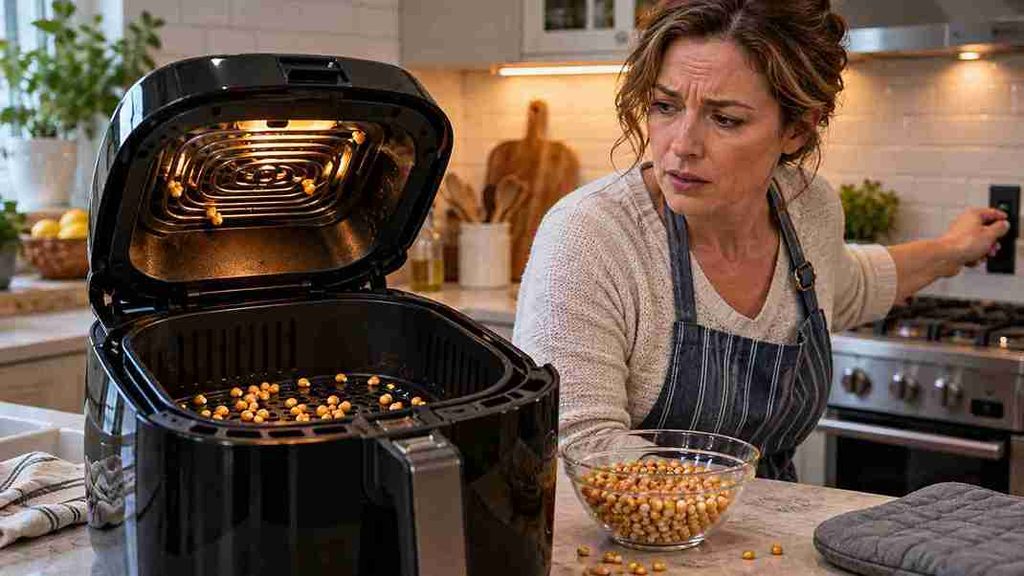
Popcorn is one food that should generally be avoided in an air fryer.
According to advice reported by the Mirror, popcorn kernels can potentially become trapped near the heating element. If the kernels come into contact with extremely hot components, they could create a fire hazard.
Unlike a dedicated popcorn maker or a suitable stovetop method, an air fryer isn’t designed to safely handle popcorn kernels.
So while throwing a handful of kernels into the basket might sound like a quick experiment, it isn’t worth the potential risk.
Wet Batter Can Also Cause Problems
Another food that can be difficult to prepare properly in an air fryer is anything covered in wet batter.
Think about classic fried chicken.
One of the best parts of traditional fried chicken is the crispy coating that forms when the wet batter is exposed to hot oil.
An air fryer works differently.
Because the food isn’t being submerged in hot oil, wet batter may fail to set properly. Instead of producing a crisp coating, it can drip through the basket or leave you with a disappointing, soggy result.
For foods that depend on a traditional deep-fried coating, conventional cooking methods may still produce better results.
Air Fryers Aren’t Always the Cheapest Option
There is another issue that many people don’t consider when deciding whether to use an air fryer or an oven: how much food you’re actually cooking.
Air fryers can be very efficient when you’re preparing small portions that cook quickly.
However, the situation can change when you’re cooking a large meal.
Money-saving expert Martin Lewis has previously pointed out that repeatedly using an air fryer for different parts of a meal may not always be the most economical approach.
During an appearance on This Morning, Lewis explained that air fryers are particularly useful for smaller foods that cook quickly. But if you have to run the appliance repeatedly for different items, using a traditional oven may make more sense from an energy-use perspective.
In other words, an air fryer may be convenient for one small portion, but cooking an entire family meal in several separate batches can take considerably more time and require repeated cooking cycles.
Bigger Meals Can Change the Calculation
Steven Kipling of Which? has also highlighted the issue of cooking in batches.
Air fryers generally have less cooking space than a full-sized oven or hob. That means larger meals may need to be prepared in multiple batches.
And that’s where some of the advantages of an air fryer can start to disappear.
If you’re cooking dinner for several people, you might have to cook the chicken first, then the vegetables, then the potatoes, and perhaps another side dish afterward.
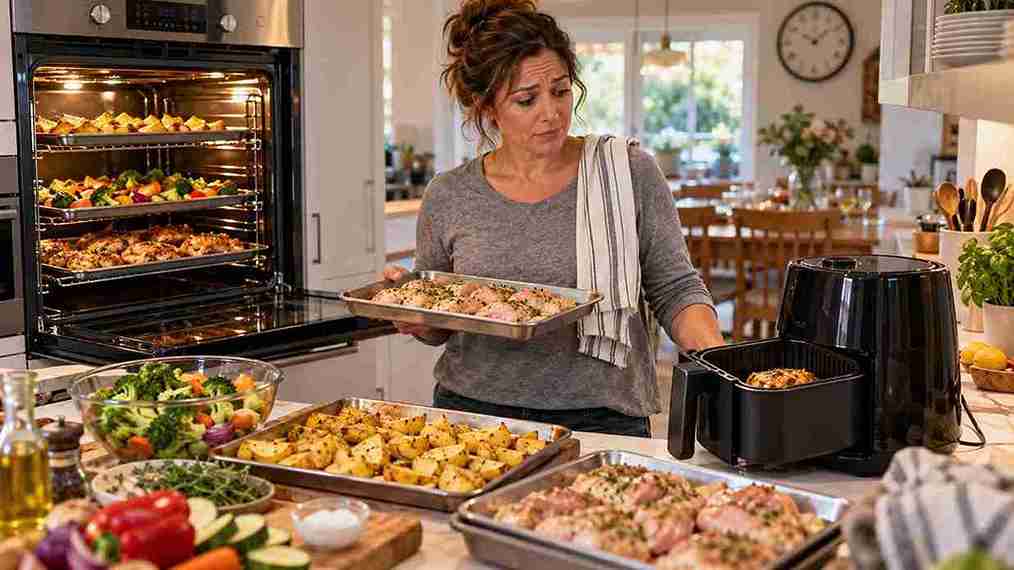
By the time everything is finished, you’ve used the air fryer several times.
For a small snack or a quick meal, that may not be a problem.
But when you’re preparing a large amount of food, an oven or hob can sometimes be a more practical option because you can cook several things at once.
Sometimes a Microwave Makes More Sense
There are also situations where neither an air fryer nor an oven is necessarily the best choice.
Lewis gave the example of a jacket potato.
If you’re preparing a single potato, using a microwave can be considerably quicker than heating an entire oven and waiting for the potato to cook.
This highlights an important point: the best appliance often depends on what you’re cooking, how much you’re making, and how quickly you need it.
An air fryer can be excellent for certain foods, but it doesn’t automatically become the most efficient choice simply because it uses less energy than an oven in some situations.
Air Fryer Fans Aren’t Giving Them Up Easily
Despite the warnings and the debate over energy use, plenty of people remain huge fans of their air fryers.
For many households, the convenience is hard to beat.
They’re quick to use, relatively simple to clean, and can produce crispy food without the large amount of oil required for traditional deep frying.
Some people have become so enthusiastic about their air fryers that they use them for almost everything.
One person jokingly commented:
“I’m not listening to him on this. I’m air-frying everything. I’ll even air fry a cup of tea.”
Of course, nobody should actually try to air-fry a cup of tea.
But the comment perfectly captures just how popular these appliances have become.
So, Should You Stop Using Your Air Fryer?
Not necessarily.
The main takeaway isn’t that air fryers are bad or that everyone should go back to using an oven for every meal.
Instead, it’s about using the right appliance for the right job.
Air fryers can be extremely useful for small portions, quick meals, reheating certain foods, and dishes that benefit from a crispy texture.
However, foods such as popcorn can present safety concerns, while wet-battered foods may not cook properly. And when you’re preparing a large meal that requires several batches, a conventional oven or hob may sometimes be more practical.
So before automatically reaching for the air fryer, it may be worth considering what you’re cooking, how much food you need, and how many separate cooking cycles you’ll need.
After all, the most convenient appliance isn’t always the most suitable one.
Do you use your air fryer for almost everything, or do you still rely on your oven for most meals?
Share your thoughts in the comments, and share this article with your family and friends on Facebook so they can see the advice too.
Note: All images used in this article are AI-generated and intended for illustrative purposes only.
0 Comments