
Most drivers from Generation X through older members of Generation Z are familiar with the basic layout of a manual transmission. First gear, second, third, fourth, fifth, and sometimes sixth are usually arranged in a familiar pattern, with reverse included somewhere on the shift gate.
But every once in a while, a driver comes across something that looks completely out of place: a gear marked with the letter “G.”
For someone who has never driven an older truck, an off-road vehicle, or a specialized manual transmission, that single letter can be confusing. Is it a mistake? Does it stand for “Gear”? Or is it some kind of performance mode?
The answer is much more interesting.
The G gear is an ultra-low gear designed to provide enormous pulling power at very low speeds. Its history stretches back through early commercial trucks, German automotive engineering, military vehicles, and even one of the most famous performance cars ever built.
What the G Actually Stands For
The letter “G” comes from the German word “Gelände,” which means “terrain.”
The term is closely associated with Mercedes-Benz and the Geländewagen, which translates roughly to “all-terrain vehicle.” The Mercedes-Benz G-Class was originally developed in the late 1970s as a military-focused off-road vehicle before civilian versions became available.
Over time, the word “Gelände” became associated with vehicles designed to handle difficult terrain. Eventually, the letter G also became associated with an extremely low transmission gear designed for similar conditions.
So if you see a G on a manual shift pattern, it isn’t simply a strange label. It usually points toward a gear designed for very low-speed, high-torque driving.

Maximum Torque, Minimum Speed
The biggest thing to understand about G gear is that it is not designed to make a vehicle go faster.
Quite the opposite.
G gear uses an extremely low gear ratio, often much lower than the vehicle’s normal first gear. That low ratio gives the engine significantly more mechanical leverage over the wheels.
This can be extremely useful when a vehicle needs to:
- Climb a very steep hill
- Pull a heavy load from a complete stop
- Crawl over rocks
- Drive through deep mud
- Travel across loose sand
- Maintain control on difficult off-road surfaces
- Move slowly without constantly slipping the clutch
The trade-off is speed.
A vehicle in G gear moves incredibly slowly. That makes it almost useless for ordinary highway or city driving, but extremely valuable when traction and control matter more than speed.
Imagine trying to move a heavily loaded truck up a steep dirt hill. A normal first gear might require too much clutch work and could allow the engine to stall.
A crawler gear changes the equation.
It gives the wheels much more torque while allowing the vehicle to move at a controlled crawl.
The Nickname That Stuck: “Granny Gear”
The ultra-low gear eventually became widely known by a much more memorable nickname: “granny gear.”
It has also sometimes been associated with the term “ground gear.”
The name may sound humorous, but it actually describes the gear surprisingly well. A vehicle using granny gear moves so slowly and steadily that it can seem almost like it is shuffling forward rather than driving.
That slow pace is not a weakness.
It is the entire point.
When a truck is carrying thousands of pounds or an off-road vehicle is crawling across rocks, moving slowly gives the driver much greater control. Instead of fighting for speed, the driver can focus on maintaining traction and keeping the vehicle moving smoothly.
Where the Gear Ratio Fits In
Early commercial vehicles needed extremely low gears because their engines simply did not produce the amount of torque available from modern engines.
Some early “granny” gears had ratios between roughly 6.0:1 and 7.02:1. By comparison, a typical modern manual transmission’s first gear may be somewhere around 3.0:1 to 4.0:1.
The difference is significant.
A higher numerical gear ratio provides greater torque multiplication. That means the engine can use its available power more effectively to move a heavy vehicle from a standstill.
For an overloaded truck sitting on a steep, unpaved hill, this could make the difference between moving forward safely and losing momentum.
In the days before modern brakes, powerful engines, and advanced traction systems, losing control of a heavily loaded truck on a steep slope could have devastating consequences.
That is why the extremely low gear was so important.
A Century of Granny Gear History
The story of the granny gear is connected to the long evolution of manual transmissions.
French engineers Louis-René Panhard and Émile Levassor helped pioneer early manual transmission technology in the late 19th century. Their work in 1894 included a three-speed design.
A few years later, Louis Renault introduced a differential axle that improved the way power could be distributed.
Early transmissions were relatively primitive by modern standards, and the limited power produced by early engines created its own engineering challenges.
Transmission technology continued to develop throughout the 20th century. In 1928, Cadillac introduced a synchronized manual transmission, reducing gear grinding and making shifting smoother.
Then the industry began moving toward automatic transmissions.
General Motors introduced the clutchless Hydra-Matic in 1938, followed by Buick’s Dynaflow in 1948.
Within only a few decades, the automobile industry had begun developing several different approaches to transferring engine power to the wheels.
The Commercial Truck Problem
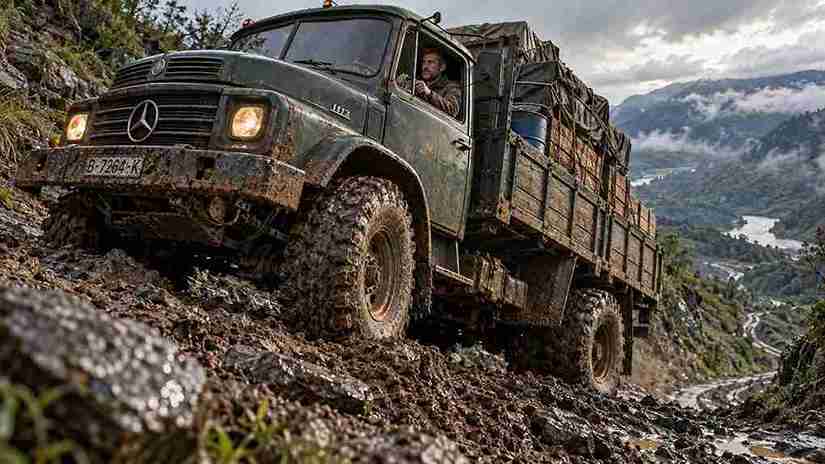
During the early and middle parts of the 20th century, commercial truck drivers faced a particularly difficult problem.
Heavy trucks routinely carried loads weighing 10,000 to 30,000 pounds over steep hills, muddy roads, and rough terrain.
The engines available at the time had nowhere near the power of today’s engines.
A normal first gear often wasn’t enough to provide the mechanical advantage needed to get a heavily loaded truck moving, especially when the truck was stopped on an incline.
If the driver lost momentum, the consequences could be serious.
Thousands of pounds of cargo could begin pulling the truck backward, creating a dangerous situation on primitive roads where maintaining control was much harder than it is today.
Engineers needed a simple solution.
The Industry’s Solution
The answer was the ultra-low granny gear.
By adding a very low gear ratio to the transmission, engineers gave truck drivers the mechanical advantage they needed to get heavy vehicles moving.
Once the truck gained enough momentum, the driver could shift into the higher gears and continue normally.
For professional truck drivers, this type of transmission remained an important part of operating heavy vehicles throughout much of the 20th century.
Manufacturers such as Ford, GM, and Ram continued producing work trucks with manual transmissions that featured very low first-gear ratios well into the late 1980s and early 1990s.
As engines became more powerful and transmissions improved, however, the need for these extremely low gears began to disappear from ordinary vehicles.
The NP435 and Its Legacy
One famous example of a granny-gear transmission is Ford’s NP435.
During the 1986 model year, Ford used this four-speed manual transmission in its trucks. Its first gear had a huge 6.68:1 ratio, showing just how heavily it was designed around torque multiplication rather than ordinary street driving.
The following year, Ford moved toward the Mazda-produced M5OD, a close-ratio five-speed manual transmission.
This represented a major shift in truck engineering.
As manufacturers developed more powerful engines and increasingly used dual-range transfer cases with low-range gearing, there was less need to place an extremely low crawler gear directly inside the main transmission.
The technology had not become useless. It had simply become less necessary for the average driver.
Why the Granny Gear Faded From Consumer Vehicles
Two major developments helped push granny gears out of everyday passenger vehicles:
More powerful engines and better transmission systems.
By the late 1980s, even relatively ordinary half-ton SUVs could produce more horsepower and torque than much larger commercial trucks from previous decades.
That meant vehicles could move away from a stop without needing such an extreme first-gear ratio.
At the same time, four-wheel-drive systems increasingly offered two-speed transfer cases with low-range gearing.
Instead of putting the crawler gear inside the primary transmission, manufacturers could provide additional low-speed gearing through the transfer case.
There was also another major change taking place: drivers were increasingly moving away from manual transmissions altogether.
In the United States, manual transmissions became a shrinking part of the new-car market. By 2021, they represented only around 1% of new car sales, with a small increase to approximately 1.7% in 2023.
As fewer people learned to drive manual vehicles, specialized gear positions such as G became increasingly unfamiliar to everyday motorists.
The Porsche 959 and Its Unexpected G Gear
Here’s where the story becomes even more unusual.
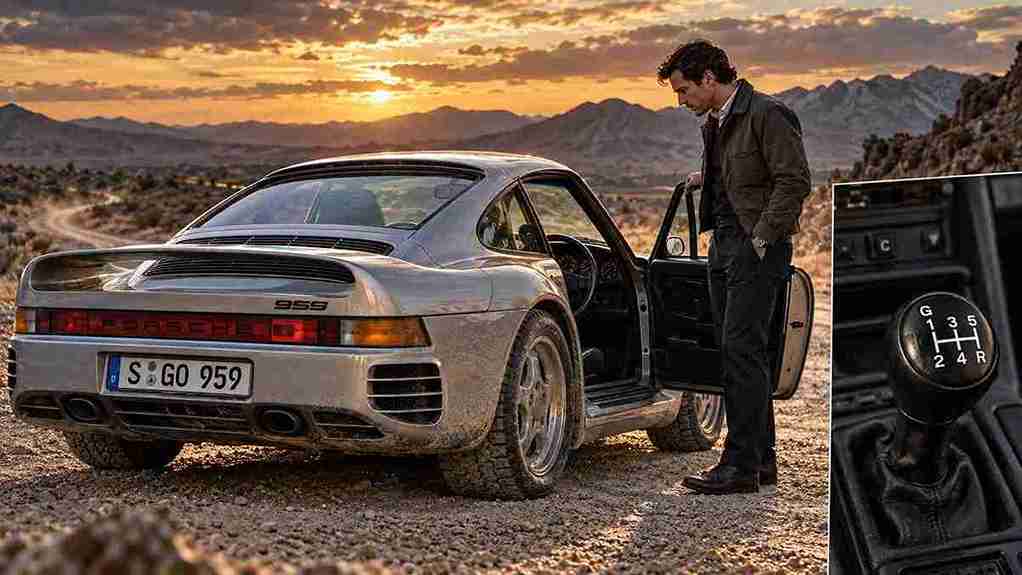
The 1986 Porsche 959, one of the most technologically advanced performance cars of its era, also featured a gear marked G.
At first glance, that seems strange.
Why would a high-performance German supercar need a gear normally associated with trucks and off-road vehicles?
The Porsche 959 used a six-speed manual transmission, but its shift pattern was unusual. Instead of simply labeling the gears from 1 through 6, Porsche marked the position above first gear with the letter G.
And there was a very specific reason for it.
The G gear was created partly as a solution to strict vehicle noise regulations.
The Noise Regulation Problem
European pass-by noise regulations required vehicles to remain below specific noise limits during standardized testing.
The Porsche 959’s sequential twin-turbocharged flat-six engine was extremely powerful and produced considerable noise at high engine speeds.
If Porsche had used a conventional transmission arrangement, the car could have faced problems during the required testing procedure.
So Porsche engineers came up with an unusual solution.
They placed the very low G gear at the base of the shift range. During the regulatory test, the car could use a higher internal ratio while keeping engine RPM lower than it would have been in a conventional first-gear arrangement.
In other words, the unusual G gear helped Porsche satisfy the regulations without compromising the car’s performance on the road.
It was an engineering workaround that had a surprisingly practical side effect.
What the Porsche 959 Actually Was
To understand why Porsche went to such lengths, it helps to understand what the 959 represented.
The Porsche 959 was an extraordinary performance machine.
Its 2.85-liter sequential twin-turbocharged flat-six produced around 450 PS at 6,500 rpm and 500 Nm of torque at 5,000 rpm.
Road & Track recorded a top speed of approximately 198 mph and a 0-to-60 mph time of about 3.6 seconds.
The car also featured Porsche’s advanced PSK all-wheel-drive system, which could dynamically distribute torque between the front and rear axles depending on road conditions.
Porsche ultimately produced only 337 examples, including prototypes, making the 959 exceptionally rare.
And despite being a road-legal supercar, the 959 was also designed with serious competition in mind.
The G Gear’s Unexpected Everyday Value
The G gear may have been introduced partly to solve a regulatory problem, but Porsche discovered that it had another useful quality.
It worked surprisingly well in slow-moving traffic.
The extremely low ratio allowed the 959 to crawl through congested streets with excellent control. A gear originally associated with heavy trucks and difficult terrain turned out to be useful in stop-and-go city driving as well.
The gear also made sense in the world of motorsport.
The Porsche 959 competed in the Paris-Dakar Rally and finished first overall in 1986. In an event involving rough terrain, sand, and long stretches of difficult off-road driving, having extremely precise low-speed control could be a major advantage.
That made the G gear an interesting combination of different engineering priorities.
It helped solve a legal problem, worked well in traffic, and had genuine value in extreme terrain.
What This Means for the Modern Driver
For most modern drivers, the G gear is now something of an automotive mystery.
Manual transmissions themselves have become increasingly uncommon, especially in the United States.
Manual transmission sales fell from around 35% of new-car sales in the early 1980s to roughly 15% by the mid-1990s. By 2010, the figure had fallen to around 6%, eventually reaching approximately 1% by 2021.
As automatic transmissions became faster, smoother, and more efficient, fewer drivers had a reason to learn how to operate a manual gearbox.
At the same time, modern engines became much more capable of producing low-end torque.
That meant most everyday vehicles simply didn’t need an extremely low crawler gear.
For ordinary road driving, a modern first gear provides more than enough mechanical advantage.
The 2021 Ford Bronco Brought It Back
Then something interesting happened.
The 2021 Ford Bronco brought the granny gear back into a modern production SUV.
The Bronco’s seven-speed manual transmission effectively combines six conventional gears with a dedicated crawler gear.
This wasn’t an accidental return to old technology.
Ford deliberately included the extra-low gear because the Bronco was designed with serious off-road driving in mind.
A dedicated crawler gear can give a driver extremely precise control at very low speeds, particularly when climbing rocks, crossing difficult terrain, or navigating steep obstacles.
For younger drivers who had never encountered a granny gear before, seeing a seventh position on a manual shift pattern could understandably be confusing.
But for experienced off-road drivers, it represented the return of a familiar and useful piece of mechanical engineering.
Why It Still Matters to Know About
Understanding the G position helps explain something important about automotive design.
The letter isn’t a mistake.
It isn’t an unfinished marking.
And it isn’t simply an outdated label that manufacturers forgot to remove.
The G gear represents a carefully engineered solution to a specific problem.
Whether you encounter it in an old Mercedes G-Wagen, a vintage farm truck, a Porsche 959, or a modern Ford Bronco, the basic principle remains the same:
Maximum torque, minimum speed, and maximum control.
The gear exists for situations where moving slowly is more important than moving quickly.
The Letter That Said Everything Without Saying Anything
The G on a manual shift pattern is one of those small automotive details that becomes fascinating once you stop and ask what it means.
For decades, countless drivers have probably looked at a shift gate containing a mysterious G without ever thinking twice about it.
But behind that single letter is more than a simple gear position.
Its story connects early commercial trucks, German military vehicle development, off-road engineering, strict European noise regulations, and one of the most advanced sports cars of the 1980s.
It shows how automotive engineering often develops: one problem leads to a solution, that solution becomes useful in another situation, and eventually the technology finds its way into vehicles that were never originally intended to use it.
So the next time you see a “G” on a manual stick shift, don’t assume it’s a mistake.
That small letter represents an entire history of engineering built around one simple idea:
Sometimes the most useful gear isn’t the one that makes a vehicle go faster. It’s the one that gives the driver enough control to move forward when almost everything else is working against them.
Note: All images used in this article are AI-generated and intended for illustrative purposes only.
0 Comments