
Finding tiny red dots on your skin can be unsettling, especially when you don’t remember seeing them before.
The good news is that many small red spots are harmless. One of the most common explanations is a cherry angioma, a benign growth made up of small blood vessels that often becomes more noticeable as people get older.
But not every red dot has the same cause.
A dermatologist usually starts by asking a simple question: Did the spots appear gradually, or did they suddenly show up?
That detail can make a big difference.
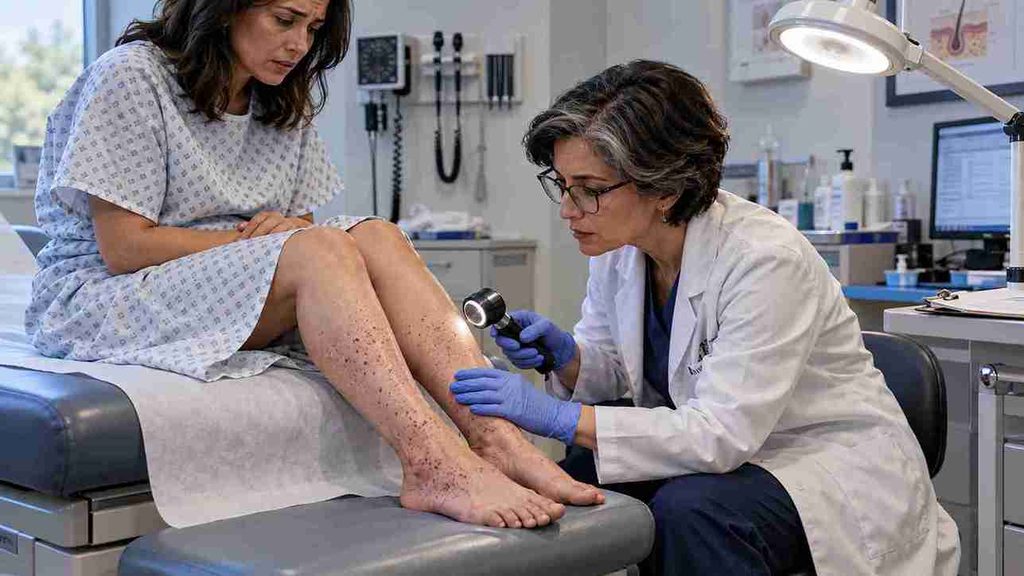
A red spot that slowly develops over months or years and remains unchanged is often less concerning. On the other hand, a sudden cluster of red or purple spots that appears within a few days—particularly on the lower legs—may represent bleeding under the skin and deserves prompt medical attention.
Doctors also look at other clues, including whether the spots become lighter when pressed, whether they itch or hurt, whether you’ve recently been sick, whether you’ve started a new medication, and whether you’re experiencing unusual bruising or bleeding.

Understanding these differences can help you know when a spot is probably harmless and when it’s time to have it checked.
Why Red Dots on Skin Appear in the First Place
Many different skin conditions can look surprisingly similar at first.
Tiny blood vessels sit close to the surface of the skin. When a small group of those vessels widens, twists, or grows, it can create a bright red pinpoint mark.
In other situations, blood can leak out of a blood vessel and collect underneath the skin. That’s an important difference because bleeding beneath the skin can sometimes point to a medical problem that needs attention.
That’s why dermatologists pay close attention to when the spots appeared.
A spot that develops slowly over several months may suggest a benign vascular growth. A group of spots that suddenly appears over 24 to 72 hours raises different questions.
A dermatologist may ask about:
- Recent viral illnesses or infections
- New medications
- Blood-thinning medications
- Supplements
- Steroid creams
- Recent exercise or heavy lifting
- Skin injuries or trauma
- New bruising
- Bleeding from the gums or mouth
- Whether the spots itch, sting, or hurt
They may also check whether the dots are located around hair follicles. In some cases, folliculitis can look like tiny red spots.
The texture of the skin matters too. Scaling, crusting, tenderness, or a sore that refuses to heal can point toward a different diagnosis and may require further examination.
The Most Common Explanation: Cherry Angiomas
According to dermatologist Christopher J. Haas, MD, FAAD, one of the most common explanations for small red spots—particularly in people with lighter skin—is a cherry angioma.
Cherry angiomas are benign growths made up of small blood vessels. They commonly appear on the trunk and arms and often become more numerous with age.
They can be tiny and flat at first. Over time, some develop into small, smooth, dome-shaped bumps.
However, the appearance alone isn’t always enough to identify a red spot.
A dermatologist may also consider telangiectasia, petechiae, an inflamed hair follicle, a bruise-like bleed, or, less commonly, a skin cancer.
That’s why a spot that changes quickly, bleeds repeatedly, becomes painful, develops a crust, or looks unusual should not simply be assumed to be a harmless mole.
When Red Dots May Need Urgent Attention
Most red dots aren’t an emergency, but sudden changes deserve attention.
If red or purple spots appear rapidly and spread over several days, particularly when they’re accompanied by other symptoms, it’s important to seek medical advice.
You should be especially alert if the spots appear alongside:
- Fever
- Unusual or unexplained bruising
- Bleeding gums
- Mouth bleeding
- Confusion
- Feeling seriously unwell
- A rapidly spreading rash
A simple home observation can also provide useful information.
With clean hands, gently press a clear glass against the spot.
Some vascular spots become lighter when pressure is applied. Petechiae, which result from blood leaking beneath the skin, generally do not blanch and remain the same color when pressed.
This isn’t a diagnosis, but it can be a useful clue to share with a healthcare professional.
Also pay attention to recent events. Did you recently have an infection? Start a medication? Receive a vaccine? Complete an unusually intense workout? Experience repeated pressure or friction from clothing?
Take clear photographs if the spots are spreading. A timeline can help a doctor understand how quickly the skin changed.
If the spots are appearing rapidly, it’s better to have them evaluated rather than waiting weeks to see what happens.
Cherry Angioma: The Common Red Mole That Usually Stays Harmless
Cherry angioma is one of the most familiar explanations for a small, bright-red spot on the skin.
It is a benign overgrowth of small blood vessels.
Many cherry angiomas begin as tiny, flat red marks. Over time, some become slightly raised and develop a smooth, dome-like appearance.
They are particularly common on:
- The torso
- Upper arms
- Thighs
- Other areas of the body
They can appear almost anywhere, although the palms and soles are less typical locations.
Age appears to play an important role. Many people notice their first cherry angiomas after age 30, followed by a gradual increase over the years. Genetics, age, and pregnancy may also influence how many a person develops.
Cleveland Clinic estimates that about half of adults have cherry angiomas after age 30, and they become increasingly common with age.
That’s one reason dermatologists often reassure patients when the spots have the classic appearance and have developed gradually.
What Cherry Angiomas Usually Look Like
A typical cherry angioma is:
- Bright red or reddish-purple
- Round and clearly defined
- Small
- Smooth or slightly raised
- Relatively stable over time
Some can bleed if they’re scratched, shaved, or repeatedly rubbed by clothing.
That bleeding can look dramatic because the lesion contains blood vessels. However, it usually stops with firm pressure.
If a cherry angioma repeatedly bleeds, becomes irritated, or gets caught on clothing, a dermatologist can safely remove it.
Don’t Try to Remove It Yourself
Even though cherry angiomas are generally harmless, cutting, burning, tying, or otherwise removing one at home can cause problems.
Home removal can lead to:
- Infection
- Excessive bleeding
- Scarring
- Skin damage
A dermatologist can numb the area and remove the lesion using an appropriate office-based technique. Depending on its appearance, the doctor may also send tissue to a laboratory to make sure the diagnosis is correct.
If a red spot bleeds after being scratched or bumped, treat it like a small wound. Clean the area, apply appropriate wound care, and cover it if necessary.
If bleeding repeatedly starts again or doesn’t stop with firm pressure, seek medical attention.
Telangiectasia: When Red “Dots” Are Actually Visible Blood Vessels
Not every red mark is truly a dot.
Some are actually small blood vessels that have become visible near the surface of the skin.
This is called telangiectasia.
Telangiectasia can look like thin red lines, branching vessels, or even a tiny spider-like pattern. It commonly appears on areas such as the:
- Nose
- Cheeks
- Upper chest
Years of sun exposure can contribute to visible surface vessels. Heat, alcohol, rosacea, skin irritation, and excessive use of topical steroids may also make them more noticeable.
As the skin becomes thinner with age, these vessels can become easier to see.
One useful difference is their appearance under pressure.
Telangiectasia often lightens when pressed, because the visible blood is still inside the blood vessel.
Petechiae behave differently because the blood has leaked into the surrounding tissue.
Protecting Skin From Further Sun Damage
Sun protection can help reduce additional damage that may make visible vessels more noticeable.
Dermatologists commonly recommend:
- Broad-spectrum sunscreen with SPF 30 or higher
- Wearing a hat during prolonged outdoor exposure
- Avoiding unnecessary tanning
- Reapplying sunscreen during extended outdoor activities
- Using gentle skin-care products
People who spend a lot of time driving or sitting near windows should also remember that UVA exposure can still reach the skin through glass.
Harsh scrubs, very hot water, and irritating skin-care products may make facial redness more noticeable.
If you have persistent facial flushing or visible vessels, a dermatologist can determine whether rosacea or another condition is contributing.
For cosmetic treatment, doctors may use vascular lasers or intense pulsed light. Treatment choice depends on the location, vessel type, and skin tone.
Petechiae and Purpura: When Red Dots Can Signal a Problem
Petechiae are very small red or purple pinpoint spots caused by bleeding beneath the skin.
They often appear suddenly and may cluster around the lower legs and ankles.
Unlike cherry angiomas, petechiae are usually flat.
They also generally don’t blanch when pressed because the blood isn’t contained inside a surface blood vessel anymore.
MedlinePlus explains that areas of bleeding beneath the skin do not become paler when pressure is applied.
Petechiae can sometimes appear after an obvious physical trigger.
For example, forceful coughing, vomiting, heavy lifting, or intense exercise can cause tiny blood vessels to break. In these situations, the spots may fade over the following days, particularly when the person otherwise feels well.
But there are also medical conditions that can cause petechiae.
Low Platelets Can Cause Petechiae
Platelets are blood cells that help the body form clots and stop bleeding.
When platelet levels become too low, a person may develop pinpoint bleeding beneath the skin.
Petechiae can sometimes occur with platelet disorders, infections, certain medications, immune conditions, or other medical problems.
That’s why doctors pay attention when petechiae appear suddenly or are accompanied by other bleeding symptoms.
Signs that deserve medical evaluation include:
- Unexplained bruising
- Bleeding gums
- Frequent nosebleeds
- Heavy menstrual bleeding
- Blood in other areas of the body
- A rapidly spreading rash
- Fever
- Feeling unusually ill
A doctor may order a complete blood count (CBC) to check platelet levels and other blood cells.
The exact evaluation depends on the person’s symptoms and medical history.
When a Red Rash May Be an Emergency
A rapidly spreading non-blanching rash accompanied by fever or significant illness can sometimes be associated with serious infections.
For that reason, don’t automatically assume that every new cluster of red spots is simply a skin condition.
The CDC notes that meningococcal disease can include a petechial or purpuric rash along with sudden fever and other symptoms.
If you suddenly develop widespread red or purple spots and feel seriously ill, seek urgent medical attention.
Similarly, if you can’t identify a clear reason for rapidly appearing petechiae, it’s better to have them evaluated promptly.
Taking photographs can be helpful because doctors may want to know whether the spots are spreading and how quickly they developed.
What a Dermatologist Checks
Dermatologists don’t assume that every red spot is cancer.
At the same time, they don’t ignore a spot simply because it is red.
The goal is to determine what the spot looks like, how it behaves, and how quickly it appeared.
During an examination, a dermatologist may check whether the spot:
- Blanches when pressed
- Has a smooth or rough surface
- Has scaling or crust
- Bleeds easily
- Has changed in size
- Has changed in color
- Has become painful or itchy
- Has been present for a long time
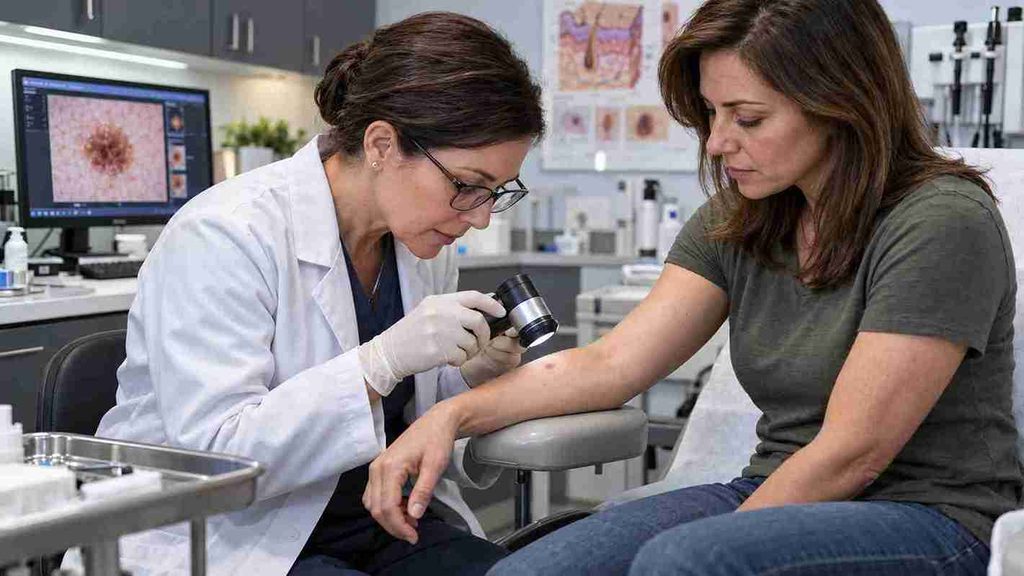
They may also use a device called a dermoscope to examine structures beneath the surface of the skin.
Your medical history matters as well.
The dermatologist may ask about:
- Sun exposure
- Previous sunburns
- Tanning bed use
- Outdoor work
- Family history of melanoma
- Immune suppression
- Recent illnesses
- New medications
- Aspirin or blood thinners
- Supplements
Sometimes a spot simply needs to be monitored.
In other cases, a dermatologist may recommend a biopsy.
When a Red Spot Needs a Skin Cancer Workup
Not every skin cancer is dark.
Some skin cancers can appear as pink, red, or unusual-looking spots.
That’s why a new lesion that looks different from the surrounding skin deserves attention, particularly if it continues to change.
Warning features can include:
- A spot that keeps growing
- Persistent crusting
- Repeated bleeding
- A sore that doesn’t heal
- A lesion that becomes increasingly unusual
- A spot that changes in color, shape, or texture
Areas that receive substantial sun exposure—such as the face, ears, scalp, chest, and forearms—deserve particular attention.
A dermatologist can use dermoscopy and, when necessary, perform a biopsy.
The American Academy of Dermatology notes that a skin biopsy is essential for determining whether a suspicious lesion is skin cancer.
If the lesion turns out to be harmless, treatment may not be necessary.
If it’s irritating, bleeding, or cosmetically bothersome, a benign lesion such as a cherry angioma can often be removed in the office.
What You Can Do at Home
You don’t need to inspect every inch of your skin every day.
Instead, develop a simple routine.
Check your skin periodically and pay attention to anything that is new or changing.
If you notice a red spot, take a clear photograph in good lighting. If possible, include something that provides a sense of scale.
Then keep track of:
- When you first noticed it
- Whether it is getting larger
- Whether new spots are appearing
- Whether it changes color
- Whether it bleeds
- Whether it becomes painful or itchy
- Whether it disappears with pressure
If the spots are spreading quickly or are accompanied by fever, unexplained bruising, bleeding, or feeling seriously unwell, don’t rely on home monitoring alone.
Seek medical evaluation.
The Bottom Line
Tiny red dots on the skin can have many explanations.
Cherry angiomas are extremely common and are usually harmless, especially when they develop gradually and remain stable.
Telangiectasia can also create small red marks or visible vessels, particularly on sun-exposed areas.
Petechiae are different because they represent bleeding beneath the skin and generally don’t blanch when pressed.
The most important clues are how quickly the spots appeared, whether they’re changing, whether they blanch, and whether other symptoms are present.
If you’re unsure what you’re seeing, a dermatologist can usually narrow down the possibilities with a physical examination and, when necessary, additional testing.
A new skin change doesn’t automatically mean something is wrong.
But a rapidly changing or unexplained rash shouldn’t be ignored either.
Note: All images used in this article are AI-generated and intended for illustrative purposes only.
0 Comments