
The bitter winter wind rattled the drafty, paper-thin windowpane of my room in the state-funded wing. Beside my narrow bed, the old cast-iron radiator hissed and sputtered indignantly, emitting plenty of noise but barely enough heat to warm my aching fingers. I pulled a threadbare woolen shawl tighter around my shoulders and looked across the manicured courtyard toward the penthouse suites, where large floor-to-ceiling windows glowed with the warm, amber radiance of luxury.
Those two worlds existed on the very same property, separated by barely fifty yards of lawn, yet they almost never intersected. The wealthy residents lived with private attendants, catered dining, and soft carpets, while those of us relying on government subsidies counted our small blessings over lukewarm broth and drafty corners.
Except beneath the great oak tree.
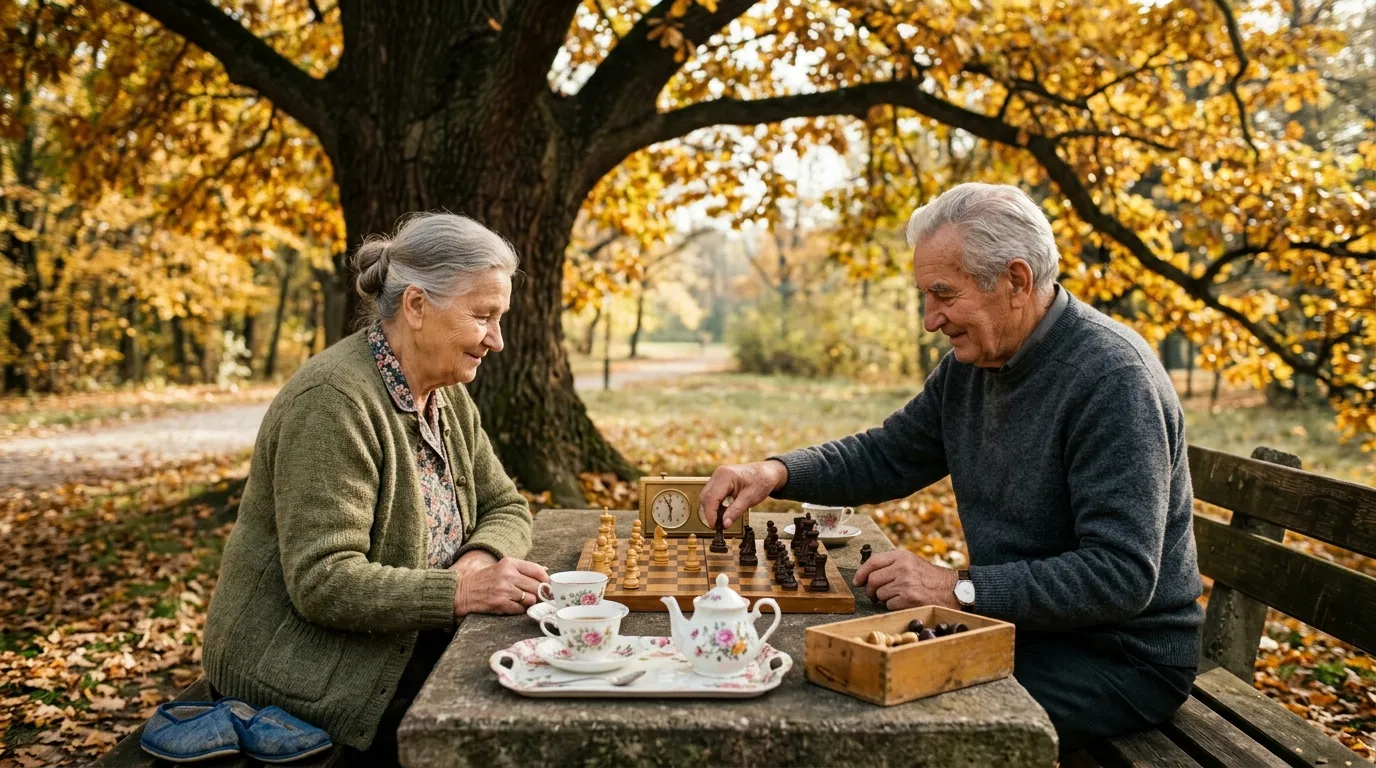
Our quiet afternoons beneath the old oak tree, where two different worlds met over a chessboard.
That ancient, sprawling tree stood dead center in the courtyard, belonging neither to the penthouse gardens nor the state wing’s gravel path. It was there that I first crossed paths with Arthur.
He was eighty-two years old, impossibly upright, and carried himself with an effortless, quiet dignity. His trousers were crisply pressed, and his tailored cashmere cardigans looked as though they had never encountered a single wrinkle or moth hole in their existence. He was sitting at a modest outdoor stone table, meticulously arranging wooden chess pieces with the unhurried grace of a man who firmly believed the rest of the world could wait for him.
As I shuffled past on my morning walk, he paused, a polished knight balanced in his weathered hand, and looked up.
“You look like someone who understands a good game,” he observed, his voice rich and deep, like cello notes in a quiet room.
I glanced at the beautifully carved pieces, then down at my own faded housecoat. “I understand losing gracefully,” I replied with a wry smile. “That is the primary lesson poverty teaches you.”
Arthur burst into a warm, ringing laugh that carried across the chilly garden. He gestured toward the empty iron chair opposite him. “Then take a seat. I haven’t lost gracefully in decades. I could certainly use the practice.”
I sat down. That afternoon, we played three games. Around the second hour, an attendant in crisp white linens carried out a porcelain pot of imported Earl Grey tea along with delicate butter biscuits. As I lifted the fragile teacup, I noticed the scuffs on my worn fabric slippers and felt an immediate flush of embarrassment. I tucked my feet beneath my chair, acutely conscious of my tiny monthly pension check.
Arthur missed nothing. “You keep apologizing for your shoes,” he said gently.
“They are old, frayed, and frankly, all I have left,” I confessed.
He looked at my slippers, then back into my eyes with genuine kindness. “Shoes carry people through long lives and into extraordinary places. Yours carried you to this table today. That makes them priceless in my eyes.”
I had no idea then how deeply those words would lodge themselves in my heart. Nor did I foresee how those quiet afternoons beneath the oak would soon become the anchor of my life.
Day after day, as autumn surrendered to frost, we met at that table until the chill forced us into the courtyard sunroom. We played chess. We listened to scratchy recordings of Miles Davis and Billie Holiday on his vintage portable turntable. We sipped hot tea, and inch by inch, we peeled back the guarded layers of our pasts.
Arthur spoke of his late wife, Clara, and the immense silence her passing had left in his days. I spoke of the humble shop my late husband and I had run until medical debts swallowed it, and the children we had dreamed of but could never have. It was honest, unvarnished company.
One grey Tuesday, after Arthur made a particularly cautious pawn advance, I finally brought up what had puzzled me for weeks. “You mentioned you have three grown children. Where are they? Why do they never visit?”
His hand hovered over his bishop, trembling ever so slightly. He stared at the board for what felt like minutes before setting the piece down. “They do not care about me,” he whispered, his voice stripped of its customary warmth. “They are simply waiting for me to die.”
“Arthur, surely that can’t be true,” I said gently. “Family is complicated, but—”
“I know my son Gregory,” he interrupted, a deep, bitter ache coloring his tone. “He is patient, polite to a fault when he needs to be, but utterly ruthless. He is planning something. I can feel it in my bones, the way an old sailor senses an oncoming gale.”
I reached across the board and rested my palm over his cold fingers. “Then let us finish this game, Arthur, and leave the storms for another day.”
He smiled faintly, though his eyes remained shadowed. “Do you realize you are the only person in this entire facility who wants nothing from me?”
“Don’t be so sure,” I teased softly. “I intend to take your queen before the sun sets.”
He chuckled. “That, my dear, you will have to fight for.”
Only once during those months did I catch sight of his family. His daughter, Evelyn, came by one Friday. She stood at the perimeter of the courtyard, clutching her designer coat against the wind, watching us with a conflicted, mournful gaze. When Arthur looked up and waved her over, she hesitated, shook her head with a look of quiet anguish, turned, and hurried away.
“Evelyn,” Arthur sighed, watching her retreat. “She is not cruel at heart like Gregory, but she is weak. She has spent her whole life doing whatever her brother tells her.”
“People can find their spine,” I offered.
“Perhaps,” he replied softly. “Usually only after the cost becomes too unbearable.”
By December, the bitter cold took its toll. Arthur developed a severe chest infection that his frail frame could barely shake off. Within weeks, he was confined to his bed in the penthouse suite, so weak he could scarcely lift a cup without help. I spent every afternoon by his bedside, reading books aloud and spooning warm broth into his mouth.
It was on one of those quiet afternoons that the peace was shattered.
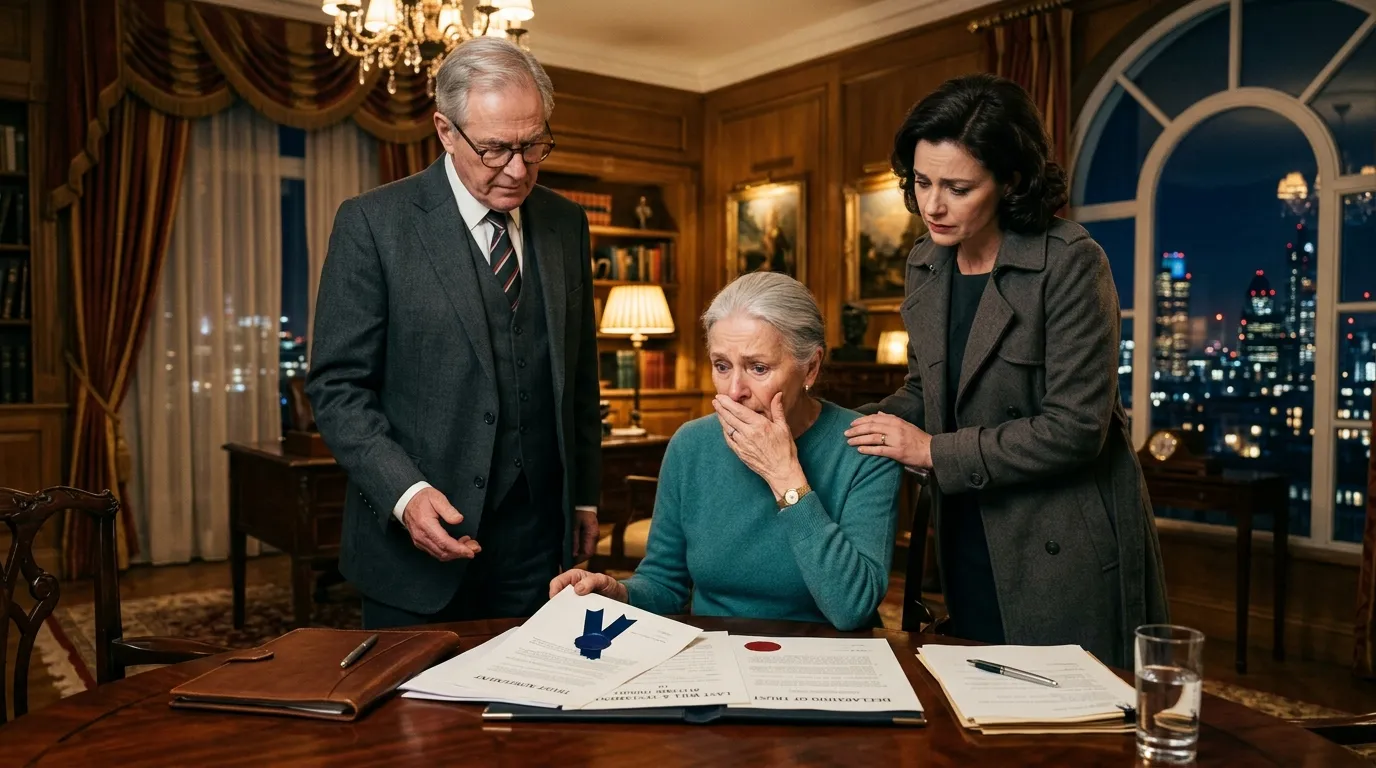
Gregory entered with an entourage of lawyers, determined to strip his father of every freedom.
The heavy oak door of the suite swung open without warning. Gregory strode in—tall, immaculately groomed, possessing Arthur’s sharp jawline but none of his soul. Behind him came Evelyn, her head bowed, followed by three solemn men in tailored suits clutching leather briefcases.
“Father, we need to talk about your care,” Gregory said flatly, ignoring the tea tray entirely. “This private suite is draining resources unnecessarily.”
Arthur propped himself up against his pillows, breathing hard, but his eyes were sharp. “My resources are mine to spend, Gregory. I do not remember summoning you.”
A lawyer stepped forward, unzipping a folder. “Mr. Arthur, your family has formal concerns regarding your cognitive and physical ability to manage your medical affairs. We are prepared to petition the court for an emergency conservatorship, appointing Gregory as your legal guardian.”
The transparent malice in the room made my blood turn cold. I stood up. “He is completely lucid. He makes his own decisions, and anyone spending ten minutes with him can see that.”
Gregory turned to me, his lip curling in disgust. “And who might you be? The charity case from the subsidized wing? This is a private family matter. Step out.”
“She stays,” Arthur whispered, his voice firm despite his wheezing. “She is the only one in this room whose presence is motivated by decency.”
Gregory scoffed, stepping closer to the bed. “Be reasonable, Father. We found a quiet, specialized facility upstate. It is far more suitable. You sign a voluntary transfer of medical and legal authority today, and we avoid an embarrassing public competency hearing.”
“You mean a warehouse where no one will notice if I slip away quietly,” Arthur said, unwavering. “You care only about the money.”
Realizing Arthur would not break that afternoon, Gregory signaled his lawyers. “Think it over, Father. We will return with a magistrate’s order.”
When the door closed behind them, Arthur gripped my hand with surprising strength. His breath came fast and shallow. “They will do it. They will find a corrupt doctor or a hurried judge, declare me senile, and lock me away.”
“We won’t let them,” I said, kneeling by the bed. “Tell me how to fight them.”
Arthur looked into my eyes with utter seriousness. “Marry me.”
I stopped, convinced I had misheard. “Arthur… what?”
“Marry me,” he repeated steadily. “A spouse holds immediate statutory standing above adult children. If we marry, I can execute an ironclad medical directive appointing you as my sole agent while my doctors still certify my competence. Gregory cannot touch me if you hold that shield.”
“People will call me a gold digger. They will say I took advantage of an old man,” I protested, my chest tight.
“Let them say whatever they please,” Arthur urged softly. “You don’t have to love me as a romantic partner. I am only asking you to save my dignity.”
Tears pricked my eyes as I squeezed his frail hands. “I already love you, Arthur. I have since you let me win that very first game.”
A weak laugh broke from his lips. “I never let you win. You were always the superior tactician.”
Three days later, in that quiet bedroom, we were wed. Arthur’s lifelong personal attorney, Mr. Vance, stood as our witness, and the nursing home’s chaplain read the vows. It was a modest, solemn ceremony devoid of fanfare, sealed with a signed medical power of attorney and a registered marriage certificate. In the doorway, Evelyn had stood watching in silence before vanishing into the hall.
When Gregory returned the following week with court papers in hand, Mr. Vance met him at the door with our legal marriage documentation and the healthcare proxy. Gregory turned crimson with rage, bellowing threats of fraud and litigation through the hallways before storming out in defeat.
Arthur smiled peacefully from his bed. “Checkmate,” he murmured.
For two wonderful years, we lived in that sunlit suite as husband and wife. I tended to his health, we read literature together, played chess every single day, and watched the oak tree cycle through snow, blossoms, and shade. For the first time in either of our lives, neither of us was lonely.
Then, on a gentle morning in late spring, Arthur drew his last breath, slipping away quietly in his sleep with his hand resting in mine.
I grieved him with every fiber of my being. I expected nothing more than the memories of the kindest man I had ever known. But one week after the memorial service, Mr. Vance knocked on the suite door, carrying a thick manila envelope and an expression of solemn gravity.
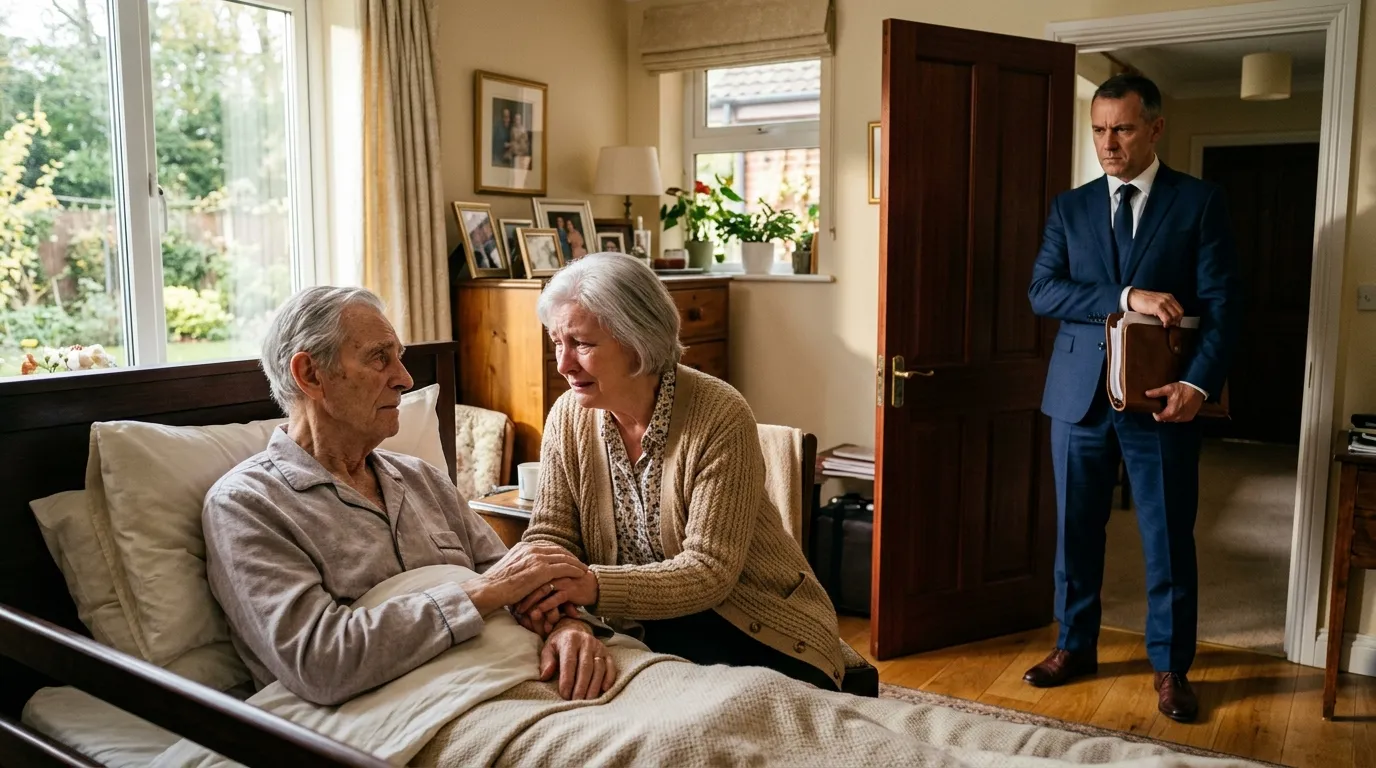
The truth revealed: Arthur wasn’t just a resident; he had protected the entire facility in secret.
Mr. Vance sat down across the dining table and pushed the documents toward me. “Arthur trusted me for thirty-five years. What I am about to tell you will completely alter how you view the last two years.”
I looked at the legal jargon, baffled. “Mr. Vance, I don’t understand. Is Gregory filing another lawsuit? Arthur had a modest savings, but—”
“Arthur did not have modest savings,” Mr. Vance interrupted gently. “He purchased this entire facility eleven years ago. The buildings, the grounds, the surrounding land. All of it.”
I stared at him, my mind refusing to process the words. “What? He lived here as a tenant. Why would he conceal such a thing?”
“Because he wanted to live where people treated him for who he was, not what he owned,” Mr. Vance explained. “And more importantly, because he wanted to personally watch over the state-funded wing. The people society routinely discards.”
Before I could speak, the suite door opened. Evelyn stepped inside, looking pale but resolute.
“He noticed you long before that first game of chess,” Evelyn said softly, stepping toward the table. “He watched you share your meager portions with other residents. He admired your spirit.”
“Evelyn, what is this?” I asked, my voice shaking.
“Gregory had arranged a secret syndicate of developers,” she confessed, her voice laden with shame. “He planned to declare our father incompetent, take over the estate, bulldoze the subsidized wing, and turn the land into luxury condominiums. Every low-income elder here was going to be thrown out on the street.”
A chill swept through me. “Dozens of helpless people… with nowhere to go.”
“Father uncovered the plot,” Evelyn continued. “He knew Gregory would tie up a normal will in probate for a decade. So with my help and Mr. Vance’s counsel, he transferred the entire nursing home and its endowment into an irrevocable living trust. And you, Clara’s successor, are the sole governing trustee and beneficiary.”
My hands trembled violently over the heavy parchment. “I am just a poor woman. I have no power, no business knowledge. How can I fight Gregory?”
Evelyn knelt beside my chair, gently taking my hands into hers. “For years, I let my brother run roughshod over everyone because I was frightened. Not anymore. I will testify to the validity of the trust. Mr. Vance will manage the legal structure. You are not alone.”
Three days later, the penthouse doors swung open once more. Gregory stormed in, flanked by two attorneys, tossing a formal eviction notice onto the table with sneering confidence.
“Time to pack your thrift-store clothes, old woman,” Gregory snarled. “As the surviving eldest heir, I have initiated probate. This suite belongs to the bloodline.”
I didn’t flinch. I sat upright, feeling the calm strength of Arthur beside me in spirit. Beside me, Mr. Vance snapped his briefcase open, and Evelyn stepped forward from the terrace.
“Sit down and be quiet, Gregory,” Evelyn said sharply.
Gregory blinked, stunned by his sister’s defiance. “What is this?”
I slid the certified trust deed across the mahogany surface. “Read paragraph four before you utter another threat.”
Gregory seized the papers, his arrogant grin evaporating line by line. The color drained from his face until he was ghost-white. “This… this is an outrage! He owned the deed? He gave the entire complex to a charity trust controlled by you? You manipulated him!”
“I witnessed the signing myself, Gregory,” Evelyn countered, her voice unwavering. “I also documented your communications with the condo developers. If you contest this trust, every email and wire transfer you made will be submitted to the state attorney general.”
The attorneys beside Gregory exchanged uneasy glances, visibly pulling back from their client. Gregory looked around the room, realizing he had walked directly into an inescapable trap. With a muffled curse, he snatched his coat and fled into the hall, his entourage trailing behind him.
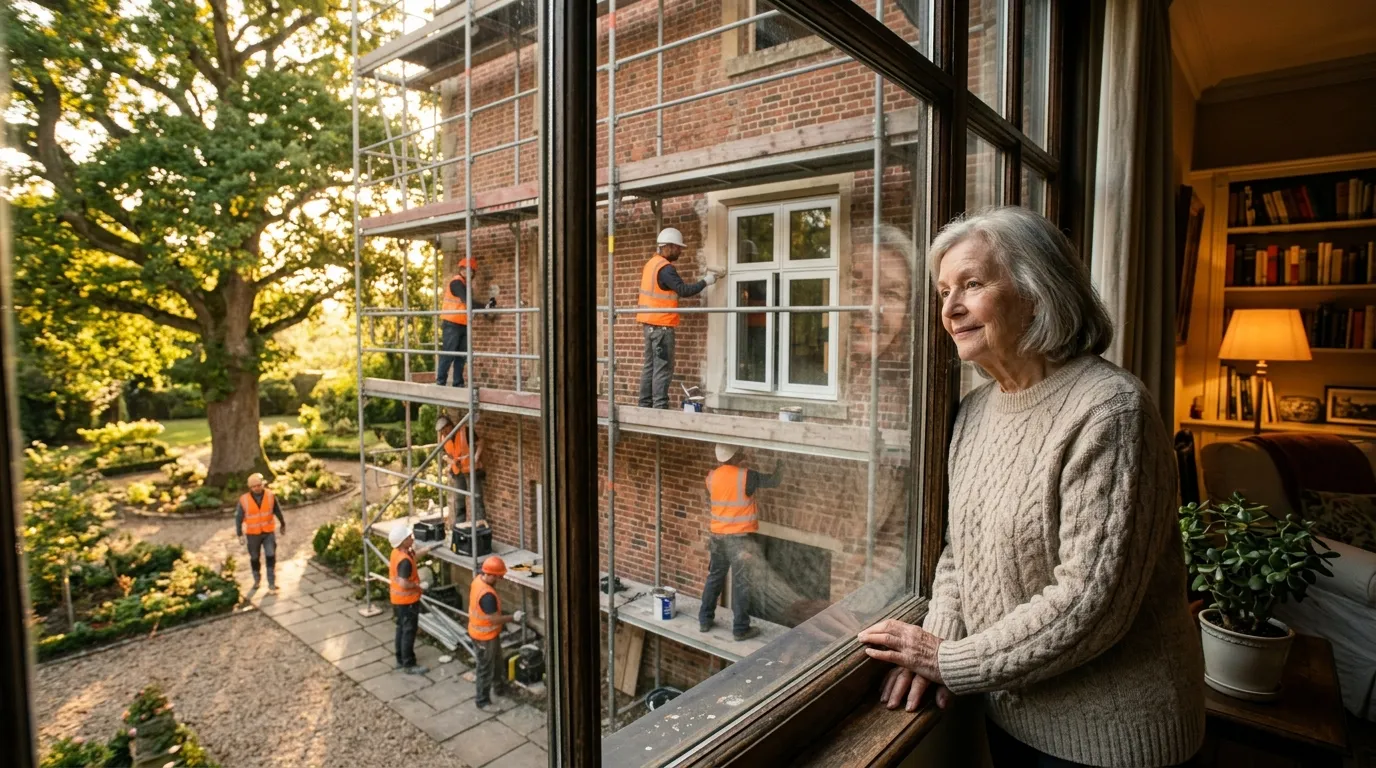
New windows, fresh paint, and lasting security for the people who needed it most.
Six weeks later, the courtyard echoed with the sounds of hammers, drills, and laughter. Contractors and carpenters were replacing the rotting frames of the subsidized wing with energy-efficient windows. State-of-the-art heating units were being installed in every single room, and fresh coats of cheerful paint brightened the hallways that had once felt so forgotten.
I stood by the courtyard window, watching the workers hoist a new insulated frame into the room I had once occupied. Down below, the great oak tree stretched its green branches toward the summer sky, proud and steadfast.
I touched the cool glass and looked down at the stone chess table where it all began.
“Arthur,” I whispered with a tearful smile, “your dream is safe. We won the game.”
And looking down at my quiet, comfortable home, I knew my worn shoes had finally brought me where I was always meant to be.
Note:This work is inspired by real events and people, but it has been fictionalized for creative purposes. Names, characters, and details have been changed to protect privacy and enhance the narrative. Any resemblance to actual persons, living or dead, or actual events is purely coincidental and not intended by the author.
All images used in this article are AI-generated and intended for illustrative purposes only.
0 Comments