
The Seventh Puppy: How a Stray Dog Rescued Us All
The stray dog I’d been trying to keep out of my yard disappeared into a flooded hole and came back carrying something alive in her mouth.
My name is Elaine Dorsey. I’m 57, I live alone in a little house outside St. Louis, and until that rainy afternoon, I thought I knew exactly what kind of dog Maisie was.
A problem.
She had been hanging around my backyard for almost three weeks. She had a brown-gray coat, one ear bent at the tip, and she was far too skinny. She was always watching me from a distance, her body tense, like she expected me to throw something at her or chase her away.
I never did.
I left water out twice. Once, I put half a chicken sandwich on an old cracked plate near the shed, watching from the window as she slowly crept forward to claim it.
But I didn’t want a dog. I didn’t want the responsibility. I didn’t want the noise.
After my husband died, I got used to a quiet house. A quiet kitchen. Quiet evenings. Quiet everything. The stillness had become my armor.
I told myself I liked it that way. It was predictable. It was safe.
Maisie kept coming back anyway.
Then one afternoon, the sky broke open, and water started collecting fast behind the fence. The drainage ditch overflowed, and within minutes, the low part of my backyard looked like a shallow, churning brown pond.
That was when I saw Maisie through the pouring rain.
She was pacing frantically beside a thick patch of weeds near the old fence. Her tail was tucked tight, and she kept whining.
Then she shoved her head into what looked like a hole in the muddy ground.
I yelled at her from the porch.
“Hey! Get out of there!”
She disappeared completely.
For a few seconds, all I could see was muddy water swirling over the spot where she had been.
Then Maisie came back up.
There was a tiny puppy in her mouth.
I froze. The breath left my lungs.
She carried it through the freezing water, placed it carefully beside my back steps, and turned around.
Then she went back.

Maisie carried them through the freezing water, one by one.
I snapped out of my shock, grabbed an old towel from the kitchen, and wrapped the soaking puppy in it. The little thing was icy cold and shaking violently.
Maisie came back with another.
Then another.
By the fourth trip, I understood the terrifying reality of what was happening.
She had made a den under the thickest patch of weeds to keep them safe.
And it was rapidly filling with water.
I started counting out loud, my voice trembling.
One.
Two.
Three.
Four.
Five.
Six.
Maisie was exhausted. She was shivering just as hard as her babies.
Her legs shook so badly when she climbed out after the sixth puppy that she almost collapsed. She stood over the squirming pile of towels for a second, breathing hard, water dripping from her bent ear.
I thought it was over. I reached out to pet her.
Then she turned toward the muddy hole again.
“No,” I said, stepping in front of her. “You can’t. It’s too deep now.”
She looked at me.
I know that sounds ridiculous to people who don’t know dogs. But she looked directly into my eyes, and then she looked back at the flooded opening.
That was when Silas Boone came running through the side gate, splashing mud up to his knees.
Silas was 17 and lived next door. I didn’t know him well. I had seen him walking home in dark hoodies with his headphones on, his head perpetually down, barely ever saying hello. I had made plenty of assumptions about him over the past year.
Teenager. Kept to himself. Probably didn’t care much about anything outside his own little world. Just another disconnected kid.
I was so incredibly wrong.
“What happened?” he asked, seeing the panic on my face.
“Puppies,” I stammered, pointing at the towel. “There may be another one in the den.”
He dropped to his knees in the mud without another word.
Silas started ripping wet dirt and tangled roots away from the opening with his bare hands while I used a plastic bucket to scoop water furiously from the low spot around it.
Maisie stood beside us, trembling, watching Silas.
“She knows,” Silas said, his voice tight.
“Knows what?”
“That one’s still in there.”
As soon as the opening was slightly wider, Maisie pushed right past us.
She disappeared again into the dark water.
Ten seconds passed.
Then twenty.
Then thirty.
I could feel my heartbeat hammering in my throat. I squeezed my eyes shut.
“Come on, girl,” I whispered into the rain. “Come on.”
Nothing.
Silas lay completely flat on his stomach in the mud and reached his entire right arm into the flooded opening, his shoulder dipping below the water line.
“Maisie!”
Still nothing.
Then his face changed. His eyes went wide.
“I feel something.”
He reached farther, his face pressing against the wet earth.
A second later, Maisie came scrambling out, gasping for air.
Her mouth was empty.
Silas kept reaching, his jaw set in pure determination.
Then, slowly, he pulled out the smallest puppy I had ever seen.

Silas dropped to his knees in the mud without another word.
It wasn’t moving.
I took the tiny, motionless body from him and wrapped it desperately in another towel.
“Come on,” I kept saying, rubbing its back with my thumbs. “Come on, baby. Please.”
Maisie stumbled over to my lap.
She ignored the other six warm puppies safely tucked under the porch.
She lowered her tired head and started licking the tiny puppy’s face.
Once.
Twice.
Again and again.
Silas and I just knelt in the mud and watched, completely silent.
Then, miraculously, the puppy made a sound.
It was barely more than a squeak, but it was the loudest thing in the world.
Maisie stopped.
I stopped rubbing.
Silas looked up at me, wiping a streak of mud from his face.
And I started crying.
Not because I was sad. Because for some reason, hearing that tiny, defiant sound broke something open in me that had been locked shut for years.
We got Maisie and all seven puppies somewhere warm and safe inside the house, where they could be checked over and cared for properly.
Every single one of them made it.
When Love Wasn’t Enough
Over the next few weeks, the puppies got stronger. They started wobbling around the laundry room, chewing on everything they could reach, and clumsily climbing over each other when it was time to eat.
Silas came by often to help.
Turns out he wasn’t rude or detached. He was just quiet. He carried a heavy load for a kid his age, living with a mom who worked long shifts to keep them afloat.
Turns out Maisie wasn’t a problem.
She was just a mother doing the absolute best she could with nowhere else to go.
And maybe I wasn’t someone who wanted to be alone as much as I had convinced myself I was.
When the puppies were finally old enough to start going to new homes, I sat on my back steps with Maisie beside me.
Her ribs didn’t show anymore. Her brown-gray coat looked shiny and soft. One bent ear still flopped sideways, giving her a permanently inquisitive look.
Silas sat on the lower step, scratching her gently under the chin.
“What happens to her?” he asked quietly.
I looked down at Maisie. She had already fallen asleep with her head resting heavily on my shoe.
“She stays,” I said.
Silas smiled.
That was it. No big speech. No dramatic decision. Maisie had already decided long before I did.
I used to think that day was about a dog saving seven puppies. Now I think it was about something else, too.
I had spent years keeping my life purposefully small because small felt safe. Maisie kept going back into that dark, flooded hole because something she loved was still inside.
And Silas, a kid I had judged without even knowing him, dropped straight into the mud beside me because something needed help.
Sometimes the ones we dismiss as strays, troublemakers, or strangers are carrying more love than we ever bothered to notice. And sometimes, all it takes to find your way back to people is refusing to look away.
Deciding What Makes a Home Truly Safe
I thought the hardest part was over the afternoon the seventh puppy took a breath.
I was wrong.
The real fight started three weeks later, when a woman stood in my kitchen and told me love wasn’t enough. And the worst part was, I understood exactly what she meant.
By then, six of Maisie’s puppies had gone to new homes. Good, thoroughly vetted homes.
At least, that was what I kept telling myself every time another warm little body disappeared through my front door, wrapped securely in somebody else’s arms.
I had not expected it to hurt. That sounds foolish because they were never mine. Not really. But after several weeks of waking up to a chorus of squeaking puppies, cleaning newspapers off the floor, and stepping over tiny paws every time I tried to make coffee, the house felt horribly strange without them.
Too clean.
Too still.
Almost exactly like before.
I quickly discovered I didn’t like “before” as much as I thought I did.
Maisie handled the departures far better than I did. She sniffed each person carefully. She followed each puppy to the door. Sometimes she stood there for a minute after the car pulled away. Then she came back inside and went to sleep.
She seemed to understand something I didn’t: Raising something and keeping something are not always the same kind of love.
The seventh puppy was different.
He was the little one Silas had pulled out of the flooded den. The one who had not been moving. The one Maisie had licked until he squeaked.
Silas named him Seven because apparently, seventeen-year-old boys are not always overflowing with creativity.
Seven stayed smaller than the others. Not sick, just small. He had Maisie’s bent ear, except both of his tried to stand up, and only one ever succeeded.
He also had an incredibly annoying habit of stealing socks. Not chewing them. Stealing them.
He would take one from the laundry basket, drag it under the kitchen table, and sit beside it like he had accomplished something of great historical importance. Silas thought this was hilarious.
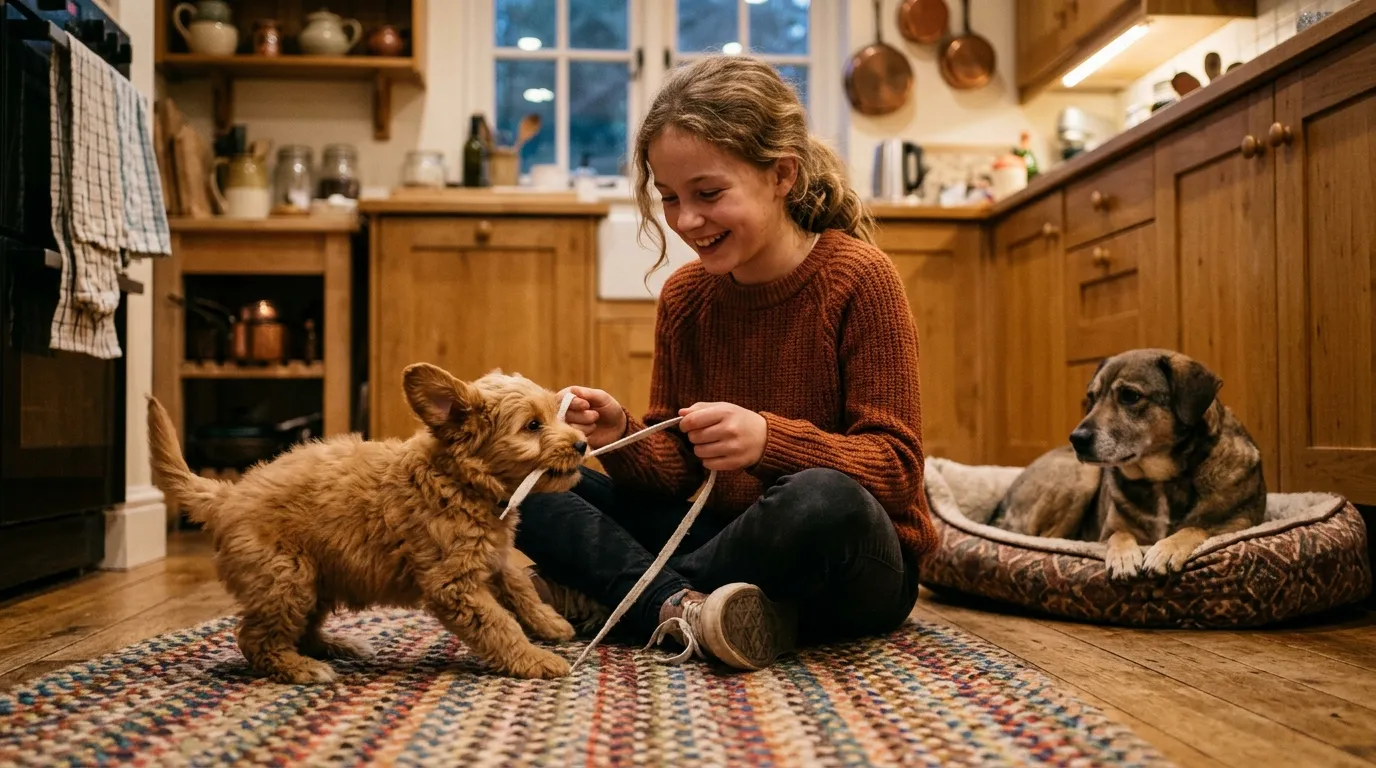
Seven sat beside his stolen treasures like he had accomplished something important.
A woman named Dana Mills had been helping me arrange the adoptions. She volunteered with a small local animal rescue. Dana was organized in a way I found both impressive and deeply exhausting. She carried a clipboard everywhere and asked questions I would never have thought to ask.
Where would the dog sleep? Was the yard fenced? What would happen if they moved? What if they had a baby?
At first, I liked Dana immediately. After what Maisie had survived, I wanted serious. Cute lasts until a puppy chews a shoe or there’s a medical bill. Responsibility has to last much longer.
So when Dana arranged an adoption for Seven with a woman named Renee—who owned a home, had a fenced yard, and was financially secure—I felt relieved. Renee was wonderful. She asked smart questions. She brought a beautiful little bed.
As she carried Seven toward the door, she rubbed Maisie’s head and whispered, “I’ll take care of him.”
My late husband used to say that. I’ll take care of it, Elaine. After he died, I had become the person who took care of everything. Small things were easier to carry alone.
But Seven came back the very next morning.
Renee was crying on my porch. She looked humiliated. “I can’t do it,” she whispered. “He cried all night. I haven’t slept well in years. I thought having a dog would help make the house feel less empty.”
She looked exhausted. Not one bad night exhausted. Years exhausted. Wanting something is not always the same as being ready for it. Renee had the house, the fence, and the money, but she simply wasn’t ready. She handed Dana the leash and left, heartbroken but honest.
Community is Not Charity
The next family to apply was a woman named Tessa and her twelve-year-old daughter, Nora. Tessa rented an apartment. She didn’t have a fenced yard. She worked two jobs to make ends meet.
But she came intensely prepared. She brought a folder with a letter from her landlord, her work schedule, and an emergency plan. When Nora got down on the floor, Seven instantly gravitated toward her. They were meant for each other.
But Dana hesitated. Tessa didn’t have a massive savings account. Dana was scared that a sudden veterinary bill could break them, or force them to return Seven.
“I’ve been poor before,” Tessa told us quietly, her pride shining through. “I’m not poor now. But I know what it feels like when people decide those are the same thing.”
After Tessa left, Silas and Dana argued fiercely. Silas saw a hard-working mother who had done everything right but was still being measured by her proximity to financial struggle. Dana had simply seen too many heartbroken families forced to return dogs when money ran out.
I sat at my table, looking at Dana’s strict application questions. If she had evaluated me the day Maisie appeared, what would she have seen? A 57-year-old widow living alone with no plan? I wouldn’t have passed the form. But I had room, time, and the willingness to rearrange my life.
I realized then that we had built too much of our lives around pretending uncertainty was a personal failure. We wanted certainty before we started. Certainty before we loved. Certainty before we trusted. But most of us were just making choices with incomplete information, hoping our character would be enough when circumstances inevitably changed.
I called Tessa.
“I’ll be backup,” I told her over the phone. “For Seven. If you get stuck at work, I can help. If you have a medical expense you can’t manage alone, you call me.”
Tessa hesitated. “I’m not asking you to pay for my dog. I don’t want to owe anyone.”
“Community is not the same as charity,” I said. The words surprised even me.
For years, I thought strength meant needing as little as possible from anyone. I thought the goal was to become so independent that losing someone would never hurt that much again. But the answer to losing one person was never going to be needing zero people. The answer was letting more people matter.
“If someone helps you with Seven someday, pay it forward later,” I told her.
Tessa agreed.
The Safest Silence in the World
Seven went home with Tessa and Nora. And life went on.
Things changed. My quiet house became “the unofficial dog station,” as Silas joked. People dropped off extra dog food. Dana convinced me to foster an older, sleepy dog named Walter. Silas started volunteering at a veterinary clinic, finding a path for his future.
My world is not small anymore.
It is inconvenient. It is noisy. It costs money. It interrupts my dinner and puts muddy footprints on floors I just cleaned. It asks things from me—sometimes more than I ever planned to give.
And I would not trade it for the safest silence in the world.

We were finally home.
I finally understand what Maisie understood before any of us.
You don’t wait until there is no risk before you love something. You don’t wait until you can guarantee the ending. You don’t decide who deserves connection based only on whether their life looks perfectly secure from the outside.
You prepare. You take responsibility. You make the best choice you can.
And when the water rises anyway, you simply hope somebody nearby is willing to step into the mud with you.
Note:This work is inspired by real events and people, but it has been fictionalized for creative purposes. Names, characters, and details have been changed to protect privacy and enhance the narrative. Any resemblance to actual persons, living or dead, or actual events is purely coincidental and not intended by the author.
All images used in this article are AI-generated and intended for illustrative purposes only.
0 Comments