
The $87,000 Secret That Rewrote My 37-Year Marriage
I am sixty-five years old. I divorced my husband five years ago, and on the exact day our marriage officially ended, he handed me a bank card with $3,000 loaded onto it. For half a decade, I never touched a single dollar of that money. But five years later, when failing health finally forced my hand to withdraw those funds, the bank manager walked toward me carrying a sealed envelope with my name on it. What I discovered inside made my entire body go numb—and rewrote the history of my entire adult life.
After thirty-seven years of marriage, Richard left me. He did it as easily as a man throwing away an old, worn-out winter coat.
The afternoon our divorce became a legal reality at a gray, bustling Chicago courthouse, he pressed a plastic bank card into my palm. His expression was unreadable.
“Take it,” he told me, his voice quiet. “That should keep you going for a little while.”
I refused to cry in front of him. Instead, I slipped the card deep into my handbag, lifted my chin, and watched him disappear down the long marble hallway without looking back even once.
Afterward, my life shrank. I rented a tiny, drafty room with water stains blooming across the ceiling and a window that rattled violently against the bitter winter winds. I cleaned other people’s kitchens to pay my rent. I watched cars outside a local pharmacy for pocket cash. I collected discarded bottles and flattened cardboard when there was absolutely nothing left in my cupboards except loose tea leaves and a shaker of salt. Some nights, the hunger kept me awake, a hollow ache in my stomach.
Still, I never touched Richard’s card.
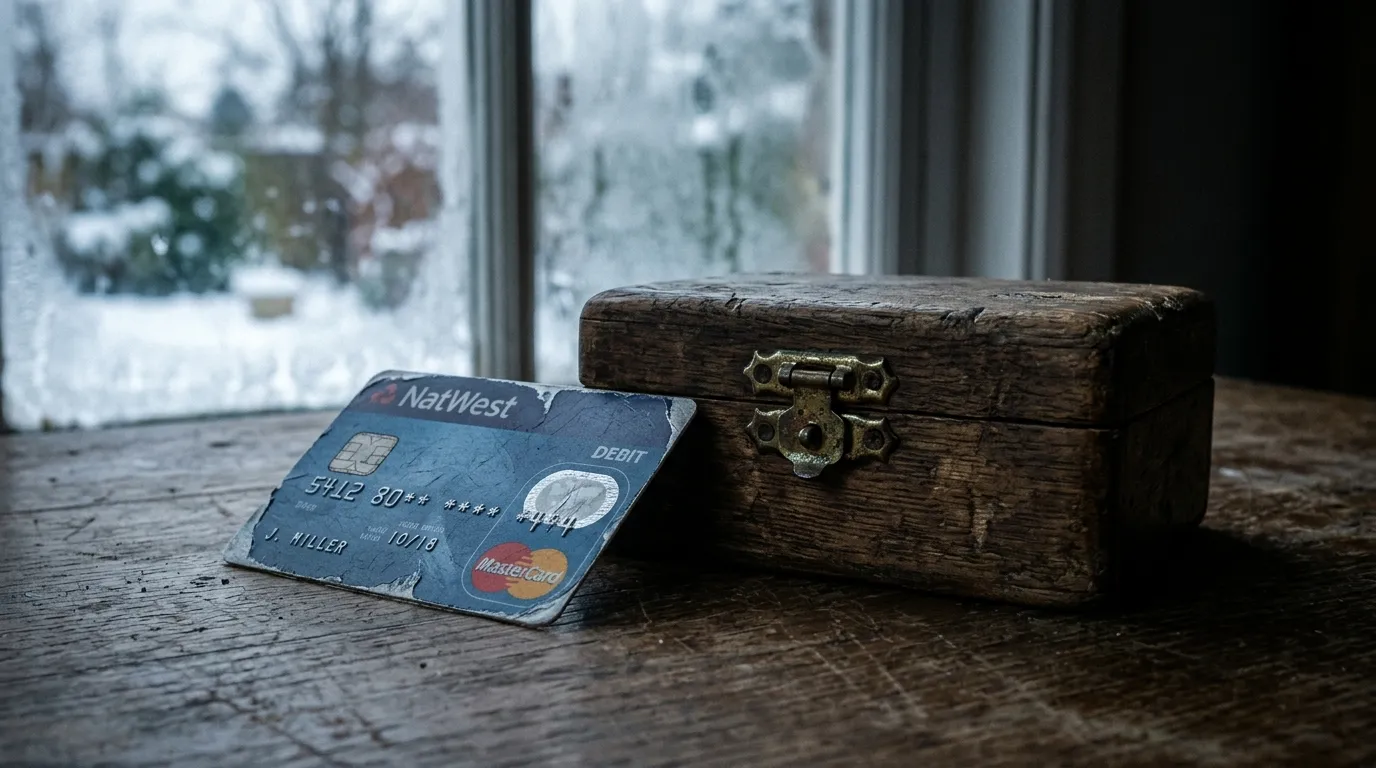
For five years, my pride and anger kept the card hidden in a small wooden box.
I left it untouched partly because of pride, but mostly because of a deep, burning anger. Those $3,000 felt like the pitiful price tag he had slapped onto thirty-seven years of my loyalty, my youth, and my love.
My two children, Anna and David, helped whenever they could, but they had their own heavy burdens: mortgages, growing children, soaring bills, and private struggles. Whenever they called to check in and asked how I was doing, I forced a bright smile into my voice.
“I’m managing just fine,” I would tell them.
Over the years, I became a master of that particular lie.
Then, a few days ago, my body finally gave out. I fainted on the concrete outside my apartment building. At the local clinic, the doctor studied my lab results with a grim expression. “Elaine, you can’t keep delaying this treatment. If we wait any longer, this could become much more serious, even fatal.”
That night, I sat on my narrow bed and opened the small wooden box where Richard’s card had remained hidden beneath my winter scarves for five long years. Maybe $3,000 could cover the hospital deposit, I reasoned with myself. Maybe it could buy me medication. Maybe it could buy me time.
The next morning, I walked through the heavy glass doors of the bank. I placed the scratched plastic card onto the polished counter. “I’d like to withdraw everything, please.”
The teller, a kind-faced woman whose nametag read Patricia, typed something into her keyboard. She stopped. She frowned slightly, then typed again. Her expression shifted from polite customer service to genuine confusion.
“Ma’am… there isn’t $3,000 in this account.”
My stomach dropped to my worn-out shoes. Had the bank seized it? Had Richard taken it back? “Then how much is there?” I asked, bracing myself.
She didn’t answer right away. Instead, she picked up her desk phone and murmured a few words. A minute later, the branch manager appeared, wearing a crisp navy suit. She was carrying a sealed envelope.
My full name was written across the front. ELAINE MERCER. It was Richard’s handwriting, unmistakable with the exaggerated loop in the ‘E’ that looked like a ribbon. The manager placed it carefully into my trembling hands.
And that is when the terrifying truth began to dawn on me. Richard hadn’t simply left me a meager $3,000 five years earlier. Whatever he had actually done had been sitting quietly inside this bank vault the entire time, just waiting for the exact day I finally swallowed my pride and used the card.
I sat down in one of the plush chairs. “What is in the account?”
Patricia glanced back at her computer screen. “As of this morning, including all accrued interest, the balance is eighty-seven thousand, four hundred and nineteen dollars and twenty-six cents.”
I thought my ears were failing me. “I beg your pardon?”
“Eighty-seven thousand, four hundred nineteen dollars.”
My hands went ice cold. “No. That can’t be right. Richard put three thousand dollars on that card five years ago.”
“He did,” Patricia nodded.
“Then what happened?” I whispered, my vision swimming.
“Mr. Mercer opened the account with three thousand dollars. After that, he arranged an automatic monthly deposit. At first, one thousand dollars a month. Later, he significantly increased it.”
I stared at her, completely paralyzed. While I had been desperately counting pennies at the laundromat, Richard had been quietly feeding thousands of dollars into an account I stubbornly refused to touch. While I ate saltines and drank watered-down tea for dinner, enough money to change my entire life was sitting right beneath my pride.
“Why didn’t anyone tell me?” I gripped the handle of my purse until my knuckles turned white.
“The account was yours to access at any time,” Patricia explained gently. “Mr. Mercer instructed us not to contact you unless there was an administrative problem. He was incredibly specific that you were not to be pressured into using it.”
“That sounds exactly like Richard,” I muttered, the familiar bitterness rising in my throat. “Deciding what everyone else needs without ever actually asking them.”
Patricia moved the envelope closer to me. “There is something else you should know before you open this. Mr. Mercer came to this branch once a year… to update his instructions concerning this envelope. The last time he was here was three months ago.”
Three months. Richard and I had not spoken a proper word to each other in nearly four years. I slid my shaking finger beneath the flap of the envelope. Inside were three sheets of paper.

The envelope had been waiting for me, updated yearly by a man I thought had forgotten me.
The first page was dated three months earlier.
Elaine,
If you’re reading this, then you finally used the card. That means one of two things. Either you forgave me enough to accept something from me, or life gave you no choice. Knowing you, I suspect the second.
Despite my shock, I almost let out a dry laugh. He still knew me too well.
The three thousand dollars was never meant to be the total, the letter continued. I knew you wouldn’t accept monthly support from me. You made that clear during the divorce. You said you wanted nothing that would make you feel purchased, pitied, or indebted. I should have listened to what was underneath those words. Instead, I listened only to your anger.
Richard went on to explain that after he sold his remaining interest in Mercer Tool & Supply—the business his father started, the business I had spent decades doing unpaid bookkeeping for, answering calls, and hosting suppliers—he funneled a portion of the profits directly into this account.
The lawyer told me I did not owe you this money, he wrote. But he was answering the wrong question. I wasn’t asking what I owed legally. I was asking what I owed honestly. This account is not an apology. Money is a poor apology. It is simply yours. Use it. Please. Stop pretending you have to carry everything alone.
The second page was a long, detailed ledger of deposits. One thousand. One thousand. Then two thousand. A five-thousand-dollar deposit on what would have been our fortieth wedding anniversary. A three-thousand-dollar deposit on my birthday two years ago. He had remembered.
The third page was agonizingly brief.
There is another envelope. It is with Martin Hale. If you want it, he’ll give it to you. If you don’t, he has instructions to destroy it unopened. There is something about the last year of our marriage I should have told you five years ago. I lacked the courage then. I hope I have more now. — Richard.
Martin Hale was Richard’s attorney, a man who used to be a close friend to both of us before the ugly lines of divorce were drawn. Leaving the bank that afternoon, eighty-seven thousand dollars felt incredibly heavy, yet infinitely less real than the twelve dollars I knew was left in my checking account.
I went home to my tiny apartment. For the first time, my cramped room didn’t feel like a punishment inflicted upon me by my ex-husband. It felt like undeniable proof of my own resilience. I had survived. Badly at times, stubbornly almost always, but I had survived.
I called the clinic to schedule my life-saving treatment. When the receptionist asked about the hefty deposit, my voice shook as I replied, “I can pay it.” I cried after hanging up. Not just for Richard, but because for five years, every single decision in my life had been dictated by what I could not afford.
The next afternoon, I found myself sitting in Martin Hale’s office. His hair was completely white now. We exchanged polite pleasantries before he reached into his desk drawer and produced a thick, cream-colored envelope.
“There is one thing I need to tell you before you decide whether to take this, Elaine,” Martin said softly. “Richard wrote several versions of this letter over the years. The first blamed himself. The second blamed circumstances. This version… this is the one he wrote after nearly two years of intensive counseling.”
Richard? In counseling? The man who once claimed talking about feelings was a waste of breath?
“Did he leave me because of another woman?” I asked, my voice barely a whisper.
“No,” Martin replied without hesitation.
I took the envelope home and waited until the city went quiet outside my window before I opened it. Inside were nine handwritten pages. The very first sentence made my heart stop.
Elaine, the worst mistake I made was not leaving. It was believing I knew what you wanted without ever having the courage to ask you.
And beneath that sentence, Richard mentioned an object I had completely forgotten about: A dark blue notebook.
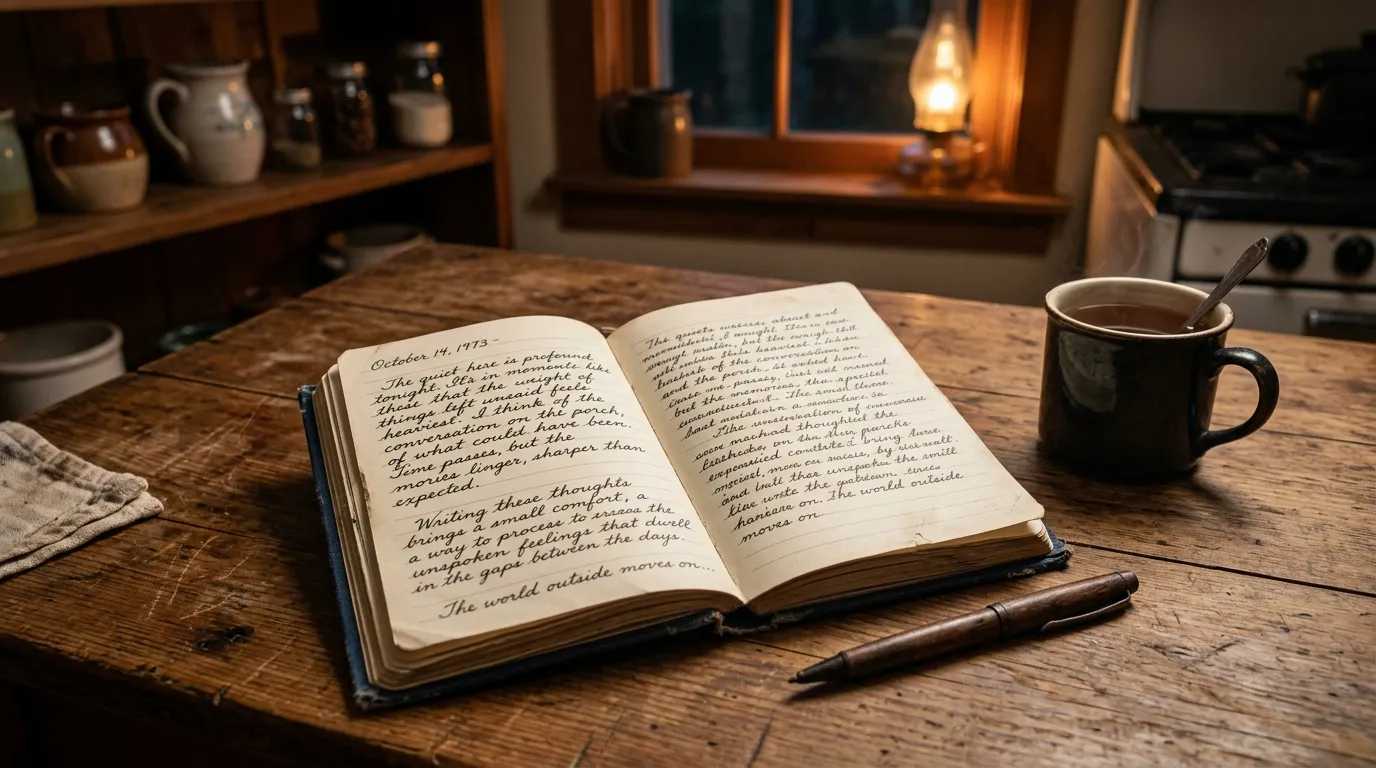
The small blue notebook that accidentally triggered the end of our marriage.
Anna, our daughter, had given it to me for Christmas during our last year together. I had used it on sleepless nights to jot down my exhaustions. I wrote about being tired of the endless routine. I wrote about wanting a room of my own—a quiet room with no television, no ringing phones, no laundry. I wrote that I wondered what it would feel like to wake up and have nobody know where I was.
According to the letter, Richard had found the notebook behind a filing cabinet. He had read those pages. During a time when his brother had just passed away and his business was struggling, he interpreted my exhaustion as a devastating verdict on our marriage.
I decided you wanted a different life without me, Richard wrote. Instead of asking if we could change together, I thought I was sparing you the humiliation of asking for a divorce.
He had spent the final year of our marriage quietly pulling away, convinced he was doing the noble thing by leaving a woman who wanted to be free of him. And I, feeling him pull away, grew proud and silent in return. Two people, waiting for the other to reach out, slowly turning to stone.
But the true tragedy was revealed on the next page of his letter. Two years after our divorce, Anna had been helping me move and found the notebook. She showed it to Richard and asked him a simple question: “Dad, did you read the next page?”
He hadn’t. The pages had stuck together.
Richard copied my words from that unseen page into his letter: I don’t want to leave Richard. I want to find a way to stop disappearing inside the life we built. Maybe those are different things. Maybe I should talk to him.
He had destroyed our marriage over an assumption. And when he found out the truth two years later, he felt he had forfeited the right to walk back into my life and disrupt the peace he assumed I had found. That profound, crushing guilt was the genesis of the $87,000 bank account.
I stayed awake until 2:00 AM. A few days later, my treatments began. Once my mind cleared from the immediate panic of my health crisis, I knew what I had to do. I had Martin Hale tell Richard to call me.
When we finally met at a neutral coffee shop by the lake, we were two entirely different people. We were older, grayed, battered by our own stubbornness, but finally willing to lay down our armor.
“When you discovered you had been wrong,” I asked him across the small table, “why didn’t you come back?”
Richard looked at his hands, then reached into his coat pocket. He placed a shiny brass key on the table between our coffee cups.
“Because I realized I had been present for every word you said for decades, without listening to any of it,” he replied softly. “This key belongs to a small studio on Sheridan Road. One room and a bathroom. Second floor. Big window facing east. I fixed it up after my counseling. A desk, a chair near the window. Nothing personal.”
I stared at him in utter disbelief. “You built me the room from the notebook?”
“I finally understand that the room was never the thing you needed most,” he said, his eyes locking onto mine with a vulnerability I hadn’t seen in him since our twenties. “What you needed was for someone to ask what you wanted. So, Elaine… I’m asking.”
We drove to the building. I put the key in the lock and pushed the gray door open. It was exactly as I had dreamt it all those years ago. Sunlight poured across the wooden floor. A deep chair waited by the window.
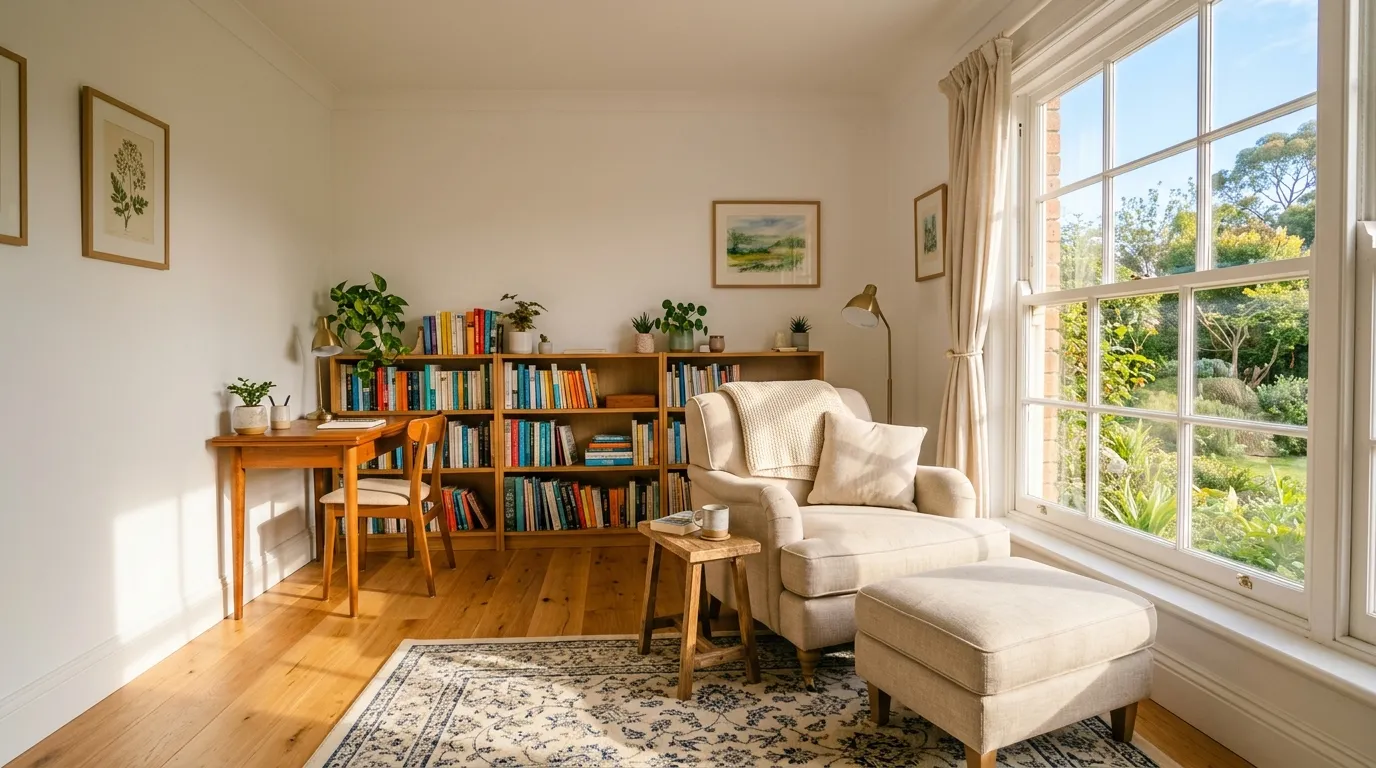
The room I had written about decades ago, waiting for me in the morning light.
“Do you want forgiveness?” I asked him, the silence of the room wrapping around us.
“I want you to have peace,” he answered.
I took the room, but on my own terms. I used the bank account to pay him for half of its market value. I moved out of my drafty apartment into a comfortable one-bedroom place, keeping the studio purely as my sanctuary. I bought canvases and took the painting classes I had delayed for thirty years. I was spectacularly terrible at it, but my family hung the paintings anyway.
Over the next year, Richard and I forged something entirely new. We didn’t remarry. We didn’t move in together. We simply learned how to communicate. If I was quiet, he asked why. If he withdrew, I demanded to know where his mind had gone. It was astonishing how difficult such simple behavior was, and yet how profoundly it healed us.
By autumn, my medical treatments proved highly successful. Richard and I took a train trip up the coast of Maine—a trip I had wanted to take since I was thirty. We booked separate rooms, walked the rocky beaches, and sat on benches watching the gulls.
When he reached out and gently held my hand on a chilly October afternoon, it wasn’t the fiery romance of our youth. It was a relationship chosen deliberately by two people who finally understood that love cannot survive on history alone; it requires brutal, beautiful honesty.
Five years ago, I believed Richard had placed a $3,000 price tag on my life. But standing in my sunlit studio today, I realize that neither money, nor a bitter divorce, nor an illness can dictate my worth. My life is finally my own to choose—and for the first time in a very long time, I am choosing joy.
Note:This work is inspired by real events and people, but it has been fictionalized for creative purposes. Names, characters, and details have been changed to protect privacy and enhance the narrative. Any resemblance to actual persons, living or dead, or actual events is purely coincidental and not intended by the author.
All images used in this article are AI-generated and intended for illustrative purposes only.
0 Comments