
The Ultimate Power Play: Why I Handed Over the Keys to My Own Beach House
I set the whole heavy key ring into Jessica’s waiting, outstretched palm.
For a woman who had spent the last several minutes boldly telling me I did not belong in my own beach house, she looked remarkably certain that this was the moment she had won. Her eyes gleamed with the quiet triumph of someone who believes they have just successfully bullied their way into power.
She had asked for the keys. And, without raising my voice or putting up a fight, I had given them to her.
What my daughter-in-law could not see, however, was that I was no longer thinking about where I would sleep that night. I was not worried about the logistics of my weekend. Instead, I was marveling at how quickly a person can reveal what they truly believe about you when they become convinced you are too old, too polite, or too desperately dependent on “family harmony” to challenge them.
And in just a few short minutes, Jessica had revealed plenty.

The coastal drive had always been my transition from the noise of the world to the peace of my sanctuary.
Only a short time earlier, I had been driving down the winding coastal road toward Malibu, the salty ocean breeze filtering through my cracked window. I was expecting nothing more dramatic than a quiet, restorative holiday weekend. The sun was sparkling on the Pacific, and my mind was entirely at ease.
At seventy years old, I had learned to deeply value quiet in a way I never quite understood when I was younger.
There was a time, decades ago, when a “free weekend” just meant catching up on a never-ending list of chores. It meant sewing late into the evening under a dim lamp, or finding one more creative way to stretch a meager paycheck to feed my family. After my beloved husband passed away, rest became a luxury I perpetually postponed. There was always another medical bill, another lingering responsibility, another practical emergency that had to take priority over my own grief.
I had worked as a professional seamstress for years. It was not glamorous work. It was certainly not easy work.
My life was built on hours spent hunched over yards of heavy fabric, measuring twice because a single mistake cost money we didn’t have. It was a life of guiding thick seams beneath a vibrating needle while the muscles in my shoulders burned and ached. But through that literal blood, sweat, and needle-pricked fingers, I learned exactly how many small, daily sacrifices could eventually add up to become something solid and immovable.
The Malibu beach house was one of those solid things.
I had not inherited this beautiful piece of real estate. Nobody had generously handed the deed to me because they felt sorry for a grieving widow. This sanctuary came from years of saving meticulously, clipping coupons, and deciding, over and over again, that the security of my future mattered far more than whatever fleeting comfort I wanted that week.
That was exactly why this house meant so much more to me than its expensive walls or its breathtaking ocean view. Every single room was steeped in memory and personal triumph.
The sunlit kitchen reminded me of early mornings when I drank black coffee alone and finally realized that solitude could feel peaceful instead of terrifying. The wooden terrace was where I had sat through long, chilly evenings when the grief of losing my husband was still fresh enough to make every empty chair feel louder than a crowded room. The garden in the back became a sacred space I tended slowly, planting one bulb at a time, because some harsh seasons of life require you to physically prove to yourself that you can still nurture something and make it grow.
I had been coming to this very house for holiday weekends for twenty uninterrupted years.
I knew every curve of the same coastal road. I took the same familiar turn. I always felt the exact same wave of relief when the air changed, growing cooler and saltier, and the vast coastline opened up ahead of my windshield.
That Friday morning should have been absolutely no different.
Then, I finally reached my driveway.

My carefully tended garden had been transformed into a chaotic playground for strangers.
The very first thing my eyes locked onto was the sheer number of cars. They were massive SUVs and sleek sedans, and none of them were mine. They did not belong to the quiet neighbors I recognized and exchanged holiday cards with. They were parked haphazardly all over the property with the casual, arrogant confidence of people who fully expected to stay awhile.
Then, the bass hit me. Heavy, thumping music carried toward the street, drowning out the sound of the crashing waves.
This was not a radio playing softly through an open kitchen window. This was loud, reverberating, weekend-party music.
I sat frozen behind the wheel for a long moment, both hands gripping the leather tightly, trying desperately to make sense of what I was seeing.
My first thought was almost absurdly simple: I have the wrong house.
At seventy years old, after driving this exact same route hundreds of times over two decades, I genuinely wondered whether I had suffered a lapse in memory and somehow turned into the wrong driveway.
But then I looked past the cars and saw my garden.
There was no mistake. This was my home.
The pristine, green lawn I personally paid to keep trimmed was heavily scattered with empty, crushed beer cans. Strange children ran wildly across my wooden terrace, aggressively chasing a heavy ball dangerously close to the delicate red geraniums I had lovingly cared for year after year. Sopping wet, sandy towels completely covered the expensive wicker chairs I had proudly purchased just the previous summer. Dirty clothes and discarded shoes were draped wherever someone had casually decided to drop them.
My quiet, sacred place looked exactly like a cheap spring break vacation rental after a careless group of college students had taken possession for the weekend.
Except it was not a rental. It was mine.
I turned off the ignition and stepped out of the car slowly, my joints stiff with sudden tension.
The keys were already clutched firmly in my hand. That specific detail stays with me so vividly because keys are such ordinary, forgettable things. We carry them every day without a second thought. We drop them blindly into the bottom of deep purses, abandon them on kitchen counters, and frantically search for them when we are running late.
But standing alone in that chaotic driveway, the weight of those keys felt profoundly different. They were undeniable proof of my routine. They were proof of my access. They were the ultimate proof that for two whole decades, I had never once needed to ask for anyone’s permission to walk through that front door.
Taking a deep breath to steady my racing heart, I started walking up the path toward the house.
Then, Jessica appeared.
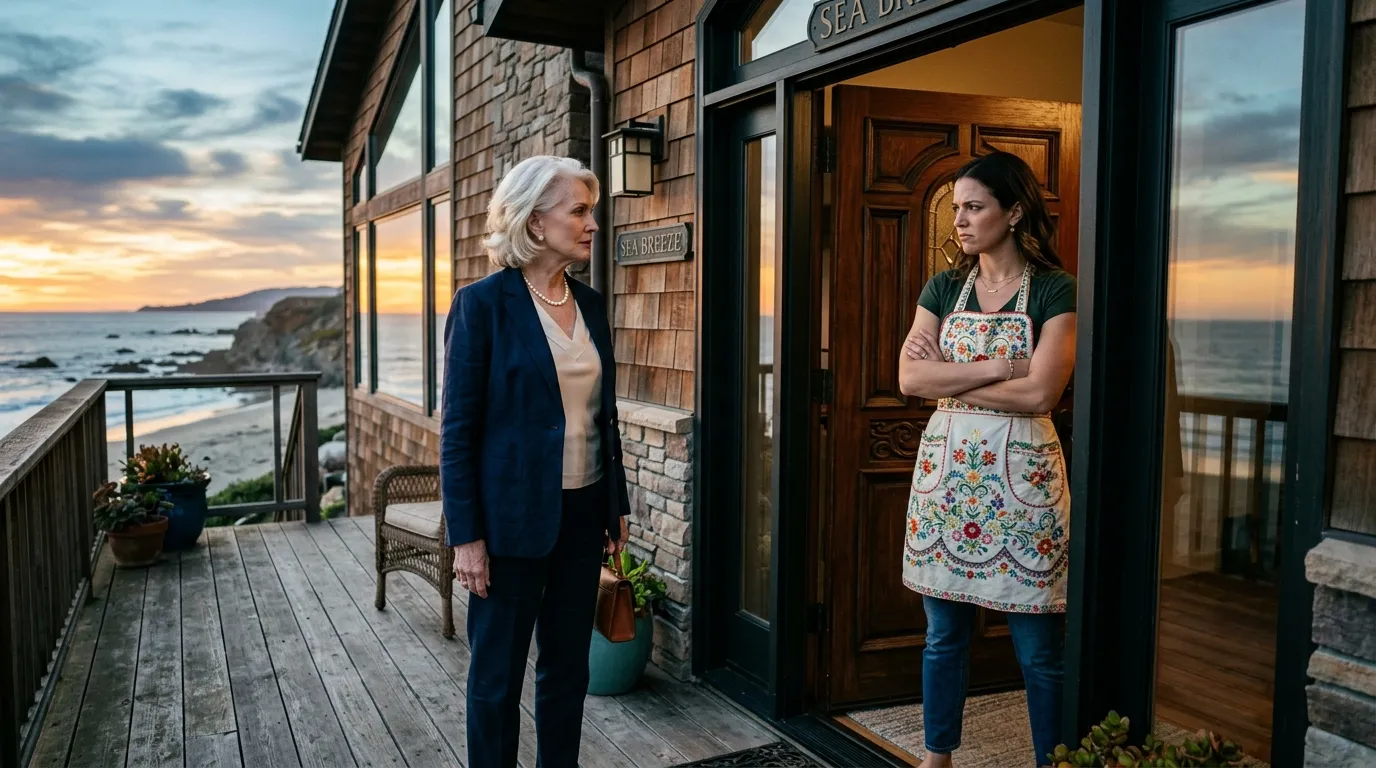
She stood in the doorway of my home, wearing the apron I had spent weeks stitching with my own hands.
My daughter-in-law stepped out and stood squarely in the main doorway, posing grandly as though she were the gracious host of the weekend herself.
Before I could even register the smug, annoyed look on her face, my eyes darted to what she was wearing over her designer clothes.
It was my apron.
And it wasn’t just some generic, store-bought kitchen apron pulled from a random drawer. It was my absolute favorite one. I had painstakingly hand-embroidered the intricate floral pattern onto the fabric myself about ten years earlier. I had taken the kind of intense, meticulous care with the stitching that only comes naturally when you have spent a lifetime working intimately with fabric.
Seeing that deeply personal item tied around her waist did something strange and visceral to me.
The discarded beer cans on the lawn were highly irritating. The wet towels ruining my wicker chairs were blatantly disrespectful. The crowds of strangers moving freely through my carefully curated rooms were alarming.
But the apron? The apron made it deeply, uncomfortably personal.
It was such a small, utilitarian object, yet it screamed volumes. It told me that Jessica had not simply arrived at the house and haphazardly used what was convenient on the counters. She had boldly settled into my private, intimate space deeply enough to open my closed drawers, rummage through my cupboards, and actively choose something that belonged specifically and exclusively to me.
I stopped at the bottom of the steps and said her name.
I forced my chest to slow down and kept my voice perfectly level.
I simply told her I had not known she was there. Then, I reminded her of a fact that should never, under any circumstances, have required reminding.
“This is my house,” I said clearly over the thumping bass of the stereo. “I come here every single holiday weekend. I have for twenty years.”
Jessica looked at me. And then, she laughed.
There are many different kinds of laughter in this world. Some people laugh awkwardly when they are embarrassed and caught off guard. Some laugh sharply because rising tension makes them nervous. Some laugh warmly because they genuinely think you are making a joke.
Jessica’s laugh was none of those things. It was cold, sharp, and dismissive.
She laughed loudly as though my purely factual statement was the most ridiculous thing she had heard all week.
She laughed as though the mere idea that a seventy-year-old widow might still expect to hold authority over a multi-million-dollar property she had purchased with her own blood and sweat was somehow wildly unreasonable.
Then, the sheer contempt flowed out of her.
She raised her voice to be heard by the people lounging on the terrace behind her. “What is this unwanted guest doing here?” she shouted, waving a dismissive hand in my direction. “There’s no room for you.”
The words hit me like a physical blow. They were almost harder to comprehend than the physical mess surrounding me.
Unwanted guest.
I remember blinking, trying to look past her shoulder into the depths of the house. Her extended relatives were absolutely everywhere. Giant duffel bags had been dragged inside and dumped on my Persian rugs. Sand-covered clothes had been tossed casually onto my antique furniture. Sweating, ice-filled drinks sat on my unprotected wooden side tables without coasters. Dozens of people moved comfortably and loudly through rooms that had, for twenty years, been intensely private and sacred to me.
Nobody looked up with guilt. Nobody appeared to be hastily packing their bags to leave. Nobody looked remotely surprised or embarrassed that Jessica was aggressively blocking the legal owner of the home at the front entrance.
The entire, bizarre situation had somehow been completely mentally rearranged by these people so that I—the woman who paid the mortgage, the property taxes, and the landscaping bills—was the annoying inconvenience.
I had spent decades of my life carefully building the exact life represented by that beautiful house, yet here Jessica was, standing in its doorway, brazenly telling me there was no room for me.
At another, younger point in my life, I might have immediately started explaining myself.
I might have desperately listed exactly what I had paid for the home, how long I had proudly owned the property, how often I retreated there, and how carefully I maintained every inch of it.
Society conditions us to do this. Older women, in particular, are so often expected to frantically explain and justify themselves when simply saying “no” should be a complete sentence.
We are constantly expected to preserve the peace at all costs. We are expected to swallow our pride and intuitively understand that our younger relatives are stressed, busy, excited, overwhelmed, or simply just “trying to enjoy themselves.” We are expected to act as emotional sponges, absorbing all the awkwardness and disrespect so that everyone else in the family can remain perfectly comfortable.
But standing on those wooden steps, listening to the thumping music, I realized something important: I had done enough absorbing in my life.
So, I did not give Jessica a frantic, defensive speech.
I looked down at the heavy ring of keys in my hand. Then, I looked back up directly into her eyes.
And I walked forward.
Jessica did not scramble to move aside with the embarrassed, hushed apology of someone who had suddenly remembered whose home she was illegally occupying. She remained firmly planted in the doorframe, her shoulders squared, as though the doorway itself had magically become a territorial line that she alone controlled.
I crossed it anyway. I brushed my shoulder past my stunned daughter-in-law and confidently stepped inside my own house.
The inside looked significantly worse than the messy terrace had suggested.
Soaking wet beach towels had been draped over my velvet armchair—furniture that was never, ever treated that way. Sticky plastic cups crowded my delicate glass coffee tables. My framed photos and decorative bowls had been unceremoniously shoved aside to make space for heavy, scuffed luggage. The serene, ordinary order of my beloved house had been violently replaced by the temporary, arrogant chaos of people who firmly believed somebody else would eventually clean up after them.
It bothered me deeply. It made my stomach churn.
But the physical mess was not the real, underlying problem.
A towel can easily be washed. A velvet chair can eventually dry. A lawn full of beer cans can be raked and cleaned.
What cannot be treated so casually, what cannot simply be washed away, is the exact moment someone actively decides that your ownership, your rich history, and your basic human dignity are entirely negotiable simply because they assume you are too weak to resist them.
Jessica spun around immediately after I crossed the threshold into the foyer.
“Where do you think you’re going?” she demanded, her voice sharp and echoing off the high ceiling.
The sheer audacity of the question almost answered itself.
I took my time. I slowly looked around the expansive living room before responding. I looked at my meticulously designed kitchen. I looked at my carefully chosen furniture. I looked at my personal belongings pushed carelessly aside into corners. I looked at her loud family occupying my sacred space as though their desire for a free beach vacation had somehow become vastly more legitimate than my legal presence.
“I’m going inside my house,” I stated simply.
Jessica sneered and tightly folded her arms across the embroidered flowers of my apron.
“We already told you. There isn’t room.”
That one specific sentence changed something profound inside of me.
It wasn’t just because her voice was louder than before. It was infinitely worse because of how entirely normal and justified she seemed to think her stance was. She was no longer just arguing over a silly miscommunication. She was not offering a fake apology, claiming she thought I would be somewhere else that weekend. She was not expressing regret for failing to pick up the phone and call me to ask permission.
She was telling me, directly and aggressively, that a house I legally owned had been packed to the brim with her extended relatives, and therefore, I was fully expected to turn around, get back in my car, and disappear into the ether.
In Jessica’s warped mind, vague “family permission” had somehow completely overridden and replaced actual, legal ownership.
And worse, she genuinely expected me to bow my head and accept that replacement.
My eyes drifted down to the apron again. The familiar, colorful stitching across the fabric—fabric I had lovingly worked on with my own tired hands under a desk lamp—looked almost completely surreal set against the chaotic, loud scene unfolding around us.
For so many years, that apron had symbolized such beautiful, ordinary things to me. Cooking warm meals. Cleaning up my own kitchen in peace. Enjoying quiet, solitary Sunday mornings watching the waves.
Now, Jessica wore it like stolen armor while actively ordering me out of the very home where it belonged.
I realized I did not need to raise my voice to match hers.
Anger can be a highly useful tool, but only when you carefully decide exactly what it is for. My anger was no longer interested in winning a petty shouting match in a crowded foyer.
I wanted to understand exactly how far Jessica truly believed this delusion of new authority extended. I wanted to see her play her entire hand.
She was more than happy to help me find out.
She took an aggressive step closer to me, invading my personal space. Then, with a look of supreme, condescending authority, she held out her open hand.
“Give me those,” she commanded.
She was staring pointedly at the keys in my hand.
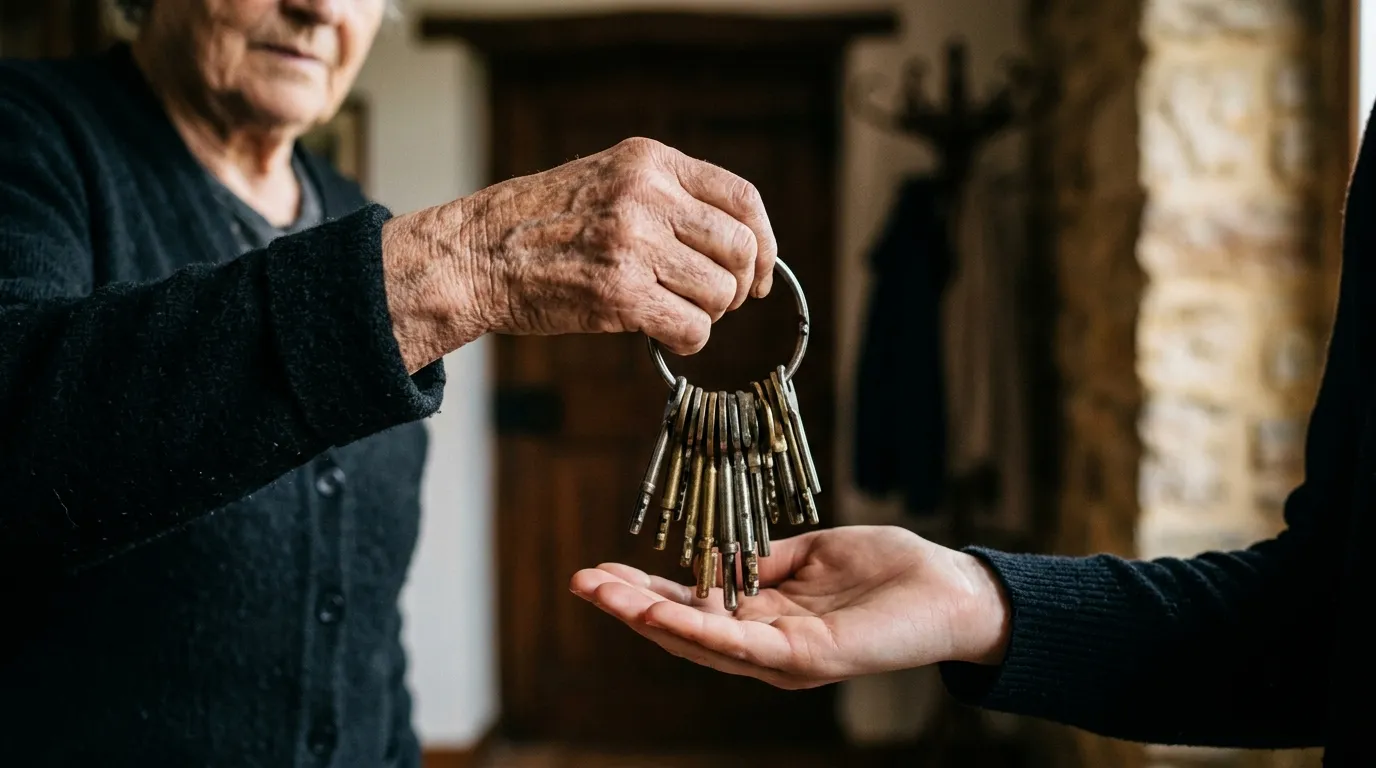
I didn’t argue. I just let the heavy ring of keys fall right into her waiting palm.
For a long, suspended moment, I simply stood there and stared at her open palm.
There are certain physical gestures in life that tell you vastly more than paragraphs of verbal explanation ever could.
Jessica did not politely ask whether I was tired from the long, winding drive. She did not ask why I had not called first, completely ignoring the fact that I had never, ever needed to call before visiting my own paid-for property. She did not nervously try to suggest rearranging the sleeping spaces to accommodate me. She did not offer a single word of apology for the crushed beer cans, the ruined chairs, the massive piles of luggage, or the dozens of strange family members spread like a virus throughout my home.
She simply asked for the keys.
That was the exact moment the entire, messy situation became crystal clear to me.
This aggressive argument was not really about a lack of physical room.
If it had just been about room, a reasonable person could have easily moved a duffel bag off a sofa. Someone could have graciously given up the master bedroom for the owner. Someone could have panicked and said, “Oh my goodness, we had no idea you were coming! Please, come sit down, we’ll figure this all out right now.”
No. This was never about beds or space.
This was about raw control.
Jessica desperately wanted the ultimate symbol of access resting firmly in her own hand. And she was arrogant enough, and confident enough in my presumed weakness, to request it directly from me.
In that suspended moment, I thought back to the frightened, grieving woman I had been right after my husband died.
That younger version of me had been terrified more often than she ever admitted out loud. She had lain awake at night, staring at the ceiling, crying and wondering whether one single seamstress’s income could possibly carry the heavy financial burdens that two people had once shared. She had painfully learned to calculate expenses down to the penny before daring to buy groceries. She had stayed up until 3:00 AM finishing hems and dresses because wealthy clients expected their clothing ready on time, completely regardless of whether she was bone-tired or drowning in grief.
But that frightened woman saved her money anyway.
She kept threading the needle anyway.
She built a beautiful, secure life anyway.
This Malibu house was the ultimate prize she had left for the older, wiser version of herself. It was meant to be the one place on earth where I would never, ever need to ask for permission to sit down and rest.
Standing there at seventy years old, staring at Jessica’s greedy hand, I realized that was exactly what she was trying to force me to do.
Ask for permission.
Not formally. Not with polite words. But in every practical, psychological sense, that was exactly what her aggressive behavior demanded.
She wanted me to bow my head and accept that her social plans mattered vastly more than my legal and moral rights, simply because standing up to her and causing a scene would be “unpleasant.” She wanted my advanced age to make me easier to bulldoze and displace. She wanted the heavy, unspoken pressure of “family harmony” to do what no deadbolt or locked door could ever do: convince me to remove myself voluntarily and hand over my kingdom.
I slowly dragged my eyes away from her face and stared down at the heavy key ring resting in my own palm.
The cool, jagged metal was so deeply familiar against my calloused fingers. I had physically used those keys so many thousands of times that the subtle wrist motion of unlocking the heavy oak front door had become automatic muscle memory years earlier.
For two decades, those keys had carried one single, uncomplicated meaning for me: Access.
With them, I could arrive whenever I wanted. I could enter my sanctuary. I could stay for as long as I needed to heal.
Jessica, in her profound arrogance, seemed to truly believe that if she physically possessed the keys, their meaning would magically change and she would become the master of the house.
Maybe that was exactly why a small, genuine smile finally crept onto my face.
I didn’t smile because anything about this chaotic, disrespectful situation was funny. I certainly didn’t smile because I naturally enjoyed confrontation. And I absolutely had not forgotten or forgiven the blatant insults that had greeted me in the driveway.
I smiled because Jessica had made a fatal miscalculation. She had fatally mistaken my refusal to scream and curse for weakness.
She had looked at a quiet, seventy-year-old woman standing in a crowded doorway and apparently decided that the absolute easiest solution was to just push hard enough until I folded and disappeared.
But I had spent way too much of my hard life working for exactly what I had to let a spoiled child’s contempt rewrite my reality.
There is a massive, fundamental difference between gracefully keeping the peace and weakly surrendering your rightful place in your own life.
I finally understood which one Jessica was aggressively demanding from me.
All around us, her loud, oblivious family continued occupying my house. Their massive bags were still piled inside my hallway. Their sweating cups were still leaving water rings on my antique tables. The thumping bass of the music had not erased the stark fact that I had driven for hours expecting the same quiet, restorative holiday weekend I had rightfully enjoyed for twenty years.
Nothing about the physical scene in front of me had improved.
And yet, standing there, I felt calmer and more grounded than I had when I first pulled up and saw those unfamiliar cars in my driveway.
Confusion is an exhausting emotion because your brain keeps frantically searching for a logical, innocent explanation. But once Jessica boldly held out her hand for my property, I no longer needed to search for an explanation.
She had made her hostile position perfectly, undeniably plain.
So, I made a choice. A choice that probably looked, to her smug eyes, exactly like a total, crushing surrender.
I slowly raised my hand, lifting the keys.
For one brief, breathless moment, the metal ring hung suspended in the air between us.
The house behind Jessica was packed with rude strangers she had welcomed without a second thought. My beautiful, hand-embroidered apron was tied tightly around her waist, a trophy of her invasion. The precious belongings I had carefully curated and arranged over years of hard work had been shoved aside for a loud weekend party I had not even been told about.
And her hand remained wide open. Waiting to take the final prize.
I did not argue with her. I did not pull the keys back and clutch them protectively against my chest like a frightened victim.
I did not launch into the fiery, dramatic speech she was likely bracing for from an angry, disrespected mother-in-law.
I simply opened my fingers and let the heavy ring fall into her palm with a satisfying, metallic clink.
Jessica immediately closed her fingers tightly around the metal, grasping onto something she foolishly seemed to believe represented total control and victory.
I looked at the keys once more after they left my hand, safely hidden inside her clenched fist.
For twenty years, they had been the simple object that let me into my home.
Now, as I turned around with a quiet, knowing calm, they meant something else entirely. They showed me exactly what Jessica thought she had taken, and they freed me to do exactly what needed to be done next.
Note:This work is inspired by real events and people, but it has been fictionalized for creative purposes. Names, characters, and details have been changed to protect privacy and enhance the narrative. Any resemblance to actual persons, living or dead, or actual events is purely coincidental and not intended by the author.
All images used in this article are AI-generated and intended for illustrative purposes only.
0 Comments