
My husband mocked me for buying our six-year-old son a two-dollar pink stroller at a neighborhood yard sale.
At first, I thought he was just embarrassed. Greg was the kind of man who obsessed over how our family appeared to neighbors, colleagues, and casual acquaintances. To him, an eight-year-old boy or a six-year-old boy pushing a pastel toy was a personal insult to his sense of masculinity.
I had no idea that the weathered little stroller, with its faded floral fabric and scuffed plastic wheels, would pull the thread that unraveled our entire marriage. And I certainly never imagined that our sweet, observant son would be the one to hand me the scissors.
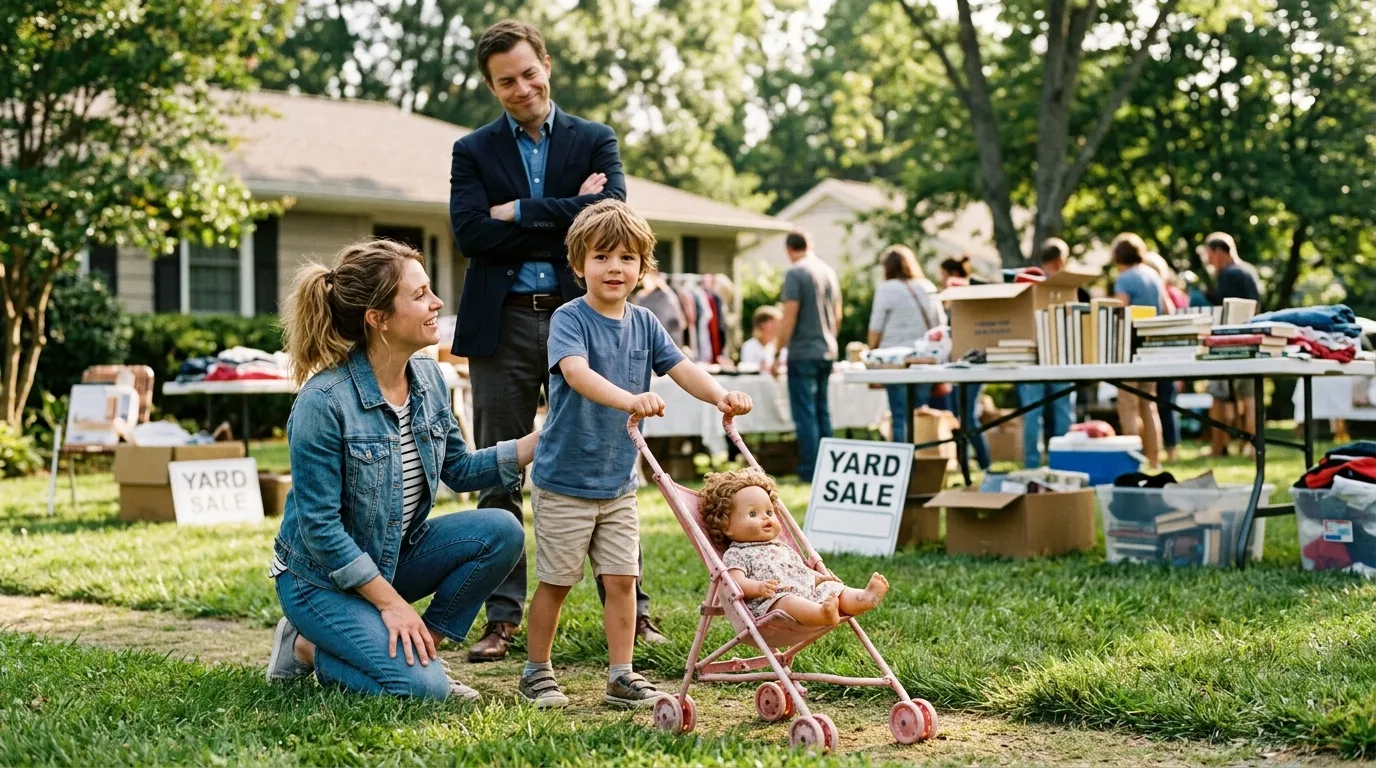
Leo immediately fell in love with the weathered two-dollar stroller.
The Rhythm of Silence
For eight years, I had been what people in our town called “an easy wife.”
My name is Hannah. I grew up on a working cattle ranch in eastern Montana, where the days were long, the winters were brutal, and words were treated as precious commodities. Out there, you didn’t shout when the wind picked up; you battened down the barn doors and waited it out. You learned that patience wasn’t weakness—it was survival.
When I married Greg, I carried that same quiet rhythm into our home. Greg was ambitious, fast-talking, and fond of control. He handled our finances, picked our vacations, and managed the big decisions. I looked after the house, nurtured our son Leo, and handled everything in between.
Whenever we disagreed—over our monthly savings, his sudden late nights, or how to discipline Leo—I usually backed down. I told myself I was choosing peace over petty squabbles. But Greg took my silence as a permanent endorsement. To him, an unanswered argument was proof that he was undeniably, perpetually right.
“You buy every piece of junk you see,” he loved to say, rolling his eyes whenever I came home from a thrift store with an antique picture frame or a well-made wooden stool that just needed a little varnish. “My little country girl can’t resist a pile of trash.”
He said it with a grin, disguising condescension as affection. I would just smile, set my finds on the counter, and let it roll off my back.
The Two-Dollar Treasure
That clear Saturday morning, the three of us took our usual stroll down our quiet suburban street. Three blocks down, a neighbor named Marla was holding a multi-family garage sale. Folded folding tables covered the driveway, laden with kitchen blenders, paperback thrillers, and outgrown clothes.
I wasn’t shopping for anything in particular. But Leo was.
The moment his sneakers hit Marla’s driveway, he froze. His wide brown eyes locked onto a small pink doll stroller tucked beneath a rack of winter jackets. He walked straight toward it, knelt down, and wrapped both small hands tightly around the curved plastic handle.
Inside the stroller sat a well-loved baby doll wearing a faded floral onesie, one missing knit sock, and a faint pencil smudge across its left cheek.
Leo didn’t move for ten straight minutes. He wasn’t browsing; he was captivated.
“I want this one, Mama,” he whispered, looking up at me as if he were guarding a treasure chest.
“It’s two dollars,” I said, checking the sticker taped to the handle. I reached into my purse, feeling around the lining until my fingers found eight quarters. “I think we can manage that, buddy.”
Behind me, Greg’s arms folded across his chest with a heavy rustle of windbreaker nylon.
“Hannah, come on,” he said, keeping his voice low but sharp. “The kid has two giant plastic bins of LEGOs and a room full of monster trucks. He doesn’t need garbage.”
“It’s two dollars, Greg. Look how happy he is.”
“That’s not the point, and you know it.”
“Then what exactly is the point?” I asked, turning to face him.
Greg flashed that familiar, patronizing smile—the one he pulled out whenever he thought he was about to deliver an unassailable life lesson.
“The point is you encourage him to hoard secondhand junk. And besides—boys don’t push pink strollers. What are the guys on our block going to think when they see him walking down the sidewalk like a toddler mom?”
Marla, standing behind a table of glassware, offered an awkward, apologetic chuckle. I didn’t laugh.
I turned my back on my husband, dropped the eight quarters into Marla’s palm, and crouched down at Leo’s eye level.
“She’s all yours, buddy,” I whispered, tapping the doll’s forehead. “Take good care of her.”
Leo’s face broke into a radiant, gap-toothed grin. “I will, Mama. I promise.”
All the way home, Leo pushed his new wheels with solemn, laser-focused dedication. He dodged cracks in the concrete, smoothed the doll’s messy nylon hair, and took his role as protector with absolute gravity.
Greg walked three paces ahead with his hands shoved deep into his pockets, shaking his head. “Leave the complicated stuff to me, Hannah. You’re confusing him.”
Leave the complicated stuff to me.
It was his favorite mantra. It was the padlock he put on bank statements, on his calendar, on any conversation that required genuine accountability.
I didn’t answer him. I just kept my eyes on our little boy.
“Are You a Mommy Now?”
That evening during dinner, Greg’s smartphone buzzed violently against the wooden tabletop. Without looking up from his steak, he snatched the phone and turned it face down.
“Work?” I asked casually.
“Just regional logistics,” he muttered, reaching for his water glass. “Nothing important.”
Twenty minutes later, he disappeared into the garage. The rhythmic hum of his muffled voice drifted through the insulated drywall for nearly half an hour. When he finally re-entered the kitchen, smelling faintly of motor oil and sawdust, he ruffled Leo’s hair with exaggerated cheer.
“Dad,” Leo asked, looking up from his drawing pad, “are you taking me to the park tomorrow?”
“Can’t do it tomorrow, buddy. I’ve got that emergency business trip down south, remember? Flying out before sunrise.”
Leo’s shoulders drooped. “Then when you come back… can we go back to the special place?”
Greg’s hand froze mid-stroke on Leo’s hair. His eyes flickered toward me for a fraction of a second—a dart of tension so fast most people would have missed it.
“We’ll see, Leo. Eat your green beans.”
I continued wiping the counter, telling myself it was nothing. Kids invented “special places” all the time—a hidden corner of the community playground, a booth at an ice cream parlor, a trail behind the library. I pushed the uneasy knot in my stomach down where it couldn’t bother me.
The next morning, Greg was gone before the alarm went off. True to his word, Leo begged to take his stroller to the neighborhood park.
I sat on a weathered wooden bench near the perimeter, holding a warm travel mug and watching Leo navigate the paved walking loop. A group of older boys from his elementary school class were kicking a soccer ball near the goalposts. When they spotted Leo and his bright pink contraption, the game stopped cold.
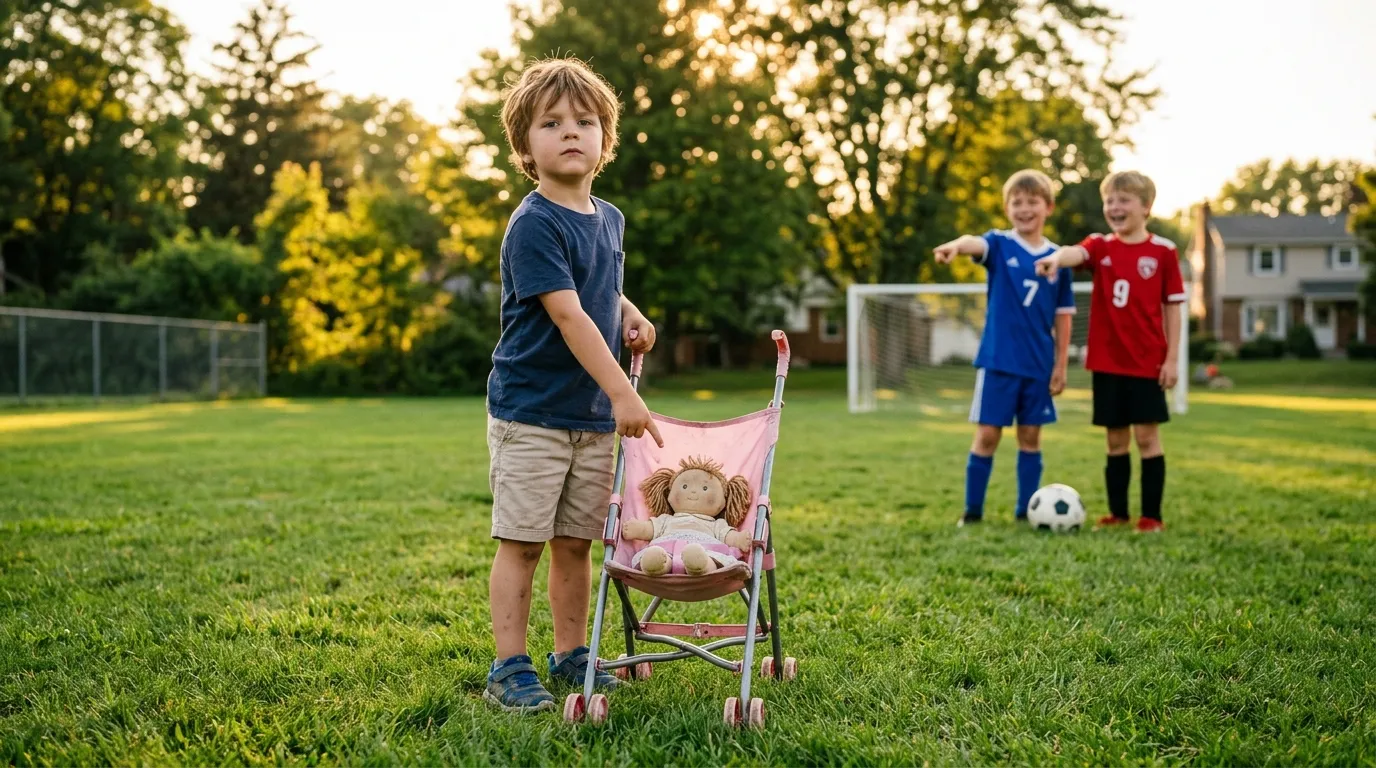
Leo stood his ground without a flicker of shame or hesitation.
“Look at Leo!” Cole shouted, pointing a dirty cleat. “He’s pushing a doll! That’s for babies and girls!”
“Yeah!” another boy barked, laughing as he booted the soccer ball into the net. “What are you doing, Leo? Are you a mommy now?”
My heart seized. I rose to my feet, ready to sprint across the lawn and shield my son from the cruelty of schoolyard banter. But before I took two steps, Leo stopped the stroller, planted his sneakers firmly into the grass, and looked straight into their eyes.
He didn’t cry. He didn’t look back for my protection.
“I’m not the mommy,” Leo answered in his clear, ringing six-year-old voice. “I’m babysitting Carol’s baby until she comes back.”
The boys blinked, bored by his total lack of tears, and chased their soccer ball toward the bleachers.
I stood frozen on the path. The name felt like a sudden plunge into freezing water.
Carol.
I jogged over to him, kneeling beside the tiny wheels. “Leo? Honey… who is Carol?”
“She’s bigger than me,” he said matter-of-factly, kicking a pinecone off the walkway. “She has red hair and freckles on her nose. We played with dinosaurs in her playroom. She let me hold the baby when we watched cartoons.”
The ground beneath my sneakers suddenly felt hollow.
“Whose playroom, sweetie? When were you in her playroom?”
“At her house! With Daddy. Lots of times.” He beamed at me, completely innocent of the earthquake he was setting off. “The stroller is Carol’s. That’s why I wanted it so bad at the yard sale. I recognized it right away!”
“Why didn’t you ever tell me about Carol, Leo?”
Leo shrugged his small shoulders, adjusting the doll’s blanket. “Daddy said it was our special secret. He said you had too much work to do at home and we shouldn’t bother you with it.”
“He Calls Everything a Secret”
When Greg returned late Monday evening, dragging his leather weekender through the front door, his eyes immediately caught the pink stroller parked by the umbrella stand.
“Hannah, please,” he groaned, rubbing his neck. “Are we really keeping that eyesore in the foyer? Can we donate it to Goodwill already?”
I stayed at the stove, gently stirring the tomato sauce. “Leo says it belongs to Carol.”
The metal spoon didn’t clatter. My hand didn’t shake. But the entire room seemed to lose all its oxygen.
Greg froze mid-stride, his jacket half-unbuttoned. “What did you say?”
“He told the kids at the park that he was holding Carol’s baby for her,” I said evenly, turning around to look at him. “He said you two visit Carol’s house all the time. Who is Carol, Greg?”
He swallowed hard. A telltale red flush crept up his collar, blooming across his cheeks.
“Oh. That,” he said, attempting a dismissive laugh that sounded brittle and hollow. “She’s… she’s just an acquaintance’s daughter. A business contact. I had to drop off some contract revisions a couple of times and Leo came along in the car. It was nothing.”
“Leo said he played in her room. He said you told him it was a secret.”
“Oh, come on, Hannah!” Greg snapped, walking over to the sink and turning on the faucet just to have something to do with his hands. “He’s six years old! You know how his imagination runs wild. He calls everything a secret. Don’t turn a drop-off into a federal investigation.”
He turned off the faucet, dried his hands meticulously on a clean linen towel, and folded it twice before setting it down.
“It’s complicated, Han. I was handling business matters. Leave the complicated stuff to me.”
There it was again.
For eight years, that phrase had been my cue to smile, nod, and pour him a cup of coffee. But this time, lying in bed beside him that night, feeling the steady rise and fall of his breathing, the word tasted like poison.
I didn’t scream. I didn’t rummage through his luggage. On the ranch, my mother had taught me: You never pull your horse until you see where the ditch ends.
I needed facts.
The Four Rachels
The next morning, Greg packed another bag for a supposed “two-day vendor summit” three hours north. The second his silver SUV cleared our street corner, I opened my laptop at the kitchen table.
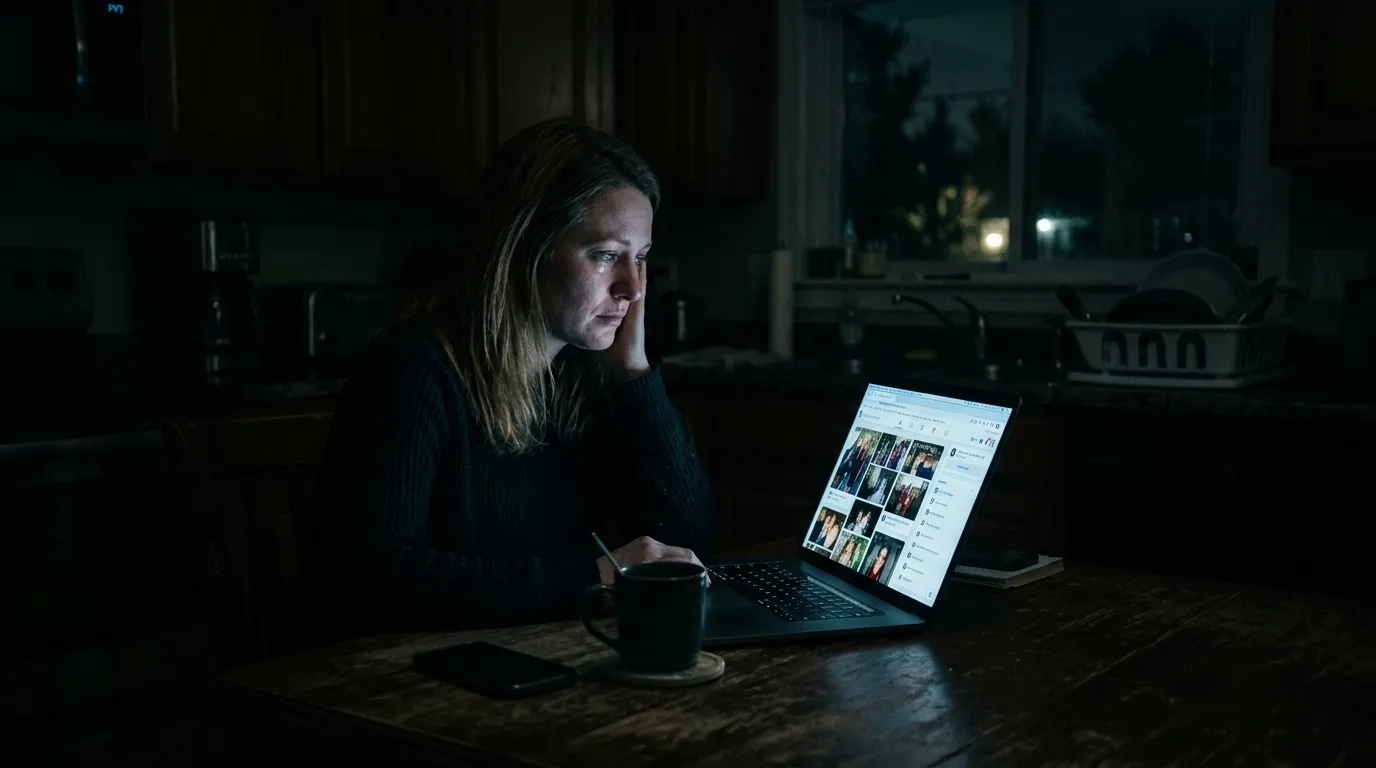
The digital trail proved far louder than my husband’s carefully crafted lies.
I pulled up the neighborhood association board and found the garage sale announcement. I typed a quick, cheerful message to Marla:
“Hi Marla! Leo is completely obsessed with that little pink stroller we bought on Saturday. He’s convinced the doll has a name. Do you remember who originally owned it?”
Marla’s reply popped up forty minutes later:
“Oh, hey Hannah! That was my friend Rachel’s daughter, Carol! Rachel just packed up and moved across the county line this past weekend, so she left behind whatever wouldn’t fit in the moving van. Glad Leo loves it!”
Rachel.
I went directly to Marla’s profile and opened her public friends list. There were four women named Rachel.
The third profile stopped my heart.
Her cover photo featured a glowing woman with wavy auburn hair standing next to a seven-year-old girl with a dusting of freckles across her nose and cheeks. The girl’s eyes had that unmistakable, piercing hazel shade I saw every single morning across our kitchen table.
I scrolled down Rachel’s timeline. Past the school photos, past the baking recipes, past the birthday parties.
Nine years back, before Greg and I had even met, there was an album titled Rooftop Summers. There was Greg—younger, laughing, holding a glass of craft beer, his arm draped securely around Rachel’s waist.
Greg had once mentioned having a serious girlfriend right before our first date. He’d claimed it ended mutually and cleanly. He had never spoken her name.
Finding his ex-girlfriend explained our past. But it didn’t explain why my son had spent afternoons in her daughter’s bedroom.
Then I scrolled to a post uploaded just six hours earlier.
It was a picture of Rachel and little Carol standing on the front steps of a modest brick ranch-style home surrounded by taped moving boxes. The caption read: “New beginnings. A fresh start for our little team.”
I zoomed in on the asphalt driveway at the edge of the frame.
Parked right behind the moving van was the back quarter of a silver SUV. Sitting right above the rear wheel well was a sharp, crescent-shaped dent.
I had watched Greg back into a concrete parking bollard with that SUV eleven months ago. I had begged him three separate times to file an insurance claim and get it fixed. He had always brushed me off, saying, “Leave the car stuff to me, Hannah.”
Right then, my phone chimed on the counter.
It was a text from Greg:
“Vendor meetings ran brutal today. Checking into the hotel now and heading straight to bed. Give our little guy a huge kiss for me ❤️”
I stared at the glowing letters until the screen faded to black.
I typed back four words:
“Sleep well tonight ❤️”
A Mother’s Quiet Strength
I packed Leo’s overnight bag with three pairs of clothes, his favorite dinosaur book, and his fleece blanket. Then I called my mother, Denise.
“Can Leo spend the night at the ranch?”
“Always,” Mom answered without hesitation. “Is everything alright, Hannah?”
“I don’t know yet,” I told her, keeping my voice steady. “I’ll know tonight.”
When I pulled up to the ranch, Mom took Leo’s hand and ruffled his hair, leading him toward the pasture where the barn cats were sunning themselves. She walked back down the gravel driveway, leaned through my open car window, and put both hands on my face.
“Do you want me to ride with you?” she asked softly.
“No,” I said, looking her in the eye. “I need to look at this myself.”
She nodded once, stepped back, and watched me drive away. She didn’t offer hollow platitudes. Women raised on the land understand when a storm is too big to outrun.
The Porch Light
The drive across county lines took an hour and fifteen minutes. For the entire trip, the radio stayed off. Only the steady thrum of tires and the patter of evening rain against the windshield filled the car.
I thought about our eight years together. I thought about the subtle ways Greg had carved away my confidence—the little smirks, the patronizing pats on the head, the way he treated my practical, common-sense rural upbringing as if it were a mild intellectual handicap.
“My little country girl.”
He had spent eight years assuming that because I didn’t raise my voice, I didn’t possess a spine.
I turned onto the quiet suburban street Rachel had tagged in her photo. Rain slicked the pavement under the golden glow of streetlight globes. And there it was—Greg’s silver SUV, parked squarely at the curb in front of house number 412.
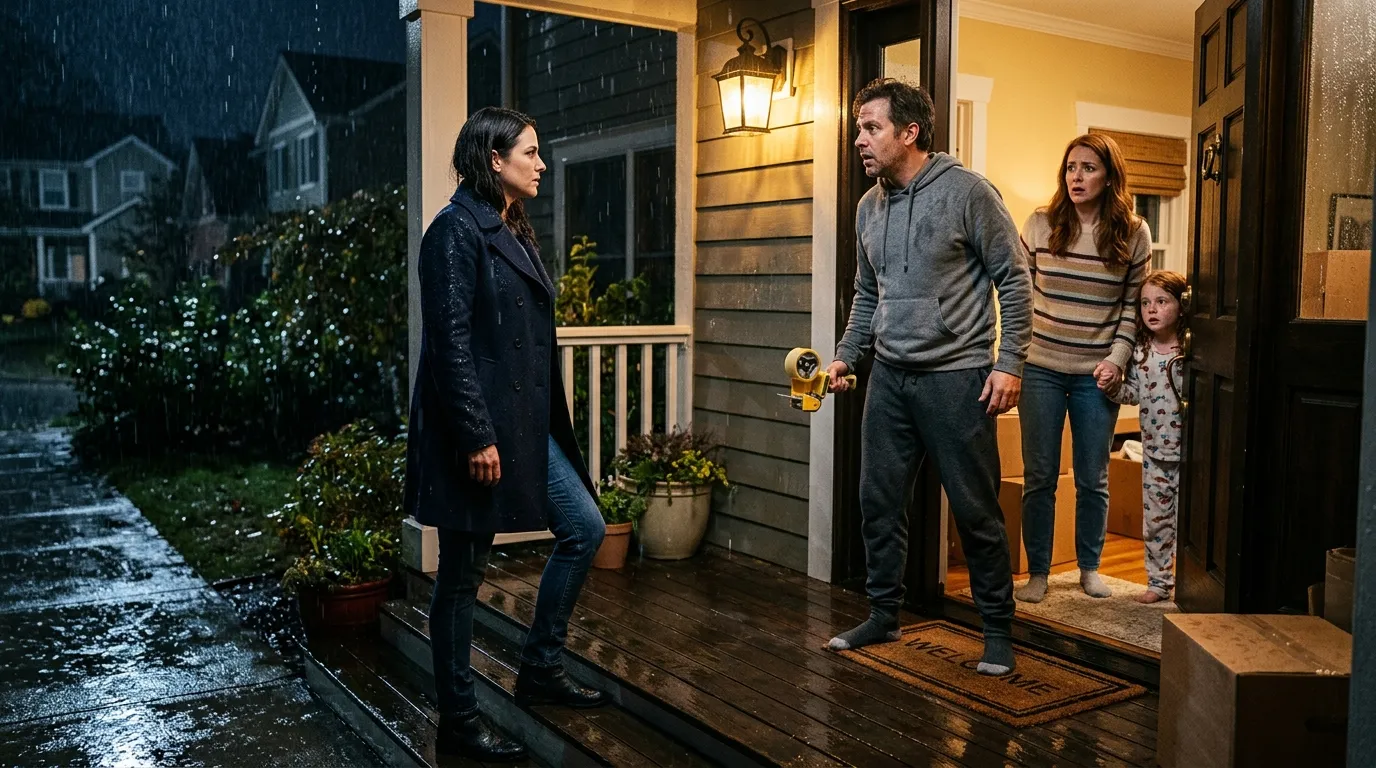
Under the glaring porch light, every carefully constructed illusion collapsed.
I parked behind his bumper, turned off the engine, grabbed my umbrella, and walked up the three concrete steps to the front door.
I knocked three times.
The lock clicked, and the door swung inward. Rachel stood there in yoga pants and an oversized sweater, a roll of packing tape in her hand. When her eyes met mine, every trace of color drained from her cheeks.
“Hannah?” she whispered, her knuckles whitening on the doorknob.
“Hello, Rachel,” I said calmly. “I think it’s time we talked.”
Before she could speak, Greg’s voice echoed down the hallway from the kitchen. “Babe, do you want these kitchen boxes stacked in the pantry or the—”
He stopped dead in his tracks. He was wearing an old grey college sweatshirt and sweatpants. He looked comfortable. He looked at home.
“Hannah?” His voice cracked like dry kindling.
Behind him, little Carol bounded down the hallway, clutching a stuffed rabbit. Without a second thought, she wrapped her arms around Greg’s leg. “Daddy, can we order pizza yet?”
Daddy.
The word detonated in the quiet foyer.
Rachel spun around to Greg, panic flaring in her eyes. “You said she knew! You told me you two finalized the separation agreements three weeks ago!”
I looked at Greg. His eyes darted toward the open front door, then toward Rachel, looking desperately for an exit that didn’t exist.
“Is she yours?” I asked. My voice was low, terrifyingly calm.
“Hannah… please, just step inside out of the rain. Let’s not do this out here—”
“Is she your daughter, Greg?”
His shoulders sagged under the weight of his own lies. “Yes. Rachel had a paternity test done four months ago after her ex was ruled out. It confirmed Carol is mine.”
“And you didn’t tell me.”
“I was trying to protect you! I was trying to figure out how to handle it!”
“You didn’t protect me,” I said, taking a step forward. “You brought our six-year-old son into this house. You introduced him to his biological sister, let them play together, and then ordered him to keep it a secret from his own mother. You turned a first-grader into an accomplice in your affair.”
Rachel gasped, her hand flying to her mouth as she turned on him. “You told me Hannah knew all about Carol! You told me you brought Leo over so the kids could bond before the divorce was announced!”
I looked at Rachel. The betrayal on her face was just as raw as mine. Greg had built two entirely separate houses of cards, balancing them on the backs of two women who had trusted his word.
“He’s not on a business trip, Rachel,” I said gently. “And we were never separated. He kissed me on the cheek this morning and told me he had an emergency client meeting.”
Rachel turned her back on him, walking toward the hallway and pulling little Carol into her arms. “Get out of my house, Greg. Take your things and get out.”
Greg lunged toward the porch, grabbing the doorframe as panic finally stripped away his polished veneer.
“Hannah, wait! Listen to me!” he pleaded, his hands trembling. “You don’t understand the legal complexities! I was going to tell you everything once Rachel was settled! I didn’t tell you because you’re a simple person—you couldn’t have handled something this complicated!”
I stopped on the bottom step and turned back to face him under the dripping eaves.
“You spent eight years confusing simple with stupid, Greg,” I told him, looking straight into his eyes. “I like quiet mornings. I like fixing broken things instead of throwing them in the trash. I like honesty. That makes me simple. But it never made me stupid.”
He reached for my arm. “Think about Leo! Think about our family!”
“You should have thought about our family before you taught our six-year-old boy that lying to his mother is what good men do.”
I opened my umbrella, walked down the driveway, and didn’t look back.
The Value of Honesty
Six weeks have passed since that rainy evening on Rachel’s porch.
My divorce attorney is handling Greg now. It turns out that when you peel away his condescending speeches about ‘complicated logistics,’ Greg’s finances and double life were remarkably easy for forensic accountants to untangle.
Leo and I are settling into our new rhythm. We spend our weekends out at my mother’s ranch, riding horses, fixing fences, and learning what real, quiet strength looks like. Leo doesn’t carry secrets anymore. When he has a question about Carol, we talk about it openly, honestly, and without shame.
And every afternoon when the sun begins to dip behind the pines, Leo still wheels that two-dollar pink stroller down our long gravel driveway. Inside, the smudged baby doll rests comfortably under a clean flannel blanket.
Every time I look at those little plastic wheels rolling over the dirt, I smile.
A two-dollar yard sale toy wasn’t junk after all. It was the best investment in truth I ever made.
Note:This work is inspired by real events and people, but it has been fictionalized for creative purposes. Names, characters, and details have been changed to protect privacy and enhance the narrative. Any resemblance to actual persons, living or dead, or actual events is purely coincidental and not intended by the author.
All images used in this article are AI-generated and intended for illustrative purposes only.
0 Comments