
The Invisible Mechanics of Life
My name is Rick Dalton. I’m fifty-two years old, and I supervise a small HVAC crew in Fort Wayne, Indiana. Most of my days are spent navigating the hidden spaces of the world—climbing up extension ladders, crouching beside aging furnaces, and crawling through dark, dusty spaces beneath floorboards. It is the kind of work that people rarely notice, right up until the exact moment something stops working.
I’ve never minded the invisibility of it. In fact, I take a quiet pride in keeping people warm and safe. My father taught me a long time ago that useful, honest work has its own inherent dignity, regardless of whether anyone stands around to applaud it.
Dad’s name is Jack Dalton. He is seventy-four years old now, and he spent fifty solid years working on the assembly line at the GM plant down in Anderson. He isn’t a man of sweeping declarations or poetic speeches. Instead, he is the kind of man who shows his love simply by showing up. If your water heater bursts and floods your basement at ten o’clock on a Sunday night, Dad appears with a heavy metal toolbox before you even have time to panic or figure out who to call. If you try to thank him too profusely, he waves his calloused hand and changes the subject, as if gratitude is a language that makes him deeply uncomfortable.
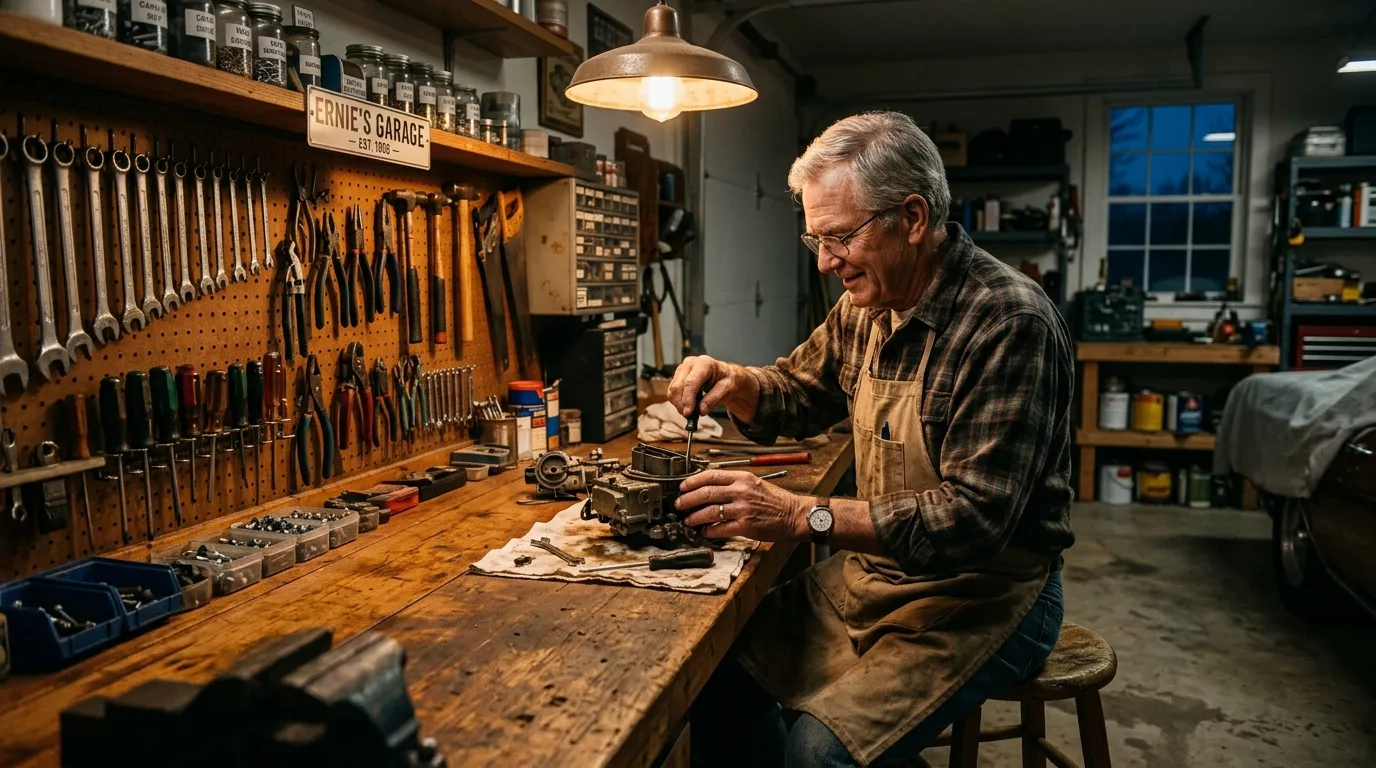
The smell of motor oil and cold concrete never meant dirt to me—it meant reliability.
For as long as I can remember, his detached garage has smelled like motor oil, cold concrete, and old tools. To some, that might seem unpleasant. But to me, that smell has never meant dirt. It meant reliability. It meant safety. When I was a kid and something in the house broke, nobody panicked. We just waited for Dad to get home. Because Dad could always, without fail, make things work again.
Two Different Worlds
My wife Karen’s family, on the other hand, came from a very different world. Her parents, Don and Margaret Whitfield, built their substantial wealth in commercial real estate. They navigated a world that valued polished manners, expensive tailored clothes, careful social presentation, and a complex set of unspoken rules that dictated who belonged and who didn’t.
To their credit, they were never openly cruel to my father. Honestly, in some ways, outright hostility would have been easier to handle. Instead, they treated him with a kind of exaggerated, stiff politeness—the sort of forced courtesy that constantly reminded him he was an outsider being graciously tolerated.
For twelve long years, I let it happen. I didn’t stay quiet because I agreed with them. I certainly didn’t believe that half a century of grueling factory work made my father any less worthy of sitting at our holiday table. I stayed quiet because I convinced myself that keeping the peace was the most important thing. I foolishly believed I could stand in the middle, playing the diplomat, and absorb whatever discomfort leaked out between the two families.
That was my mistake. And I didn’t truly understand just how massive a mistake it was until one Thanksgiving morning.
The Breaking Point
It was around eleven in the morning. The turkey had already been roasting in the oven for two hours, filling the house with that warm, familiar, and comforting aroma that defines Thanksgiving. Everything felt perfect. I picked up my phone and called Dad to let him know I was getting ready to drive over and pick him up.
Normally, this was the part where he would make a dry joke about whether my truck’s suspension could handle a man who had already eaten breakfast twice. But this time, his voice sounded tight and careful.
“Rick, I don’t think I’m coming this year.”
I stopped in my tracks. “What?”
“Karen called last night,” he said quietly. “She said it was going to be a small dinner and she didn’t want me feeling crowded.”
For a long moment, the air seemed to leave my lungs. I didn’t say anything. Finally, I managed, “She called you?”
“Yeah. She was nice about it,” he replied, pausing for a second. “She’s probably right anyway. You know me. I’m not much for crowds.”
That was a lie. My father had spent five decades working shoulder-to-shoulder with hundreds of people on a noisy factory floor. He could strike up a genuine conversation with the cashier at the grocery store or a stranger at a diner. He wasn’t making an excuse for himself. He was making one to protect Karen. That was exactly the kind of man he was—he took someone else’s unkindness and reshaped it into something softer, something easier for everyone else to live with.
“I’ll call you back, Dad,” I said, my voice eerily calm.
Drawing the Line
I walked out of the kitchen and into the dining room. Karen was humming quietly, arranging the silverware. It was the good set. The heavy, polished silver she only ever brought out for major holidays or to impress special guests.
“Why did you tell my father not to come?” I asked.
She placed a silver fork perfectly beside a porcelain plate and turned toward me. She didn’t look guilty. She didn’t even look surprised.
“Rick, you know how my parents are.”
“What does that have to do with Dad?”
She let out a long, weary sigh. “Your father smells like an old garage. My mother notices things like that, and I don’t want to spend Thanksgiving trying to manage an awkward situation.”
I just stared at her.
“He’s not coming,” she added firmly. She said it with the calm, detached tone of someone who had successfully solved a minor logistical problem.
For several long seconds, I stood frozen. I’m a man who is much better with problems that have physical, tangible solutions. A broken furnace motor. A leaking coolant line. Something you can diagnose, take apart, examine, and put back together correctly. This wasn’t that kind of problem. But as the silence stretched between us, I finally understood exactly what I was looking at.
This wasn’t really about a smell. My father had smelled faintly of his hard work for as long as Karen had known him. She had eaten countless meals at his table. She had accepted his help without hesitation. She had let him drive forty minutes through a blinding snowstorm one February morning to repair our furnace when it died in the middle of the night. Nobody had complained about his “garage smell” when the house was freezing.
No, this was about who Karen and her parents believed belonged in the room. And who did not.
For twelve years, she had safely assumed I would continue absorbing the blows and smoothing things over. That morning, I decided I was done.
“Fine,” I said.
“Fine?” she echoed, looking relieved.
“If Dad isn’t welcome, then we’re not having Thanksgiving here.”
Karen blinked, her smile faltering. “What are you talking about?”
“Exactly what I said.”
“Rick, my parents will be here in an hour.”
“I know.”
“You can’t be serious.”
“I am.”
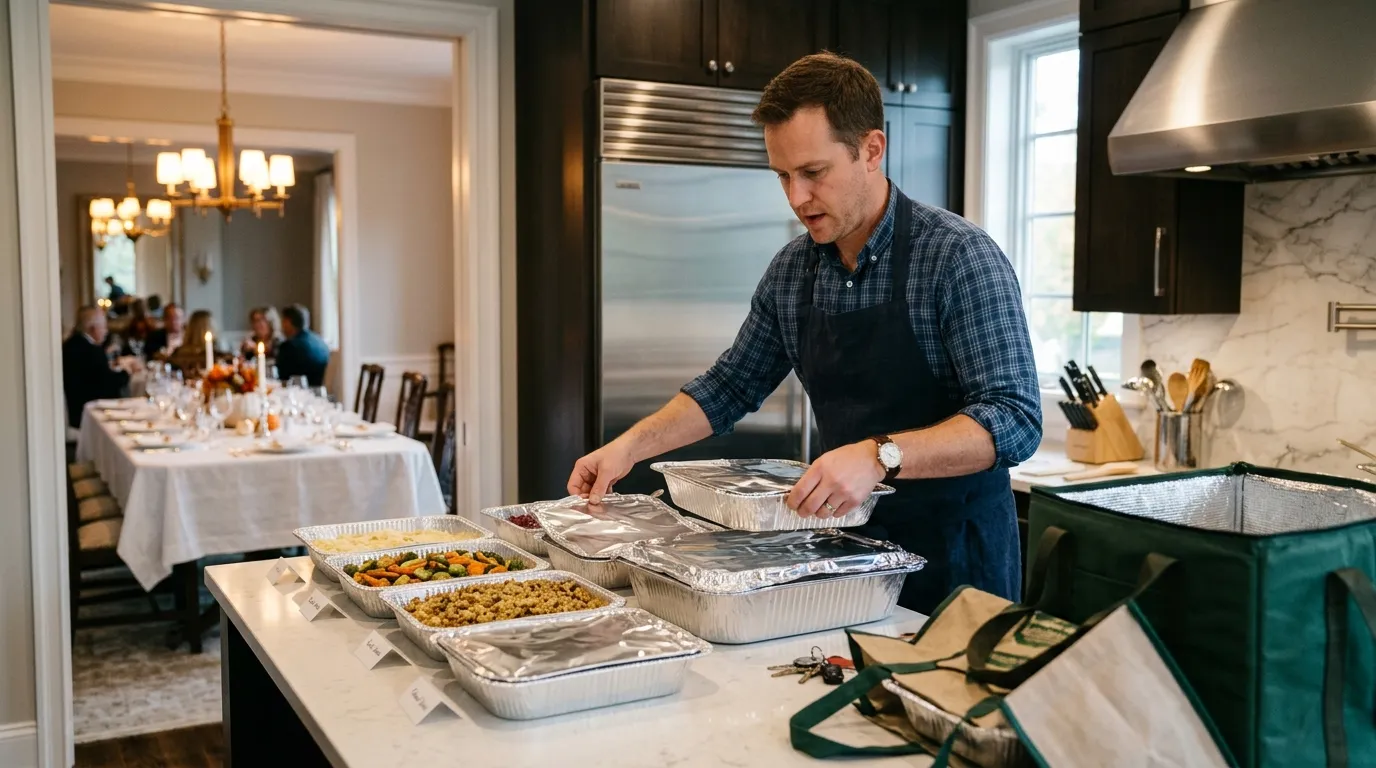
I opened the cabinet and pulled out the foil trays. There was nothing left to debate.
I didn’t yell. I didn’t slam a single door or throw anything across the room. I simply walked into the kitchen and surveyed the meal. The turkey was beautifully browned and resting on the counter. The sweet potatoes were bubbling warmly in the oven. The green bean casserole sat ready. Fresh rolls. A pumpkin pie cooling on a wire rack. Everything Karen had meticulously prepared for the people she believed deserved a seat at the table.
I opened the cabinet above the refrigerator, pulled out a stack of aluminum foil trays, and started packing.
Karen appeared in the doorway, her eyes wide. “What are you doing?”
“Packing dinner.”
“Rick.”
I kept working, carefully transferring the sweet potatoes. “I heard you tell my father he wasn’t welcome in his own son’s home on Thanksgiving because he smells like the work he spent fifty years doing.”
She stared at me, speechless.
“I’m not sitting down to a dinner after that,” I told her.
“So you’re just ruining Thanksgiving?” she asked, her voice trembling.
“No,” I said, covering a tray securely with a sheet of foil. “I’m having Thanksgiving with my father.”
She followed me as I carried the food out, telling me I was being childish. She said her parents would be mortified. She said I was making a terrible mistake. I listened to all of it as I loaded the trays into the passenger seat of my truck. But I didn’t argue. There was nothing left to debate.
The Table He Built
I drove to Dad’s house. The trip usually took twenty-two minutes with traffic. That morning, with the streets dead and most families already gathered where they planned to spend the holiday, it took seventeen.
Dad lived in a modest 1960s ranch house sitting on a quiet corner lot. His detached garage had never had an empty bay for as long as I could remember. There was always something inside being brought back to life: a neighbor’s stubborn lawn mower, an old pickup truck, a friend’s broken snowblower.
The porch light was on. It almost always was.
I walked up and knocked. Dad opened the door, looked at my face, and then looked down at the towering stack of foil trays in my arms. He looked back at me.
“Rick?”
“Happy Thanksgiving, Dad.”
He stared for another second, processing the scene, before his mouth twitched into a tiny smile. “You planning on standing out there in the cold all day?” He stepped aside.
His house smelled deeply familiar—a mix of black coffee, pine cleaner, and that faint, indelible trace of motor oil that seemed permanently woven into the fabric of his life. I had always found it incredibly comforting.
I set the food down on his kitchen table and started uncovering the trays. Dad watched me closely.
“Karen know you’re here?”
“She knows.”
He was quiet for a moment. “Everything all right?”
I stopped and looked at him. I looked at the man who had worked half a century to give me a good life. The man who fixed our furnace without being asked, and who had tried to protect me from family conflict by pretending that being excluded didn’t break his heart.
“No,” I said honestly. “But it will be.”
Dad nodded once, understanding without needing all the details. He walked over to the cabinet and pulled down two plates.
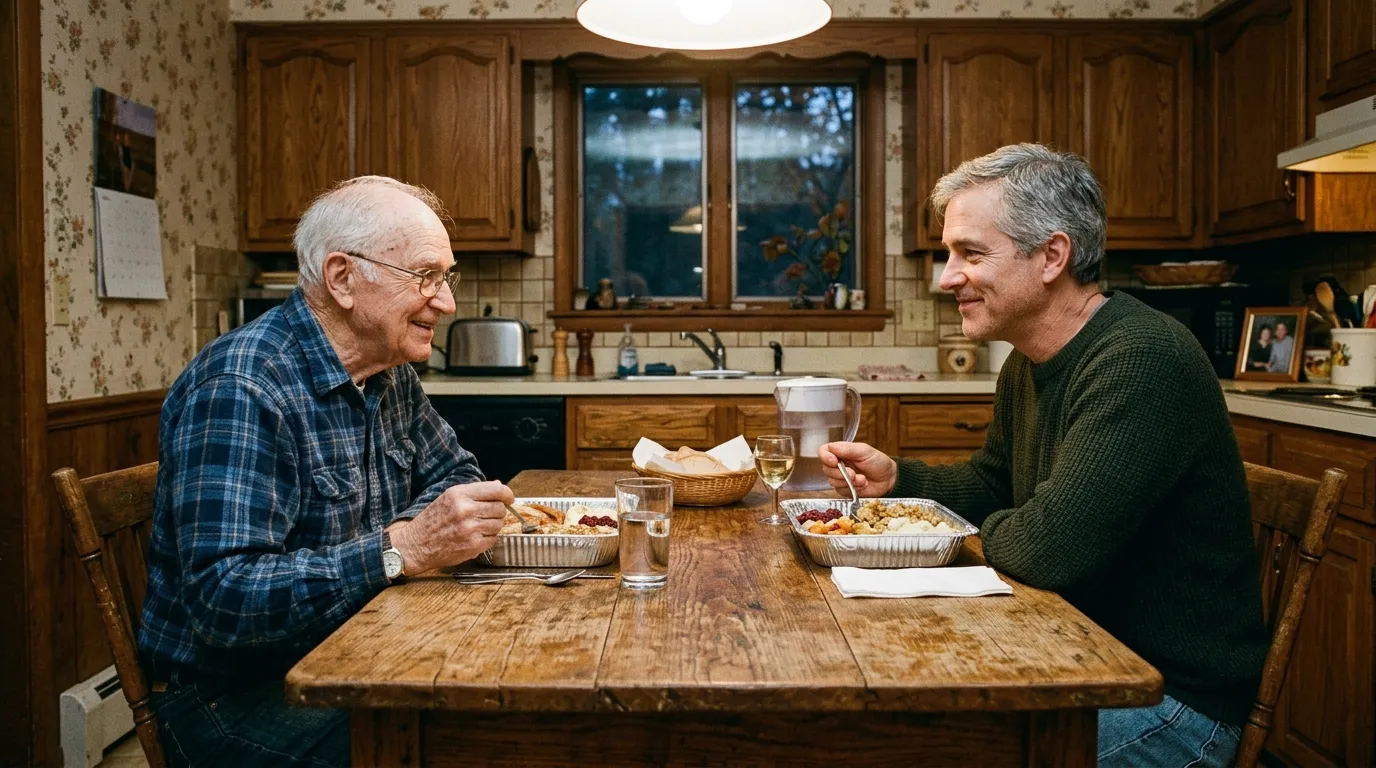
We ate at the kitchen table he had built himself in 1987. The turkey was excellent.
We ate our Thanksgiving dinner at the kitchen table he had built with his own hands back in 1987. The turkey was excellent. The sweet potatoes had gotten a little soft and lukewarm during the drive, but Dad took two hearty servings anyway.
We watched the end of the Thanksgiving parade on his old TV, followed by a football game neither of us cared much about. Mostly, we just talked. We talked about my HVAC crew, about the old Silverado carburetor he was painstakingly rebuilding for a neighbor, and about whether I needed to swing by before the first snow to replace the weatherstripping around his garage doors.
He never pressed me for details about what had happened at my house. He already knew.
Later, over black coffee and slices of pumpkin pie, Dad looked down at his mug and said quietly, “You didn’t have to do this.”
“Yes, I did.”
“She’s your wife, Rick.”
“I know.” I looked him right in the eye. “And you’re my father. I should have said something years ago. I let this go on too long.”
Dad stared into his coffee. “I really didn’t mind staying here.”
I knew exactly what he was doing. He was still trying to make it easier for me, still trying to take the burden. “You should have been there,” I told him firmly. “You’ve always deserved to be there.”
He didn’t answer. After a while, he took another bite of his dessert and looked at his plate. “Good pie.”
I smiled softly. “Karen made it.”
Dad nodded in genuine appreciation. “She’s a good baker.”
That was my father in a nutshell. Seventy-four years old. Excluded from his own son’s Thanksgiving table by his daughter-in-law, and still finding it in his heart to compliment her pie.
Setting Things Right
My phone had been buzzing constantly in my pocket most of the afternoon. Karen had called several times. Don Whitfield had even called twice, which was highly unusual because the man hadn’t dialed my number directly in twelve years. By late afternoon, the tone of Karen’s text messages had shifted from furious anger to genuine worry.
I stayed with Dad until the evening set in. When it was finally time to leave, I hugged him tight and promised to return on Saturday to check the garage doors. He patted my back and told me to bring a decent lunch next time because he was sick of eating cold sandwiches.
When I arrived back home, the house was silent. Karen was sitting alone in the living room. Her parents had already left. Through the doorway, I could see the dining table was still perfectly set. Six untouched place settings. The gleaming silverware. The sparkling crystal glasses. Everything arranged beautifully for a lavish meal that had ultimately been eaten twelve miles away, served from foil trays on a table my father built.
Karen had clearly been crying. Her eyes were red and puffy.
“Sit down,” I said softly.
We sat across from each other, and for the first time in our marriage, I finally said the things I should have said a decade earlier.
“My father is not a problem for you to manage around,” I began, my voice steady.
Karen looked down at her hands.
“He is the reason I know how to work. He is the man who taught me to show up when people need help, no matter the hour. He taught me how to fix things instead of just throwing them away and buying new ones.” I pointed toward the untouched dining room table. “When you called him and told him there wasn’t room for him, you weren’t protecting your parents’ comfort. You were telling him that their snobbish preferences mattered more than everything he has ever meant to me.”
Karen didn’t interrupt. She just listened.
“Your parents have spent years looking down their noses at him because he works with his hands. Because he gets grease under his fingernails.”
“That isn’t what I—” she started to protest weakly.
“I know you probably didn’t think of it that way,” I interrupted gently but firmly. “And that’s exactly the problem.”
We talked long into the night. It wasn’t an easy conversation. Karen was not an inherently cruel person—I knew that, and it was important to remember. But she had spent a lifetime absorbing her parents’ superficial views of status and class so completely that she didn’t even realize when she was acting on them. She truly believed she had just been managing an awkward social dynamic. I forced her to see the human cost of that management.
“My father built the table we ate our dinner on today,” I told her quietly. “He built it almost forty years ago, and he’s refinished it twice to keep it nice. He has never, not once, asked anyone for something he couldn’t repair, build, or earn with his own two hands. Meanwhile, your parents have never done a single favor for us without making absolutely sure we understood the price tag attached to it.”
She didn’t argue. She knew I was right.
The Garage
Two days later, on Saturday morning, I called Dad before heading over.
He answered immediately. “Bring lunch worth eating.”
“I’ll stop at the deli,” I laughed. “Get turkey.”
“You just ate turkey.”
“I’ve been thinking about turkey,” I joked.
When I hung up the phone and grabbed my keys, Karen was standing tentatively in the hallway doorway.
“Can I come?” she asked.
I looked at her for a long moment. “That’s your decision.”
She nodded.
“But if you come,” I warned her, “don’t come because you’re trying to manage anything. Come because you want to be there.”
“I understand.”
“And we’ll probably spend most of the afternoon out in the garage.”
“That’s fine.”
“You know what the garage smells like,” I reminded her.
She looked at me, a soft, determined expression on her face. “I know.”
So, Karen came with me. When we arrived, she walked out to the detached garage and sat quietly on an old wooden stool while Dad showed me the intricacies of the carburetor he was rebuilding. To my absolute surprise, she didn’t just sit there counting the minutes. She started asking questions. Real, genuine questions.
Why was that specific metal part worn down? How exactly did the fuel mixture work? Was restoring this rusty old truck really worth the time and effort?
Dad didn’t gloat. He didn’t punish her for Thanksgiving, and he certainly didn’t try to embarrass her. He answered every single question patiently, treating her with the same easy grace and respect he treated almost everyone else in the world.
By the time we went inside to eat our deli sandwiches, the air between us felt different. The relationship wasn’t instantly “fixed”—twelve years of quiet disrespect do not magically vanish after two hours of shop talk in a garage. But it was different.
Easter and the Porch Light
Karen and I had many more difficult conversations over the following months. Some forced both of us to admit uncomfortable truths about our marriage and our families. But a fundamental shift had occurred that Thanksgiving. For the first time in my life, I had stopped accepting the responsibility for everyone else’s discomfort.
In December, Don Whitfield called me. He spoke formally, as he always did. He cleared his throat and said he understood there had been “some difficulty” regarding Thanksgiving.
I didn’t sugarcoat it. “My father will be invited to every holiday dinner in this house from now on, Don. If his presence bothers anyone, that is their problem to solve. Not mine.”
Don was silent on the line for a long time. Then he said, “Your father worked at GM for a long time.”
“Fifty years.”
“That’s a long time.”
“Yes.”
Don didn’t formally apologize. Knowing him, I wasn’t expecting him to. But when Easter Sunday rolled around a few months later, Don sat right beside my Dad at the dining table.

For twelve years, they shared an interest neither knew existed, simply because nobody had created the space to discover it.
Karen and I had set the table for eight. Dad was there, seated the same as everyone else. During the meal, Don leaned over and asked Dad about the vintage Silverado he had been working on. Dad answered enthusiastically. Then, somehow, the conversation shifted, and the two men started talking passionately about the Chicago Cubs. For twelve years, those two men had apparently shared an interest that neither knew existed—simply because nobody had ever created a safe, equal space for them to discover it.
Dad wore a clean, pressed flannel shirt that day. He always wore clean clothes to family gatherings. He smelled like Irish Spring soap, and underneath it, very faintly, he smelled like the garage. Like work. Like himself. If Don Whitfield noticed the smell, he didn’t say a word.
After dinner, while we were cleaning up, Karen pulled me aside and told me her mother had asked on the drive over whether Dad was coming to dinner.
“What did you say?” I asked.
“I told her he was bringing pie,” Karen smiled.
And he had. A beautiful cherry pie. Months earlier, he had casually asked our niece, Natalie, which kind of pie she liked best. She had told him cherry. He remembered. Dad always remembered things like that. He always showed up.
That evening, after the last guest had pulled out of the driveway, I stood alone at the kitchen sink, looking out into the darkened backyard. The good silverware was washed and drying beside me on a towel. The glass pie plate was completely empty.
My mind drifted back to that cold Thanksgiving morning. I thought about the heavy foil trays. The gray Indiana sky. The seventeen-minute drive across town. And I thought about my father’s porch light, glowing steadily in the distance.
He had left it on for me. He always did. Just in case someone needed to find their way home.
Some things take fifty years to build. Respect. Trust. A rock-solid reputation for showing up when things get hard. And sometimes, it takes only one afternoon to realize just how badly you have failed to protect those precious things.
My father had spent his entire life being the man who came when people needed him. He never complained, and he never asked for a medal. The very least I could do was make absolutely sure there was always a warm, welcoming place waiting for him when he finally arrived.
That Easter night, Dad drove home in his old truck knowing exactly one thing for certain: He was welcome.
And in the end, that was everything.
Note:This work is inspired by real events and people, but it has been fictionalized for creative purposes. Names, characters, and details have been changed to protect privacy and enhance the narrative. Any resemblance to actual persons, living or dead, or actual events is purely coincidental and not intended by the author.
All images used in this article are AI-generated and intended for illustrative purposes only.
0 Comments