
My phone buzzed with an urgent vibration while the police officer was still standing in my parents’ gravel driveway. Through the living room bay window, I stood holding my breath beside Haley. Across the yard, my father was gripping the folded emergency protective order in his hands, staring down at the legal print as if it had been drafted in an ancient script he never in his life expected to encounter.
My mother stood stiffly three paces behind him, clutching her cardigan around her elbows. Rachel was leaning back against the garage siding, arms crossed tightly over her chest, her jaw set. For the first time in as long as I could remember, none of them carried that smirk—that familiar, condescending amusement they wore whenever they believed they held all the cards.
Then my screen lit up again. The notification was from a neighbor who had been at the backyard barbecue the previous weekend.
I recognized her name instantly, even though our interactions had never gone beyond friendly waves across the fence line. Her first sentence hit like ice water in my veins: “I think you need to know what Rachel said before Haley arrived.”
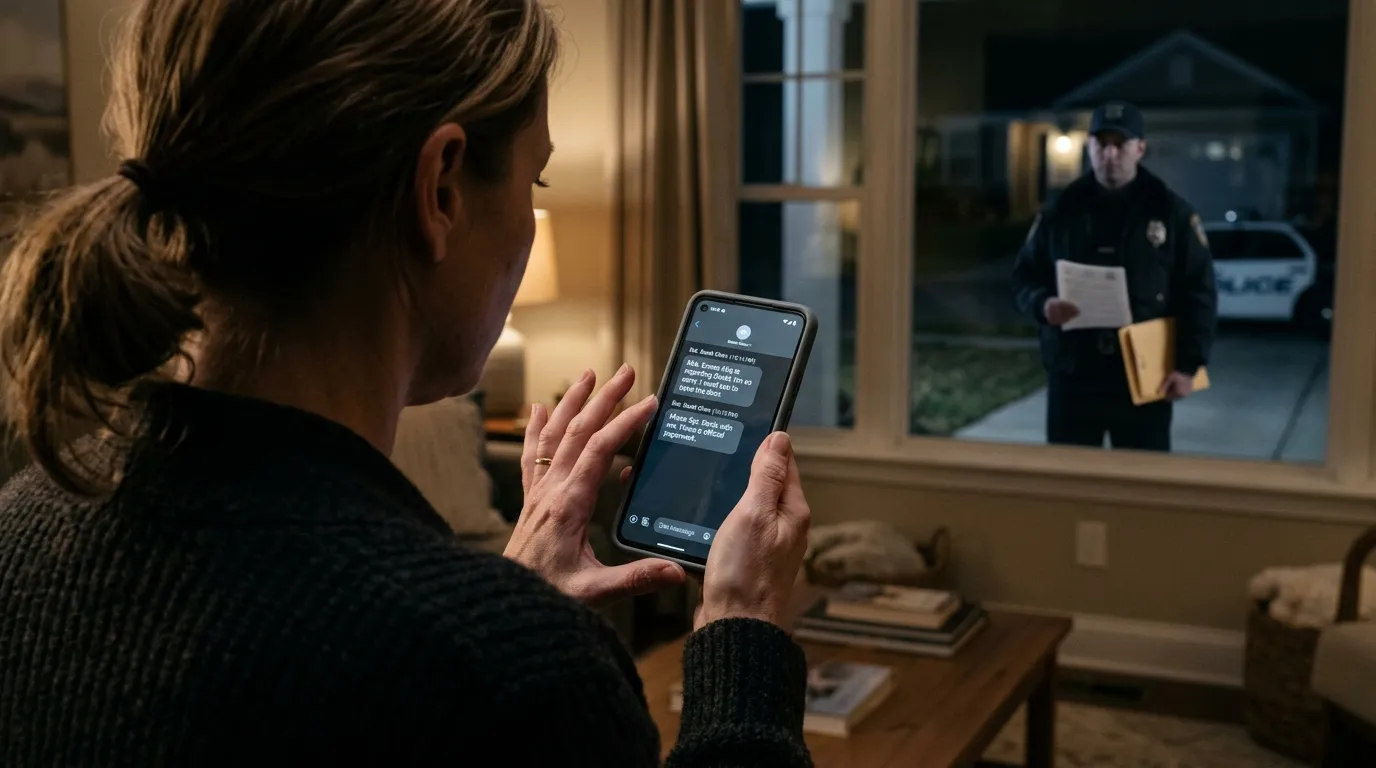
The sudden realization that the poolside cruelty had been calculated long before we walked through the gate.
Attached to the message was a series of saved screenshots. The neighbor included a brief note explaining that she had saved the group exchange earlier that afternoon, sick with guilt and unable to stay silent any longer. Opening them, I had braced myself for an unflattering photo or some petty remark. What I saw instead was chilling.
Rachel shoving my eight-year-old daughter into the deep end of the swimming pool had not been a sudden, thoughtless impulse. It was not a practical joke that went tragically wrong. She had plotted to “teach her a lesson” hours before Haley and I had even set foot inside the backyard gate.
In black and white, Rachel complained that I was coddling my daughter, claiming I was raising Haley to be “weak and soft.” She insisted someone needed to force Haley to stop clinging to my side whenever she felt nervous. Then came the words that turned my hands completely numb: Rachel typed that if Haley refused to jump into the eight-foot deep end herself, she would throw her in.
My father’s reply was even more horrifying. He told Rachel not to stress about me interfering or stepping in. His exact words: he would “handle” me.
And my mother had read every single line. Rather than shutting it down, she chimed in to warn them that I would inevitably “make a dramatic scene,” telling Rachel not to let my sensitivity ruin everyone’s sunny afternoon.
In that instant, the world fell away. The gentle hum of the refrigerator, the faint murmur of the television playing cartoons in the den, the muffled voice of the police officer outside outlining the court order—all of it vanished. The only thing left in the room was the sound of my own shallow, ragged breathing.
I read through every word again. Then a second time. Then a third.
The push had not been a reckless dare. My father physically pinning my arms behind my back as I screamed while my child thrashed in deep water had not been a panicked split-second reaction. My mother’s cold refusal to toss a life ring had not been paralysis from shock. It was a coordinated plan. Every single micro-aggression at the grill—the condescending digs about Haley’s sundress, the snide remarks about me being a struggling single mom—was simply the warm-up to an act of deliberate cruelty they had already given themselves permission to commit.
I walked softly down the short hallway toward the master bedroom. Haley was sitting cross-legged in the center of the bed, her little ankles tucked underneath her, coloring quietly inside a therapeutic workbook the hospital nurse had slipped into her discharge bag.
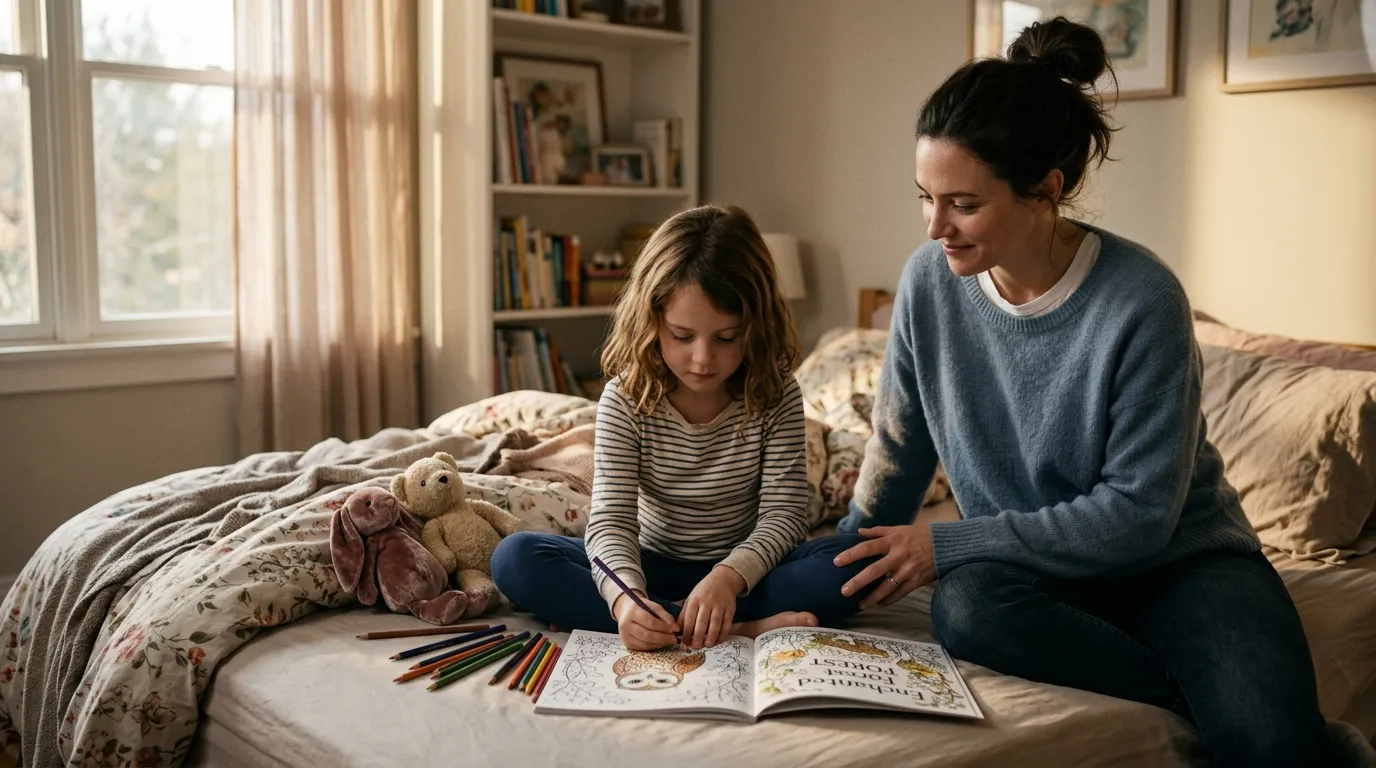
Finding safety in the quiet spaces, far away from family who treated cruelty like discipline.
Her favorite pastel pink hoodie was absent. The moment we had walked through our front door hours earlier, I had double-bagged the damp, chlorine-soaked fleece and sealed it tight. I couldn’t bring myself to throw it out yet, but I couldn’t bear to see it hanging in her wardrobe either. For years, that soft pink color had meant early morning dance rehearsals, spilled apple juice, school drop-offs, and warm hugs wrapped tight around my neck. Now, every time I closed my eyes, all I could see was that pink cloth sinking below the shimmering blue surface.
My fingers trembled as the neighbor’s follow-up message popped up. She confessed that earlier during the party, Rachel had openly flashed her phone at my mother, laughing about how Haley was finally going to “learn today.” The neighbor had assumed they were talking about an informal swimming lesson. Only after witnessing Rachel shove my daughter and seeing my own father tackle and hold me down on the concrete patio did she comprehend the dark truth. She had spent days tormented by whether to speak up, but seeing the cruiser pull up to my parents’ house gave her the courage to hit send.
I didn’t waste a second. I dialed the officer standing in my parents’ driveway. When I told him that an eyewitness had just forwarded documented evidence detailing premeditation, his demeanor transformed immediately from routine formality to sharp, procedural precision.
“Preserve the original thread,” he instructed firmly. “Do not delete or modify anything.”
I forwarded the entire chain without hesitation. Then I sat down on the mattress beside Haley. She looked up from her coloring page, her brown eyes carrying a weight that no child should ever carry.
“Are they mad at us, Mommy?” she asked softly.
The innocent question sliced right through me. She wasn’t trembling from fear of their anger; she asked because, in her eight-year-old heart, she wondered if our suffering was somehow her fault. She thought we were the ones who had done something wrong.
“No, sweetie,” I replied, smoothing her hair behind her ear. “And even if they are, that will never, ever be your job to fix.”
She watched my face closely, searching for certainty. “Are we ever going back there?”
“No.”
It was the clearest, easiest syllable I had ever spoken in my life. In the past, I would have softened it with endless caveats: Not until they apologize. Not until everyone cools down. Not until we sit down and talk it through. For over a decade, I had left doors wide open for relatives who treated my forgiveness as an all-access pass to demean me again. But that afternoon, I turned the deadbolt and locked it forever.
The officer followed up that night. He had reviewed the timestamped screenshots and the witness’s formal statement. He confirmed the sender identities, and I verified each number without hesitation: Rachel’s, Dad’s, Mom’s. He instructed me not to reach out to them under any circumstances. I told him I had zero intention of ever contacting them again. The finality in my voice surprised even me.
Over the following days, our home became strangely, beautifully quiet. There were no fists banging against the front door, no screaming matches on the sidewalk, no manufactured excuses from Rachel demanding to be understood. The emergency protective order established a rigid perimeter that my polite boundaries never could. Three hundred feet. To a surveyor, that was a standard measurement. To me, it was pure, unadulterated oxygen.
I marched down to Haley’s elementary school the very next morning. The administrative staff updated her authorized pickup records, red-flagging every member of my extended family. The teachers were briefed with clear instructions: no relative was allowed near her classroom under any pretext. I systematically scrubbed my parents’ contact information from medical forms, dental records, and extracurricular rosters. Then, with steady fingers, I blocked their phone numbers on every device.
The court order had granted us immediate physical safety. But the permanent boundary—the total severance—was entirely my choice.
Still, the emotional scars lingered beneath the surface. Haley refused to sit in a full bath, insisting on quick showers with the bathroom door pushed half open. A simple drop of water splashing on her nose made her flinch. One sunny morning, as an automated lawn sprinkler suddenly hissed on while we walked down our block, she seized my forearm with such panic that her fingernails dug deep into my skin. I knelt beside her right there on the warm sidewalk.
“You’re safe, baby. I’m right here,” I whispered.
She nodded against my shoulder, but her body stayed rigid. Healing wasn’t something that automatically arrived with court paperwork. A signed legal document could keep unsafe adults away, but it couldn’t instantly teach a frightened child that water wasn’t a weapon. That required time, safety, and endless patience.
During her follow-up evaluation with a child counselor, Haley slowly pieced together what she remembered from that terrible afternoon. She remembered Rachel’s rough hands against her back. She remembered the blinding splash, the sudden drop, and kicking frantically toward an unreachable bottom. But what broke my heart the most was what she saw when she broke the surface: she had seen me screaming on the pool deck, pinned to the floor by her grandfather.
“I thought you weren’t coming to get me,” she whispered, burying her face in my sweater.
It took everything in me to keep my composure. “I was always coming, Haley. I will always come for you.”
That promise became our daily anchor. Whenever the panic crept back in, we would repeat it together: I was always coming.
Meanwhile, the neighbor’s detailed statement completely upended the narrative my family tried to construct. The records proved that Rachel had planned the incident, that Dad had pre-arranged to physically hold me back, and that Mom had chosen to oversee it all like an indifferent spectator. In the formal custody and protective hearings that followed, my father tried his customary routine: framing the entire ordeal as a harmless family misunderstanding. He claimed no one intended any genuine danger, arguing that Rachel simply wanted to “toughen the girl up” and that he had restrained me only to keep me from “making a scene.”
I sat in silence across from them, refusing to flinch. For my entire upbringing, my father had possessed an uncanny ability to rebrand cruelty as discipline and dismiss natural fear as weakness. But gaslighting fails when confronted by cold, documented evidence in a room governed by law. An eight-year-old who could barely swim had been deliberately shoved into deep water. Her mother had fought desperately to save her. Another adult had physically assaulted that mother to prevent the rescue. And a third had stood by and watched. The family mythology collapsed against the reality of the physical facts.
The protective order was reaffirmed and kept strictly in place. They were barred from our lives. For the first time, their tired refrain of “but we’re family” wasn’t a master key that excused abuse. It was just empty noise.
Rachel tried once to bypass the decree by passing a long, written apology through an extended cousin. I handed it right back unread. I didn’t care about her remorse, her excuses, or her claim that she had misjudged the pool’s depth. Intentions did not matter anymore. Protecting my child was the only thing that mattered. My parents had spent twenty years conditioning me to wonder if their bad behavior was ever “bad enough” to justify my boundaries. The poolside water had washed that toxic conditioning clean away.
A few weeks later, Haley approached me in the kitchen. “Mom, what happened to my pink hoodie?”
I paused, letting her know I still had it stored safely away in the garage. “Do you want it back?”
She shook her head softly. “Can we throw it away?”
Part of me had held onto that garment like a dark artifact, a reminder of the day our old lives ended. But it was her hoodie, and it was her memory. Together, we carried the plastic bag out to the trash bin by the fence. Haley reached inside, took hold of the faded pink sleeve, and stared at it for a quiet moment. Then, without a word, she let it go.
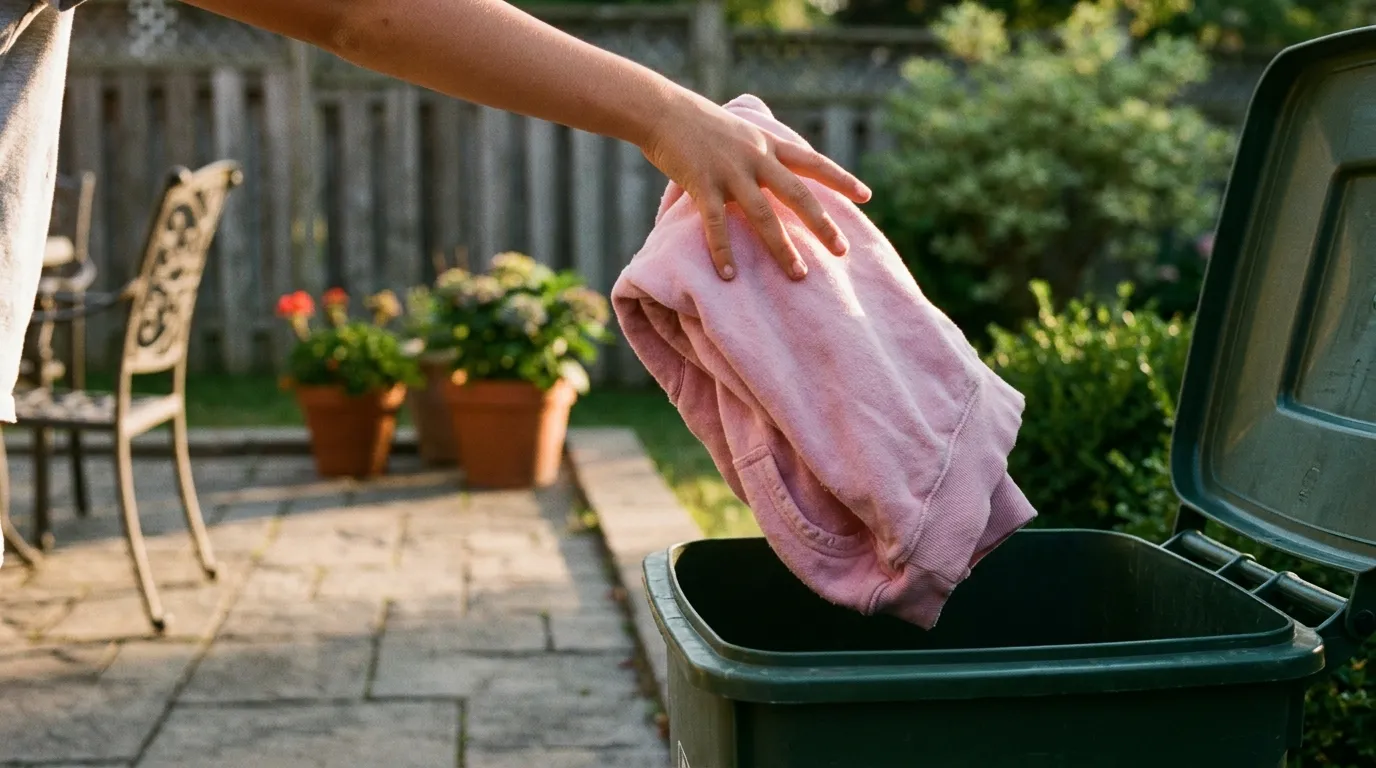
Letting go of the past: throwing away the pink hoodie that once carried so much fear.
There were no grand speeches. Just the soft rustle of fabric landing in the bin, and the snap of the plastic lid closing. She simply walked back into the house, standing a little taller.
A few days after that, while helping me set the dining table, she asked the question that had lingered in the back of her mind: “Will I ever have to see Aunt Rachel again?”
“Not unless you grow up, feel completely safe, and decide you truly want to,” I answered truthfully.
She considered that carefully, then met my eyes: “I don’t want to. Not ever.”
“Then you never will.”
That single promise mattered more than anything else. At that barbecue, a group of dysfunctional adults had decided that an eight-year-old’s terror didn’t matter. Rachel decided that trauma built character. Dad decided fear was something to be beaten out of a child. Mom decided my child’s panic was an inconvenience. I couldn’t erase those horrifying seconds underwater, but I had the power to redefine everything that came next. Her feelings mattered. Her safety mattered. Her no was absolute.
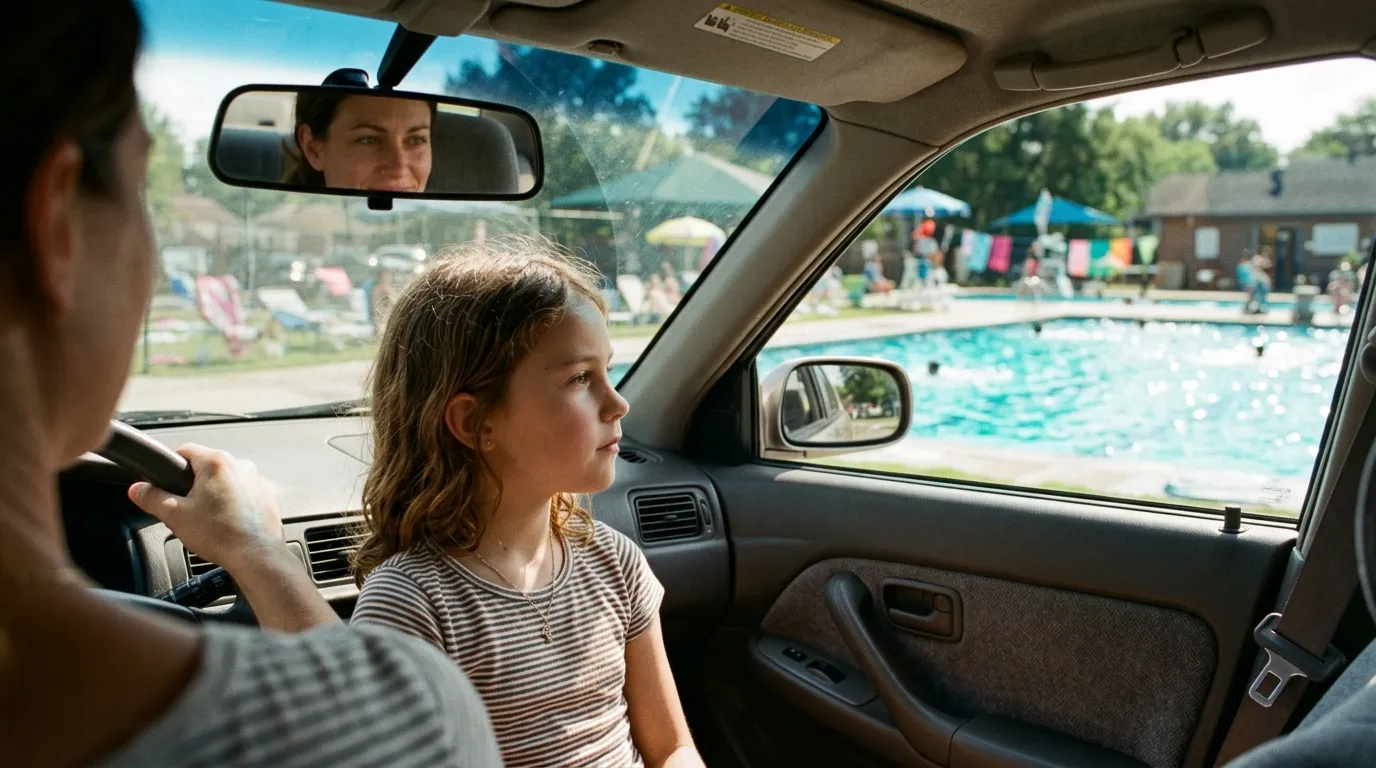
Healing takes time: viewing the water with growing courage and unconditional love.
Months later, on an unusually warm spring afternoon, our car passed the local municipal pool on the way home from school. I felt the atmosphere shift in the cabin as Haley went completely silent behind me. I glanced up into the rearview mirror. She was watching the afternoon sun dance across the sparkling turquoise water, ripples reflecting against the chain-link fence. I braced myself, expecting her to pull down the sunshade or turn her head away.
Instead, she held her gaze. “Maybe someday,” she whispered.
I kept both hands steady on the steering wheel, smiling back at her reflection. “Whenever you’re ready, baby. Only whenever you’re ready.”
Those people thought they were teaching a little girl that surviving cruelty was the price of belonging. Instead, they taught a mother how to walk away, and they permanently forfeited the privilege of knowing her. The legal order established the first three hundred feet of safety. I built the rest out of unconditional love, fierce boundaries, and unwavering truth.
The little girl whose pink hoodie was swallowed by that pool learned something infinitely more enduring than how to float: she learned that when she speaks, she will be heard. She learned that biology does not confer a license to harm. And above all, she learned that the promise I made at her bedside will stand as long as I live—I was always coming.
Note:This work is inspired by real events and people, but it has been fictionalized for creative purposes. Names, characters, and details have been changed to protect privacy and enhance the narrative. Any resemblance to actual persons, living or dead, or actual events is purely coincidental and not intended by the author.
All images used in this article are AI-generated and intended for illustrative purposes only.
0 Comments