
Luke was just eighteen years old when his five-year-old sister, Hannah, fell desperately ill. What started as simple childhood lethargy quickly spiraled into a nightmare that brought us to our knees: acute liver failure. The doctors in the pediatric intensive care unit were frank. Without an immediate transplant, my little girl would not survive the month.
Their father, Victor, had walked out on our family years earlier, vanishing into thin air. No matter how many calls I placed, how many old contacts I pleaded with, or how many messages I left, I could not track him down. Desperate to save my daughter, I underwent exhaustive donor testing myself, praying that my body could give her a second chance at life. But the medical team delivered crushing news: I was medically incompatible.
Then, the doctors evaluated Luke.
The results arrived less than forty-eight hours later: he was an absolute, flawless match.
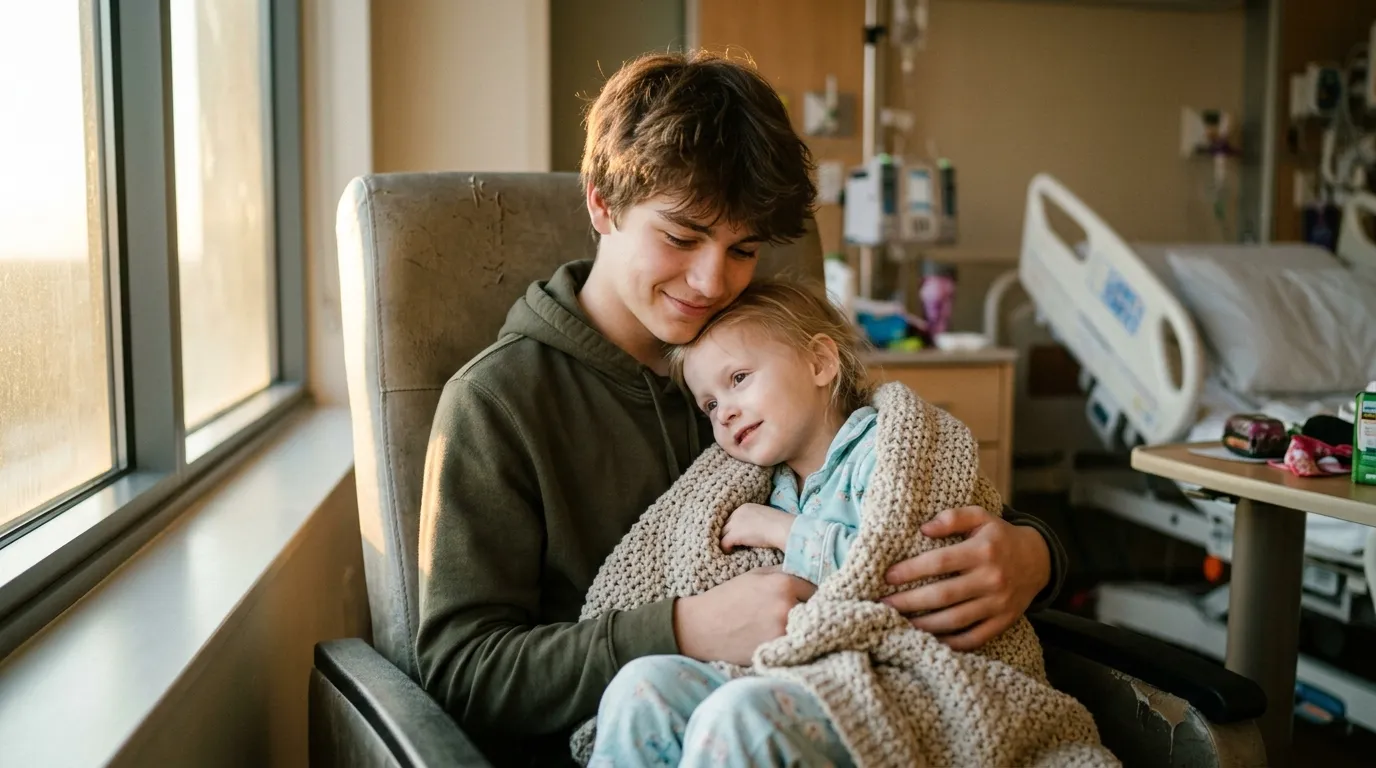
Luke never hesitated when he learned he was a match for his baby sister.
I felt a sickening mix of relief and terror. My firstborn son was the only person on earth who could save my youngest child. In the quiet corridor outside Hannah’s room, I broke down in tears, gripping Luke’s forearms with everything I had.
“Sweetheart, I know your heart. I know how much you love her,” I wept, my voice shaking. “But you’re my baby, too. How am I supposed to watch two operating tables roll away? What if I lose you both?”
Luke didn’t look away. His eyes were completely clear, grounded by a maturity far beyond his eighteen years.
“She’s my little sister, Mom,” he whispered softly. “If I don’t step up, who will? How could I live with myself knowing I had the cure inside me and did nothing to save her?”
The surgeons walked us through every statistic. They assured us that donor liver resections carry low fatality rates and insisted they expected both siblings to recover fully. Clinging to their optimism, we signed the consent forms and moved forward.
Hannah’s surgery was a textbook success. Within days, her jaundiced skin cleared, her vital signs stabilized, and her tiny body accepted the graft. She was growing stronger by the hour.
Luke, however, went down a very different road.
Instead of recovering his strength, my son deteriorated. What began as mild post-operative fever turned into a chain reaction of internal organ stress. Days turned into an agonizing blur of blood panels, emergency scans, and anxious consultations. I tried to convince myself that he was just exhausted, that a young boy’s resilience would eventually kick in.
Then came the morning when the chief surgeon walked slowly into my waiting room, his surgical mask hanging around his neck, and asked me to sit down.
“We are seeing an exceptionally rare post-operative cascade,” the surgeon murmured, his voice heavy with dread. “Right now, our team is doing everything humanly possible to stabilize him.”
They fought for Luke with everything modern medicine possessed. But they couldn’t turn the tide. My boy passed away from an acute, unpredictable complication—what the medical staff numbly described as a one-in-a-million medical tragedy.
I honestly do not know how I survived that first month. The pain of outliving your child is a suffocating weight that alters the very air you breathe. Losing my firstborn left a hollow silence in our home that never quite faded. But as I watched Hannah sleep peacefully in her bed, breathing with the breath Luke had preserved for her, I knew I had to keep living.
I never remarried, and I never had another child. I raised Hannah alone on a modest income, keeping Luke’s photographs in every room. Hannah grew up knowing every detail about her older brother—the boy who had paid the ultimate price so she could run, graduate, and dream.
Thirteen years passed.
Hannah grew into a vibrant, brilliant young woman who never experienced another medical crisis. On the afternoon of her eighteenth birthday, our living room was filled with laughter, wrapped gifts, and two of her closest friends. Watching her blow out her candles, my chest tightened. Luke had been eighteen when he died. Hannah was now the exact age her brother was when he saved her.
As she cleared the wrapping paper from the coffee table, her eyes fell upon an unusual envelope tucked between two gift boxes. It was an off-white envelope, devoid of any postal stamps.
“Mom?” Hannah asked, furrowing her brow. “Did you slip this in here?”
“No, honey. What is it?”
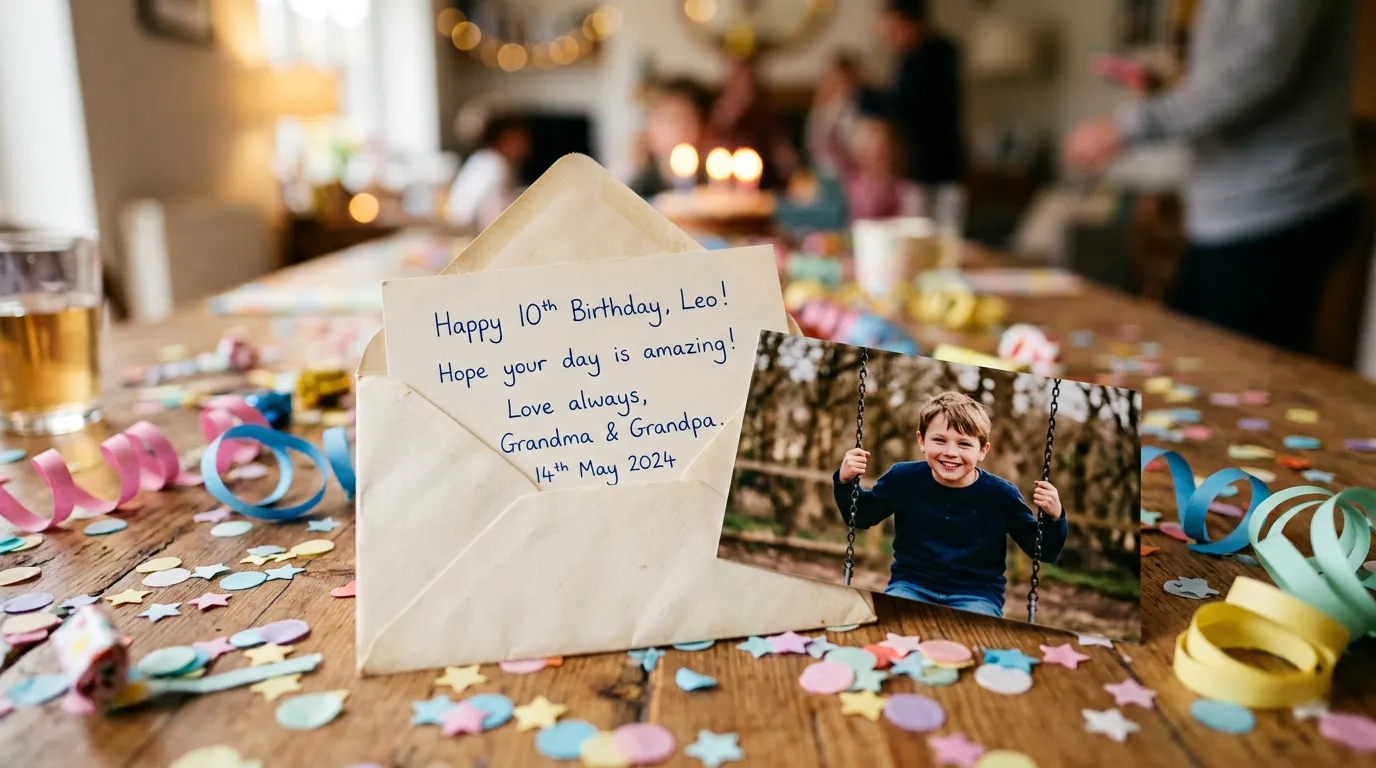
The handwriting on the card belonged to someone who had been gone for thirteen years.
Hannah slid the card open. Out fell a glossy photograph—a candid picture of Hannah laughing at an outdoor table near the local coffee shop where she worked, taken only three days ago.
Then she opened the birthday card itself. When I saw her complexion drain of all color, I walked over immediately. In familiar, boyish blue ink—letters I had read on high school essays and old sticky notes years ago—were eight simple words:
“Happy birthday, little sister. I promised I’d be here.”
My knees gave way, and I grabbed the arm of the sofa to steady myself. Luke was Hannah’s only brother. No one else could have known that handwriting, and no one else could have written those words.
“Is this a sick joke?” Hannah’s voice cracked, tears instantly welling in her eyes. “Luke is gone. Everyone knows how much he means to me. Who would do this?”
Before I could even process the impossible object in her hands, the front doorbell chimed.
I gently urged Hannah’s friends to stay by her side, thinking an uninvited visitor had arrived at the worst conceivable moment. I stepped into the foyer and opened the heavy front door.
The man standing on the porch took my breath away. My hands flew to the doorframe to keep from falling backwards onto the hardwood floor.
“Oh my God…” I gasped, unable to find my voice. “Victor?”
Standing before me was my former husband—thirteen years older, his hair dusted with silver, his eyes rimmed in red. He was holding a small, neatly wrapped gift box.
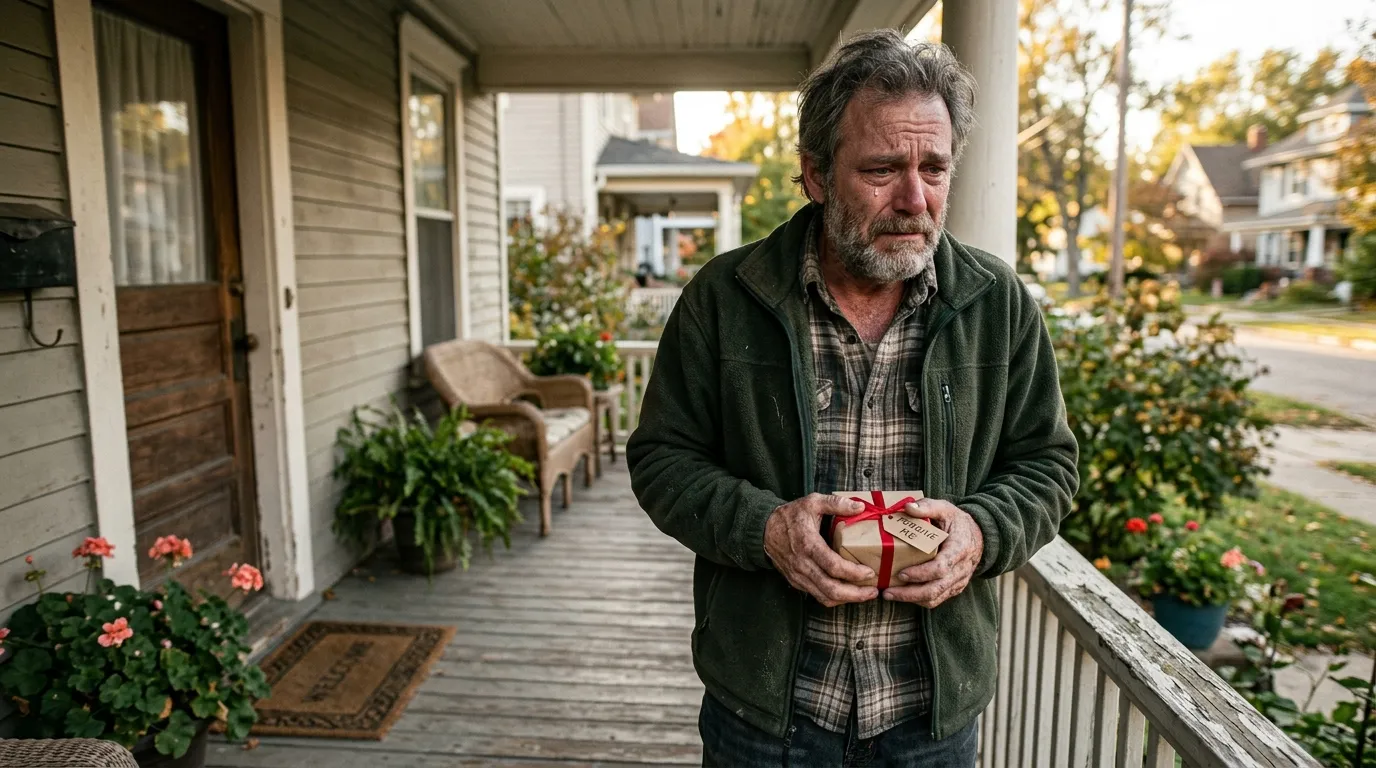
Thirteen years after vanishing, Victor appeared on our doorstep to fulfill a forgotten promise.
“How… how are you here?” I stammered, fresh tears spilling down my cheeks. “After all these years? Where did that card come from?”
Victor swallowed hard, his voice trembling. “Luke tracked me down, Daphne. The week before the surgery.”
I stared at him in utter disbelief.
“He found where I was working two cities over,” Victor confessed, wiping away a tear. “He showed up on my doorstep. He told me Hannah was dying. He told me he was going to give her half his liver, but he also knew every medical risk involved. He looked me in the eye and said, ‘If I don’t make it out of that hospital, Dad, Hannah is going to need someone. Promise me you’ll show up on her eighteenth birthday and give her this card.’”
The realization hit me like a physical wave. Luke had anticipated the worst. He had made contingencies to ensure his little sister would never feel abandoned.
“You kept that letter for thirteen years?” I asked, struggling to breathe.
“In my top drawer. Through every move, every job, every regret,” Victor whispered. “I was terrified of facing you. I was a coward who abandoned his family when you needed me most. But I couldn’t bring myself to throw it away. I watched from afar. I knew what high school she attended. I knew where she worked.”
“You were watching us?”
“I just checked on her from the street,” he said quietly. “Three days ago, I sat outside that coffee shop. She was laughing with a coworker, and she looked so much like Luke that it stopped my heart. I took that photograph right then, slid it into Luke’s envelope, and slipped it into your mailbox yesterday. Then I drove back here today because Luke asked me for one thing: to show up.”
Behind me, floorboards creaked. I turned to see Hannah standing in the entryway, clutching the handwritten card against her chest, her eyes wide with shock.
“Who is he, Mom?” she whispered.
I took her trembling hand into mine. “Hannah… this is your father.”
Hannah froze in place. Victor slowly knelt down onto one knee on the welcome mat, keeping his distance out of respect, entirely humbled.
“I know I don’t deserve to be on this porch,” Victor said, his voice breaking completely. “Your brother was braver at eighteen than I have been in my entire life. He gave his life for you, and he made me swear that when you became an adult, you would know you were loved. I failed you as a father, Hannah. But I couldn’t fail Luke’s dying wish.”
Hannah stood motionless, the afternoon breeze fluttering the edges of the card in her hand. She stared at the father she had never known, then turned her tear-streaked face toward me.
“Mom… what am I supposed to do?”
I squeezed her fingers gently. “That choice belongs entirely to you, sweetheart. But remember why Luke did this. He wanted you to know that you are never alone. That’s what he meant when he wrote, ‘I promised I’d be here.’”
Silence stretched across the porch. Hannah looked back down at the boyish ink, then back up at Victor.
“I can’t promise you forgiveness,” Hannah said firmly, her voice steadying. “And I can’t pretend the last thirteen years didn’t happen.”
Victor nodded quickly, wiping his eyes with his sleeve. “I don’t expect it, Hannah. I really don’t.”
“But,” she whispered softly, “I will let you tell me what Luke said to you.”
The weeks that followed brought no instant miracles or cinematic happy endings. Rebuilding trust after a lifetime of absence is messy and slow. Victor didn’t force his way into our lives; instead, he showed up quietly. A scheduled phone call every Tuesday. A cup of coffee on Sunday afternoons. Small, patient efforts that asked for nothing in return.
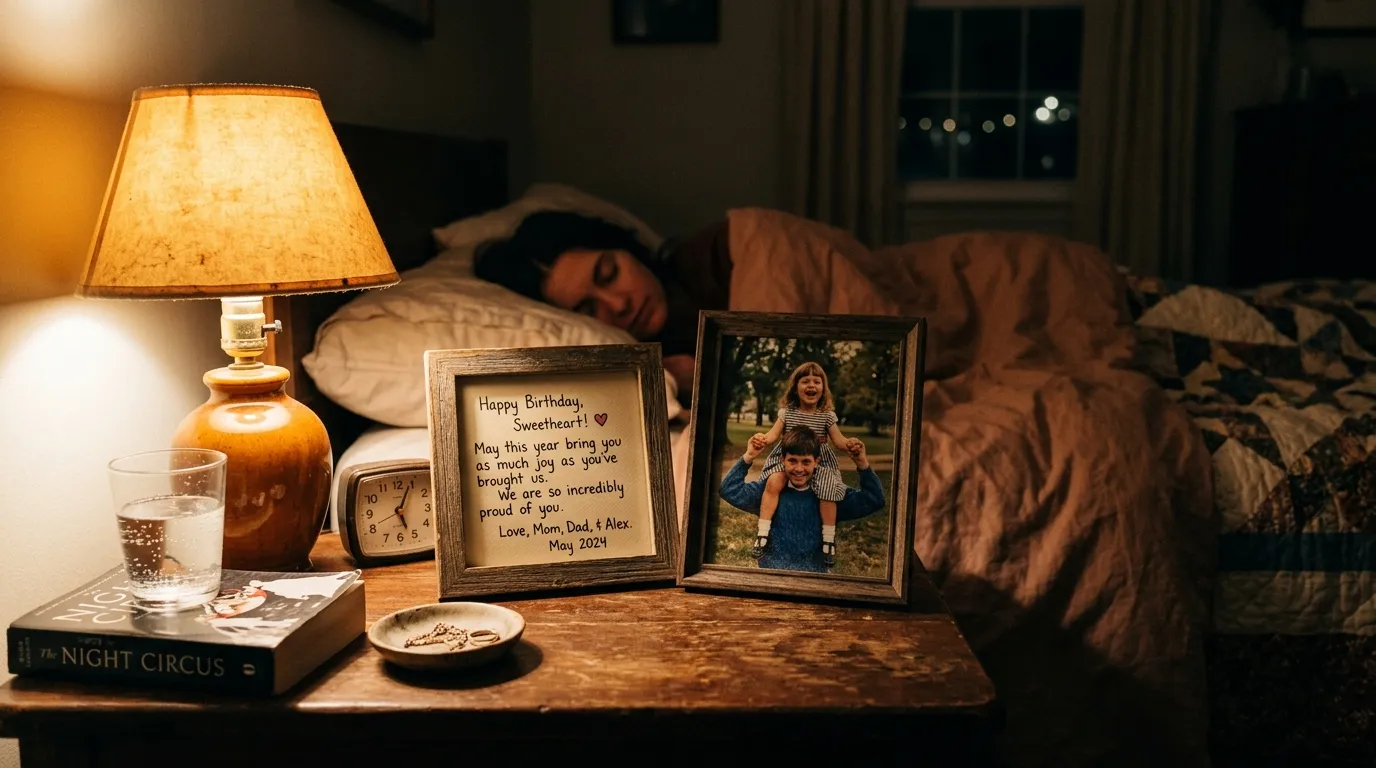
Hannah kept Luke’s final message close, a permanent reminder of an unbreakable bond.
Hannah took Luke’s card and placed it into a simple wooden frame, keeping it on her bedside table where she could read it every morning before starting her day.
A few months later, I found myself standing alone in the hallway late at night, staring at the framed portrait of eighteen-year-old Luke holding baby Hannah in his arms. I reached out and gently pressed my fingers against his smiling face behind the glass.
“She’s eighteen now, Luke,” I whispered into the quiet dark. “And she’s thriving.”
A warm tear traced down my cheek, but for the first time in thirteen years, it wasn’t accompanied by bitter grief.
“You kept your promise, sweetheart,” I told him softly. “You were right there beside her. And somehow, across all those years, you brought her father home, too.”
Some promises take a lifetime to fulfill. But love that runs that deep never truly dies.
Note:This work is inspired by real events and people, but it has been fictionalized for creative purposes. Names, characters, and details have been changed to protect privacy and enhance the narrative. Any resemblance to actual persons, living or dead, or actual events is purely coincidental and not intended by the author.
All images used in this article are AI-generated and intended for illustrative purposes only.
0 Comments