
I got my driver’s license at sixty years old.
For most people, that probably doesn’t sound like an extraordinary milestone. You usually picture nervous teenagers in driver’s ed, not a woman with silver hair clutching the steering wheel at ten-and-two. But for me, holding that little piece of plastic felt like getting my entire life back.
My husband, Paul, had driven everywhere during our forty-one years of marriage. He loved being behind the wheel, navigating backroads and highways while I managed the radio and the snacks. It was our routine, a rhythm we settled into for decades. When he died suddenly two years earlier, the silence in the house was deafening. And suddenly, I was left standing alone in my kitchen, staring at a bowl of car keys I had absolutely no idea how to use.
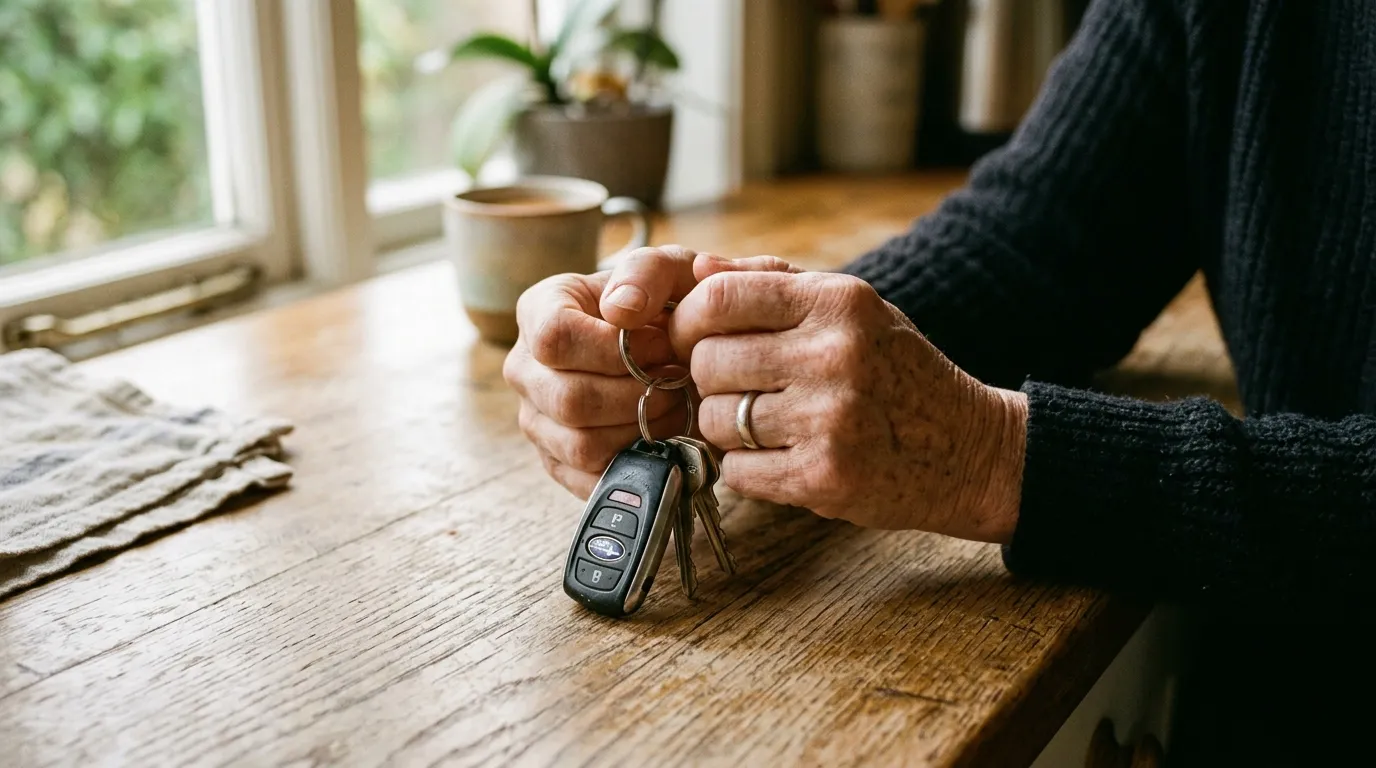
Those keys felt heavier than anything I had ever held before.
For the next year, my world shrank. I depended entirely on everyone else just to survive. My best friend Stella drove me whenever she could. My daughter helped with errands when she came to visit. Wonderful women from my church took turns taking me grocery shopping, and when all else failed, I relied on a patchwork of expensive taxis and delayed buses.
Every single ride came with the same heavy, uncomfortable feeling—the quiet guilt that I was inconveniencing somebody else. I hated being a burden.
The breaking point arrived on a Tuesday. I missed my eight-year-old granddaughter Emma’s very first piano recital. Stella’s ancient car wouldn’t start, the local cab company was backed up, and I simply couldn’t find another way to make the trip to Columbus.
Emma called me later that evening, her little voice trembling through the receiver.
“Grandma, why didn’t you come? You promised.”
Those words broke me completely. I cried myself to sleep that night, but by the time the sun came up, my tears had turned into resolve. The next morning, I marched down to the local driving school and enrolled.
Six grueling months later, I passed my driving test on the very first attempt. I was terrified, overly cautious, and undoubtedly the slowest new driver in the state of Ohio, but I finally had my license. The Chevy was mine to command. I thought the hardest part of my journey was officially in the rearview mirror.
Then, Ryan moved in across the street.
Ryan was in his late thirties. He drove a massive, aggressive black pickup truck that sounded like a jet engine, and he rarely bothered speaking to anyone in our quiet neighborhood. At first, I barely gave him a second thought. I was too busy enjoying my newfound freedom.
Until one morning, I walked outside and discovered his oversized truck parked terribly, its back end completely blocking my driveway.
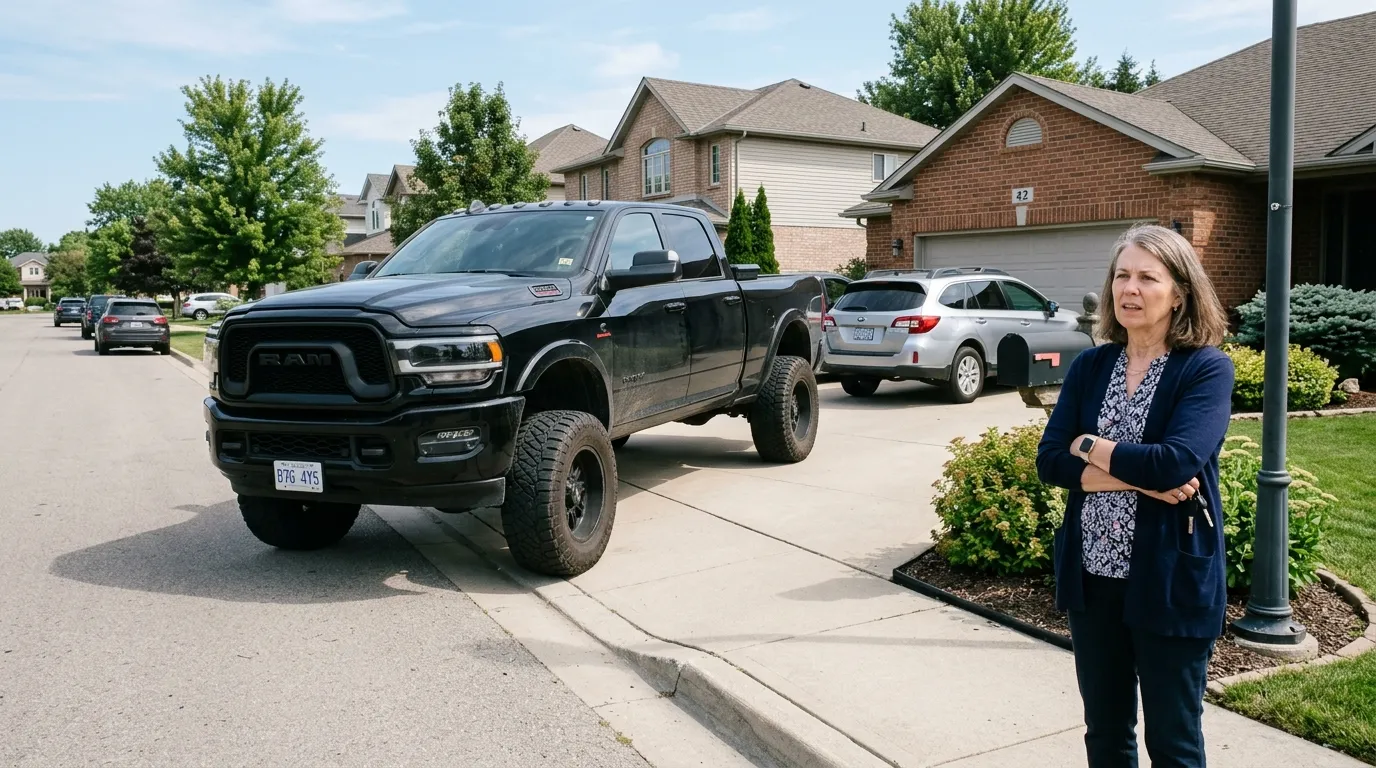
Ryan’s truck wasn’t just a vehicle; it was a loud, obnoxious statement.
I had a doctor’s appointment I couldn’t miss, so I walked across the street and politely knocked on his door.
“Ryan, good morning. Would you mind moving your truck just a bit? I need to leave,” I said, offering a neighborly smile.
He leaned against the doorframe, looked right past me toward my little Chevy, and then he laughed. It was a cruel, dismissive sound.
“Maybe take an Uber, Carol. Women your age have no business driving anyway.”
I stood on his porch, utterly stunned by the sheer audacity.
“That’s an incredibly rude thing to say to your neighbor,” I replied, my voice shaking slightly.
“It’s a true thing to say,” he shot back, and shut the door squarely in my face.
I ended up paying for a cab that day, trying my hardest to forget about his ignorance. But Ryan apparently wasn’t finished making his opinions known.
A few days later, I was carefully attempting to parallel park near the crowded farmers’ market downtown. The spot was tight, and I was taking my time. Suddenly, I heard him shouting from the sidewalk across the busy street.
“Careful, Carol! That mailbox didn’t do anything to you!”
A few pedestrians chuckled. My face burned with intense humiliation, but I took a deep breath, checked my mirrors, and finished parking perfectly. I locked my car and walked away with my head held high, refusing to give him the angry reaction he clearly wanted.
Unfortunately, his childish bullying soon escalated into something much more serious.
One Tuesday morning, I stepped outside to run errands and stopped dead in my tracks. All four tires on my Chevy were completely flat. Upon closer inspection, it was obvious they hadn’t just lost air—each one had been deliberately slashed with a blade.
Furious, I marched straight across the street and banged on his door.
“Why are you doing this to me?” I demanded when he answered.
Ryan barely blinked. He didn’t admit to it directly, but he didn’t deny it either. Instead, he repeated the same insulting garbage he had been pushing from the beginning: women, especially older women, simply shouldn’t be on the road. He actually looked me in the eye and told me that driving was “a man’s job.”
Having my car towed and replacing those four tires cost me $462. On a widow’s fixed budget, that was a painful, stressful amount of money. But I absolutely refused to be bullied out of my independence. I bought the tires, got my keys, and got right back behind the wheel.
I figured ignoring Ryan’s tantrums might eventually bore him. I was wrong.
At 6:47 on a Monday morning, a horrible, metallic grinding noise woke me from a dead sleep. I threw on my robe and slippers and rushed out the front door.
Ryan was standing casually in my driveway, holding a mug of coffee, directing two construction workers operating a small mobile crane. Hanging from the crane’s heavy chains was an enormous, solid concrete block.
Before I could even process what was happening or shout for them to stop, they lowered the massive slab directly behind my Chevy. THUD.
My car was completely, hopelessly trapped.
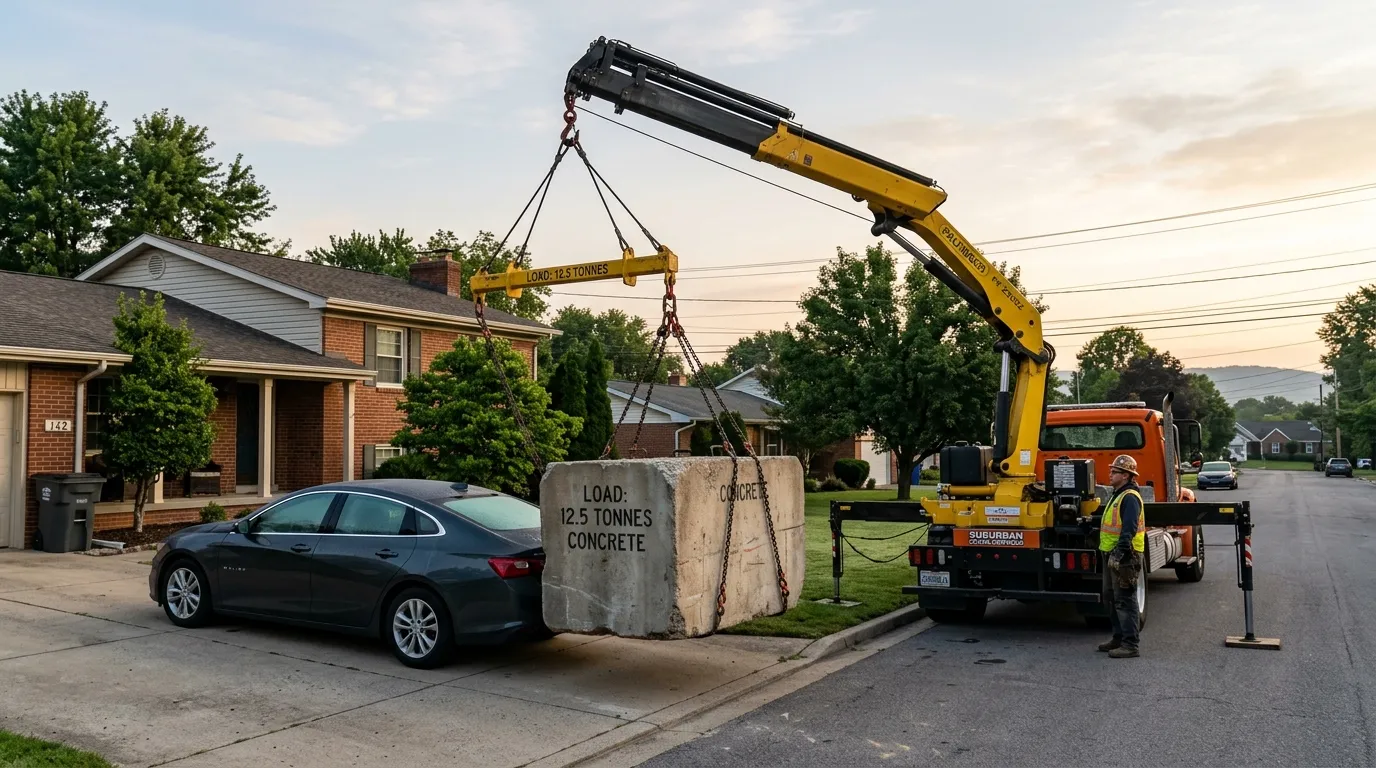
The absolute absurdity of a giant concrete block placed right behind my car.
“What on earth are you doing?!” I screamed, clutching my robe.
Ryan smiled over his coffee mug. He smoothly claimed that the very edge of my driveway crossed over onto his property line. He said his “surveyor” had determined he had every legal right to place the block exactly where it sat.
When I threatened to call the police immediately, he just shrugged his shoulders. He confidently explained that the police wouldn’t touch it. It would become a civil property dispute, require expensive lawyers, cost me thousands of dollars, and potentially take months to resolve in court.
Then he leaned a little closer, his voice dripping with condescension.
“Take an Uber, sweetheart.”
I wanted to scream until my lungs gave out. I wanted to smash his coffee mug. Instead, I spun on my heel, went back inside, and locked my door. I leaned against the wood and cried for exactly ninety seconds.
Then, my brain cleared, and I remembered something incredibly important.
Three weeks earlier, at our neighborhood Fourth of July barbecue, I had met Ryan’s mother. Her name was Patricia. She was a petite woman, somewhere around seventy, with elegant silver hair, a crisp navy cardigan, and the unmistakable, weary expression of a woman who had spent years losing patience with her own son.
At that barbecue, Ryan had been several beers deep and loudly bragging to anyone who would listen that his mother was responsible for him having his beautiful house, and that she would “handle anybody” who ever tried to challenge him.
Patricia hadn’t laughed at his boasting. In fact, later that evening, she had quietly slipped away from the crowd and approached me by the potato salad.
“You’re Carol, aren’t you? The widow who lives across the street from my son?”
“Yes, I am,” I had replied cautiously.
Without another word, she slipped a small, folded piece of paper into my hand.
“If he ever crosses a line with you, call me. Not him. Me.”
I had tucked that slip of paper inside my old floral address book and completely forgotten about it. Until this exact moment.
I tore through my kitchen drawer, flipping through the worn pages of the book. There it was. Patricia. A phone number was written neatly in blue ink underneath.
I picked up my phone and dialed. She answered on the second ring.
“Carol?”
“Yes. Patricia, I am so sorry to bother you so early in the morning, but—”
Her tone changed instantly, sharpening like a freshly whetted blade. “What did he do?”
So, I told her everything. I told her about the blocked driveway. The cruel insults about my age. The slashed tires and the $462 bill. And finally, the massive concrete block currently trapping my car.
When I finished speaking, there was a long, heavy silence on the line.
Then, Patricia spoke.
“I’ll be there in less than five minutes.”
She hung up.
At exactly 7:02 AM, a pristine silver sedan turned onto our quiet street and parked sharply at the curb. Patricia stepped out. She wasn’t wearing a cardigan today; she was dressed in sharp business attire, carrying a thick manila folder.
Ryan was still sitting comfortably on his front porch, enjoying the morning breeze. The second he saw his mother’s car, the smug color drained completely from his face. He went stark white.
Patricia didn’t even look at him. She marched straight over to my driveway, inspected the concrete block, looked at my trapped Chevy, and immediately pulled out her cell phone.
“The entire block,” she said into the phone, her voice carrying across the street. “I want it removed within the hour. Yes. Bill it to my account.”
That was when Ryan came sprinting across the street, his bathrobe flapping wildly.
“Mom! Mom, wait! What are you doing?”
Seeing her absolute fury, he suddenly and desperately tried to change his story.
“It was a joke! A neighborhood prank!” He looked at me, his eyes wide with panic. “Carol knows it was a joke. Tell her, Carol!”
I calmly folded my arms across my chest.
“Funny,” I said flatly. “I must have forgotten to laugh.”
Patricia finally turned to him. She opened her thick folder, removed a stapled legal document, and shoved it directly into her son’s chest. Then, she calmly revealed the brilliant detail Ryan had never expected me to learn.
The house across the street didn’t belong to him.
It belonged entirely to Patricia. Ryan, the big tough guy, was merely renting it from his mommy—and he was currently three months behind on his rent.
Even worse for him, the lease he had signed explicitly prohibited the harassment of neighbors and strictly forbade unauthorized property alterations.
Patricia glared at the concrete block, then back at him. “I’d say this little stunt qualifies as both.”
Ryan stared at her, utterly speechless.
Then, Patricia delivered the final blow.
“You have thirty days to move your things out of my house.”
Suddenly, the man who had spent weeks terrorizing and mocking me looked like a terrified little boy.
“Mom, please. Be reasonable. Where am I supposed to go?”
Patricia adjusted her glasses and looked him dead in the eye.
“Anywhere that teaches you some damn manners.”
Panicking, Ryan turned toward me and started offering a frantic string of apologies and empty promises. I stood quiet and let him babble.
When he finally ran out of breath, I looked at him and simply reminded him that being a man didn’t give him ownership over the roads, the neighborhood, or the women around him.
And as I turned to walk back inside my house, I couldn’t resist borrowing his absolute favorite piece of advice.
“Maybe try an Uber.”
For the first time since she arrived, I saw the corner of Patricia’s mouth twitch into a satisfied smile.
The concrete block was gone before 8:00 AM. My driveway, and my freedom, were mine again.
But the biggest, most wonderful surprise came afterward. Patricia stayed for a cup of coffee at my kitchen table. That was when she opened up and told me her own story.
For thirty-one years, her former husband had ruthlessly controlled her. He told her women couldn’t drive. He locked up the car keys, managed the finances, and decided exactly where she was allowed to go. She had finally summoned the courage to leave him at fifty-two years old. And one of the very first things she did after walking out? She learned how to drive.
Suddenly, it all made sense. I understood exactly why Ryan’s behavior had triggered such a fierce reaction in her. She had spent decades suffering under the weight of those same toxic words from his father. And despite her best efforts to raise Ryan differently, she had to watch her son repeat the cycle he had grown up witnessing.
Ryan moved out twenty-eight days later.
On his last day, just before leaving, he walked up to my front door. This time, there were no crude jokes. There was no smug, arrogant smile.
He genuinely apologized for the slashed tires, the truck in my driveway, the concrete block, and every single ugly thing he had said about my age and my gender. Then, he handed me a white envelope. Inside was $462 in cash for my new tires, plus an extra $28 for the cab ride I had to take.
As he turned and walked away, he paused at the bottom of my porch steps and looked back.
“For what it’s worth, Carol…” he said quietly.
I waited.
“You’re a really good parallel parker.”
Then, he climbed into his loud truck and drove away for good.
Patricia eventually sold the property to a lovely young family with two golden retrievers. But thankfully, she didn’t disappear from my life. She became one of my dearest friends. Today, every single Thursday without fail, she joins Stella and me for breakfast at our favorite local diner.
A few months after the concrete block incident, I finally did something I had once believed was utterly impossible for me.
I packed an overnight bag, keyed the ignition of my Chevy, and drove four hours down the highway to Columbus. By myself.
Emma had her second piano recital.
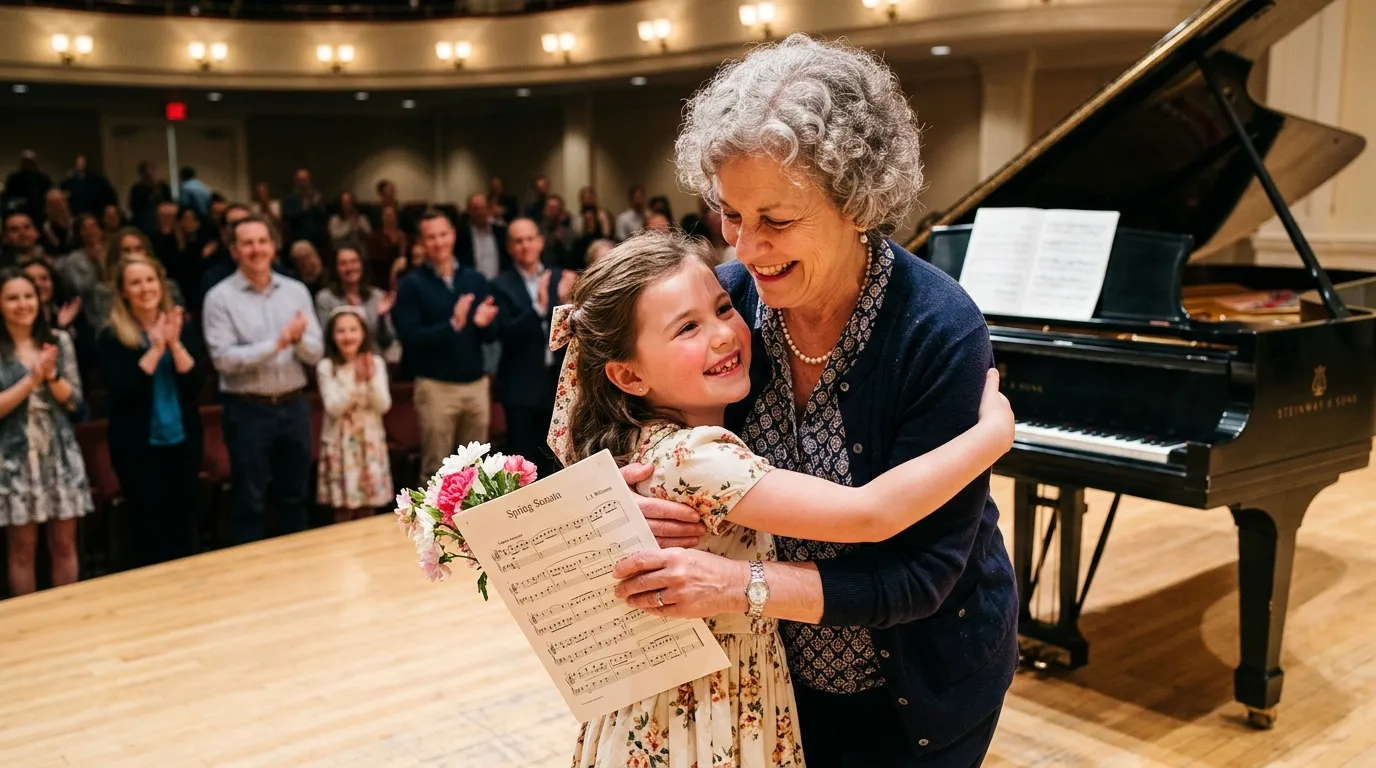
Four hours on the highway, all for this one perfect moment.
When my granddaughter walked onto the brightly lit stage, she nervously scanned the audience. Then, she saw me sitting in the third row. Her entire face lit up like a Christmas tree.
After she played beautifully, she ran down the aisle and launched herself into my arms.
“You came! Grandma, how did you get here?”
I hugged her tight and smiled.
“I drove.”
Her little mouth fell open in absolute shock.
“You drove all by yourself?”
“Four whole hours,” I beamed.
She stared at me in awe for a second, then grinned from ear to ear.
“Grandma, that’s so cool.”
I got my driver’s license at sixty years old thinking that independence meant I would never need to rely on anyone ever again. I thought it meant doing everything completely alone.
I was wrong.
Sometimes, true strength means finally learning to steer your own life. But sometimes, strength means knowing exactly when to pick up the phone and ask the right person for a little bit of help.
That turned out to be one of the most important lessons I ever learned on the road.
Note:This work is inspired by real events and people, but it has been fictionalized for creative purposes. Names, characters, and details have been changed to protect privacy and enhance the narrative. Any resemblance to actual persons, living or dead, or actual events is purely coincidental and not intended by the author.
All images used in this article are AI-generated and intended for illustrative purposes only.
0 Comments