
Six agonizing years after my husband, Daniel, and our three beautiful sons disappeared on a weekend fishing trip, I still hadn’t found the strength to empty their rooms. The house had grown around their absence, but their spaces remained untouched.
Everything in those rooms remained almost exactly as they had left it on that fateful Friday morning. Their jackets hung on the backs of chairs, their favorite books were stacked on nightstands, and the faint, lingering scent of their cologne still haunted the hallways.
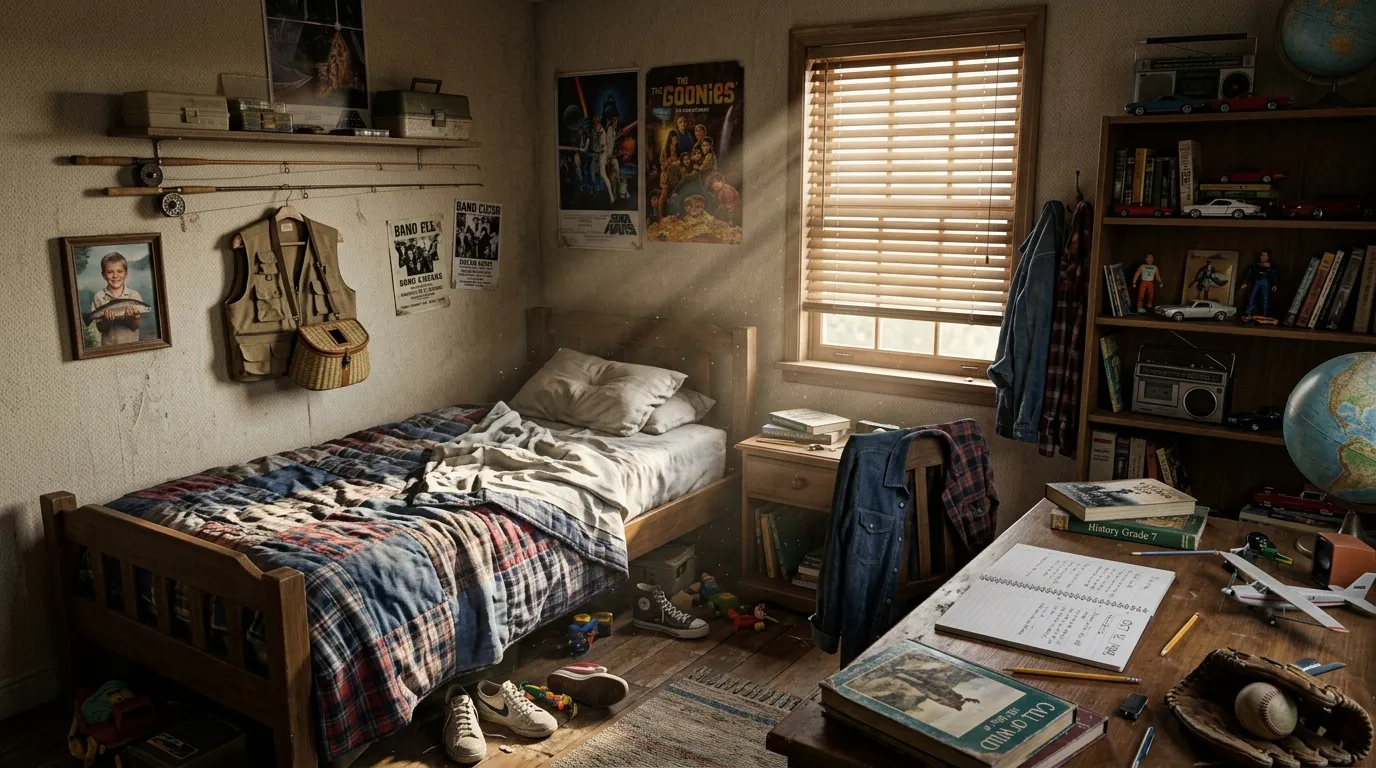
The rooms remained exactly as they had left them, a quiet shrine to the boys who never came home.
Then, one quiet Sunday afternoon, my oldest daughter, Sophie, found an old, cracked smartphone buried at the very bottom of a dusty electronics box.
It belonged to Daniel.
It was the exact phone he had told me he lost nearly a year before the fishing trip. We had searched everywhere for it—under couch cushions, in the car, beneath the garage workbench—before he finally gave up and bought a replacement.
Sophie silently found a matching cord and charged it. We sat at the kitchen table, watching the cracked screen flicker to life. What we found inside that digital time capsule didn’t just break my heart all over again; it changed absolutely everything.
The Last Photograph
Before the phone powered on, my mind drifted back to the driveway. I remembered the video and the photographs from the day before Daniel and our boys disappeared. There was one specific memory that always played on a loop in my mind.
“Everybody look at me for three seconds,” I had pleaded.
Daniel was standing beside his heavy-duty truck, meticulously checking the straps on the boat trailer for what had to be the fourth time. I was desperately trying to get the boys to stand still long enough for a single, unblurred family photograph.
“Three seconds,” I begged. “That’s all I’m asking.”
“Dad’s squishing me,” my youngest complained, wiggling under his father’s grip.
Daniel just tightened his arm playfully around his small shoulders. “Good. Maybe you’ll stay still.”
The boys erupted into laughter. I raised my phone. Click.
Daniel immediately glanced back toward the truck, his mind already on the checklist. “Life jackets?”
Three identical, exasperated groans answered him. “Yes, Dad.”
“Whistles?”
“Three seconds,” I said again, trying to pull their attention back.
My middle son threw his head back dramatically. “Dad, they’re packed.”
Daniel nodded with utter seriousness, as if he’d just received confirmation that national security was secure. That was my husband. He was a man who filled the gas tank before every road trip, checked the weather twice, and then checked it a third time because he believed the atmosphere could drastically change in seventeen seconds.
Daniel had fished that specific lake for three years. He knew every hidden launch point, every shallow stretch of water, and every treacherous cove where the current became unpredictable after a heavy rain. He knew that sprawling lake better than most people knew their own neighborhood streets.
That morning, I kissed him goodbye. I reminded the boys not to survive the entire weekend on potato chips and soda. Daniel climbed into the driver’s seat of the truck.
“Sunday night,” he promised.
“I know.”
He smiled warmly through the open window. “Miss me responsibly.”
“Go,” I laughed.
The boys waved enthusiastically from the back seat. I took one last picture as the truck pulled away, tires crunching on the gravel. At the time, I thought I was simply capturing another mundane family memory. I had absolutely no idea I had just photographed four people I would never, ever see again.
The Unanswered Question
Sunday evening finally came. Dinner sat on the stove and got cold.
At seven o’clock, I called Daniel. No answer.
At seven-thirty, I called our oldest son. The phone rang until it went to voicemail.
By eight o’clock, I was deeply annoyed.
By nine o’clock, I was terrified.
At ten-fifteen, I called the police.
The very next morning, Daniel’s truck was found parked near the marina. The empty boat trailer was still faithfully attached to the hitch. His wallet was sitting safely inside the center console. So were two of their jackets.
The boat was discovered several hours later, washed up on the opposite shore of the lake. It was completely empty and badly damaged from striking the rocks.
Search teams spent weeks meticulously combing the massive lake. Divers plunged into the murky water. Boats crisscrossed the shoreline. Helicopters chopped through the sky from above, while hundreds of volunteers walked the muddy banks. Everyone searched. The entire community rallied around us.
But nobody found Daniel. Nobody found the boys.
Eventually, the official conclusion became the only explanation anyone could offer me: A tragic boating accident. A sudden, strong current. Bodies likely carried away into the deep.
I nodded numbly whenever people said it. I signed the horrible paperwork. I listened to the sympathetic explanations from the authorities. Then I went home to three grieving daughters and four glaringly empty places at our dining room table.
But one question never, ever stopped scratching at the back of my mind. How?
Daniel was careful. He was painfully, obsessively careful. If the forecast looked even slightly bad, he canceled. If equipment needed minor repairs, the trip waited. If one of the boys had forgotten a life jacket, Daniel would have driven all the way home before ever launching the boat without it.
So how had a man like that taken all three of our precious sons onto a lake and never brought any of them home? Nobody could answer me.
Daniel’s brother, Dean, certainly tried. He was around constantly after the accident, a ghost of his brother helping us pick up the pieces. He changed a flat tire for me in the pouring rain because I had completely forgotten that ordinary, mundane things like cars and flat tires continued to exist even after your entire life had fallen apart.
But whenever I mentioned the lake, something shifted in Dean’s expression.
“Andrea, you have to stop,” he would say softly.
“I just want to understand.”
“You can’t. It was an accident.”
“What if they missed something? What if Daniel turned around because something happened?”
Dean would rub both hands exhaustedly over his face. Then he’d give me some version of the exact same answer: “You have three daughters who still need you.”
I hated him for saying that. Not because he was wrong, but because it sounded far too much like: Forget the other four.
I never did.
The Ghost in the Machine
Six years passed. The girls grew up around the massive crater of absence in our home. One daughter started college. Another learned to drive. The youngest eventually stopped asking when her brothers were coming home.
And I still couldn’t bring myself to empty those rooms.
Then, Sophie finally said what everyone else had apparently been too afraid to say.
“Mom, we need to go through their things.”
I looked at her. She was standing in the doorway of her brothers’ room, holding an empty, flattened cardboard box.
“No,” I said firmly.
“Mom…”
“I said no, Sophie.”
“We’re not throwing anything away,” she urged gently. “Just donating what somebody else could actually use.”
I stared past her into the dim room. It wasn’t a shrine. At least, that’s the lie I kept telling myself. But too many things were still exactly where they’d been. Their neatly folded clothes. Their scuffed old shoes. Fishing gear. Heavy schoolbooks. Toys they had long outgrown.
They were little objects that had once seemed completely meaningless, but had become utterly priceless the moment they were no longer there to leave them behind.
Some foolish part of me had never stopped expecting footsteps in the hallway. A door creaking open. One of the boys shouting for me from the stairs.
Sophie lowered her voice, her eyes filling with sudden tears. “Mom… they’re not coming back for these.”
The words cut deep. She knew they would. “I’m sorry,” she whispered.
I looked away, swallowed the lump in my throat, and reached for another box. “Fine.”
We started packing. I lasted less than an hour before the memories became too suffocating. I finally escaped to the kitchen and started aggressively preparing dinner, even though it was only two in the afternoon. I just needed an excuse to leave that room.
That was the afternoon Sophie found the phone.
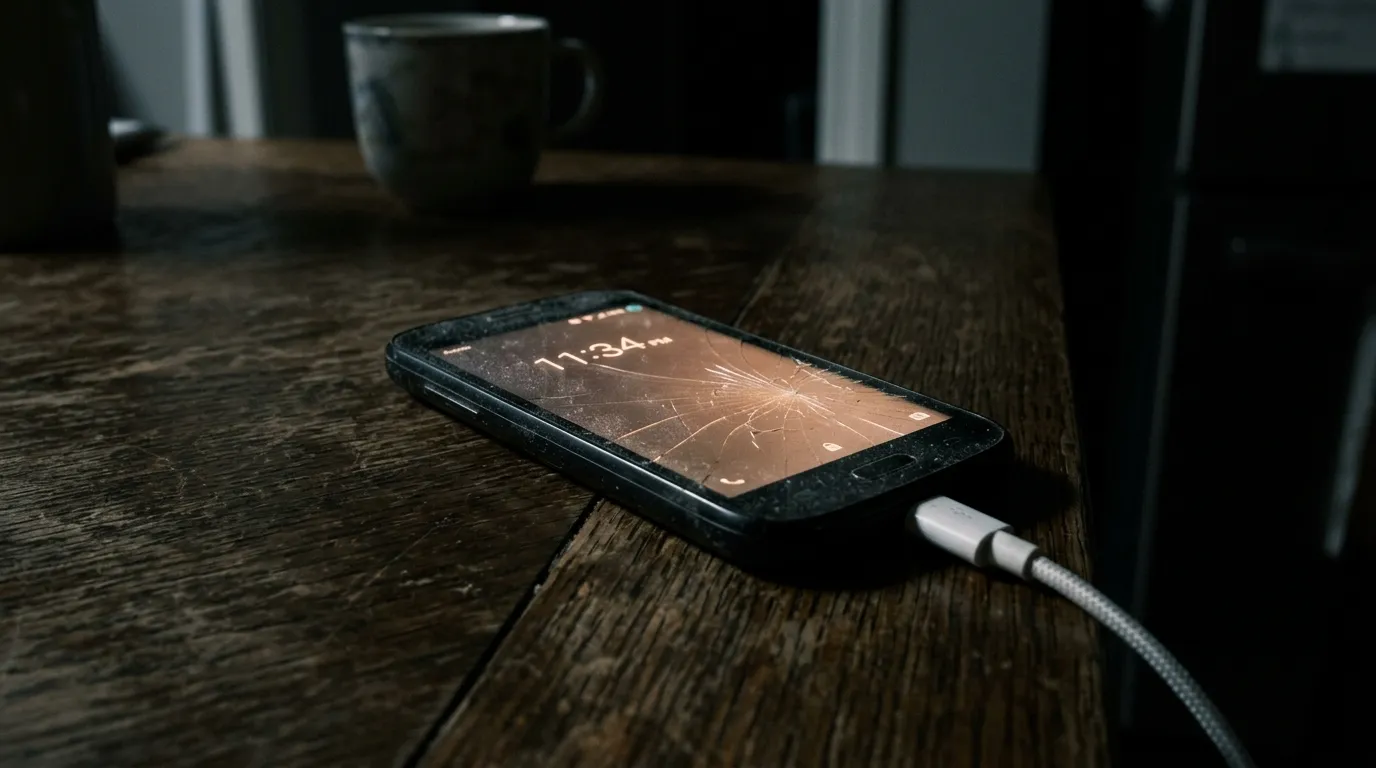
When the old, cracked screen finally lit up, it felt like opening a door to the past.
She came into the kitchen holding a black rectangle with a cracked corner. “Mom? Wasn’t this Dad’s?”
My heart began pounding against my ribs. I took it from her. It was Daniel’s old phone. The one he’d lost so long ago.
“Where was this?” I breathed.
“Bottom of the electronics bin.”
It was completely dead. Sophie found a matching charger, plugged it into the wall, and set it on the table. She sat beside it as though she were waiting for a medical monitor to show a pulse.
“Mom, what if there are pictures?” she asked, her voice trembling. “What if there are videos? Voice notes?”
I couldn’t answer. When the phone finally powered on and automatically connected to our home Wi-Fi, old photographs began appearing in the gallery. I couldn’t watch. Not yet. I left her at the table and fled upstairs.
A few minutes later, I heard her sprinting down the hallway.
“Mom…”
Something frantic in her voice made me turn. Sophie was standing in my bedroom doorway, her face ghostly pale. She was clutching the phone with both hands.
“What happened?”
She swallowed hard. “There’s a video that synced from Dad’s cloud account. It’s from the day before the fishing trip.” She stepped toward me, her eyes locked on mine. “Mom, I know what really happened back then. Dad wasn’t alone in it.”
I stared at her, uncomprehending. “What?”
“Uncle Dean was there.”
The Hidden Truth
She pressed play.
Daniel appeared on the small screen. He had propped the phone on his workbench while meticulously checking his fishing equipment. He was vibrant. Alive. Laughing. Moving around the garage with that easy grace I missed so terribly.
For six long years, I had replayed the last day I saw him in my mind. Now, I was watching him again. Alive.
Then, someone walked into the frame behind him. Dean.
I stared at the screen in disbelief. “What is he doing there?”
On the video, Dean’s voice was clear. “I’m not going, man.”
Daniel looked up sharply from his tackle box. “What do you mean you’re not going?”
I turned toward Sophie, my pulse roaring in my ears. “Going where?”
“Fishing, I think,” she whispered.
Dean had been invited. And in six years of mourning, six years of sitting at our table, he had never once told me.
On the video, Daniel threw a bright orange life jacket onto the workbench. “You need this weekend.”
Dean laughed bitterly. “My girlfriend walked out three months ago, Dan. Sitting on a boat fishing isn’t going to fix that.”
Daniel looked at his brother with deep empathy. “No. But sitting alone in your dark house won’t either. Come with us.”
“No.”
“Fine.” Daniel picked up another life jacket. He checked the nylon straps carefully. Then, he said something that made every single hair on my arms stand straight up.
“Kids don’t remember every expensive thing you buy them, Dean,” Daniel said, pulling hard on the plastic buckle to test its strength. “They remember whether you came back.”
The video froze for half a second as it buffered. My breath caught in my throat. Daniel had said those haunting words the day before he disappeared.
But that wasn’t all.
Daniel looked back at Dean. “Fine. Don’t come fishing. But come over Sunday night. The boys are going to talk your ear off whether you like it or not.”
The video ended.
Sophie opened another folder. “Dad’s old phone was still connected to the same account as his new one. Look at this.”
She showed me a saved GPS location. It was a small outdoor-supply store, miles out of the way from Daniel’s usual, meticulously planned route to the marina. The timestamp was glaring: Sunday morning. The very day they disappeared.
“Why would he go there?” I asked.
Sophie shook her head. “I don’t know. But we need to find out.”
Retracing Their Steps
We drove to the store. It was small, dusty, and smelled of cedar and bait. An older employee with a gray beard studied the last photograph I’d taken in our driveway.
He stared at the boys for a long moment. Then, he pointed a weathered finger at the screen. “These three.”
My heart jumped into my throat. “You remember them?”
“Hard not to,” he chuckled softly. “They argued for ten straight minutes over whistle colors.”
“Whistles?”
“Orange emergency whistles. Your husband bought one for each boy. Made them put them on lanyards right there at the register.”
That sounded exactly like Daniel. Always preparing for the worst.
Then the employee added something that made me freeze. “And he bought another adult flotation vest.”
I frowned, confused. “He already had one.”
The employee shrugged. “Said his brother might be meeting them at the lake.”
I left the store and drove straight to Dean’s house. I banged on the door until he opened it. He took one look at my pale face and the tears streaming down my cheeks.
“What happened, Andrea?”
I held up Daniel’s old, cracked phone like a weapon. “You were supposed to go with them.”
Dean looked as though he’d been struck by lightning. He stepped back, the color draining completely from his face. The silence stretched between us, thick and suffocating.
“I changed my mind Sunday morning,” he finally whispered, his voice cracking.
“What?”
“I woke up and decided to go. I was driving toward the lake to surprise him when the emergency vehicles passed me on the highway.” Dean’s eyes filled with hot, heavy tears. “I got there right after the search started.”
My voice shook with anger and grief. “Why didn’t you tell me? For six years, Dean!”
“What would it have changed, Andrea?!” he cried out. “I’ve spent six years thinking that if I had just been on that boat, maybe there would’ve been another adult to help. Maybe I could’ve done something to save them.”
“And you decided I couldn’t handle knowing that?”
“I thought you had enough weight to carry,” he sobbed, burying his face in his hands.
I stared at the broken man in front of me. The anger slowly drained away, replaced by a profound, hollow sadness. I told him about the trip to the store. About the extra flotation vest.
Dean looked up, bewildered. “He bought that for me?”
“Apparently.”
His face crumpled entirely. “I never even used it.”
The Orange Whistle
That realization birthed our next desperate question: If Dean never boarded the boat, where had that extra life vest gone? And where were the orange whistles?
We contacted a retired search coordinator who had worked the case. He helped us review the old, dusty recovery inventory. Most of the gear had been quickly cataloged without anyone knowing exactly what Daniel had originally packed.
Now, we had an exact inventory. And the numbers didn’t match.
The spare adult flotation vest was missing. So was one of the orange emergency whistles.
The coordinator stared at the printed report for a very long time, tracing the lines with his pen. Then, he looked up at me and said something that made my stomach twist into knots.
“There was another incident on that lake that same afternoon, Mrs. Miller.”
“What incident?”
“A small aluminum boat capsized just before the storm hit. An older man and his teenage grandson were in the water.”
“Did they survive?”
“Both of them,” he confirmed, tapping the paper.
I gripped the cold edge of the metal table to steady myself. “Who helped them?”
He adjusted his glasses and read the fine print. “The official statement says another passing fishing boat reached them first and provided flotation devices before the weather turned.”
My heart hammered against my ribs. “Who was on the boat?”
“One adult male. Several young boys.”
A wave of sheer dizziness hit me. Sophie grabbed my hand, her grip bruising. I already knew.
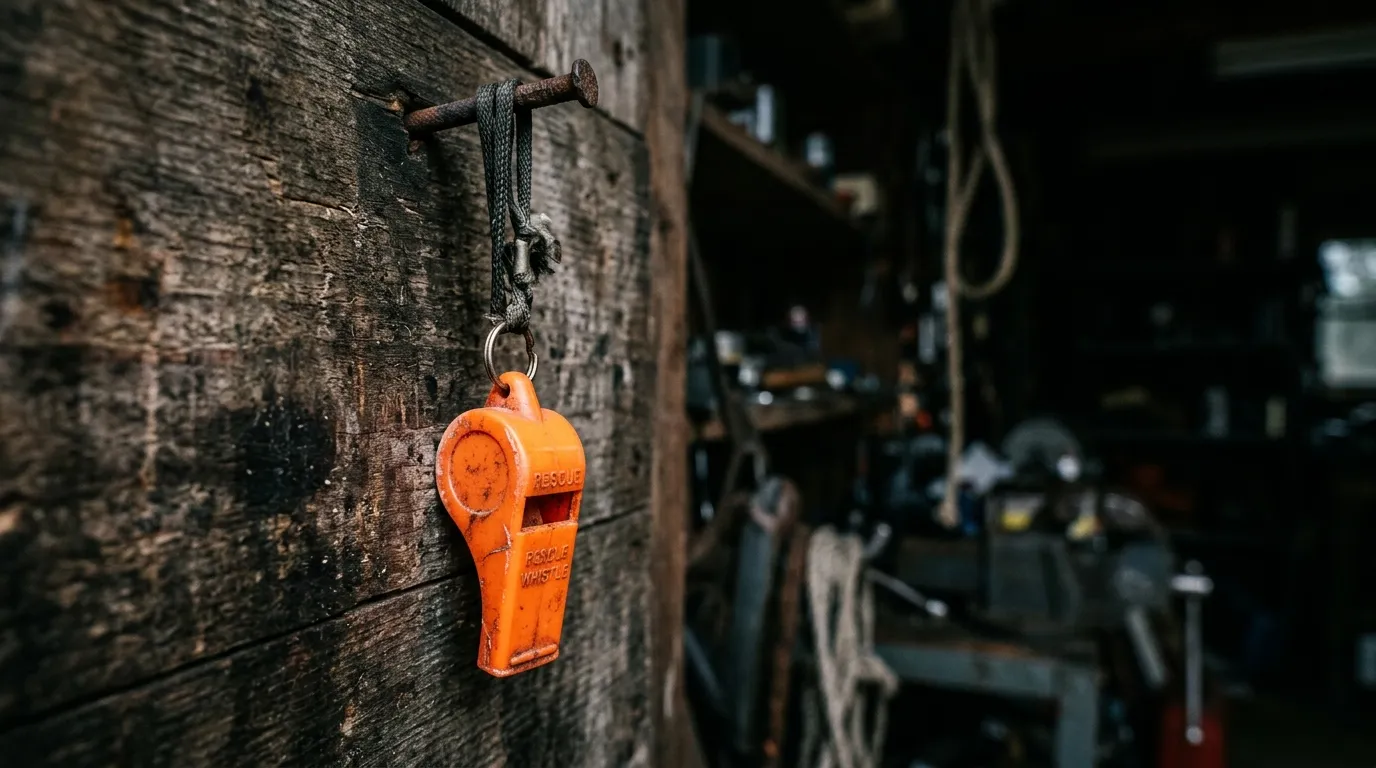
It was cheap plastic, bright orange, and it was the proof I had been searching for.
Through police records, we tracked down the grandfather. The man still had the whistle when we met him. Six years later, it hung respectfully from a nail in his garage. It was orange. It was cheap plastic. It was Daniel’s.
When I showed the old man our driveway photograph, he didn’t hesitate. He pointed a trembling finger at my husband and my sons.
“That’s them,” he said, his eyes watering. “God bless them, that’s them.”
My knees nearly gave out. He invited us in and told us the story he had carried for six years.
His boat had overturned when a freak storm rolled in much faster than any weather forecast had predicted. His grandson, Ben, had been panicking, struggling to keep his head above the choppy, freezing water.
Then, Daniel’s boat appeared through the mist.
The man described how the boys immediately threw their flotation gear into the water. One of the boys—a loud, commanding kid—kept shouting instructions over the roaring wind.
“Both arms! Put both arms through!”
I covered my mouth to muffle my sob. Sophie buried her face in my shoulder. I knew that voice without even hearing it. My bossy, fiercely protective middle son used to bark those exact words whenever he helped his younger sisters put on their heavy winter backpacks.
“Both arms.”
The grandfather smiled sadly, wiping a tear from his weathered cheek. “That brave kid wouldn’t stop yelling until my Ben had the vest on right. Your husband made sure we were secure.”
Another, larger rescue boat eventually reached them. Daniel waited, holding his boat steady in the terrible chop, until he was certain help had arrived. Only then did he turn his boat toward the shore as the weather violently worsened.
That was the very last thing the grandfather remembered seeing through the rain.
There was no magical explanation. No secret survival on a hidden island. No hidden rescue. It was just the beautiful, heartbreaking truth of the last known thing my husband and sons had done on this earth.
They had stopped. Because someone needed help.
What Remains
Ben was eighteen years old now. When he walked out into the garage to meet us, I stared at him longer than is socially polite. For six long years, I had counted the children who never came home. Standing right in front of me, breathing and alive, was one who had.
He barely remembered Daniel’s face. But he remembered the shouting through the rain.
“Both arms.”
That was enough. It was more than enough.
The final hours of my sons’ short lives had always existed only in the darkest corners of my imagination. I had pictured only cold water. Paralyzing fear. Unimaginable panic. Pitch darkness.
Now, I finally knew there had been something else entirely. Their voices. Their taught habits. Their deep, intrinsic instinct to help someone who was in trouble. I saw them.
That evening, Sophie and I went back upstairs to the bedrooms. The flattened donation boxes still covered the floor.
She looked at me tentatively. “Should we put everything back?”
I looked around the room. For six years, I’d kept their belongings frozen in amber because some broken part of me believed that moving their things meant moving away from the people who had owned them.
But I finally understood something vital. Keeping a room frozen in place wasn’t the same thing as keeping their memory alive.
“No,” I said, taking a deep breath of the dusty air. I picked up a box and opened it. “We started. We finish.”
A few days later, we met Dean, Ben, and his grandfather at a quiet park near the edge of the lake. The water was perfectly calm, reflecting the golden hues of the setting sun.
I brought one of my sons’ favorite fishing rods. When I offered it to Ben, he stared at it with wide eyes.
“He would’ve absolutely hated seeing a perfectly good rod sitting uselessly in a dark closet,” I told him.
Ben took it carefully, as if handling glass, and whispered his thanks.
Dean stood close beside me, looking out toward the vast, glittering water. The heavy burden he had carried for years seemed just a fraction lighter. “I’ve spent six years thinking an empty place on that boat belonged to me,” he said quietly.
I looked at the bright orange whistle resting in the grandfather’s hand. “Maybe not everything Daniel packed ended up where he expected it to.”
Dean’s eyes filled with tears, and he nodded.
A few feet away, Sophie quietly raised her phone.
“Mom,” she called out.
I turned. For one terrible, breath-stealing second, all I could see was that gravel driveway six years earlier. Daniel laughing. Three boys groaning about pictures. The last photograph.
The memory hit so hard that I almost couldn’t breathe.
Sophie looked at her screen, framing the shot. “Closer.”
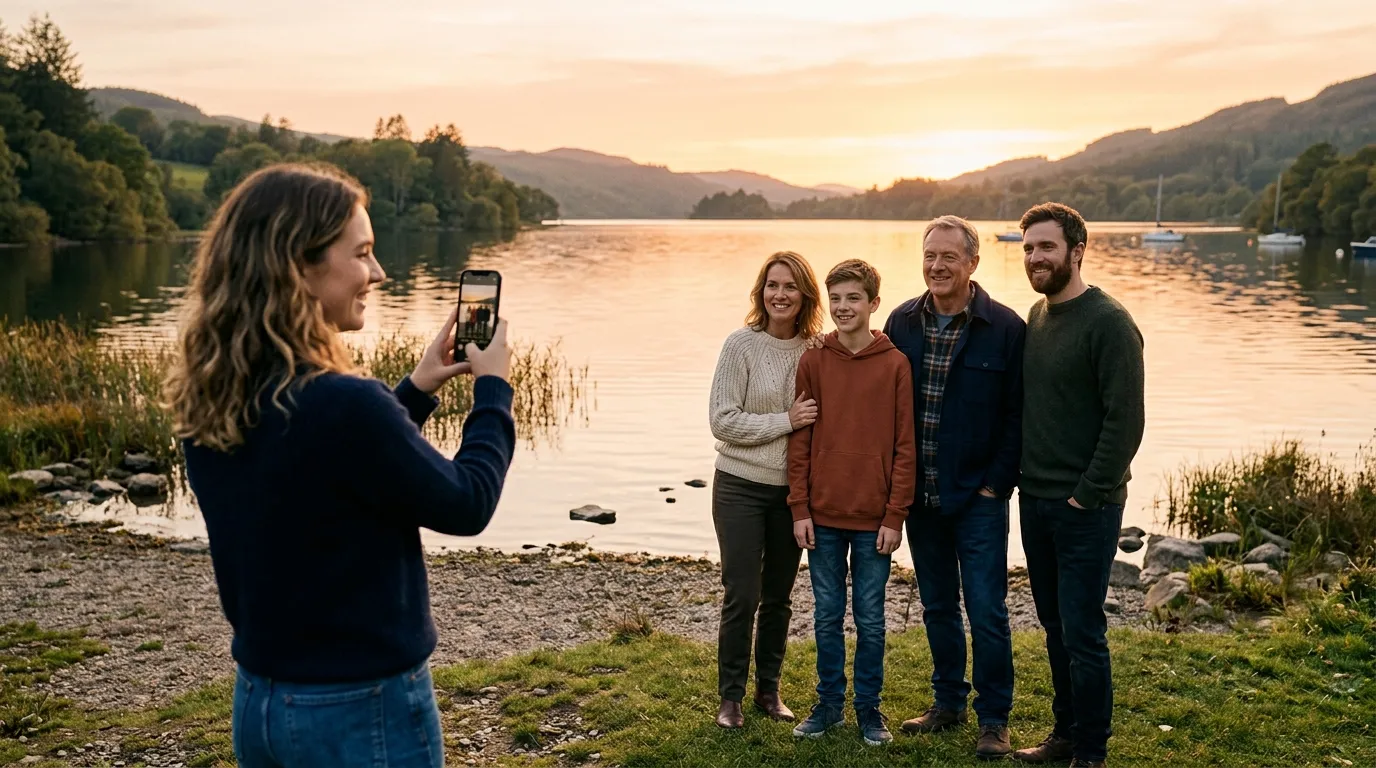
We were connected not just by tragedy, but by the love and heroism that survived it.
Dean stepped up beside me, putting an arm around my shoulder. Ben held the fishing rod proudly. His grandfather rested a loving hand on the teenager’s shoulder.
Nobody replaced anybody. Nobody ever could. But we were all intrinsically connected by the grace of what happened on that water.
Sophie smiled brightly. Click.
The digital shutter sounded. And this time, I didn’t wonder who might disappear after the picture was taken. I simply let myself be in it, fully present.
For six long years, I had believed the last photograph of my family was the one I took as Daniel and our boys drove toward the lake. I had thought that picture represented the exact moment everything was brutally taken from me.
But standing beside the lake that day, feeling the warm sun on my face, I finally understood that it meant something entirely different.
It was the last picture before the tragedy, yes. But it didn’t have to be the absolute last picture of what my family left behind.
Because Daniel and my brave sons had not simply disappeared into the dark water. They had left behind indelible evidence of exactly who they were. A careful, loving father who checked every life jacket twice. Three brothers who knew exactly how to help someone in trouble. A husband who truly believed that people mattered far more than possessions.
And three boys who, in the final terrifying moments anyone could remember, stopped what they were doing because another child needed saving.
For six years, I had been desperately searching for the moment my family disappeared. Instead, thanks to a lost phone, I found one of the very last moments they were exactly who I always knew them to be.
And somehow, beautifully, that made it possible for me to finally take another picture. This time, I didn’t take it to remember what I had lost. I took it to celebrate what remained.
Note:This work is inspired by real events and people, but it has been fictionalized for creative purposes. Names, characters, and details have been changed to protect privacy and enhance the narrative. Any resemblance to actual persons, living or dead, or actual events is purely coincidental and not intended by the author.
All images used in this article are AI-generated and intended for illustrative purposes only.
0 Comments