
Claire Montgomery controlled approximately $3 billion in assets. She ran a sprawling logistics empire that seamlessly moved massive freight across six continents, and she had spent the better part of her adult life surrounded by people who were highly accustomed to telling her exactly what she wanted to hear.
At 34 years old, she was entirely used to being watched.
Men often looked at her with a quiet, calculating intensity, intimidated by her immense wealth or silently wondering how they might benefit from a close proximity to it. Women sometimes regarded her with a complicated mixture of intense scrutiny and thinly veiled envy. Her own employees meticulously studied the microscopic changes in her facial expressions before deciding just how confidently they could speak in the boardroom.
Claire rarely had to wonder what kind of effect she had on a room. She owned the room.
That was precisely why the man sitting alone on the public beach bothered her almost immediately.

Wealth had turned geography itself into a form of separation.
The day had begun at her sprawling estate on Carbon Beach, a place where extreme wealth had essentially turned geography into a physical barrier. Her house stood proudly behind floor-to-ceiling glass panels. An expansive infinity pool seemed to merge seamlessly with the vast Pacific Ocean. A private security detail occupied a sleek black SUV parked strategically near the end of her winding driveway.
Claire should have been inside working.
A massive supply-chain bottleneck in Rotterdam had aggressively consumed most of her attention for days. Shareholders were demanding answers. Suppliers were busy blaming one another for the delays. Managers desperately needed decisions that only she could make.
She couldn’t breathe. She needed to walk.
Stepping off her private deck, she wore an $800 black one-piece swimsuit and a pair of designer sunglasses that cost more than many people’s monthly rent. For approximately two miles, she followed the shoreline, walking through the beautifully quiet, pristine stretch of beach that belonged exclusively to the multi-million dollar houses surrounding hers.
Usually, Claire would turn back long before reaching the public section of the coastline.
But on that particular day, feeling restless, agitated, and entirely unable to quiet the mounting anxiety inside her chest, she simply kept walking.
The beach began to change gradually. Perfectly raked, untouched sand slowly gave way to brightly colored umbrellas, chaotic families, running children, plastic coolers, loud music, and overlapping voices.
It was the vibrant, beautiful disorder of ordinary life.
And that was exactly where she saw him.
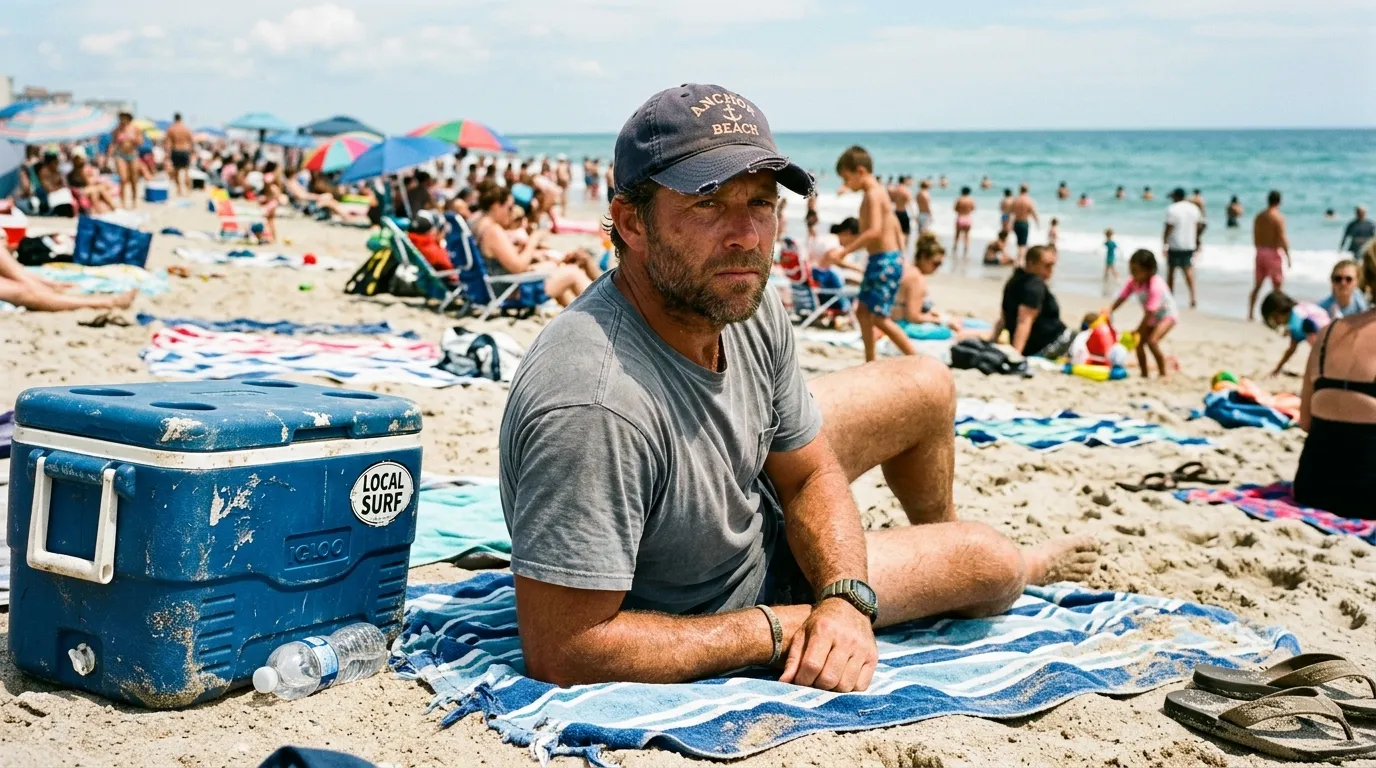
Something about his stillness cut through the chaos of the crowded beach.
The man sat on a frayed, faded beach towel, leaning comfortably back on his elbows. He wore an old gray T-shirt featuring a heavily cracked logo, paired with board shorts that appeared to have survived several harsh summers well beyond the point when most people would have thrown them away. Beside him sat a badly scratched plastic cooler.
Claire slowed her pace.
Something about his absolute stillness caught her attention amid the movement of the crowd. Then, with a sudden prickle of irritation, she realized he was staring directly at her.
His tired eyes were partly hidden beneath the brim of a battered baseball cap, but he did not glance away or pretend to look elsewhere when she noticed him watching her. He simply kept looking.
Claire felt a familiar, deeply cynical amusement wash over her. Men, she had learned over the years, could be remarkably predictable—regardless of their income, their education, or the setting. She decided, in a moment of frustration fueled by her stressful morning, to confront him.
She confidently climbed the slight rise in the soft sand and stopped just a few feet away from his towel. The man still did not move.
Claire crossed her arms defensively.
“Enjoying the view?” she asked.
Her voice carried the exact same icy tone that had successfully ended countless heated arguments in global boardrooms.
The man blinked slowly, acting as though he was returning from somewhere very far away. He looked up at her face. Then he looked down at her firmly folded arms. A long, incredibly tired breath left his chest.
“Honestly?” he said.
Claire stood her ground and waited.
“You’re standing right in the middle of it.”
Her confident expression shattered, replaced by immediate confusion. “Excuse me?”
The man calmly lifted a finger and pointed directly past her waist.
“My kid,” he said simply.
Claire turned slightly, looking over her shoulder.
Approximately ten yards away, a small five-year-old boy with messy brown hair and a thick smear of white zinc across his nose was digging furiously in the wet sand with a cheap yellow plastic shovel.
“If I take my eyes off him for thirty seconds in this crowd, he could be gone,” the man explained, his voice devoid of anger but heavy with exhaustion. He looked back up toward Claire. “So, respectfully, could you take a step to the left? You’re blocking the only thing in this world I actually give a damn about looking at.”
Claire froze entirely. A sudden gust of ocean wind swept her dark hair across her face, but for once in her highly controlled life, she did not immediately recover her composure.
She looked again at the little boy. He was happily humming a tune to himself, entirely unaware of the tense conversation happening just yards away. Then, she looked back down at the man.
He had not been admiring her.
He had not been intimidated by her wealth or her presence.
He had barely been thinking about her at all. He was just a father watching his son. Relentlessly. He watched the boy as though that child represented the single, undeniable fixed point around which everything else in his entire universe revolved.
“I…” Claire found herself completely and unexpectedly without language. “I apologize.”
“It’s fine,” the man muttered, shifting his weight slightly on the towel so he could see around her legs. “Just a little to the left. Thanks.”
Claire awkwardly shuffled two steps to the side. She remained standing there for several agonizing seconds, feeling strangely exposed and incredibly foolish, despite having spent most of her adult life navigating high-stakes situations designed specifically to test a person’s composure.
The man did not look at her again. His absolute attention had returned immediately to the little boy with the yellow shovel.
Claire turned around and began the long walk back toward her empty glass house. For the first time in years, she felt very, very small.
The Weight of Empty Victories
By Tuesday morning, the massive Rotterdam shipping bottleneck had been officially resolved. Claire had aggressively threatened two suppliers, unceremoniously fired a mid-level manager who failed to deliver, and authorized enough corporate funds to remove most of the remaining obstacles at the European docks.
Her board of directors began sending glowing congratulatory emails. The multi-million dollar problem had vanished.
Claire sat alone on the enormous, imported leather sofa in her silent living room overlooking the crashing Pacific waves, and she felt almost nothing. Her thoughts kept drifting away from the spreadsheets and returning stubbornly to the public beach.
The faded gray shirt.
The dark, exhausted eyes.
That one devastating sentence: You’re blocking the only thing in this world I actually give a damn about looking at.
Claire cared deeply about many things in her life. She cared about the stock price. Profit margins. Her corporate legacy. Global expansion. Peak performance.
But realizing the harsh truth, none of those things carried the sheer, undeniable weight she had heard in that stranger’s tired voice. Her life had slowly devolved into an uninterrupted, endless sequence of cold transactions. You give me this. I give you that. Nothing in her world felt unconditional. Nothing felt completely irreplaceable.
Claire stood up abruptly.
She changed out of her work attire into a simple linen shirt and a pair of denim shorts. The casual outfit still cost thousands of dollars, but it lacked the severe, intimidating tailoring of the corporate clothes she usually wore. She left her designer sunglasses behind on the counter. She also told her security detail to stay behind.
Then, she walked the two miles down the beach.
The public stretch of sand was significantly quieter than it had been over the weekend. It was a Tuesday afternoon. Most ordinary people were at work. Claire genuinely did not know whether the man and his son would even be there.
Then, she spotted the familiar faded yellow umbrella.
She did not approach him immediately. Instead, she retreated to the wooden boardwalk that ran parallel to the sandy beach.

The boardwalk clam shack offered a front-row seat to real life.
Outside an aging, weather-beaten clam shack, she found an empty wooden picnic table. She ordered a simple black coffee and sat down. Then, she just watched.
For approximately one hour, Claire quietly observed the man and his son from a safe distance. Eventually, the father began packing up his scratched cooler. He lifted the completely exhausted boy onto his broad shoulders. The child went almost limp with fatigue, sleepily clutching a plastic bucket against his dad’s neck.
As the man began crossing the soft, shifting sand, Claire noticed for the first time that he limped slightly, clearly favoring his left knee beneath the added weight of his son.
He and the child slowly climbed the wooden stairs from the beach, walking directly toward the clam shack.
Claire quickly looked down at her glowing phone screen, pretending to read an important email. They stopped at the ordering window approximately ten feet away from her table.
“All right, Leo,” the man’s voice floated over to her. It was tired, yet infinitely patient. “One hot dog, right? You want fries with that?”
“Yes, please, Dad!” the boy chirped enthusiastically.
“You got it.”
The man reached into his pocket and removed a worn, splitting leather wallet. From Claire’s subtle angle, she could see directly inside it. There were exactly three worn, wrinkled one-dollar bills.
He bypassed the cash and pulled out a standard debit card. At the window, he ordered one child’s hot dog meal and a cup of tap water.
The bored teenager working the counter looked at him and asked if he was eating, too.
“Had a big breakfast.” The lie came easily, smoothly masking his hunger.
He tapped his plastic card against the digital reader.
The machine beeped angrily. Declined.
The man froze, staring blankly at the tiny glowing screen. “Can you run it again?”
The teenager sighed heavily, clearly annoyed by the inconvenience. “There should be enough,” the man muttered quietly.
She reset the machine. “Tap it again.”
He did. The machine beeped again. Declined.
His broad shoulders dropped instantly. The movement of defeat was almost imperceptible to a casual observer, but Claire saw it. She felt it.
He looked down at little Leo, who was currently studying the colorful photograph of the hot dog on the menu board with wide, open anticipation.
The man slowly crouched down to eye level. “Hey, buddy.”
Leo looked away from the menu and met his father’s eyes.
“Looks like the machine is broken today. How about we go back to the apartment and make those dinosaur chicken nuggets you like?”
The little boy’s bright face fell in an instant. “But we always have nuggets. I wanted a boardwalk dog.”
“I know, buddy.” The man swallowed hard, fighting to keep his voice steady. “I’m sorry.”
The Apology Tax
Claire stood up from the picnic table before she even consciously decided to do so.
She stepped swiftly into line directly behind them and gently placed a crisp twenty-dollar bill on the scratched metal counter.
“Ring up the hot dog,” she told the teenager.
The man turned around sharply.
“And add a cheeseburger and a large order of fries,” Claire added without missing a beat.
He recognized her instantly. It was the wealthy woman from the beach. His initial look of total surprise lasted only a fleeting moment before a rigid, prideful defensiveness quickly replaced it.
“We don’t need your money,” he said stiffly.
“I know you don’t,” Claire replied, intentionally keeping her tone calm and completely neutral. “But I owe you for standing squarely in your line of sight the other day.”
She offered him a faint, genuine smile. “Consider it a late apology tax.”
He studied her face. His jaw tightened visibly. He seemed to be actively searching for the hidden condition, the invisible strings attached to the gesture. Claire completely understood his hesitation. People did not usually appear out of thin air from an entirely different social world and buy strangers lunch without wanting something in return.
“Please,” she said softly, allowing all of the sharp corporate hardness to melt completely out of her voice. “Just let me buy lunch.”
The man looked down at Leo. The hungry child was almost vibrating with pure excitement at the magical mention of french fries.
Finally, his father let out a slow breath and nodded once toward the cashier. Then he looked back at Claire.
“Cole,” he said quietly.
“What?”
“My name. It’s Cole.”
“Claire,” she replied.
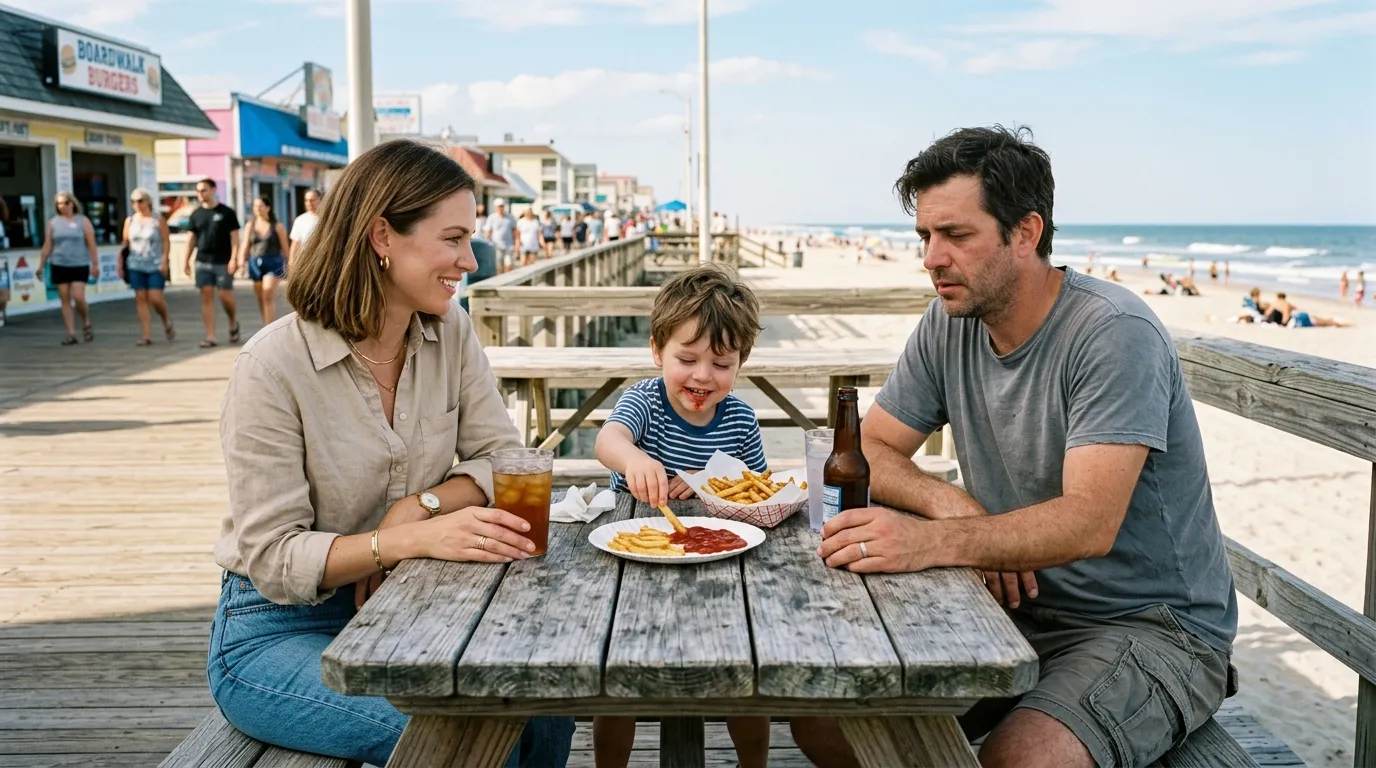
The most valuable exchanges don’t happen in boardrooms.
They sat together at the weathered wooden picnic table.
Cole ate the cheeseburger with the quiet, focused efficiency of someone who had not had a full, hot meal in much longer than he intended to admit to anyone. Leo, on the other hand, talked almost constantly between bites. He animatedly described a fast little crab he had seen earlier in the tide pools, joyfully dipping his fries into a massive, messy puddle of red ketchup on his paper tray.
Eventually, his hunger satisfied, Cole leaned back against the wooden bench. “So.”
He looked thoughtfully at Claire’s pristine linen clothes. Then his eyes drifted to the incredibly expensive, diamond-studded watch resting on her wrist.
“You live down on the private strip. The massive houses that look like giant Apple stores.”
“I do,” she admitted.
“What exactly do you do for a living that lets you wander around the beach at noon on a random Tuesday, just handing out twenty-dollar bills to strangers?”
“I run a logistics company,” Claire explained, leaning forward slightly.
She broke it down for him. Supply-chain management. Massive cargo ships crossing oceans. Sprawling automated warehouses. Complex trucking routes spanning continents.
Cole raised an unimpressed eyebrow. “You’re the boss.”
“I am.”
“Must be really nice being in charge of all that movement.”
Claire let out a short, hollow laugh that contained absolutely no humor. “It’s mostly just putting out fires all day long.”
She described the reality of her life. Men in expensive suits shouting angrily about fractional margins over conference calls. Anonymous shareholders becoming irrationally angry because a solitary ship was stuck in a canal halfway across the globe. The constant, crushing pressure to make everything in the world move just a little bit faster, a little bit cheaper, a little bit more efficiently.
“It’s empty, a lot of the time,” she confessed softly, surprised by her own brutal honesty.
Cole looked at her properly then. It was the exact same direct, piercing gaze he had leveled at her from the beach towel days ago.
“Empty,” he repeated the word slowly, tasting it.
Then, he glanced down at his deeply worn, empty wallet resting on the wooden table. Across from them, little Leo was currently attempting to shove three ketchup-covered fries into his mouth all at once.
“My wife died two years ago.”
The heavy sentence landed on the table without any warning, sucking the air out of the space between them.
“Cancer,” he added quietly.
Over the next ten minutes, Cole told Claire exactly what followed that diagnosis. The relentless medical treatments that violently drained their meager life savings. The unavoidable foreclosure when they lost the family house. He explained how he took punishing night work at a massive distribution center—unloading heavy boxes from trucks not entirely unlike the ones managed by Claire’s multi-billion-dollar company.
He slept approximately four hours a day, usually in disjointed fragments.
Almost every single waking hour of his existence was fiercely organized around one singular, unbreakable purpose: Making absolute certain that little Leo did not feel the full, crushing size of the absence his mother had left behind.
Cole leaned forward, resting his calloused hands on the table, locking eyes with the billionaire CEO sitting across from him.
“So, respectfully, Claire,” he said, his voice gentle but unwavering. “I don’t really have a lot of sympathy for your empty spreadsheets.”
Claire sat there, listening to the ocean breeze and the sounds of the boardwalk. She did not raise her voice. She did not pull rank. She did not defend herself.
Because nobody had spoken to her that honestly in years, and deep down, she knew he was entirely right.
Note:This work is inspired by real events and people, but it has been fictionalized for creative purposes. Names, characters, and details have been changed to protect privacy and enhance the narrative. Any resemblance to actual persons, living or dead, or actual events is purely coincidental and not intended by the author.
All images used in this article are AI-generated and intended for illustrative purposes only.
0 Comments