
The Ocean of Boundaries: How I Traded My Entitled Family for a Year-Long Cruise
I buried my husband on a gray Tuesday, and no one knew that during that very same week, I had bought a ticket for a year-long cruise around the world. When my son, Austin, dumped three pet cages in my living room as if I were his hired servant, I knew my mourning had reached its absolute limit.
My daughter-in-law, Chloe, didn’t even bother to greet me. She simply pushed the cages onto my pristine rug, crossed her arms, and said, “There are your instructions.” I didn’t scream. I didn’t cry. I merely smiled. Because I knew something they didn’t: by sunrise, when my massive ship left the Port of Miami, my disappearance was going to turn their entitled lives completely upside down.

The chaotic intrusion of entitlement in a space meant for mourning and peace.
The Weight of Being Used
The house still carried the heavy, sorrowful scent of funeral lilies and melting candle wax when Austin walked in without knocking. Ernest had been gone for only a week. I had buried the love of my life in his favorite white linen shirt, his rosary woven between his fingers, and our little Key West vacation photograph tucked safely into his pocket like one last private memory just for us.
For seven torturous days, I cried until my eyes physically ached. But on day eight, the tears stopped. On day eight, I bought the cruise ticket.
I didn’t do it for drama. I did it for survival. After forty years of serving as my family’s emergency fund, on-call nurse, private chef, chauffeur, babysitter, backup plan, and the designated place to unload all their emotional baggage, I finally understood a profound truth.
Grief was heavy. But being used was heavier.
When Ernest first became deeply ill, I quietly sold the diamond wedding earrings he had given me just to pay for his expensive medications. When Austin lost his job two years ago, I emptied my personal savings because he swore he only needed “temporary help.” When Chloe had her baby, I spent three exhausting months sleeping on their lumpy couch, waking for midnight bottles while she smugly told her friends I was “so lucky to have a purpose.”
Yet, at Ernest’s funeral, my own son didn’t embrace me. He didn’t hold my hand. Instead, he looked right past the fresh cemetery dirt on my black shoes and asked, “Mom, have you thought about what you’re going to do with the house?”
I carried the sting of that callous question with me all week.
The Final Straw
So, when Austin returned in a crisp new shirt and expensive dark sunglasses, speaking to me with the demanding tone Chloe had always encouraged, I already understood exactly what he had become.
“Mom, we’re going away to the Bahamas for a few days,” he announced.
“That’s nice, son.”
“You’re going to watch the pets.”
Right on cue, Chloe followed him inside carrying three large cages. Two parakeets shrieked frantically from one. A white rabbit shook nervously inside another. The family cat flattened itself against the back of an old carrier, acting as though even it understood it had been delivered to the wrong place at the worst possible time.
Chloe callously set all three cages directly beside Ernest’s memorial photograph. There were no flowers from them. No warm embrace. Not even a simple “How are you holding up?” There were only animals, bags of food, and a list of demands.
“Change the water for the parakeets twice a day,” Chloe instructed, her eyes glued to her smartphone screen. “Don’t give the rabbit lettuce. The cat gets stressed, so don’t let him out. And make sure to clean up properly because it smells awful afterward.”
I stared at her, genuinely stunned by her lack of empathy. “Chloe, I just buried my husband.”
She sighed heavily, shifting her weight as if my grief were an inconvenient delay to her tropical vacation. “Oh, Mrs. Theresa, everyone has problems.”
Austin showed absolutely no embarrassment. He didn’t step in to defend his grieving mother. He simply shrugged his shoulders. “Besides, that’s why you’re here, Mom. You’ll get bored all by yourself.”
The birds continued their piercing screams. Beside Ernest’s photograph, the memorial candle flame flickered in the draft. For once in my life, anger didn’t rise inside me. I didn’t feel the urge to argue or cry. Instead, I became completely, terrifyingly calm.
I studied the cages. Then I looked at my son. And I smiled.
“Of course, sweetie. Leave them with me.”
Chloe paused, clearly surprised by how easily I surrendered. “We also left you the spare key to our apartment in case you need to fetch more food,” she muttered.
Austin kissed my forehead casually, a gesture devoid of real affection. “Thanks, Mom. We can always count on you.”
After they left, those words lingered in the quiet house like a ghost. They could always count on me. That was exactly the problem. For decades, I had been an open wallet, a spare bedroom, a fully stocked refrigerator, and a pair of capable hands always ready to scrub away everyone else’s messes.
The Great Escape
I didn’t shed a single tear that night. Instead, I went straight to the hall closet, pulled out my sturdy blue suitcase, and packed exactly three dresses, comfortable sandals, Ernest’s last bottle of cologne, my passport, and a thick legal folder my attorney had prepared months ago without Austin’s knowledge.
Then, I picked up the phone and called Mrs. Mary, my lovely neighbor next door.
“Is your nephew still able to come pick up the animals?” I asked.
“Yes, Theresa. He already has the shelter ready,” she replied warmly.
By four o’clock that morning, my living room was completely clean. The cages were gone. So was the pungent smell of birdseed and frightened animals. I gently extinguished Ernest’s candles and left my house keys on the polished wood table beside a folded, handwritten note.
It wasn’t an apology. It simply read: “Austin, when you read this, do not call to complain. Call your lawyer.”
At five-thirty, a quiet taxi carried me away toward the Port of Miami. The sky remained deeply dark, and an early mist covered the sleeping road. For the first time in years, the only thing I needed to hold onto was my passport.
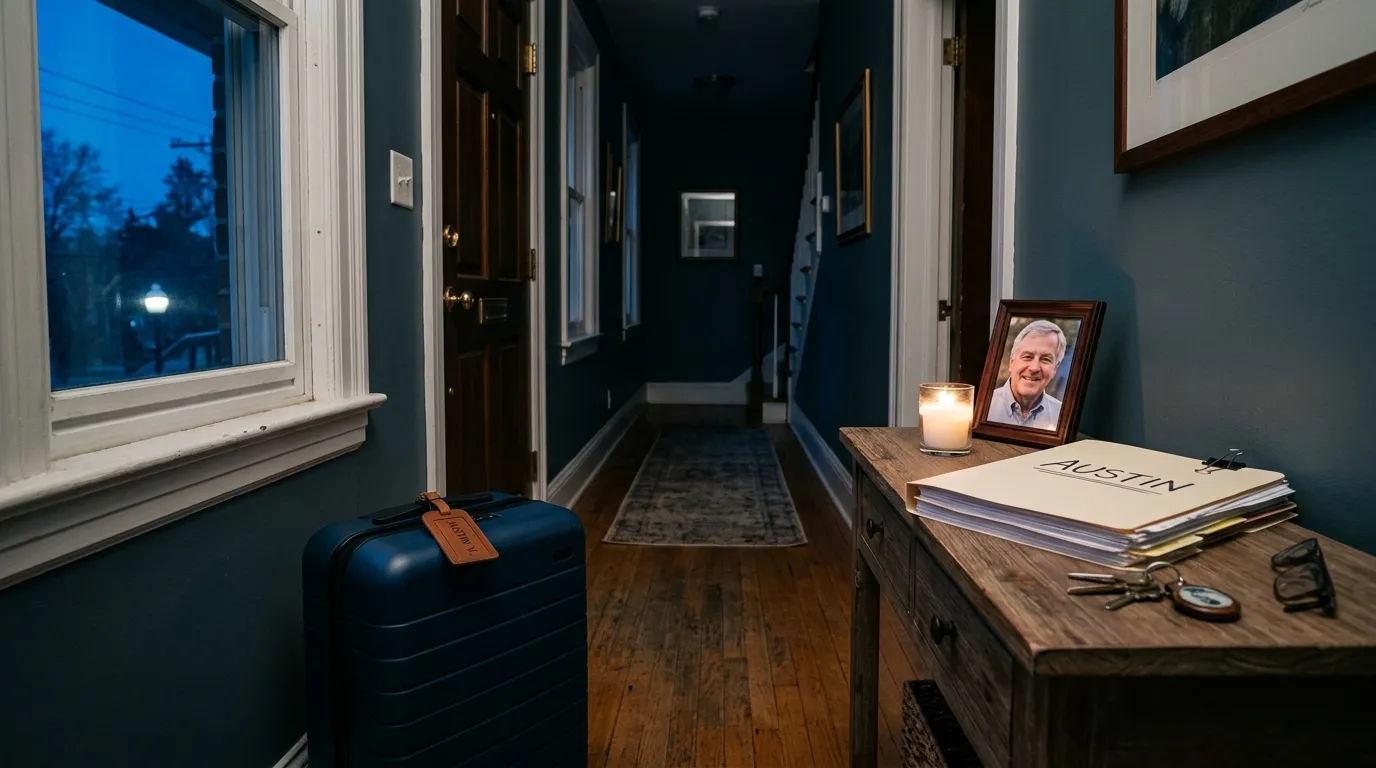
The quiet dawn of a new chapter, leaving behind a hard truth for an entitled son.
The Shocking Discovery
Chloe called first. Then Austin. Then Chloe again. I let my phone vibrate silently on my lap as the bright white majesty of the cruise ship appeared ahead, rising out of the water like a floating city waiting to carry me to a new life.
Just before boarding, one frantic message stopped me.
“Mom, what did you do? There’s a woman from the court at the door saying the house isn’t ours anymore.”
I looked toward the crashing waves of the ocean and smiled to myself.
Then, Austin sent a photograph. He stood pale and wide-eyed in my living room, clutching my handwritten note. Behind him, resting on the table, was the second legal folder I had deliberately left behind with his name prominently displayed on it. I hadn’t hidden it. I placed it beside Ernest’s memorial photograph—exactly where Chloe had callously dropped those cages, treating my grief as just another empty surface to dump her responsibilities on.
In Austin’s photo, his fingers gripped the folder so hard the cardboard was bending. Chloe stood behind him, her phone nowhere in sight. Her expensive sunglasses were pushed back into her hair, her mouth hanging slightly open. For once in her life, she looked terrified instead of mildly irritated.
Austin called again. This time, I pressed answer. But I waited for him to speak.
“Mom,” he breathed, sounding more like the frightened ten-year-old boy I remembered than a grown man.
“What is this?”
In the background, I could hear the court woman firmly instructing him to step away from the table. Then Chloe whispered, “Austin, just open it.”
His arrogant confidence finally shattered. Because the first page wasn’t a sentimental letter from a forgiving mother. It was a certified copy of the document Ernest and I had signed while he still had enough physical strength to hold a pen—and enough mental clarity to realize our son was already circling the family home like a vulture, assuming his inheritance was unconditionally guaranteed.
Austin made a strange, choked sound. Not quite crying. Not yet. It was just the hollow sound of certainty leaving a man who had spent his entire adult life believing his mother would never, ever refuse him.
Then, Chloe read the second line aloud, her voice cracking in disbelief.
“…the property shall remain solely under Theresa’s ownership for the remainder of her natural life.”
A Promise Kept
The room on the other end of the line fell dead silent. Austin seemed to literally stop breathing.
“What?” he gasped.
The court officer tapped the folder. “Mr. Bennett, you need to read the entire document before you make any assumptions.”
Austin read it again. Quickly at first. Then painfully slower. Then from the very beginning. His entire tone changed.
“No,” he whispered into the phone.
Chloe moved closer. “What does it say?”
Austin swallowed hard. “It says Mom transferred the house into a protected trust.”
“A trust?” Chloe shrieked.
“Three years ago,” Austin muttered.
Three years. Sitting in the back of the taxi, I closed my eyes and let the memory wash over me. Ernest had been sitting at our kitchen table, his frail hands trembling as he signed the complex paperwork. Afterward, he looked up at me with those deep, loving eyes.
“Theresa, promise me something,” he had said.
“What?”
“Don’t let them turn this house into your punishment for surviving me.”
I promised him. And Ernest had fiercely protected that promise. Without telling Austin, he had instructed our family attorney to establish an iron-clad trust. The house, the savings connected to it, and the modest investment account we had built together over forty years were entirely protected.
Austin knew absolutely nothing about it because whenever Ernest tried discussing the realities of the future, our son would quickly change the subject. Austin only wanted to know what he would inherit; he rarely wanted to know how his dying father was actually feeling. That was the tragic difference between us.
Setting Sail
My phone rang again. I answered.
“Mom.” Austin sounded completely defeated. “Where are you?”
Through the taxi window, I watched Miami’s bright neon lights beginning to glow against the dark morning sky.
“I’m going on vacation,” I replied smoothly.
“Mom, this isn’t funny.”
“I know.”
“You can’t just leave us like this!” he protested.
I almost let out a laugh. Leave them? They had left me standing completely alone beside Ernest’s freshly dug grave. They had abandoned three noisy cages in my living room. They had handed me a list of chores while I was still dressed in my mourning black. Now, they were furious because I had finally been the one to walk away.
“Austin,” I said quietly, firmly. “You didn’t lose the house today.”
He stayed silent.
“You lost the right to assume that it was yours.”
His breathing became jagged and uneven. “Mom, please.”
That word caught me off guard. Please. I couldn’t remember the last time my entitled son had used that word with me. But I wasn’t turning the car around.
“Take care of Chloe,” I said. Then I ended the call.
For the first time in forty years, I powered down my phone. At the massive Port of Miami, I boarded the luxurious ship with one single suitcase and a mountain of grief that I no longer felt obligated to apologize for.
A cheerful young crew member greeted me at the ramp. “Traveling alone, ma’am?”
I glanced back toward the bustling city one last time. “Yes.”
For once, the word didn’t sound lonely. It sounded like freedom.

Finding freedom, peace, and myself somewhere across the endless ocean.
Finding Theresa
Three days later, I stood out on my private cabin balcony looking across an ocean that seemed beautifully endless. I had never seen anything so vast, or so incredibly peaceful.
The massive ship cut through the water beneath the brilliant morning sun. I drank hot coffee. I read Ernest’s old, worn-out books. And for the very first time since burying him, I genuinely laughed. Not because I had forgotten my husband, but because I finally understood that loving Ernest didn’t require spending the rest of my life acting as a servant to people who didn’t return that love.
That afternoon, out of curiosity, I turned my phone back on. Forty-three missed calls. Twenty-eight from Austin. Eleven from Chloe. Four from unknown numbers.
My attorney had left one brisk voicemail. I played it.
“Mrs. Bennett, everything is handled. The trust is valid. The house is perfectly protected. Mr. Bennett and his wife have no ownership rights whatsoever. They have until Friday to remove their belongings from the property if they have any.”
I smiled.
Then, another frantic text message arrived from Austin. “Mom, Chloe wants to talk to you.”
I deleted it.
A minute later came another. “Please.”
I stared at that single, desperate word. Then I typed three of my own.
“You already did.”
I sent the message, powered the phone off again, and put it away in my drawer.
Weeks melted into months. The glorious cruise carried me from Miami down to Jamaica, weaving through the vibrant Caribbean, and eventually sailing toward the historic ports of Europe. I finally saw the breathtaking places I had spent forty long years promising myself I would visit “someday.”
Someday always came after somebody else. After Austin needed financial help. After Chloe demanded a babysitter. After Ernest needed to recover. After the bills were paid. After everyone else was perfectly comfortable. There had always been another ‘after.’
Until there wasn’t.
So, I stopped waiting for my life to begin. I learned to dance beneath the stars on the upper deck. I ate rich, leisurely breakfasts all by myself without rushing. I joined a messy, wonderful watercolor class. I sat with fascinating strangers and listened to the wild stories of their lives.
And the best part? Nobody asked what I could do for them. They simply asked my name.
“Theresa,” I would say.
And for the first time in decades, that was enough.
The Apology
Two months into the cruise, the phone rang. It was Austin. I decided to answer.
“Mom.” His voice sounded remarkably different. Stripped of its usual bravado. Softer.
“I wanted to tell you something,” he murmured.
“What?”
“I went to Dad’s grave.”
I remained silent, letting the weight of his words settle.
“I hadn’t gone since the funeral,” he admitted quietly.
My throat tightened slightly. “What did you say to him?”
Austin exhaled a long, shaky breath. “I told him I was sorry.”
I stared out across the sparkling blue ocean. “Sorry for what?”
“For treating you like you were just supposed to keep taking care of me forever.”
I closed my eyes. There it was. The profound, heartbreaking sentence I had waited forty years to hear from my child. But strangely, sitting out there on the water, I realized I no longer desperately needed it to validate my worth.
“I hope you meant it,” I said softly.
“I do.”
“And Chloe?”
“She understands now.”
I almost smiled at that. “Does she?”
“She does.”
A long, tentative silence stretched between us across thousands of miles of ocean. Then Austin whispered, “Are you coming home?”
I looked around my peaceful little cabin. My blue suitcase in the corner. The little vase of fresh flowers I had bought for myself that morning in port. Ernest’s smiling photograph resting beside the window.
“No.”
Austin went completely quiet.
“I mean… not yet,” I clarified.
“Mom—”
“I love you, Austin,” I interrupted.
His voice cracked with genuine emotion. “I love you too.”
“But loving you doesn’t mean living for you.”
He finally began crying. I let him. Sometimes, tears are the very first honest thing a person has left to offer. “I’ll see you when I’m ready,” I said. Then I hung up.
A New Foundation
Six months later, the great ship finally returned to the Port of Miami. I walked ashore carrying the exact same blue suitcase. But the woman carrying it had profoundly changed.
Mrs. Mary was waiting near the terminal. She hugged me immediately, pulling back to look at my face. “You look different.”
“I feel different.”
She laughed brightly. “What are you going to do now?”
I looked toward the bustling skyline of Miami, then toward the highway that led back to my old life. “I think I’m going to sell the house.”
Mary raised a surprised eyebrow. “The house?”
“Yes.”
“Are you entirely sure?”
I nodded without hesitation. “Ernest and I built it together with love. I refuse to let it become a battlefield of entitlement.”
“And where will you live?”
I smiled, picturing it perfectly in my mind. “Somewhere with a porch.”
Mary chuckled. “Of course.”
“And maybe a small garden.”
“Of course.”
“And a guest room.”
She eyed me suspiciously. “Why?”
“So my son can visit.” Her expression softened immediately. “But,” I added with a wink, “only when I invite him.”
We both laughed until our sides hurt.
Three weeks later, I officially sold the old house. Every penny went into a secure account under my name alone. I bought a gorgeous, small white cottage nestled right near the water. It had a wide, welcoming porch. A beautiful blooming garden. Two sturdy rocking chairs. And a quiet, sunlit corner reserved perfectly for Ernest’s photograph. I wasn’t replacing my husband; I was simply making a new, healthy space for him in my future.

A new home built on peace, love, and the courage to say no.
The Value of Being Loved
One breezy Sunday afternoon, there was a knock at the door. I knew exactly who stood outside before I even turned the handle.
Austin was standing there alone. No expensive sunglasses. No flashy shirt. No demanding, arrogant tone. He was just my son.
He carried a small, velvet box in his hands. “Can I come in?”
I studied his face, seeing the genuine humility in his eyes, then gently moved aside.
Austin walked into the kitchen and carefully set the small box on the table. Inside, resting on the velvet, were my diamond wedding earrings. The exact same earrings I had desperately sold years earlier to afford Ernest’s medication.
I stared at them, the breath catching in my throat. “Where did you get these?”
“I tracked them down. I bought them back.”
My eyes filled with hot tears.
“I know they aren’t the same,” he murmured, looking down.
“No,” I whispered, touching the cool metal. “They’re not.”
Austin nodded solemnly. “I can’t give you back the years.”
“No.”
“I can’t completely erase how I acted.”
“No.”
He looked up, meeting my gaze. “But I can stop asking you to carry me.”
For the very first time in his life, my son truly sounded like an adult. I wiped a tear away, gently closed the velvet box, and looked at him.
“You can stay for dinner,” I offered.
His eyes instantly filled with tears. “Really?”
“Yes.” I gave him a knowing smile. “But you’re washing the dishes.”
He let out a watery laugh. And for the first time in years, hearing that sound didn’t hurt my heart.
That night, long after Austin had left, I stood out beneath the glowing stars on my new porch. The ocean was dark and vast, the comforting smell of salt carried on the cool evening breeze. Ernest’s photograph rested quietly on the small table beside my rocking chair.
I reached out and touched the wooden frame.
“You were right,” I whispered to the night air.
For most of my life, I had fatally mistaken being needed for being loved. They weren’t the same thing at all. Love meant being remembered. Being respected. Being allowed to rest without feeling guilty. And sometimes, true love required having enough courage to finally say no.
I looked toward the empty, quiet road, then smiled.
My beloved husband was gone. My entitled son had finally grown up. The old, heavy house was gone. So was my exhausting old life.
But I was still here. I had survived.
That was what nobody in my family had understood. They had foolishly assumed that Ernest’s death had taken everything from me. They were completely wrong.
Through the grief, the miles of ocean, and the courage to set a boundary, I had finally found myself. And this time, I wasn’t giving her away to anyone.
Note:This work is inspired by real events and people, but it has been fictionalized for creative purposes. Names, characters, and details have been changed to protect privacy and enhance the narrative. Any resemblance to actual persons, living or dead, or actual events is purely coincidental and not intended by the author.
All images used in this article are AI-generated and intended for illustrative purposes only.
0 Comments