
I sacrificed every spare dollar, every quiet evening, and both of my aching knees to send my daughter, Chloe, to nursing school in London. When you are a single mother who has spent a decade scrubbing floors and waiting tables, your child’s diploma isn’t just a piece of paper. It is your family’s freedom.
When she first moved into her cramped student dormitory across the Atlantic, the loneliness nearly broke her. She called me every single night without fail. Sitting on the edge of her narrow cot, she would weep into the receiver, telling me how cold the rain felt, how demanding the ward shifts were, and how desperately she missed the smell of our small kitchen. I stayed on the line for hours, murmuring lullabies and reassuring words until her breathing slowed and sleep finally claimed her. I would have given ten years off my life just to wrap my arms around her.
Then, after four months, the pattern broke.
The daily calls dwindled to rushed, three-minute check-ins. Her voice, once so transparent and needy, turned guarded. She seemed eager to hang up, always murmuring excuses about early clinical rotations or study groups. Whenever I gently pressed her—asking if there was a young man in her life, or if she was seeing someone—she would let out a strained little laugh and immediately steer the conversation elsewhere.
By the time spring arrived, Chloe announced that she had booked a ticket home for a short visit. My heart leaped. I begged her to send me a photo of her life in London—a snapshot of her dorm room, her friends, anything to help me picture her world. For weeks, she deflected.
“Just wait until I get home, Mom,” she would say softly. “You’ll understand everything then.”
Finally, exactly one week before her flight touched down, my phone screen chimed with an incoming picture message. My hands were wet from doing the dishes, and I wiped them eagerly on my apron before tapping the screen.
The moment the image loaded, the breath vanished from my lungs.
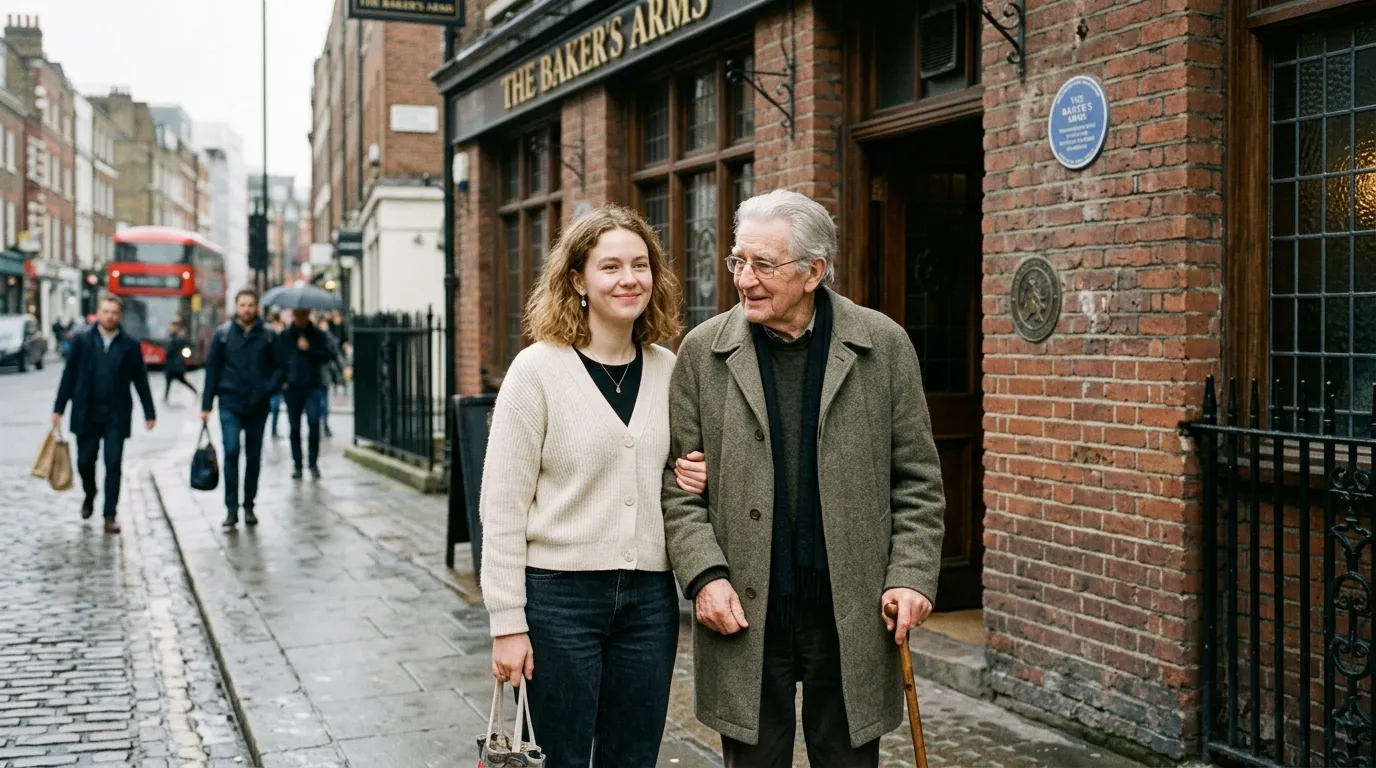
The photograph that arrived on my phone without warning.
Standing beside my twenty-two-year-old daughter was a man who looked nearly eighty. His hair was stark silver, his shoulders were frail, and deep lines etched every inch of his face. Before my thumb could even type out the horror rising in my chest, the phone began to ring. Chloe’s name flashed across the screen.
I answered with a trembling whisper. Her voice on the other end was unnervingly calm, devoid of the tears she used to shed.
“Mom,” she said, speaking deliberately. “I need to tell you before I land. We got married. Two weeks ago. In secret.”
The room spun around me. Nausea slammed into my stomach like a lead weight. My little girl—the girl whose tuition I had paid with double shifts and worn-out shoes—had married a man old enough to be her grandfather. The bitterest thought imaginable took root in my mind: She sold her soul. She couldn’t take the struggle, so she traded her youth for a wealthy man’s fortune.
I spent the next seven days living in a blur of grief and rage. But when Chloe finally walked through our front door yesterday, the fantasy of wealth vanished in an instant.
There were no diamond tennis bracelets on her wrists. No designer coat draped over her shoulders. No limousine idling at the curb. Chloe stood in the entryway wearing a faded cardigan she had owned since high school. Her face was hollow, dark circles shadowed her eyes, and she looked so weary she could barely keep her head upright.
I couldn’t hold back the anger any longer. The hurt spilled over before she even set her duffel bag down.
“How could you do this?” my voice cracked, tears burning my cheeks. “After everything I sacrificed to keep your head held high? Why would you tie yourself to a man who belongs in an assisted living facility? What did he promise you?!”
Chloe didn’t flinch. She didn’t raise her voice. She simply looked at me with an expression of heartbreaking gentleness. She walked over, pulled out a chair, and guided me down by my hands.
“Sit down, Mom. Please.”
Unzipping the worn front pouch of her backpack, Chloe pulled out a small, brittle slip of paper. It was folded in quarters, yellowed with age, and frayed at every corner. She held it reverently between her fingers before laying it flat on the wood between us.
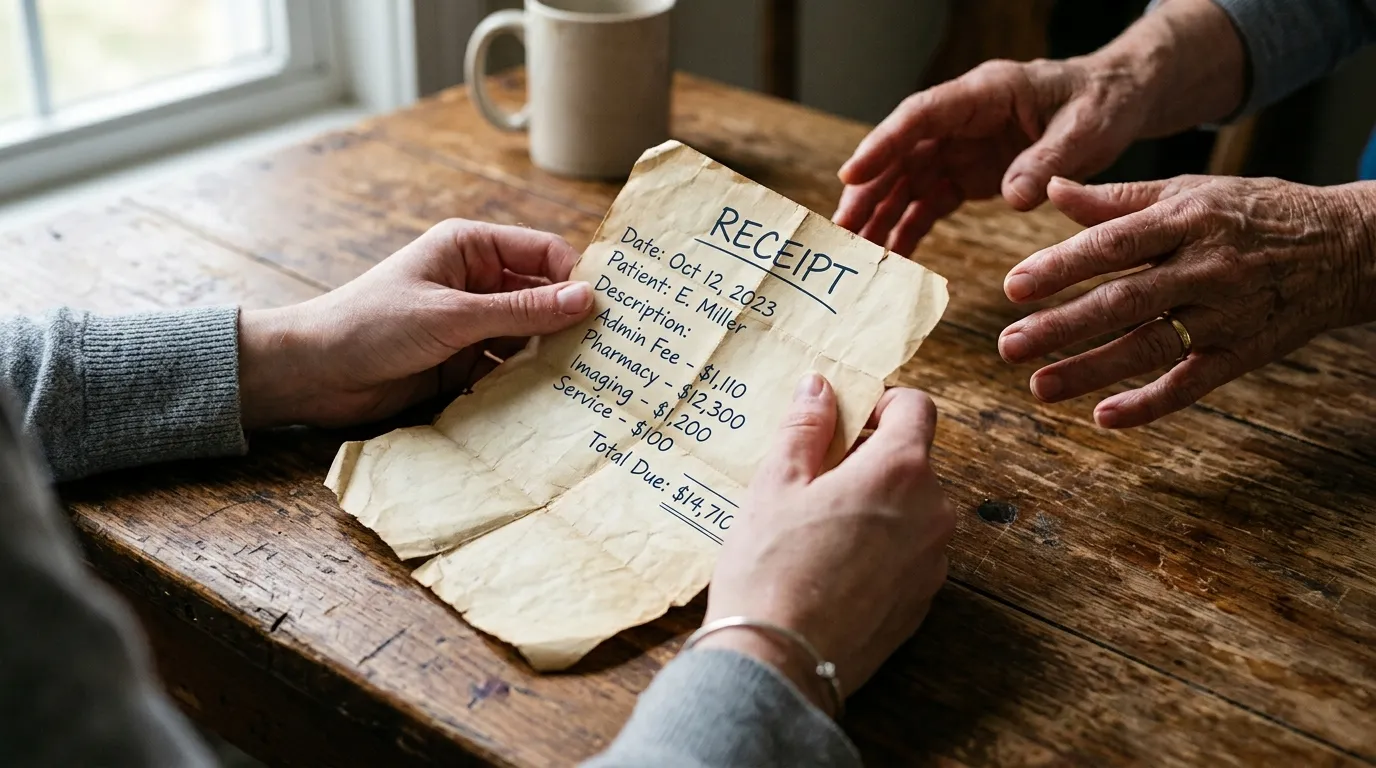
A ten-year-old piece of paper that held the key to our survival.
“Mom,” she whispered, tears finally pooling in her eyes. “I didn’t marry him for a mansion. I didn’t marry him for money. I married him because of what he did for you ten years ago.”
I stared down at the paper. It was an official hospital billing voucher, dated a decade earlier.
“What does this have to do with him?” I asked, my voice barely audible.
Chloe flipped the brittle receipt over. On the back, written in faded blue ballpoint ink that had begun to bleed into the pulp, was a name:
Dr. Daniel Carter
A chill swept through my spine. The name echoed down through the deepest corridors of my memory. I hadn’t seen the man in the photograph before, but that name… that name had lived in my prayers every night for ten long years.
When I was forty-seven, Chloe was only twelve. I was working fourteen-hour days between an industrial laundry and a roadside diner just to keep our tiny rental apartment heated. One freezing December evening, I collapsed on the concrete floor of the laundry room. When I woke up, bright fluorescent lights were blinding me, and an agonizing tightness gripped my chest. A surgeon told me that an artery had blocked and that I required an emergency bypass within forty-eight hours.
I had no health insurance. I had thirty-seven dollars in my checking account. I remember lying in that sterile bed, weeping silently into the scratchy pillow, paralyzed not by the fear of dying, but by the terror of leaving twelve-year-old Chloe entirely alone in this cruel world.
Then, the following morning, the administrative nurse walked in with a cleared clipboard. She told me my procedure had been scheduled, the deposit had been wired, and the remaining surgical fees were fully settled. When I begged to know who had saved us, the nurse only touched my shoulder and said the donor insisted on complete anonymity. I never received a bill. I never knew who gave me my life back.
I lifted my eyes to meet Chloe’s gaze across the table. “You’re telling me… the man in the photo is the one who paid?”
Chloe nodded, wiping a tear from her jawline. “His name is Daniel Carter. He was a senior cardiology consultant at that hospital ten years ago.”
“Why would he do that for a stranger?” I sobbed, clutching the paper. “Why keep it hidden all these years?”
“Because you reminded him of his wife, Martha,” Chloe whispered. “She had passed away from cancer three months before you collapsed. He had poured every cent of their life savings into experimental treatments trying to save her, but nothing worked. When she died, he fell into a deep depression. He made a vow to God that if he couldn’t save the woman he loved, he would never stand by and watch another mother die simply because she was poor.”
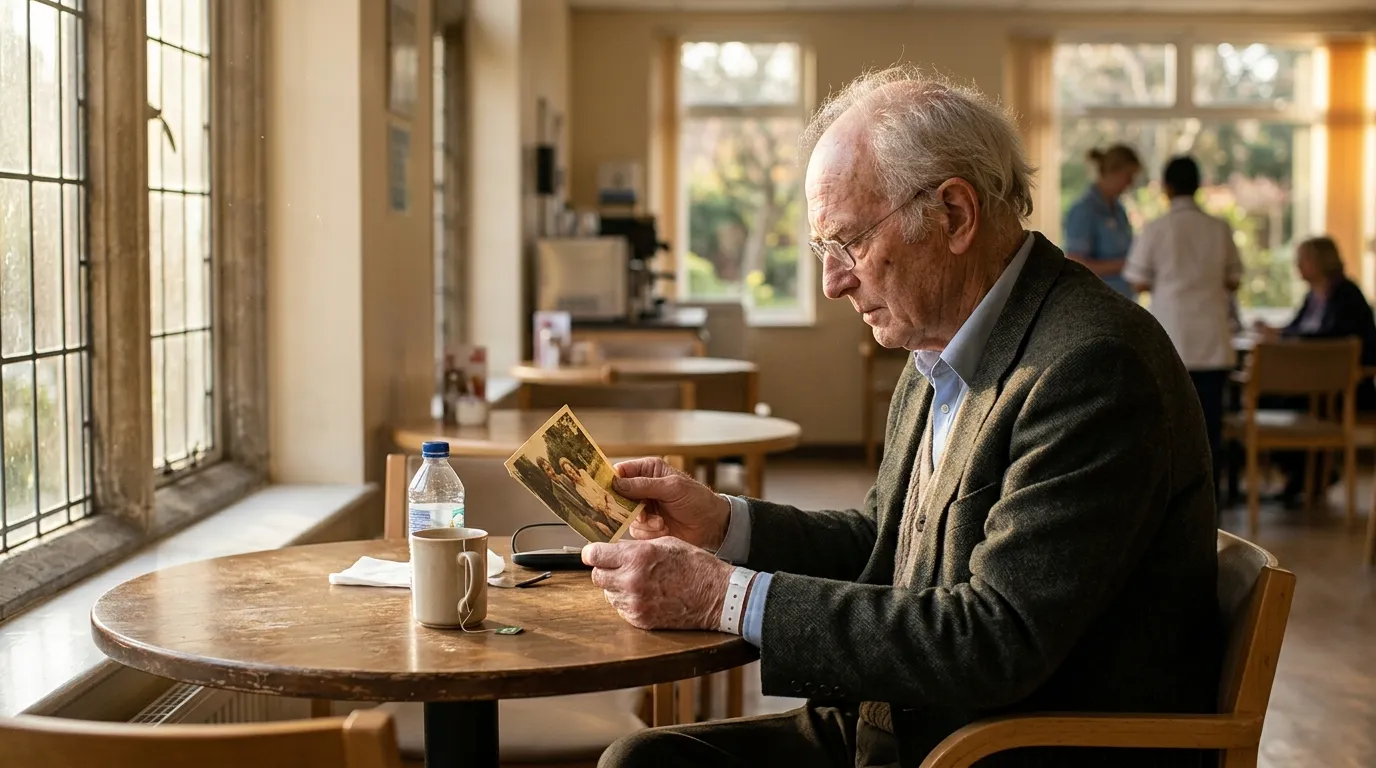
Dr. Daniel Carter, carrying the memory of the lives he quietly protected.
Chloe went on to explain how their paths had crossed. During her second-year nursing clinicals at a teaching hospital in central London, she had noticed a retired physician who occasionally came to sit quietly in the public cafeteria. In his worn leather wallet, he carried a small, creased clipping of an old hospital newsletter commemorating staff volunteers—and standing in the distant background of the image was me, wiping tables in the cafeteria during my brief recovery period.
Chloe had approached him out of sheer curiosity after recognizing his name on a donor plaque in the lobby. When he realized she was the little girl whose mother he had kept alive a decade earlier, the old doctor had broken down in tears right there in the dining hall.
“And then,” Chloe’s voice wavered, “I found out he was dying.”
The pieces fell together with brutal clarity. The exhaustion in her eyes. The sudden distance. The constant hospital shifts.
“He has end-stage congestive heart failure, Mom,” she said, her chest heaving. “He has no children. His brothers are gone. Every person he ever loved is buried in the ground. When he learned how hard you worked to put me through nursing school, he couldn’t bear the thought of spending his final months staring at the walls of an empty flat, waiting for his heart to stop.”
“Chloe…” I reached across the table and gripped her cold fingers. “Why did you have to marry him? You could have just looked after him as a nurse.”
“Because he needed more than a nurse,” she said fiercely, looking straight into my soul. “He needed someone who belonged to him. He made me sign a strict prenuptial agreement guaranteeing I would receive no financial inheritance, no offshore accounts, nothing. He didn’t want the world to think I had been bought.”
She squeezed my hand with all her strength. “You always taught me that when someone gives you your life, you don’t pay them back with coins. You pay them back with your presence. You show up when the night gets dark. I became his wife so he could have a family to hold his hand.”
I buried my face in my hands and wept for my shame, for my hasty judgments, and for the boundless, fearless heart of the daughter I had raised.
Chloe reached back into her bag and retrieved a legal envelope. Inside was a legal medical power of attorney, naming Chloe as his sole proxy. Beneath it lay a deed of trust for a small stone cottage on the outskirts of Kent. Attached was a handwritten note from Dr. Carter:
“To the mother who raised a daughter capable of selfless grace: You fought for her life, and she brought light to the end of mine. This home is transferred to Chloe on the condition that if I pass before she finishes her studies, it belongs entirely to you. You are never to struggle for shelter again.”
Three months later, the call came at four in the morning. Chloe’s voice was choked with tears: “Mom… it’s time.”
I boarded the first flight out. When I stepped into the hospice room in London, the room was quiet, bathed in the pale amber glow of a setting sun. Dr. Daniel Carter lay propped up against crisp white pillows, his breath shallow, his body frail as autumn leaves.
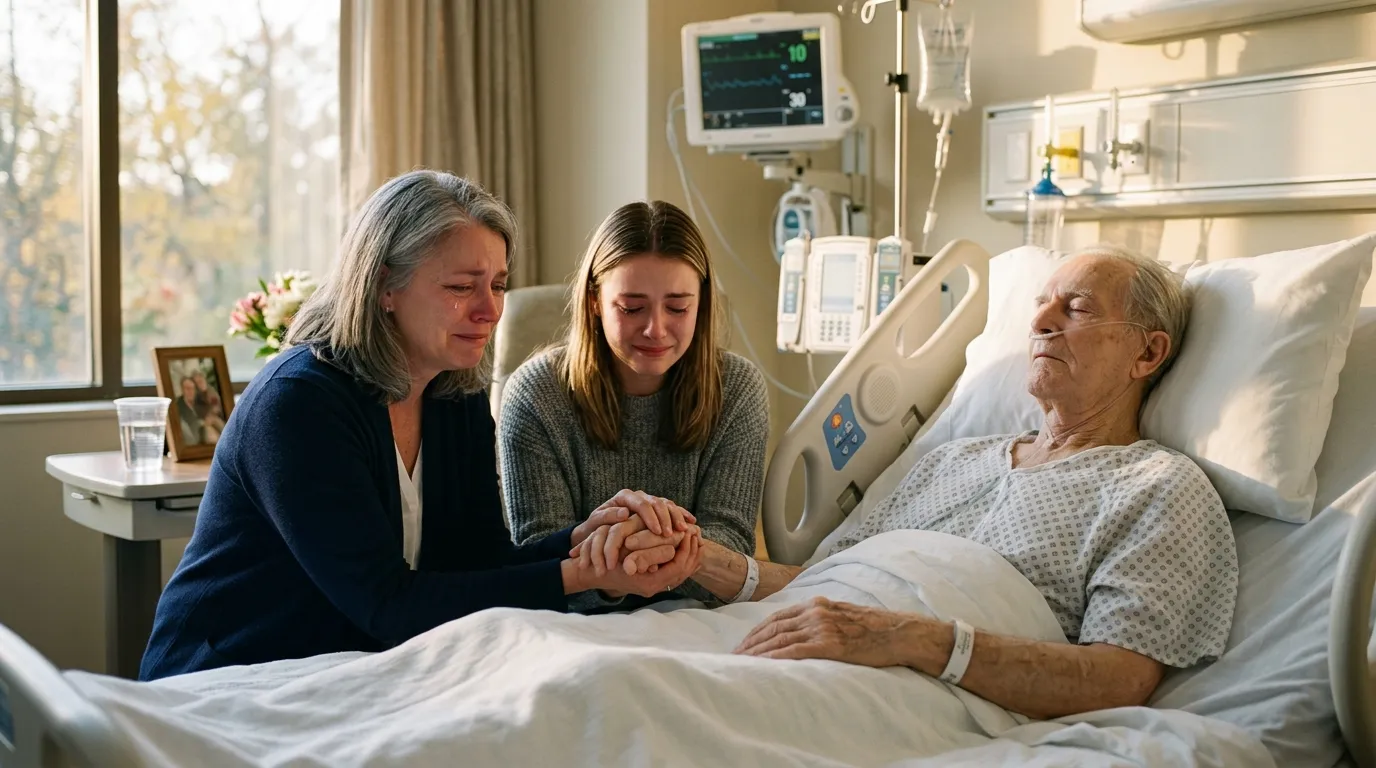
In his final hours, Dr. Carter was surrounded by the family he had earned.
When he saw me enter, his dim eyes flickered with recognition. A fragile smile touched his lips. He reached out a trembling, paper-thin hand, and I rushed forward to take it in both of mine.
“I have wanted to thank you for ten years,” I whispered, tears spilling onto the bedsheets.
He shook his head slowly, squeezing my fingers with the last reserve of strength he had left. He looked over at Chloe, who was sitting on the opposite side of the mattress, smoothing his hair.
“Don’t let her think… she was paying a debt,” he whispered, his chest straining. “Chloe didn’t owe me anything. She gave an old, lonely man the greatest gift under heaven.”
“What gift, Daniel?” I asked softly.
“A family,” he murmured. “She made sure… I didn’t have to cross over alone.”
A few moments later, his breathing slowed to a peaceful stop. His fingers relaxed in ours. The monitors hummed softly, and the room fell into a sacred, unbroken silence.
As Chloe collapsed into my arms, weeping against my shoulder, I held her tighter than I ever had before. My daughter had not sold herself to an old man. She had returned to the angel who had rescued our family, stood beside him through his darkest valley, and ensured that a man who saved so many lives was cradled in love when his own came to an end.
Note:This work is inspired by real events and people, but it has been fictionalized for creative purposes. Names, characters, and details have been changed to protect privacy and enhance the narrative. Any resemblance to actual persons, living or dead, or actual events is purely coincidental and not intended by the author.
All images used in this article are AI-generated and intended for illustrative purposes only.
0 Comments