
A Table for Eight: The Thanksgiving That Changed Everything
There is a specific kind of woman who knows exactly what she is doing when she looks at you, tilts her head, and says, “I didn’t think you’d mind.”
She is not confused. She is not forgetful. She is not operating under a genuinely mistaken belief that her actions fall within acceptable, normal limits. She knows precisely where the boundaries are because she has tested them carefully, methodically, over years. She has decided that those limits simply do not apply to her. When she says I didn’t think you’d mind, it functions as a closing argument rather than a genuine explanation. By the time the words leave her mouth, the thing is already done. The only question left is whether you are going to make a scene about it.
She is counting on the fact that you won’t.
She has been right about that for a very long time.
My name is Rachel, and my mother-in-law’s name is Helen. For six years of my marriage, I let her be right. I had convinced myself that keeping the peace was the exact same thing as keeping the family together. It took twenty uninvited guests, one small change to a dining room, and a mountain of casseroles to help me finally understand the difference.
This is that story.
The House on Elm Street
I need to tell you about the house first, because the house is central to everything.

The Victorian on Elm Street: perfectly eccentric and built for a family.
Daniel and I bought it four years ago. We had spent three years in a small, cozy apartment that was exactly right for two people but entirely wrong for the family we had decided we were going to become. The house we found is a Victorian on Elm Street. It is old, a little particular in its creaky eccentricities, and large enough that when we first walked through the heavy front doors, we both stood in the front hall, looked at each other, and communicated an entire conversation in a single glance: This is way too much house, and it is exactly right.
Crucially, it has a dining room that can seat fourteen comfortably, provided you have the right table and the right wooden extension leaf installed. This detail matters more than you can imagine.
The house also features a back entrance through the kitchen, a front parlor that proudly displays its original plaster medallions, a sprawling porch that demands repainting every other year, and a second, narrow staircase from the kitchen. The previous owners used it for practical back-stairs purposes; my children use it entirely for elaborate ambush purposes. Over four years, the seven bedrooms have slowly and specifically become ours, filling with our memories, our clutter, and our love.
When Helen first saw the house, she stood in the foyer, looked around, and said: “This is much too big for just the four of you.”
This is how Helen talks about the world. Everything is measured in terms of whether it is appropriate for your circumstances—by her specific measurement, of course.
She had not been invited to see the house before we bought it. We had merely mentioned we were looking, and she had miraculously shown up at the showing. Daniel had somehow not anticipated this when he casually mentioned the address to her on a phone call. She had walked through every room with the assessing, sharp gaze of a woman deciding whether the space would serve her own purposes. After delivering her verdict—much too big—I smiled politely and said we liked the space. She countered quickly: “Well, it’s very useful for entertaining.”
This, I now understand with crystal clarity, was the exact moment she began planning.
The Complication of Love and Debt
Helen is seventy-one years old, and she is, in many profound ways, a woman worth knowing.
She raised Daniel entirely alone after her husband left when Daniel was just nine. She did it with the specific, terrifying fierceness of a woman who decided that her son would not be defined by his father’s absence. She worked two jobs for three grueling years. She was present at every school event, every baseball game, every graduation, and every important moment. She was not there as a performance; she was a genuine, constant presence. She had decided her son was the central project of her life, and she was going to see it through to perfection.
Daniel loves her.
He loves her the way you love someone who has sacrificed everything for you. The emotional accounting is complicated. How do you possibly weigh the immense debt of a mother being present for every vital moment of your childhood against the very specific ways that presence has slowly, inevitably calcified into control?
He has been managing this calcification his whole adult life.
I have been managing it for six years of marriage.
The first Thanksgiving in our new house, Helen arrived at nine in the morning for a meal scheduled for two in the afternoon. I had thought I was perfectly prepared. I had the turkey roasting in the oven, the side dishes meticulously planned, and a timeline written on a notecard taped to the inside of a kitchen cabinet. The house smelled of sage, butter, and anticipation.
Helen arrived at nine with her own turkey.
It was a whole turkey, sitting in a massive roasting pan, pre-brined, heavily seasoned, and ready to cook.
“I didn’t know if you’d have time,” she said smoothly, setting it heavily on my pristine counter.
“I have a turkey in the oven,” I said, trying to keep my voice steady.
She looked at the oven, then back at me. “Well,” she said. “Now you’ll have two.”
She cooked her turkey in my oven, demanding the rack I had specifically reserved for the stuffing and the yams. We ate both turkeys because to have done otherwise would have been to make a massive issue of it. Daniel’s eyes carried that pleading look they get when he is desperately trying to communicate, Please, Rachel, just let this one go without saying anything.
So, we ate two turkeys.
The second year, she completely rearranged my dining table.
I had set it carefully the evening before. I used the good tablecloth, the delicate place cards, and a centerpiece I had spent two evenings lovingly assembling. I created a specific seating arrangement designed to put people who genuinely enjoyed each other’s company next to each other. Helen arrived, took one look at the table, and immediately began moving things.
“The centerpiece blocks the sightlines,” she declared, lifting my floral arrangement. “You want people to be able to see each other.”
The centerpiece was exactly six inches tall. Not a single sightline was blocked.
I stood silently and watched her move it to the kitchen counter. “It’s a bit much for the space,” she added dismissively.
The third year brought the unprompted house tour. I came downstairs to discover that Helen was enthusiastically escorting a group of extended relatives through the second floor of my home. They walked through my bedroom. My private bathroom. The room I use as a home office, where my laptop was still open, displaying sensitive work, and my notebooks were spread across the desk.
“Helen,” I said, keeping my tone as neutral as possible. “Can I talk to you?”
She turned gracefully at the top of the stairs. “Oh, I’m just showing them the house. It’s such a lovely house.”
“I’d appreciate it if you asked first,” I said firmly. “This is my home.”
She smiled her practiced smile. “You’re acting like a guest in your own home, Rachel,” she said. Then she turned her back to me and continued chatting with the relatives. I stood at the bottom of the stairs, feeling the sting of that sentence settling into my chest. It had been perfectly aimed.
“My son would never celebrate like this if I didn’t help,” she would say to anyone who would listen, year after year.
As if the house were solely his, and I were just a temporary guest passing through it. As if twenty-three years of his life before me had produced the man, and six years of marriage to me were simply a convenient administrative arrangement. As if I didn’t exist, except as the silent person who bought the centerpiece she felt entitled to move to the counter.
But I let her have it. Every single year, Daniel would catch my eye over the crowded table, and his look would say: I know. I’m sorry. Just let me have this one day. And I would let her have it, because I loved Daniel, I knew what his mother had sacrificed for him, and I knew the immense emotional cost of him being caught between the two women he loved. I told myself that the cost of peace was manageable.
The Year of the Twenty
The extra relatives had been steadily building for three years. It started small. One extra person the first year—a cousin passing through who needed a warm place to be. Two the second year—an aunt and her new boyfriend, casually added to the headcount a mere forty-eight hours before the meal. Three the third year, justified with a breezy, “They were going to be alone, and you know how big your house is.”
I had absorbed them all.
I had pulled up extra chairs from the basement. I had stretched the food to feed more mouths. I had smiled at absolute strangers who walked into my sanctuary without having been invited by the people who actually lived there. I had said, “Welcome, I’m so glad you could come,” because the alternative was to say what I actually thought: This is my house, this is my Thanksgiving, and if someone is going to invite people to it, that someone should be me.
But I didn’t say that. I smiled.
Until the year of the twenty.
The pivotal conversation with Daniel’s cousin happened on a completely ordinary Tuesday. His name is Michael. He was one of the original uninvited additions from three years ago, but he has since become someone I genuinely like—a complication I hadn’t anticipated. He was at the house helping us carry heavy boxes up from the basement. With the casual air of a man asking about logistics he assumed had already been ironed out, he said, “So, where are all the extra people supposed to sit?”
I stopped walking and put down the heavy box I was carrying. “What extra people?” I asked slowly.
He looked at me. His face instantly contorted into the specific expression of a man who has just realized he has stepped on a landmine, and who is frantically calculating whether there is any version of the next thirty seconds that doesn’t end in an explosion.
There was not.
“Your mother-in-law,” he said carefully, “mentioned that she’d invited some people. I think she said almost twenty.”
I looked at him for a long, heavy moment. “Almost twenty,” I repeated flatly.
“More or less.”
“How many, exactly, Michael.”
He ran a quick, panicked mental calculation. “Around twenty,” he said. “Maybe a few more.”
I calmly picked up the box, carried it to where it belonged, and did not say a single word more to Michael. He stood in my basement looking profoundly relieved that I had not done whatever terrifying thing he had been afraid I might do.
I asked Daniel about it that evening. I use the word asked in the most technical sense. After our two children were fast asleep, I sat across from him at the kitchen table, folded my hands, and said: “Daniel, did you know your mother invited twenty additional people to our Thanksgiving?”
He rubbed the back of his neck. It’s the specific tell he has when he is about to say something that requires a kind of courage he isn’t fully sure he possesses.
“She mentioned it,” he admitted quietly. “But I figured she’d already talked to you.”
I let the silence sit between us, heavy and thick. “She hadn’t,” I said.
“I know that now.”
“Did you know it then?”
He did not answer immediately, which was all the answer I needed. “I should have checked,” he whispered.
“Yes,” I said.
“I’m sorry.”
“I know.”
“Rachel—”
“Daniel,” I interrupted, keeping my voice terrifyingly calm. “I’m not angry at you right now. I’m going to deal with this. But I need you to hear me clearly when I say that this has to stop. Not after this Thanksgiving. Now. It stops now.”
He looked at me, eyes wide. “What are you going to do?”
I had thought deeply about this. What I was not going to do was call Helen and have the exhausting conversation that she would willfully ignore. I would not explain that inviting twenty people to my home without telling me was unacceptable, only to have her agree with the surface of my words while continuing to believe she had done absolutely nothing wrong. If I did that, next year would be infinitely worse, because she would carry the grievance of having been confronted.
I had tried those conversations. Smaller versions, different angles—after the house tour, after the centerpiece incident, after the extra relatives. Each time, she had received my words with the gracious, patronizing tolerance of a woman doing me a favor by listening. Nothing ever changed.
What I was going to do was something entirely different.
“I have a plan,” I told him.
“What plan?”
“One small change,” I said.
He looked at me with the weary expression of a man trying to decide whether asking more questions would only bring him more pain. “Do you want to know about it?” I offered.
He thought about it for a long time. “No,” he finally sighed. “I think I probably trust you.”
“You should,” I said.
“Rachel. Whatever you do—don’t make it worse than it needs to be.”
“I am going to make it exactly as bad as it needs to be,” I promised him. “Not an ounce more.”
He was quiet for a moment. “Okay,” he said. “That’s fair.”
The Small Detail
Here is the single, small detail I changed.
I removed the extension leaf from the dining room table. That’s it.
The table seats fourteen luxuriously with the extension. Without it, it seats exactly eight. I called a good friend with a pickup truck on Wednesday morning. Together, we carried the heavy wooden extension to her garage across town, where it would safely stay for the next forty-eight hours.
I then rearranged the dining room around the smaller table. I set it for exactly eight people, and it looked absolutely magnificent.
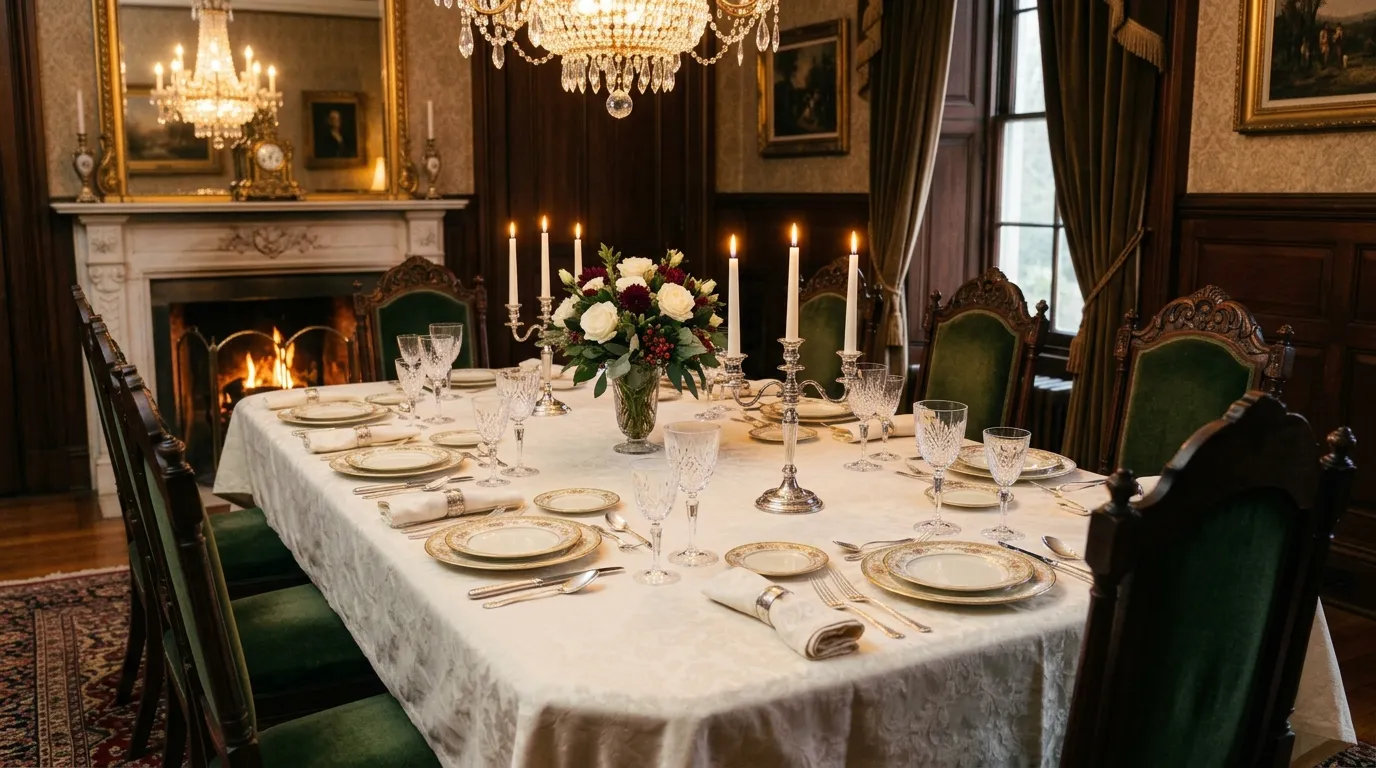
Eight place settings. The good china. The real silverware.
Exactly eight place settings. The expensive china we got for our wedding. The heavy, real silverware. The beautiful linens I had purchased the year we moved in and had been saving for a truly special reason to use. The centerpiece—the exact same style as the one Helen had banished to the kitchen counter the year before, six inches tall, perfectly proportioned—sat proudly in the very center of the table.
Eight chairs.
Eight plates.
Eight of everything.
I had prepared food for eight. I did not make the chaotic Thanksgiving-for-thirty production of previous years. I crafted a perfect, complete, utterly gracious Thanksgiving for eight people. The turkey was exactly the right size. The sides were elegantly scaled. There was dessert—three kinds, because dessert should always present options—in quantities appropriate for eight people who were going to eat very well.
I carefully wrote out eight place cards.
Me. Daniel. Our two beautiful children. Michael. Daniel’s sister Pam and her husband. And Pam’s daughter, who was twelve and possessed a sophisticated palate that I respected enough to want her at the main table.
Eight people who had been explicitly invited.
Eight people who were expected.
Eight people who would experience exactly the Thanksgiving I had thoughtfully planned.
I made absolutely no other preparations. I did not frantically call rental companies for folding tables or extra chairs. I did not bake additional casseroles. I did not, in any way, prepare for the guests that Helen had invited in my name, to my house, without my knowledge.
The house was spotlessly clean, wonderfully warm, and smelled intensely of roasting turkey, melted butter, and the particular combination of spices that makes November feel right. I put on the beautiful dress I had bought for this specific occasion.
And then, I waited.
The Arrival
The cars began arriving right at noon.
They came one after another, which is the specific, exhausting quality of how twenty uninvited guests arrive. They don’t arrive all at once, which would be its own kind of loud statement. Instead, they trickle in, drawn-out and unrelenting, carrying the assumption that they have somewhere to be, something to contribute, and a warm seat waiting for them.
They carried heavy pies.
They carried massive casseroles that were absolutely not going to fit in my oven, because my oven was wholly committed to my perfect, smaller turkey.
They carried giant desserts meant for thirty people, bottles of wine, and the loud, festive energy of people arriving at a holiday gathering.
I opened the large front door for each and every one of them.
I smiled warmly and said, “Hello, I’m Rachel. I’m glad you’re here.” This was entirely true, in the sense that I was deeply glad they were here because their physical presence was entirely necessary for what was about to happen.
They stepped inside, brushing off the cold air.
They looked at the elegant dining room.
They looked at the table, perfectly, immaculately set for eight.
They looked at each other in confusion.
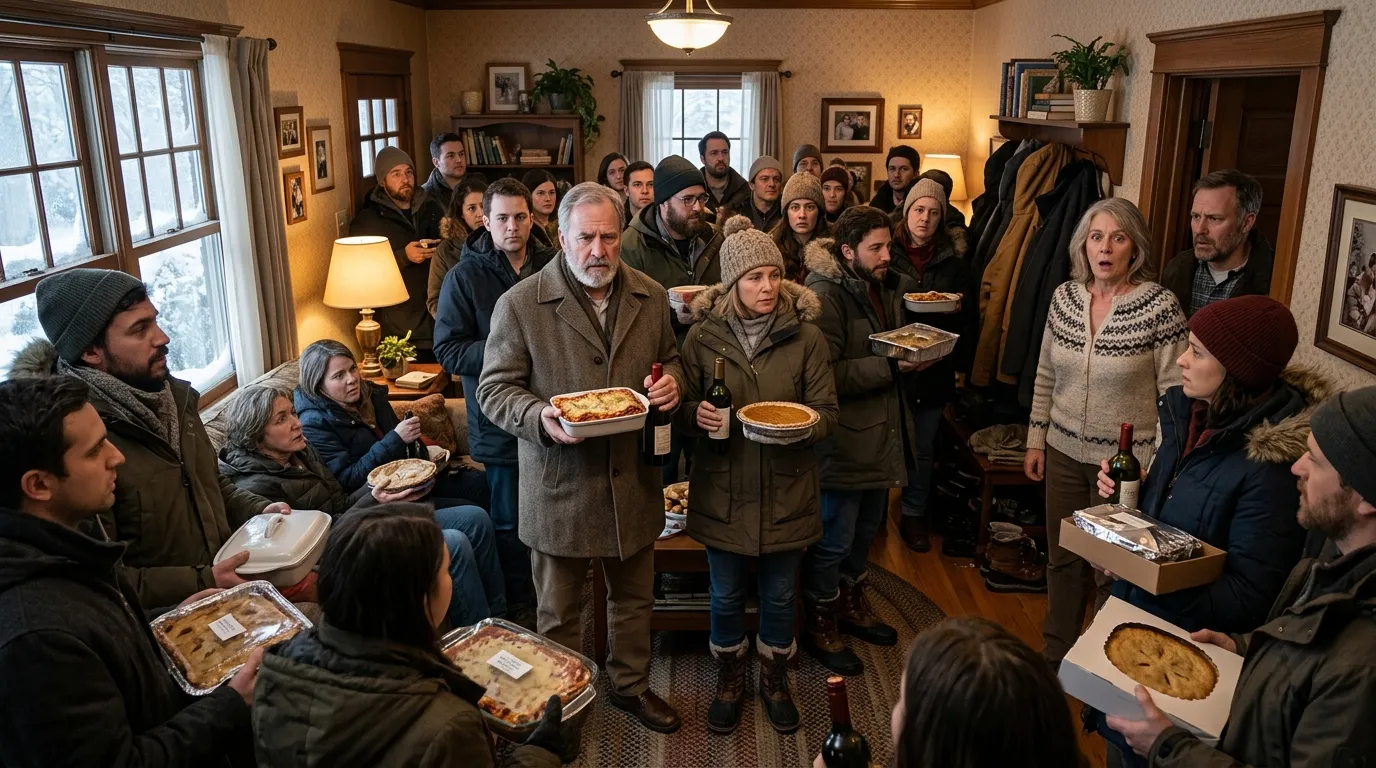
The chaotic parlor, filled with uninvited guests and nowhere to sit.
Slowly, they began piling their contributions in the kitchen, which was the only available flat surface. Then, they gravitated to my front parlor. They stood around with their winter coats still on, clutching their wine glasses, murmuring in the low, hesitant voices of people who suddenly realize they have walked into an incredibly awkward situation.
Helen, true to form, arrived last.
This was never an accident. Helen always arrived last, even to events she was allegedly helping host, because arriving last afforded her the full dramatic effect of what had been assembled—the crowd already gathered, the house already buzzing, the scene perfectly set for her grand entrance.
She swept through the front door at twelve-forty-five.
She looked around at the sheer mass of people squeezed into the parlor. She took in the mountain of coats, the barricade of wine bottles on the kitchen counter, and the precarious stacks of casserole dishes covering every inch of available space.
She smiled. It was the deeply satisfying smile of a woman who believes she has successfully pulled off a magnificent coup.
Then she dramatically removed her expensive coat, turned purposefully toward the dining room, and stopped dead in her tracks.
She blinked.
She stared at the table.
Eight settings. Eight chairs. The forbidden centerpiece sitting defiantly, exactly in the center.
She turned around very slowly.
She looked at me.
When she finally spoke, her voice possessed a raw quality I had never heard from her before. It wasn’t the smooth, unshakable certainty of the woman who gives house tours without asking. It was the faltering, breathless voice of a person who has confidently walked onto a stage only to realize the play has completely changed.
“Oh my God,” she whispered. “What did you do?”
Clarity
The room went terrifyingly quiet. You could hear a pin drop on the hardwood floor.
Twenty-odd people stood frozen in my front parlor. Twenty people who had driven here in total good faith, acting on an invitation they had received in good faith, were now breathlessly watching the showdown between me and the woman who had carelessly issued that invitation.
I looked her dead in the eye and said, evenly: “I set the table for the people I invited.”
Helen’s eyes darted back to the table. She stared at the eight perfect little place cards.
“There are people outside,” she hissed.
“Yes,” I agreed.
“You knew people were coming.”
“I found out on Tuesday,” I said, ensuring my voice carried just enough for the parlor to hear. “From Michael. Two days before Thanksgiving. I found out that you had invited nearly twenty people to my home without telling me.”
The stillness in the house was absolute.
“Rachel,” she began, her voice frantically shifting into the careful, patronizing register of a woman preparing to manage a hysterical child. “This is family. Family doesn’t need—”
“Helen,” I cut in sharply. “I want to be very, very clear about something. This is my house. I decide who is invited to my house. Those are not abstract principles or minor technicalities—they are the actual, hard facts of this situation. You invited twenty people to my home without asking me, without telling me, and without giving me a single opportunity to prepare.”
“I thought you wouldn’t mind,” she blurted out.
There it was. The golden sentence. The shield she always had ready.
“I know you thought that,” I said, stepping slightly closer. “I know you’ve thought that for a very long time. Because I have let you think it. Every time you arrived with an extra turkey, and I quietly cooked both turkeys. Every time you moved my carefully made centerpiece, and I left it where you threw it. Every time you brought extra relatives, and I pulled up chairs, smiled, and said welcome. Every time you gave invasive tours of my private home without asking, and I let it go because I convinced myself it wasn’t worth the argument.”
She opened her mouth, but no words came out.
I wasn’t finished.
“What I desperately want you to understand today is that I let you think it. Not because it was true. But because I was constantly choosing to keep the peace. But keeping the peace has a massive cost, Helen, and I’ve been paying it in silence for six years. This year, you invited twenty people without telling me because you were absolutely certain I’d just absorb the blow and manage it. I am standing here telling you, right now, that I am not going to manage it.”
She stared at the eight chairs again. Panic flickered in her eyes.
“What are they supposed to do?” she asked, gesturing weakly toward the twenty people in the parlor holding their cold casseroles.
“I don’t know,” I replied simply. “You invited them. That’s your question to answer.”
Helen stood frozen in my dining room for what felt like an eternity. I want to be brutally honest about what that moment felt like. It was not a simple, victorious triumph. It was profoundly complicated. It contained a thousand different emotions at once.
Helen’s face was processing the deeply unfamiliar experience of being fully, undeniably accountable for her own actions. There was no tour to give. No centerpiece to shove aside. No second turkey to assert dominance with. There was only a table for eight, the twenty people she had wronged, and the gaping chasm between those two facts. It was entirely her creation.
I knew Daniel was standing somewhere behind me. I could feel his presence. I didn’t turn around to look at him, because reading his face might have weakened my resolve, and I needed to finish what I had started.
The twenty people in the parlor were silent. Some of them were distant relatives of Daniel’s I’d never had the chance to actually know, mostly because I’d always been too busy running myself ragged managing the chaos of their unexpected arrivals. Among them was an older woman standing near the front door. She had a striking quality of stillness about her. She was taking the entire explosive situation in without needing to whisper or comment, a trait I instantly respected.
These people had come in good faith. They had driven hours with their pies. Whatever had gone wrong, they hadn’t done it to me. Helen had done it to me. And, shockingly, she had done it to them, too, by using them as pawns in her power play without their knowledge.
That was the genius of my plan. The plan was not punishment. The plan was pure clarity.
“Helen,” I said, breaking the silence. “There are a few things I can do. I can order enough takeout for everyone here. It will take two hours, people will have to wait in the parlor, and I’ll ask you to explain to them exactly why they’re waiting.”
I paused, letting it sink in.
“Or, the two of us can go to the basement, haul up the folding tables, and do some creative rearranging in the den. It won’t be the elegant holiday anyone expected, but people will eat.”
Another pause.
“Or, the people you invited can go home, and we can have the Thanksgiving I planned for the people who were actually invited.”
Helen stared at me in horror. “You would really send them home?”
“I would really let them choose,” I corrected her. “They’re adults. They didn’t know they were walking into this situation. They deserve to make an informed choice.”
“Rachel—”
“Helen, I am not doing this to humiliate you. I’m doing this because you desperately need to understand that I mean what I say. This is my home, and I decide who enters it. I have been patient, flexible, and quiet for years. It ends here.”
She looked at me differently then. Not the tolerant assessment of a manager. Not the smooth authority of a matriarch. She looked at me as if she was actually seeing me as an equal for the very first time.
“You planned this,” she whispered.
“Yes,” I said without flinching.
“The extension is gone.”
“Yes.”
She fell silent.
The Intervention of Evelyn
Then, from the crowded parlor, the older woman’s voice cut through the heavy air. The woman with the stillness.
“Helen,” she said clearly. “I think we owe this young woman a profound apology.”
Helen whipped around.
The older woman was standing in the parlor doorway, radiating the calm, unshakable authority of someone who has lived long enough to know that absolute clarity is infinitely more valuable than fleeting comfort.
“We came without an invitation,” she said to Helen. “That is not her fault. That is yours.”
Helen’s jaw dropped.
“I know you didn’t think of it that way,” the older woman continued relentlessly. “You never do. But the woman whose house this is has been very clear about what happened and what she needs. The absolute least we can do is listen to her.”
She turned her gaze to me. “I’m Evelyn,” she introduced herself warmly. “I’m Daniel’s father’s aunt. I haven’t met you before because you’ve never been given a fair chance to invite me.”
“Rachel,” I breathed, utterly stunned.
“Rachel,” Evelyn smiled gently. “What do you need us to do?”
What happened next shattered every expectation I had. Evelyn—the uninvited guest—took total, graceful accountability. She turned to the crowded parlor and announced, “We’re going to figure this out, and the very first thing we’re going to do is apologize to the woman whose home this is.”
And the apologies poured in. They weren’t dramatic or excessive; they were genuine. People murmured, “I’m so sorry, I had no idea,” and that was exactly enough. Some quietly gathered their coats and pies, expressing understanding before slipping out the front door without a shred of drama. Others rolled up their sleeves, marched to the basement with Daniel, and hauled up the folding tables. They rearranged the den without me having to direct them, and they did it without making me feel guilty.
Helen stood rooted in the dining room for a long time. Eventually, she picked up her expensive coat.
She found me in the kitchen. “I need to think,” she said softly. “I’m going to go home.”
I looked at her, exhausted but resolute. “Helen, I don’t want you to go home.”
She looked genuinely shocked.
“I want you here for Thanksgiving,” I told her. “I want you at the table for eight. Your place card is sitting right there. But I need you to understand that everything changes today. We’re changing the part where you make sweeping decisions about my home, and I swallow my feelings, and we all play make-believe. Can you be here for that Thanksgiving? Not the one you planned. The one I planned.”
She looked at me for a very long time.
Helen is a highly intelligent woman. She could not unknow what had just been exposed in front of twenty people. She could not unfeel the raw reality of standing powerless in front of a table for eight.
“I didn’t know you felt this way,” she finally murmured.
“I’ve been telling you for six years in every single way except directly,” I replied. “I should have been direct.”
“Yes,” she agreed.
“And you should have asked.”
She was quiet. Then, softly: “Yes.” It wasn’t defensive. It was real.
The Thanksgiving I Planned
We had Thanksgiving for eight. Actually, it was for ten. Daniel’s sister insisted Evelyn stay, and I happily added two everyday place settings. It was magnificent.
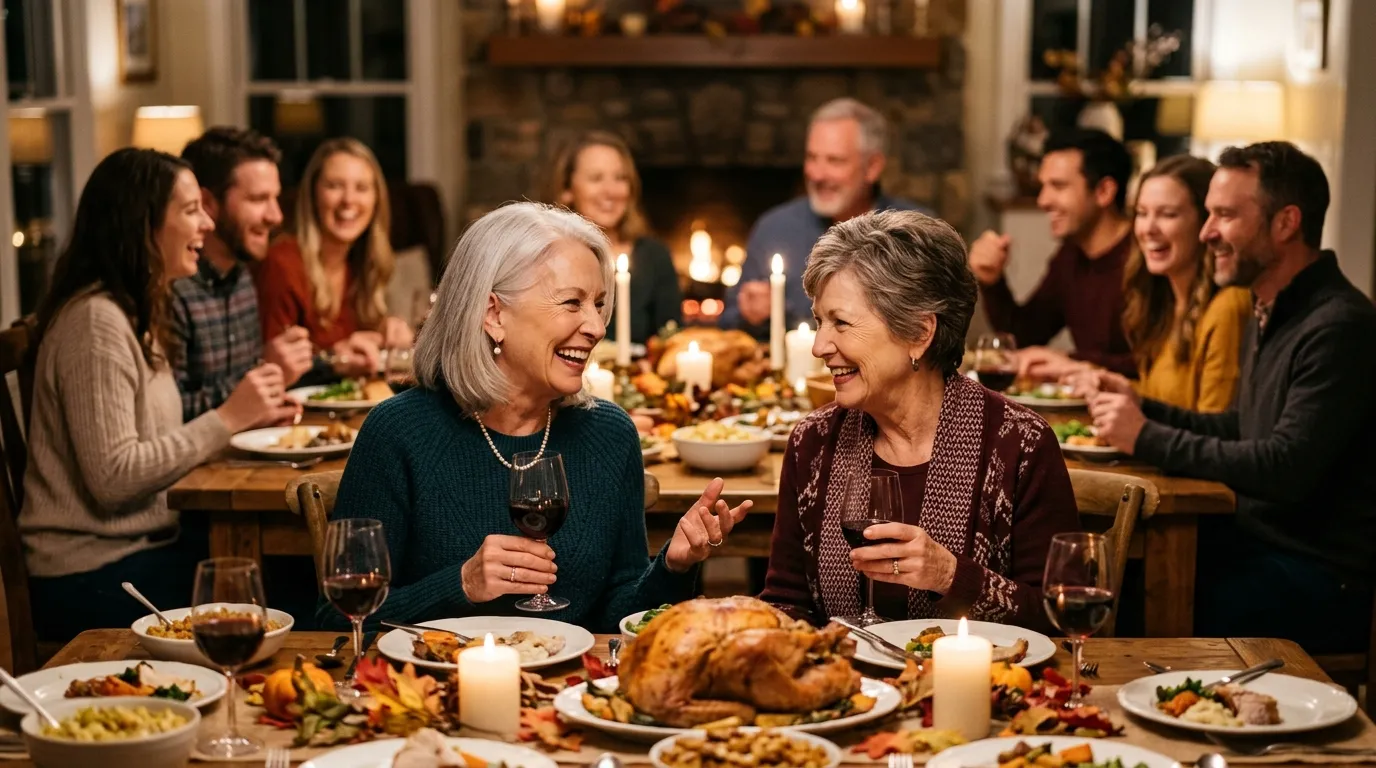
The dinner we needed. Intimate, loud with genuine laughter, and perfectly honest.
The turkey was flawless. The sides were incredible. The smaller table meant we could actually hear each other. I watched conversations unfold across the table that had never been possible before. When thirty people are crammed together, everything is a performance. At a table for ten, it is genuine connection.
Helen sat next to Evelyn. For the first time in six years, Helen was not performing. She wasn’t managing the room. She was simply present. It looked remarkably good on her.
Across the table, Daniel caught my eye. He wasn’t stressed. He wasn’t meditating a conflict. He just looked like himself, relaxed and happy in his own home.
He mouthed two words to me: Thank you.
I let it land.
Later in the kitchen, as Helen and I wrapped leftovers in a companionable silence, she stopped and looked at me. “I spent a very long time making sure I had control over everything I could,” she confessed quietly. “When Daniel’s father left, my world shattered. I don’t think I noticed how far my need for control had spread.”
“Did tonight help you notice?” I asked gently.
She almost smiled. “That table for eight was very, very clear.”
“I meant it to be.”
“I know.” She sighed. “I would like to try to do this differently. If you’ll give me the opportunity.”
“If you want to help with something,” I told her, “I will gladly ask you. But I need you to let me ask.”
She thought about it. “That sounds like me having less.”
“It sounds like you having something real,” I corrected. “Instead of something you had to forcibly take.”
She laughed. It was the very first time I had heard Helen laugh without an audience. “You’re a good woman, Rachel.”
“I know,” I smiled.
Moving Forward
I will not lie to you and say that everything magically transformed overnight. People do not rewrite their entire personalities in a single evening. Helen is still the woman who sometimes pushes boundaries. That history exists.
But the invisible thing was finally named, and you cannot unname a thing once it is spoken into the light.
Helen knows that the table in my dining room seats eight, or it seats fourteen, depending entirely on how many people I have invited. And she knows that the question of how many people are invited is my question to answer.
The wooden extension is back in the table.
The centerpiece remains exactly where I place it.
My house is my house.
It took a table for eight, an uncomfortable silence, and a whole lot of casseroles to claim it. Sometimes that is all it takes. Not years of swallowing your feelings. Not screaming matches. Just a perfectly set table, sitting squarely in the center of a room that belongs to you.
Clear. Undeniable. Honest.
I set the table for the people I invited.
Note:This work is inspired by real events and people, but it has been fictionalized for creative purposes. Names, characters, and details have been changed to protect privacy and enhance the narrative. Any resemblance to actual persons, living or dead, or actual events is purely coincidental and not intended by the author.
All images used in this article are AI-generated and intended for illustrative purposes only.
0 Comments