
Every prospective family before us fell instantly in love with four-year-old Josie. Who wouldn’t? With her bouncy cascade of brown ringlets, giant dark eyes, and a laugh that could brighten the grayest room, she looked like an illustration ripped straight from a storybook. But every single one of those families walked away the second they discovered the fine print: Josie had a sixteen-year-old brother named Jace, and they were an unbreakable package deal.
When our caseworker laid out the reality of the situation, my husband Daniel and I didn’t hesitate. We didn’t ask for time to deliberate in the hallway. We looked at each other, nodded, and said yes to both of them.
Back then, in the whirlwind of background checks, home visits, and legal paperwork, I genuinely believed we were simply offering two displaced foster children a safe, permanent roof over their heads. I thought we were the ones extending a lifeline.
I had no idea they had already conducted their own quiet interview—and made their own decision about us.
It took an unexpected phone call from their former foster mother, exactly one month after the moving boxes were unpacked, to shatter everything I assumed about our adoption journey. She paused on the line, lowered her voice, and asked a single question that stopped me dead in my tracks:
“Wait… they still haven’t told you why they picked you?”
That was the exact moment the room tilted. We hadn’t just been chosen by an agency or approved by a state board. Two children had scrutinized our souls and decided we were worthy of their trust.
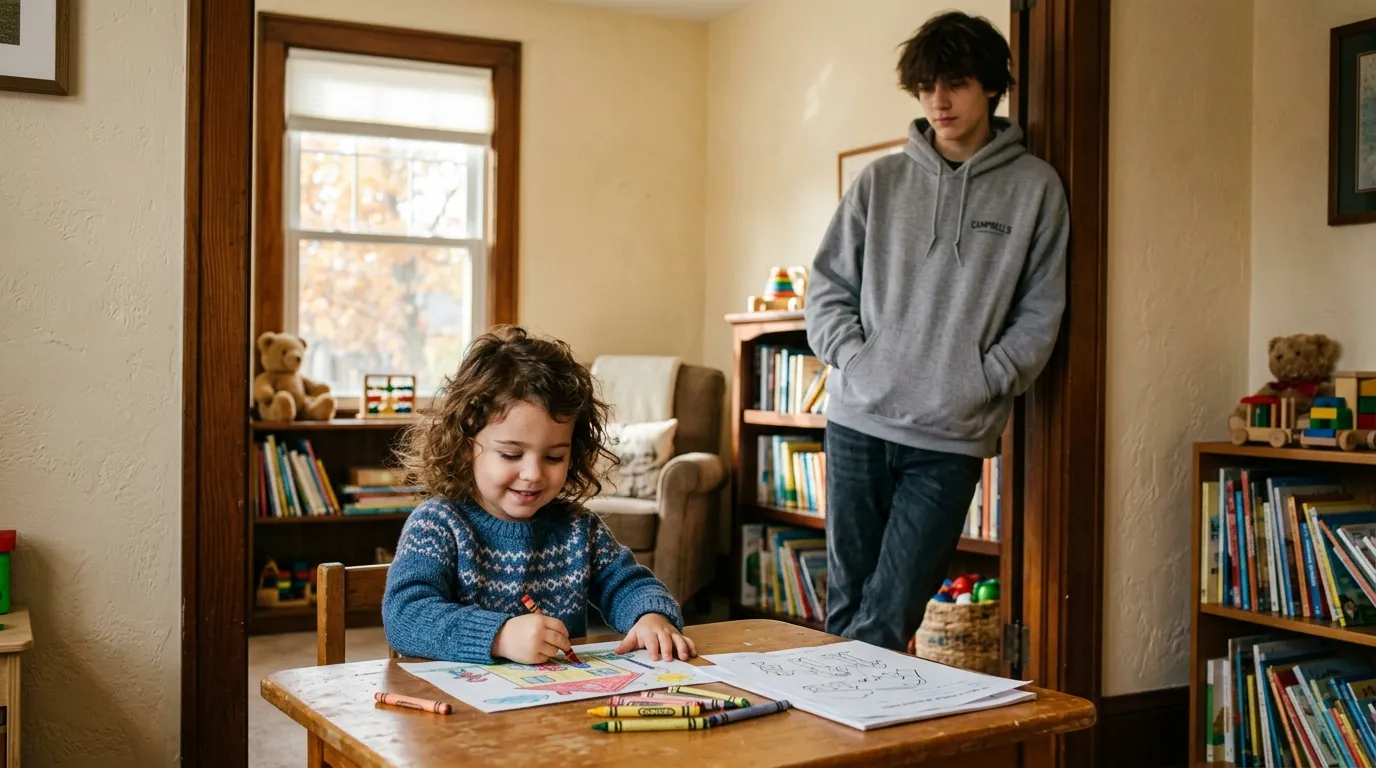
The afternoon our lives changed forever: meeting Josie and Jace for the very first time.
To really understand how we got here, you have to know about the quiet grief that preceded it. Daniel and I spent five grueling years navigating the clinical trenches of infertility. Month after month, year after year, our lives revolved around ultrasound clinics, hormone injections, invasive procedures, and a cruel cycle of fragile hope followed by crushing grief.
It wasn’t that our desire to be parents ever faded. We were simply spent. Our hearts were bruised, our savings were depleted, and the silence in our suburban home had grown suffocating. The breaking point arrived late one Tuesday night after a consultation that delivered the definitive, final verdict: biological parenthood was not going to happen for us.
I collapsed right onto the cold kitchen tile and sobbed until my chest burned. Daniel slid down next to me, pulled me into his arms, and rested his forehead against mine. Neither of us tried to offer platitudes. We just sat there in the wreckage of a dream.
Then Daniel wiped a tear from my cheek and whispered six words that rewrote our future: “We still have room to love.” He looked around our quiet, empty house and added, “Let’s build our family through adoption.”
Eight months later, we found ourselves sitting in the colorful family room of a county adoption agency, our palms sweating as we waited to meet Josie. When she walked in, she carried herself with an endearing mix of toddler curiosity and learned caution. She settled at a low craft table, gripped a purple crayon, and began shading in the outline of a four-legged animal.
Daniel carefully pulled up a tiny plastic chair beside her. “That’s a really nice dog,” he ventured gently.
Josie didn’t look up from her paper. “It’s a wolf,” she corrected him with deadpan toddler seriousness.
Without missing a beat, Daniel nodded with total gravity. “My mistake. That is an exceptional wolf.”
She froze, tilted her head up, and examined his face for three long seconds—looking for condescension or mockery. Finding none, her dimples showed, and she erupted into a musical giggle. Right then and there, my heart cracked wide open. We had been warned by every parenting book and social worker not to expect an instantaneous movie-style connection, but looking at her, something foundational shifted in my spirit.
A few moments later, our caseworker, Rebecca, gently gestured for Daniel and me to step outside into the corridor. Her expression was guarded.
“Before you get too attached,” Rebecca began, her voice cautious, “there is an essential factor you must understand. Josie is not alone. She has a sixteen-year-old biological brother named Jace. They are legally classified as a bonded sibling group. They cannot and will not be separated.”
Daniel straightened. “Where is he right now?”
“Waiting in the quiet room down the hall.”
“Why wasn’t he in the room with his sister?” I asked, an uneasy feeling settling in my stomach.
Rebecca hesitated. That brief pause spoke volumes. “Over the past year, nearly half a dozen prospective families fell in love with Josie’s profile. But every time they learned that an adolescent boy was part of the commitment, they backed out. Teen placements are notoriously difficult. Most families want a clean slate with a baby or a toddler.”
A wave of secondhand shame washed over me. “Does Jace have severe behavioral issues? Any history of violence?” Daniel asked directly.
“No more than you would expect from a boy who has endured prolonged neglect, housing instability, and the responsibility of practically raising his baby sister,” Rebecca answered softly. “Jace knows exactly why those other families walked away. He knows he’s viewed as the baggage.”
I looked Rebecca straight in the eye. “And he thinks we’re going to reject him, too?”
Rebecca gave a sad, knowing nod. “I think Jace has learned that adults rarely mean what they say. He expects people to prove it.”
When Jace finally entered the room, the contrast between the siblings was striking. While Josie was vibrant and open, Jace looked like an armored bunker. He was tall, thin, and clad in an oversized heather-gray hoodie pulled tight against the warmth of the room. His shaggy dark hair shadowed his eyes, and when introduced, he offered only a stiff, barely perceptible nod. He didn’t bother to paste on a fake smile.
Josie, however, lit up. The moment he crossed the threshold, she dropped her crayons and threw herself around his legs. Jace’s guarded posture instantly softened; his hand instinctively rested on top of her wild curls in a gesture of pure, practiced protection.
For the next two hours, we navigated the awkward dance of getting to know one another. Josie chattered enough for four people, while Jace weighed every single syllable he uttered. Daniel noticed the athletic build of his shoulders and asked if he played sports.
“Basketball sometimes,” Jace muttered with a noncommittal shrug.
“Yeah? What position?”
“Point guard.”
Daniel chuckled warmly. “I ran point guard back in my high school days. Though these days my knees remind me I’m eighty.”
For a fleeting second, Jace’s eyebrows lifted. He actually met Daniel’s gaze. A microscopic grin touched the corner of his mouth before he locked it back down. But it was there—a tiny fissure in the stone fortress he lived in.
As our visit wound down, Rebecca suggested we grab dinner together during the next scheduled visit. I turned down to Josie. “What’s your ultimate comfort meal?”
“Kraft mac and cheese with the dinosaur shapes!” she declared proudly.
I laughed, then shifted my attention directly to the teenager sitting back in his chair. “And what about you, Jace? What’s your favorite?”
He blinked, visibly startled, as if an inanimate piece of furniture had just spoken to him. “Me?”
“Of course you,” I smiled. “Unless you were planning to survive solely on dinosaur pasta.”
Jace glanced over at Josie, whose eyes were fixed intently on his face. “I’ll eat whatever you make. I’m not picky.”
It was such a mundane exchange. But to a young man who had spent years being treated like an inconvenient contractual obligation attached to a cute little girl, being asked what he wanted for dinner was revolutionary.
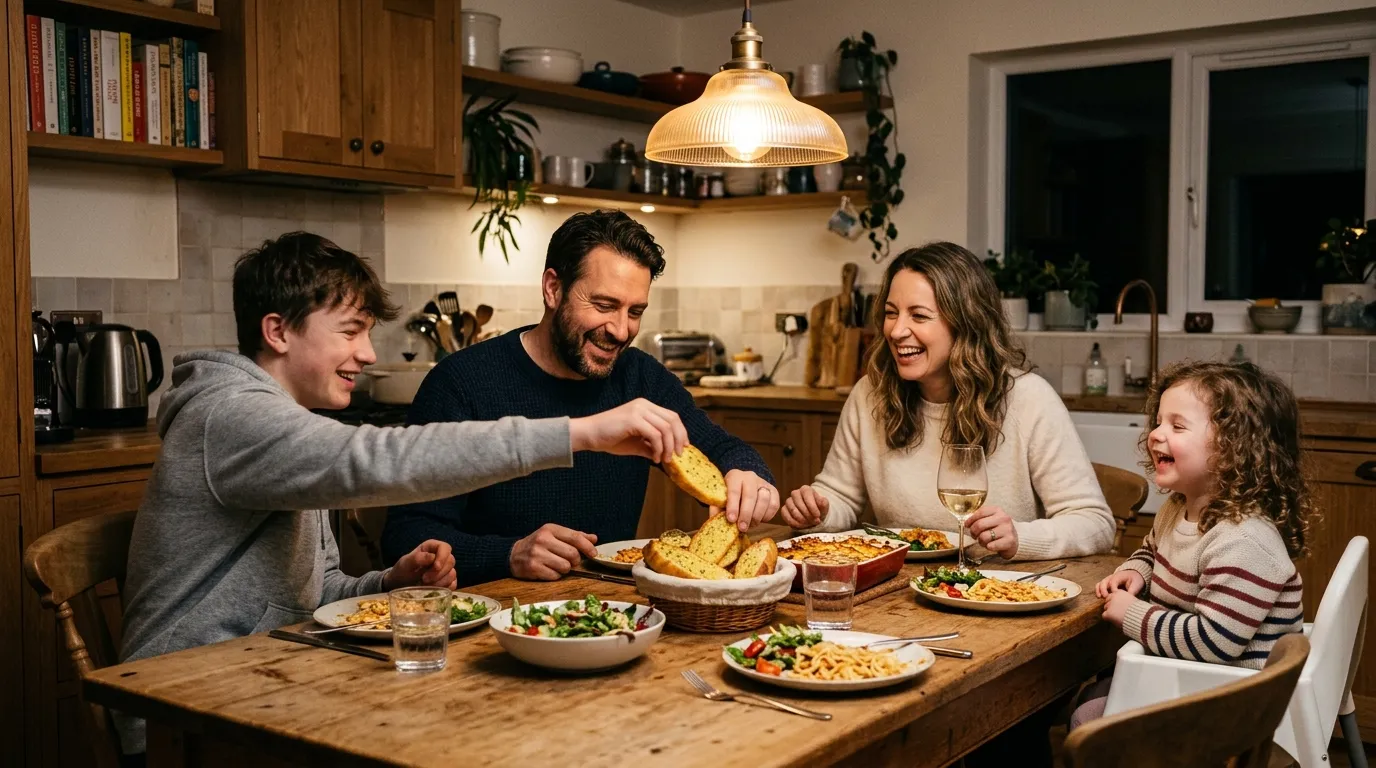
Finding our rhythm: the evening laughter took over and the house began to feel like home.
Within a month, the placement was finalized, and the children moved into our home. The transition wasn’t a fairy tale. The first week was raw and exhausting. Josie woke up in terror almost every night, shrieking with night terrors born of trauma. Before Daniel or I could stumble down the hall, Jace was already there, kneeling beside her mattress, murmuring, “I’ve got you, Jo. I’m right here. You’re safe.”
He never acknowledged that Daniel and I were standing in the hallway, ready to help. He had been her sole protector for so long that he couldn’t fathom relinquishing the post.
Gradually, Josie began to let her guard down. On our third week together, she padded into our bedroom at dawn, scrambled under the duvet between Daniel and me, and drifted back to sleep. When Jace appeared at our bedroom door searching for her, he stopped dead. He saw his sister sleeping peacefully between two adults who hadn’t hurt her or pushed her away. For the first time, he didn’t pull her back. He simply lingered in the frame for a quiet moment, then walked silently back to his room.
Jace, however, remained an enigma. He was hyper-polite, constantly answering with “Yes, sir” and “Thank you, ma’am.” He cleared plates without being asked, washed dishes immediately, and kept his bedroom impeccably pristine. Too pristine.
After ten days, I peeked into his room to fold clean laundry and realized why: Jace had never unpacked.
His two worn canvas duffel bags sat zipped tightly in the corner of his closet. His schoolbooks remained tucked inside his backpack, and his basketball shoes sat squarely beside his luggage. He was living out of suitcases, poised for rapid departure.
“You know, you can use the mahogany dresser,” I mentioned casually that evening as he folded a towel. “And the hangers in the closet are all yours.”
“Thanks. I will,” he replied evenly.
He didn’t move an inch of fabric. My maternal instinct screamed at me to unpack his clothes for him, to show him this was permanent. But an inner voice warned me that violating those bags would feel like tearing away his life jacket. So I held my tongue. Every day, I checked. Every day, those bags remained sealed.
And yet, life steadily crept into the cracks of his defenses. A worn Wilson basketball began living by our garage door. A box of sugary cinnamon cereal took over the middle pantry shelf. A tangled phone charger permanently claimed an outlet on the kitchen island.
The turning point happened over a massive pot of homemade spaghetti. Daniel told an excruciatingly corny dad joke, and Jace let his guard slip—laughing so suddenly and violently that milk shot straight out of his nose. Josie shrieked with absolute glee, clapping her sauce-covered hands. Daniel and I doubled over until our ribs ached. In the midst of the chaos, Jace boldly leaned over, grinned, and swiped a thick piece of garlic bread right off Daniel’s plate.
“Hey! Get your own carbs!” Daniel laughed, playfully swatting at his wrist.
Jace took a huge, triumphant bite, his eyes sparkling with pure, unburdened teenage mischief. For that one golden hour, nobody was tiptoeing on eggshells. Nobody was calculating exits. We were just a family having dinner.
The very next afternoon, my cell phone buzzed with an incoming call from Marlene, their former foster mother. She was checking in to see how the placement was progressing. I eagerly shared our milestones: Josie was thriving in her early childhood program, and Jace had not only joined the junior varsity basketball league, but had also spent the previous night helping Daniel prep marinara sauce.
“He cooked with Daniel?” Marlene asked, her tone shifting sharply.
“He did. Why do you sound so shocked?”
A heavy, deliberate silence hung over the line. “Marlene? What’s going on?”
“Honey… did they really not tell you why they picked your family?”
I gripped the phone tightly. “Why who picked us? We applied for them.”
Marlene let out a breath that sounded like half a laugh and half a sigh. “Call your caseworker, dear. Ask Rebecca what happened behind closed doors after your first intake meeting.”
Ten minutes later, Daniel and I had Rebecca on speakerphone. When we relayed Marlene’s words, Rebecca cleared her throat. “I assumed Jace would have brought it up by now. In our agency, when older children are involved in sibling adoptions, we give them significant agency in the placement. After your very first visit, when you walked out to your car, I asked Jace what he thought. He looked at me without blinking and said, ‘That’s our family. That’s who we want.’”
Daniel and I sat frozen. “He chose us?” I whispered. “He barely said ten words to us that day!”
“He made up his mind before you even left the parking lot,” Rebecca said gently. “If you want to know the reasoning behind it, you need to hear it from him.”
That revelation turned my world upside down. Jace had actively chosen us. Yet for four solid weeks, he had lived out of two zipped duffel bags, ready to be discarded at a moment’s notice. The two realities clashed violently in my mind: Why pick a family, only to live like you were waiting to be evicted?
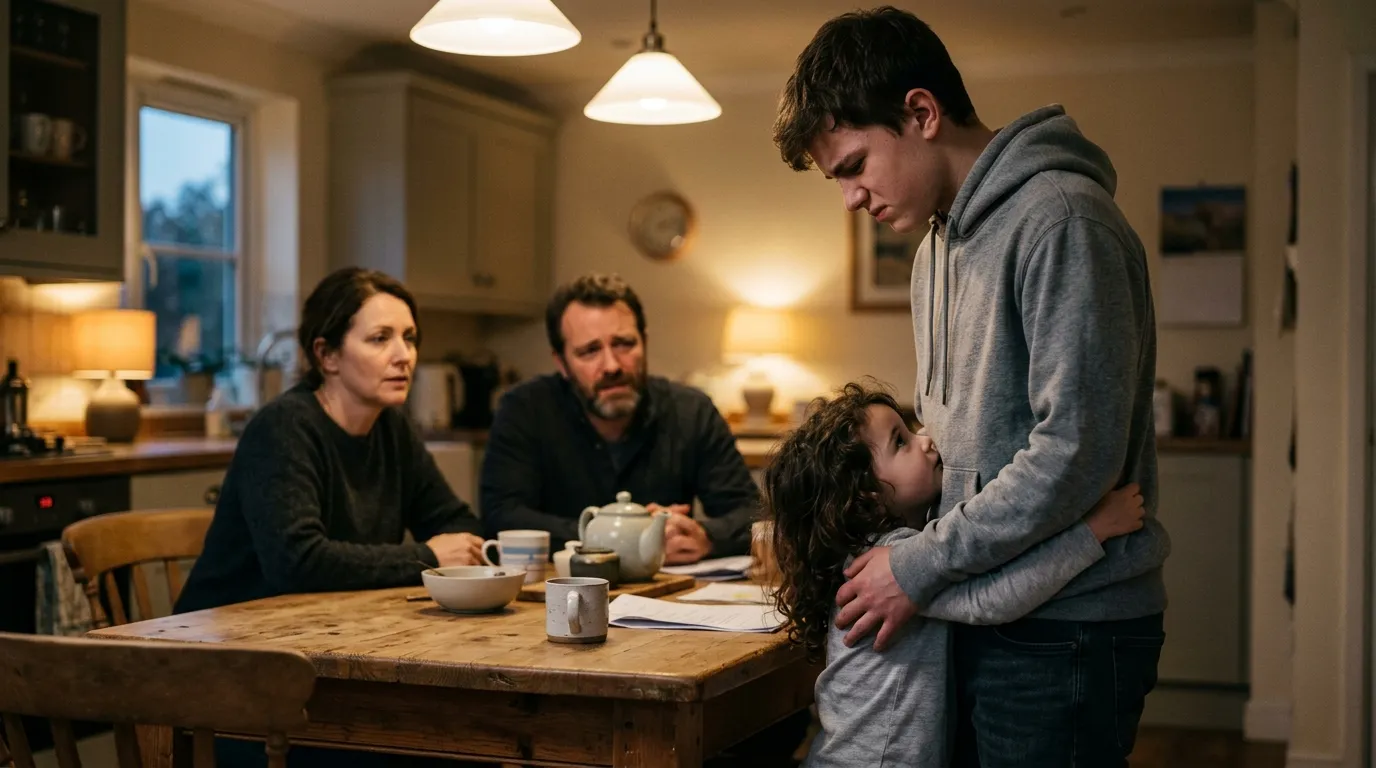
The truth revealed: Josie holding onto her brother with fierce, unwavering devotion.
That night after dinner, Josie curled up on the living room rug with her sketchbook. Jace stood at the sink, methodically rinsing plates. Daniel pulled out a kitchen chair and cleared his throat. “Hey, buddy. You got a second to talk?”
Every muscle in Jace’s back went rigid. That familiar, heartbreaking flinch of a foster kid awaiting bad news rippled through him. He set the plate down slowly, dried his hands on a dishtowel, and glanced nervously toward the living room to ensure Josie was out of earshot.
“Did I do something wrong?” he asked, his voice strained and quiet.
“No, Jace. Not at all,” I assured him, pulling out a chair beside Daniel. “Marlene called today. And then we spoke with Rebecca.”
A flicker of raw exposure darted across his eyes. He sat down slowly, his knuckles white as he gripped his knees. “Oh.”
“Rebecca told us that you were the one who made the call,” Daniel said gently. “She said you told her you wanted us to be your parents. Can you tell us why?”
Jace looked away, staring fixedly at the grain of the kitchen table. He swallowed hard. “Because Josie picked you.”
I blinked, completely caught off guard. “Josie? But sweetheart… she was only four years old.”
“That’s the whole point,” Jace said, his voice catching with an unexpected, fierce passion. “Nobody ever listens to little kids about things that actually matter. Adults ask them what flavor ice cream they want or what cartoon they like. But when it comes to their whole life—where they sleep, who takes care of them—grown-ups just make the choice and drag them along.”
He rubbed his thumb over a knot in the wood. “I promised our mom before she lost custody that I’d make sure Josie was okay. When Josie told me she wanted you guys, I made damn sure Rebecca made it happen.”
Hearing her name, Josie trotted into the kitchen, clutching a purple marker. She squeezed her little frame between Jace’s knee and Daniel’s chair, looking up at all of us. “What are we talking about?”
I leaned down, brushing a curl from her forehead. “Jace was just telling us that you picked Daniel and me to be your mommy and daddy. Why did you choose us, sweet girl?”
Josie looked at me like I had asked why the sky was blue. She reached out a small hand and pointed directly at her brother’s chest. “Because you talked to him.”
I paused, my throat tightening. “We talked to him?”
“Everybody is nice to me,” Josie said with an eerie, heartbreaking clarity that belonged to an adult, not a four-year-old. “Strangers smile at me. They buy me toys. But they don’t talk to Jace. They talk about him.”
She crossed her little arms. “They ask if he breaks things. They ask if he has bad moods. One lady took us to an ice cream shop and whispered that her house only had one spare bedroom, so Jace would have to stay somewhere else.” Her lower lip trembled with remembered anger. “After that, I wouldn’t eat her ice cream. I wouldn’t even look at her.”
“You didn’t?” Daniel asked, his voice thick with emotion.
“No!” Josie declared fiercely, wrapping both arms around Jace’s torso and burying her cheek against his gray sweatshirt. “If someone doesn’t want my brother, I don’t want them either. I stopped caring if people were nice to me. I only cared if they were nice to Jace.”
She looked up at Daniel, her eyes blazing with fierce, protective loyalty. “You asked him about basketball. And you,” she turned to me, “asked him what he wanted to eat for dinner. You didn’t treat him like he was extra.”
A solitary tear escaped Jace’s eye, tracking silently down his cheek. He quickly wiped it away with the sleeve of his hoodie, staring down at his little sister as she held onto him like an anchor.
The profound weight of her words settled over the kitchen. At barely four years old, this little girl had engineered her own adoption, using her brother’s dignity as her sole litmus test. She had refused to be loved by anyone who treated her brother like an unwanted surcharge.
I reached across the table and laid my hand gently over Jace’s trembling fingers. “If Josie chose us, and you made sure Rebecca listened… why haven’t you unpacked your bags, Jace?”
The boy seemed to shrink. He looked out the window into the dark backyard, his voice barely a whisper. “Because people always change their minds.”
“We won’t,” Daniel promised immediately. “Never.”
“You can say that now,” Jace countered, not out of malice, but out of the devastating wisdom of a boy who had been abandoned too many times. “At first, everybody thinks they can handle a teenager. They think it’ll be fine. Then I leave dishes in the sink, or I get quiet, or I cost too much money for clothes and sports gear. And suddenly they realize they only wanted the cute toddler. They get tired of me being around.”
He finally lifted his head, locking eyes with me, bare and unprotected. “I kept the bags packed so that when the day comes and you tell me I have to go, I can just grab them and walk out. I didn’t want to make a mess. I didn’t want to make it harder than it had to be.”
Those canvas bags were not an exit strategy. They were emotional body armor. They were the only control a powerless child had left in a world that continually discarded him.
I swallowed the lump in my throat, blinking back my own tears. I knew that piling on promises would do nothing; words had failed Jace his entire life. Only actions could rebuild that shattered trust.
“Jace,” I said softly, pointing down the hallway toward his room. “That big dresser in your bedroom? I didn’t buy it for a guest. I bought it because our son lives in that room. The closet belongs to you. This house belongs to you. But I understand why those bags are packed. You leave them by the door for as long as you need. Whenever you feel safe enough to unpack, you do it on your own terms.”
He didn’t say another word that night. He simply nodded, kissed Josie’s forehead, and walked quietly to his room.
The next morning, the duffel bags sat in their usual spot. They stayed there through the weekend. They stayed there through the following Tuesday. I forced myself to stop glancing through his open doorway. Unpacking had to be his declaration of safety, not our demand for closure.
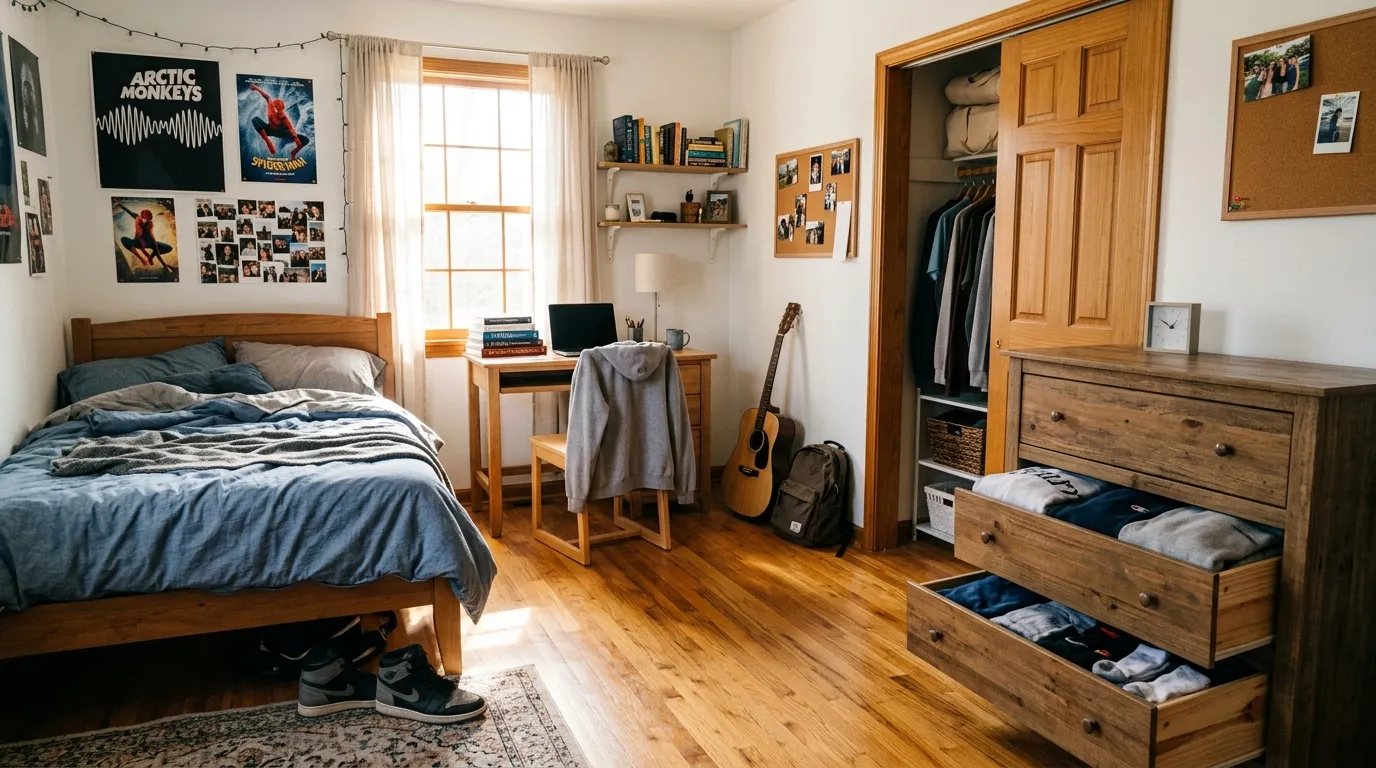
The quietest victory: empty duffel bags folded neatly away in the closet.
Ten days after our kitchen conversation, I walked down the hall carrying a basket of folded towels and stopped dead in front of Jace’s room.
The floor was a typical teenage disaster zone. Size twelve high-tops were kicked haphazardly under the bedframe. A crumpled hoodie was slung lazily over his desk chair. A stack of comic books and basketball magazines lay scattered across the nightstand. The dresser drawers were slightly ajar, bursting with folded jeans and graphic tees.
And there, on the top shelf of his open closet, sat two canvas duffel bags—flattened, empty, and zipped shut.
I felt a sudden, hot rush of tears spill over my eyelashes.
“Hey,” a deep voice spoke from behind me. Jace was standing in the hallway, holding a bowl of cereal, looking mortified. “What’s wrong?”
I turned to him, pointing into the cluttered, glorious room. “You unpacked.”
His ears turned bright crimson. He shifted his weight, looking down at his spoon. “Yeah, well… my shirts were getting wrinkled. Don’t make it weird, Mom.”
Mom.
It was the very first time the word had ever crossed his lips.
“I’m not making it weird,” I choked out, laughing through a sob as I swiped at my wet cheeks. “I’m just really glad you don’t like wrinkles.”
A broad, genuine smile spread across his face—the kind of open, unrestrained grin that belonged to a boy who no longer had to carry the weight of the world on his shoulders. “Go finish your laundry,” he chuckled, darting down the stairs toward the living room where Josie was already loudly singing along to a morning cartoon.
I stood alone in his bedroom doorway for a long time, soaking in the beautiful, chaotic mess. For years, Daniel and I had mourned the empty bedrooms in our home, wondering why our path had to be so full of heartbreak. We thought adoption was about us reaching down to rescue two children from the uncertainty of the foster system.
In reality, they had rescued us. Josie had fought relentlessly for a family that would honor and cherish her brother. Jace had shouldered the burden of adulthood before his time, just to ensure his sister had a safe harbor. And in doing so, they showed us that family isn’t forged in biology or sealed with signatures on a court document.
Family is built in the patient, unglamorous aftermath of saying yes. It’s found in burnt garlic bread stolen across a dinner table, midnight nightmares conquered together, and high school basketball games cheered from the bleachers. Most of all, it’s found in the quiet, monumental courage of a boy who finally decided it was safe enough to unpack his bags and stay.
Note:This work is inspired by real events and people, but it has been fictionalized for creative purposes. Names, characters, and details have been changed to protect privacy and enhance the narrative. Any resemblance to actual persons, living or dead, or actual events is purely coincidental and not intended by the author.
All images used in this article are AI-generated and intended for illustrative purposes only.
0 Comments