
The answer came so softly that for a fraction of a second, I genuinely wondered if I had heard Elaine correctly.
“I told her to sit down and stop performing,” she said, her voice completely devoid of empathy.
The paramedic tending to my daughter looked up, his expression freezing. The police officer standing nearby did not move a muscle. Neither did I. My entire world had narrowed down to the ambulance stretcher in my driveway. My seven-year-old daughter, Lily, sat on the edge of it, a nebulizer mask covering her small nose and mouth. Beneath her favorite pink T-shirt, her tiny chest was still rising and falling far too rapidly.
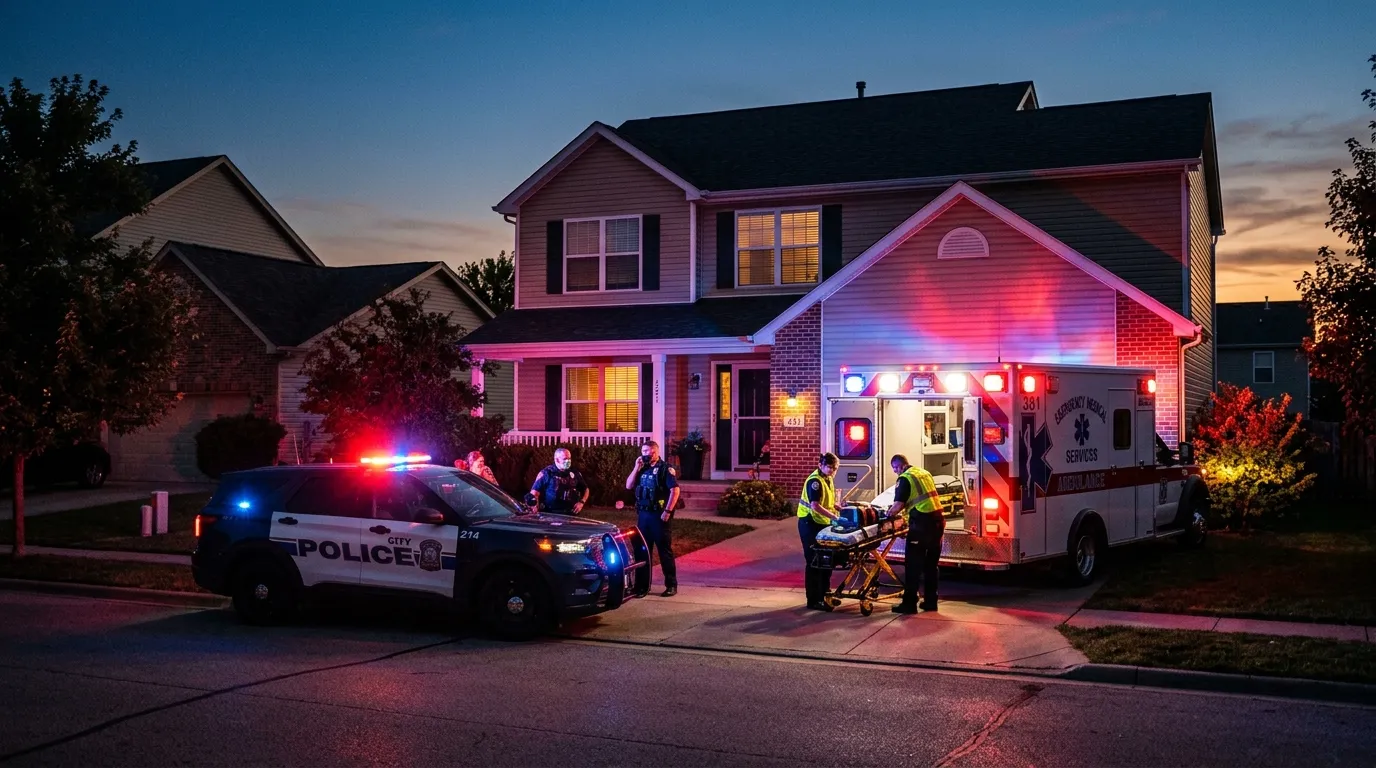
The terrifying sight of flashing lights outside your own home changes you forever.
Elaine, my mother-in-law, stood just ten feet away, wearing her neatly pressed church cardigan. She was facing an officer whose body camera was capturing every single word of this unbelievable nightmare.
“You believed she was pretending she couldn’t breathe?” the officer asked, his tone measured but sharp.
Elaine simply crossed her arms, standing firm in her self-righteousness. “She gets worked up when she doesn’t get her way.”
The officer’s gaze flicked toward Lily, then back to Elaine. “Did she tell you she needed her prescribed rescue inhaler?”
“Yes.”
“And you knew exactly where it was?”
Elaine’s eyes shifted momentarily toward the clear plastic evidence bag held by a second officer. “Yes.”
“Yet you refused to give it to her?”
Elaine’s jaw tightened, her pride refusing to yield. “I was teaching her respect.”
The Timeline of Terror
For nearly twenty agonizing minutes, I had been moving too fast to process any coherent emotion. At exactly 3:17 p.m., my phone had rung. It was Lily, and she was gasping for air. By 3:29 p.m., the police were on their way. At 3:31 p.m., the ambulance was officially dispatched. At 3:36 p.m., my tires screeched as I turned onto our street, my heart dropping into my stomach as I saw flashing red and blue lights washing over our living room windows.
Now, standing beside the stretcher, I was finally still. And that was when the blinding fear crystallized into pure, unadulterated anger. It wasn’t a loud, screaming anger. It was something much colder. It is the specific kind of rage that settles into your bones when the person who endangered your child stands in front of you, calmly explaining why she felt entirely entitled to do so.
“Slow breaths for me, sweetheart,” the paramedic cooed, gently adjusting the elastic strap on Lily’s mask.
Lily nodded weakly. Her wide, frightened eyes found mine. I stepped in close, positioning myself so she could reach out and touch my wrist without having to take her hands off the life-saving mask.
“You’re okay,” I whispered, fighting to keep my voice steady. “Mommy’s right here. I’ve got you.”
Instantly, her eyes welled up with tears. She pulled the mask away slightly, trying to force words out. The paramedic was quick, gently guiding her hand back. “Save your breath, little one. No talking right now.”
Lily nodded again. And then, impossibly, my sweet girl gave me a look I had seen a hundred times before. It was the look she gave me when she spilled juice on the rug, or forgot her spelling homework, or snapped a brand-new crayon.
It was a look of profound apology.
My beautiful daughter was sitting in the back of an ambulance, struggling to pull oxygen into her lungs, and some part of her still believed that she was the one who had caused trouble. That realization nearly brought me to my knees.
Behind us, Elaine scoffed. “See? She does this. Everything becomes dramatic.”
I spun around, but the officer beat me to it.
“Ma’am,” he commanded, his voice brooking no argument. “I need you to stop speaking about the child while she is being medically treated.”
Elaine blinked, stunned. Nobody in Elaine’s family ever told her to stop. That, as I was painfully realizing, had always been the root of the problem.
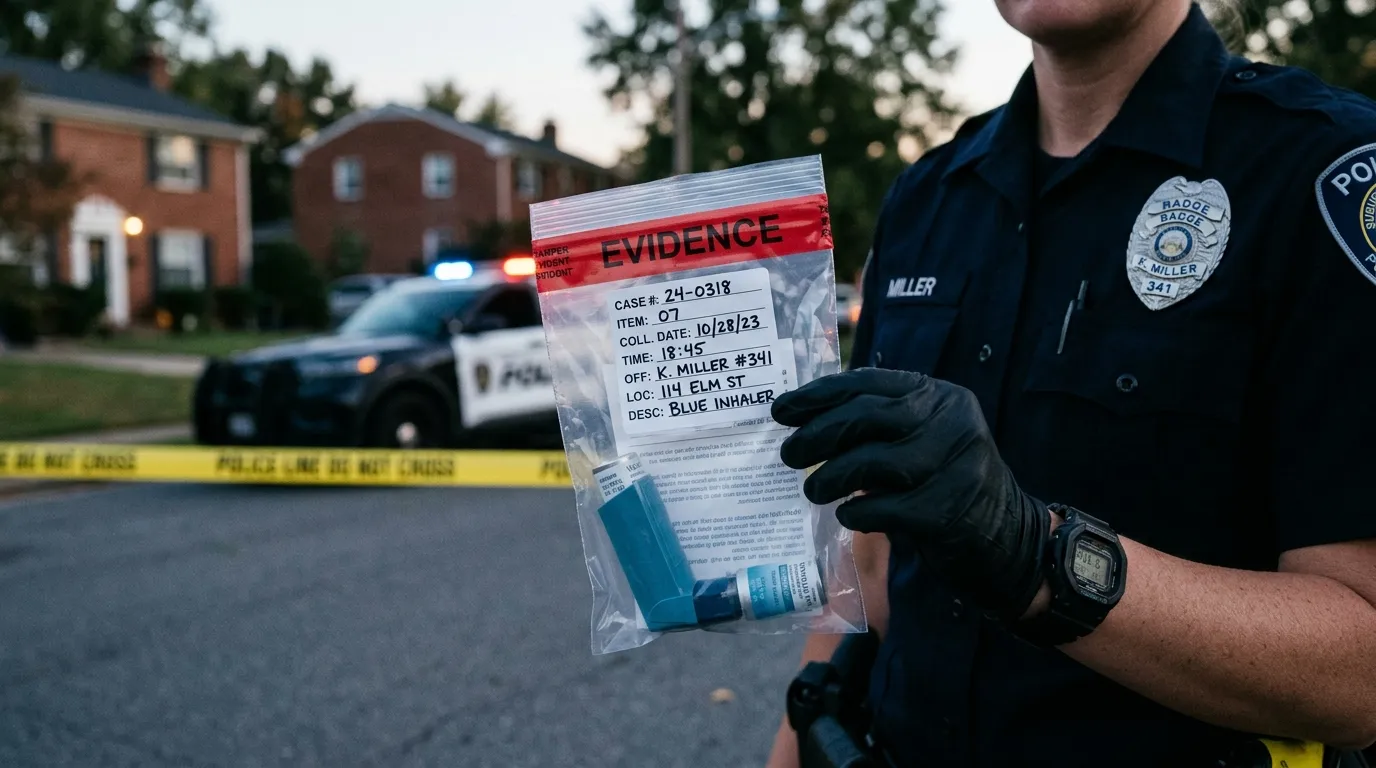
The inhaler Elaine hid for “ten minutes” became the object that changed our family forever.
The Generational Cycle of Fear
My husband, Daniel, is forty years old. He is a strong, capable man, yet he still physically shrinks when his mother uses a certain tone of voice. She only has to say, “Daniel Michael,” and his shoulders instantly pull up toward his ears. If she sighs after he disagrees with her, he immediately begins backpedaling and over-explaining himself. He has spent his whole life apologizing for conflicts before they even exist.
For years, I had written this off as simply part of his personality. He was a peacekeeper. But over time, I started noticing he only did it around Elaine. She proudly referred to his behavior as “respect.” Slowly, I had learned the actual word for it: Fear.
Elaine loved to regale us with stories about raising Daniel, speaking about his childhood as if it were a military boot camp. She bragged about taking the doors off their hinges when he slammed them as a teen. She proudly recalled throwing away his favorite toys when he dared to argue. She casually mentioned sending him to bed with an empty stomach when she felt he required an “attitude adjustment.”
Every single story ended with her favorite catchphrase: “And he turned out fine.”
Daniel usually offered a tight smile when she said it. But the smile never reached his eyes. Standing there that afternoon, listening to the mechanical hiss of my daughter’s nebulizer, I finally understood why that phrase had always made my skin crawl.
For Elaine, a child’s mere survival was the only evidence she needed to excuse whatever psychological or physical harm she inflicted along the way.
The Boundary is Drawn
The second officer began walking toward his cruiser, the evidence bag swinging lightly in his grip. Elaine watched him, her brow furrowing.
“Why are you taking that?” she demanded.
“It’s being documented as evidence,” the officer replied flatly.
“It belongs to my granddaughter!” she protested, as if she were the victim.
The first officer looked her dead in the eye. “She needed it twenty minutes ago.”
For the first time all afternoon, Elaine was speechless.
As the paramedics peppered me with questions about Lily’s medical history—moderate persistent asthma, known triggers like exercise and respiratory infections—the officer continued pressing Elaine on the timeline. She admitted, reluctantly, to taking the inhaler “maybe a few minutes” before Lily called me. She tried to frame it as a minor disciplinary action, completely ignoring the terrifying reality of an asthma attack.
When our neighbor stepped out onto the sidewalk, Elaine’s facade cracked. She hated public embarrassment more than anything. She tried to enlist me to downplay the situation to the police, insisting Lily “needed to stop challenging adults.”
When the officer ordered her to step back, Elaine looked genuinely frightened. Not because her granddaughter couldn’t breathe. Not because the police were at her son’s house. But because, for the first time in her life, someone had informed her that her absolute authority had a hard boundary.
My phone vibrated. It was Daniel. I had only managed to text him three words during my frantic drive: LILY. AMBULANCE. HOME.
“Is she okay?” he gasped into the phone.
“Paramedics are treating her,” I replied, my voice steady. “Your mother took Lily’s inhaler away because she thought Lily was being disrespectful. She hid it while Lily was having trouble breathing.”
The silence on the line was deafening. Then, the old conditioning kicked in. “Put Mom on,” he said.
“No.” The word flew out of my mouth before I could even think about it. “She’s speaking to the police. Get here safely.”
I hung up. For years, when Elaine created drama, we all handed it to Daniel to fix. We expected him to calm her down, to translate her toxicity into something manageable. Not anymore. She created this emergency, and she was going to face the authorities herself.
When it was time to take Lily to the hospital for observation, Elaine tried to climb into the ambulance. The officer blocked her, and when she tried to use her intimidating “mother tone” on me, I looked right through her.
“You are never supervising Lily alone again,” I told her, my voice like ice. When she accused me of overreacting and claimed she would never hurt her, I pointed to the evidence bag. “You already did.”
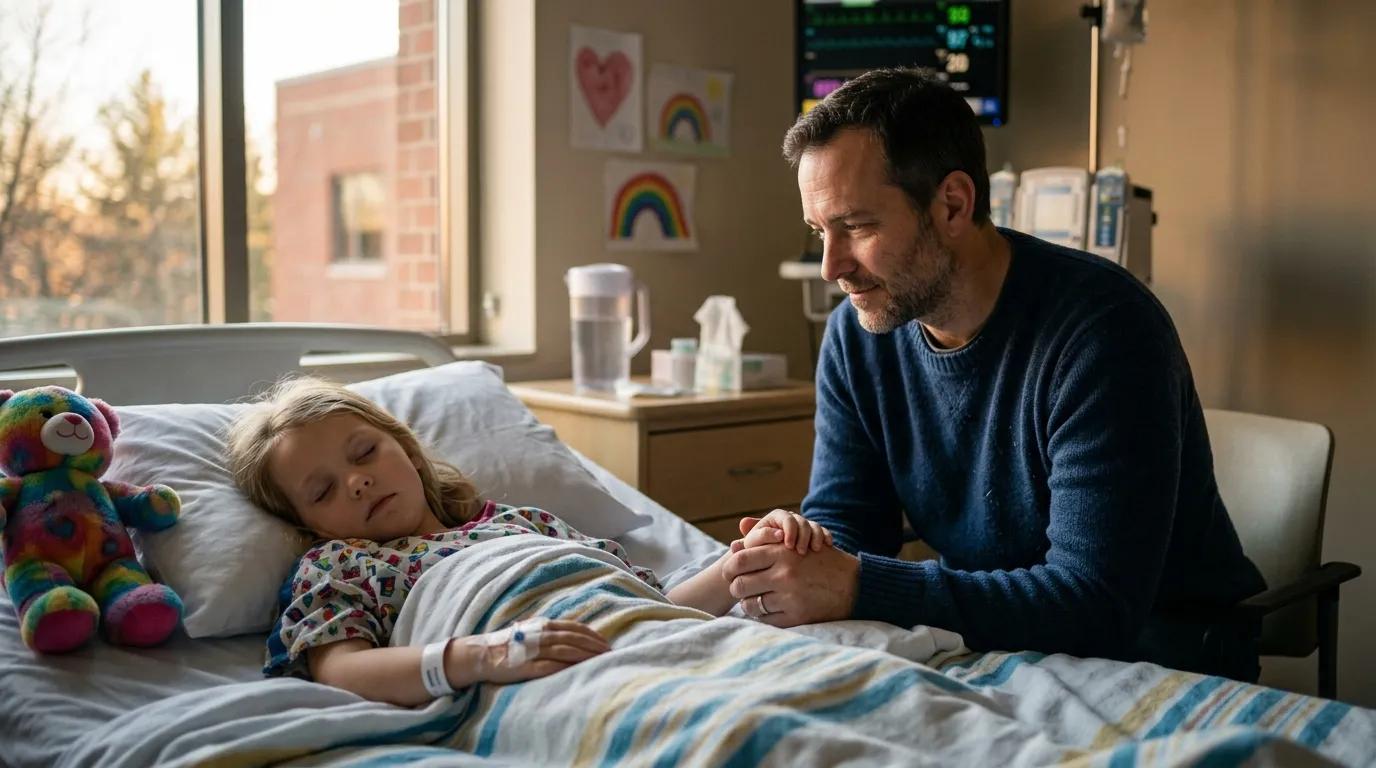
At the hospital, Daniel finally realized that his mother’s version of “respect” was just fear in disguise.
Breaking the Cycle
Daniel arrived just as the ambulance doors were closing. Elaine called out to him, expecting him to run to her side as he always had. He stopped for a split second, the old reflex pulling at him. But then, Lily coughed from inside the ambulance.
Daniel turned his back on his mother and climbed into the ambulance with his daughter. He chose his child over his abuser. It was the first consequence Elaine could not argue away.
Later, in the quiet of the hospital room, Lily looked up at her father. “Daddy? Am I in trouble?”
Daniel’s face completely collapsed. “No, baby,” his voice cracked, tears spilling over. “Never for asking for your medicine.”
“Grandma said I was rude,” Lily whispered.
Daniel took her small hand in his. “You can be angry. You can disagree. You can even be rude sometimes, and we’ll deal with that separately. But nobody gets to take away medicine you need to breathe. Grandma’s feelings are not your job.”
In the weeks that followed, our family transformed. We laid down ironclad rules: Elaine had no unsupervised access, no keys to our home, and absolutely no handling of medication. When she predictably pushed back, trying to justify her actions, Daniel finally found his voice.
“You don’t get to teach my daughter the same lesson you taught me,” he told her firmly. “That being scared is safer than asking for help.”

Breathing is never negotiable, and neither is a child’s safety.
Today, Lily is thriving. Her inhaler is always within reach, and she knows with absolute certainty that an adult’s authority ends the exact moment her safety begins.
Months later, Lily called me from the backyard, asking to turn on the sprinkler. Her voice came through the phone clear, breathless only from the sheer joy of laughing. For a terrifying half-second, the sound took me right back to that awful afternoon. But then she laughed again, loud and full of life, and I could hear all the beautiful, unrestricted air she needed.
Note:This work is inspired by real events and people, but it has been fictionalized for creative purposes. Names, characters, and details have been changed to protect privacy and enhance the narrative. Any resemblance to actual persons, living or dead, or actual events is purely coincidental and not intended by the author.
All images used in this article are AI-generated and intended for illustrative purposes only.
0 Comments