
For as long as I could remember, my grandfather Henry kept a weathered world map folded inside his dresser drawer. Whenever the Ohio winters dragged on, or whenever he missed my grandmother a little too much, he would pull it out and trace the vast blue expanse of the Pacific Ocean with a trembling finger.
“Just once more,” he used to whisper, his voice soft with memory. “Before the curtain falls, I’d give anything to smell that salt air one last time.”
Grandpa Henry was stationed on Oahu as an eighteen-year-old private during World War II. He had survived the catastrophic morning of December 7, 1941, returned home to Ohio, married Grandma Evelyn, and built a quiet life. There were three children, decades of factory shifts, home repairs, and grocery bills. Life had a way of happening, and the dream of returning to the island slipped quietly into the background. When Evelyn passed away after fifty-six years of marriage, Grandpa stopped talking about vacations entirely.
I was his only granddaughter, the girl he taught to drive on dusty backroads and the one who received a phone call from him every single Sunday morning without fail. So, I secretly worked extra shifts, saved every spare dollar for two years, and finally handed him an envelope with two plane tickets tucked inside.
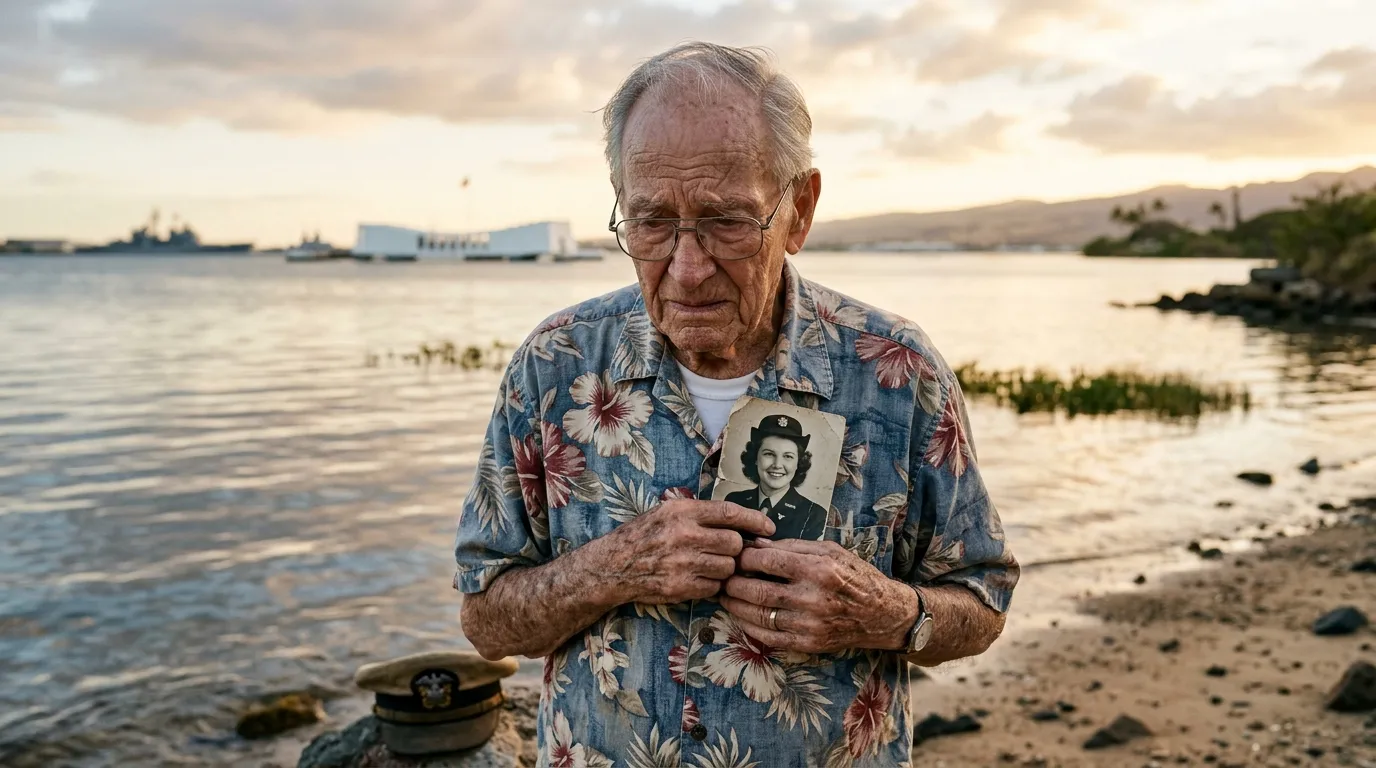
At 102, Grandpa Henry finally returned to the waters he had dreamed about for over eight decades.
The Whispers in the Lobby
From the moment our plane touched down in Honolulu, the years seemed to melt off Grandpa’s shoulders. At 102 years old, his step gained a sudden bounce. He let the warm island sand sift through his knuckles, touched the aerial roots of an ancient banyan tree like an old comrade, and stood in reverent silence at the Pearl Harbor memorial, pressing Evelyn’s pocket portrait against his lapel.
We stayed in a charming, family-owned heritage hotel near the coast—a historic wooden property surrounded by swaying palms and flowering plumeria. The hospitality was exceptional, yet an undeniable mystery hung in the air from the hour we checked in.
The hotel staff kept staring at Grandpa.
On our second morning, a housekeeper dropped an armful of fresh linens when she rounded the corridor and saw his face. During breakfast, the line cook peeked through the swinging kitchen doors, watching Grandpa butter his toast with wide, disbelieving eyes. Later that afternoon, I caught the front desk clerk leaning across the counter, pointing discreetly at Grandpa as he walked toward the elevator.
“Maybe they’ve never seen an old fellow pull off bright orange hibiscus petals,” Grandpa joked, smoothing down his collar. He chuckled, oblivious to the quiet storm brewing around him.
But on our final afternoon, while Grandpa was upstairs taking his afternoon nap, the hotel manager intercepted me near the garden corridor. His hands were clasped tightly together, and his eyes were glistening with unshed tears.
“Excuse me, miss,” he began, his voice thick with emotion. “I apologize for troubling you, but we have been looking for your grandfather for more than eighty years. Our family had almost surrendered all hope, but he is here. Truly here.”
A chill rippled down my spine. “Sir, my grandfather served here in 1941, but he hasn’t stepped foot in Hawaii since the war. You must have him confused with someone else.”
“No confusion,” the manager replied gently. “He did something extraordinary here—something I know he never told you. Please, walk with me.”
The Room Behind the Wall
He led me past the front desk into an administrative annex I hadn’t noticed before. He unlocked a heavy cedar door that opened into a quiet, sunlit room smelling of aged paper, polished wood, and dried hibiscus flowers. Sitting quietly in an armchair by the window was an elderly Hawaiian woman, her silver hair woven into an elegant braid.
When she looked up and saw my face, she let out a quiet gasp. Tears immediately spilled down her lined cheeks.
“The eyes,” she whispered. “You carry Henry’s exact eyes.”
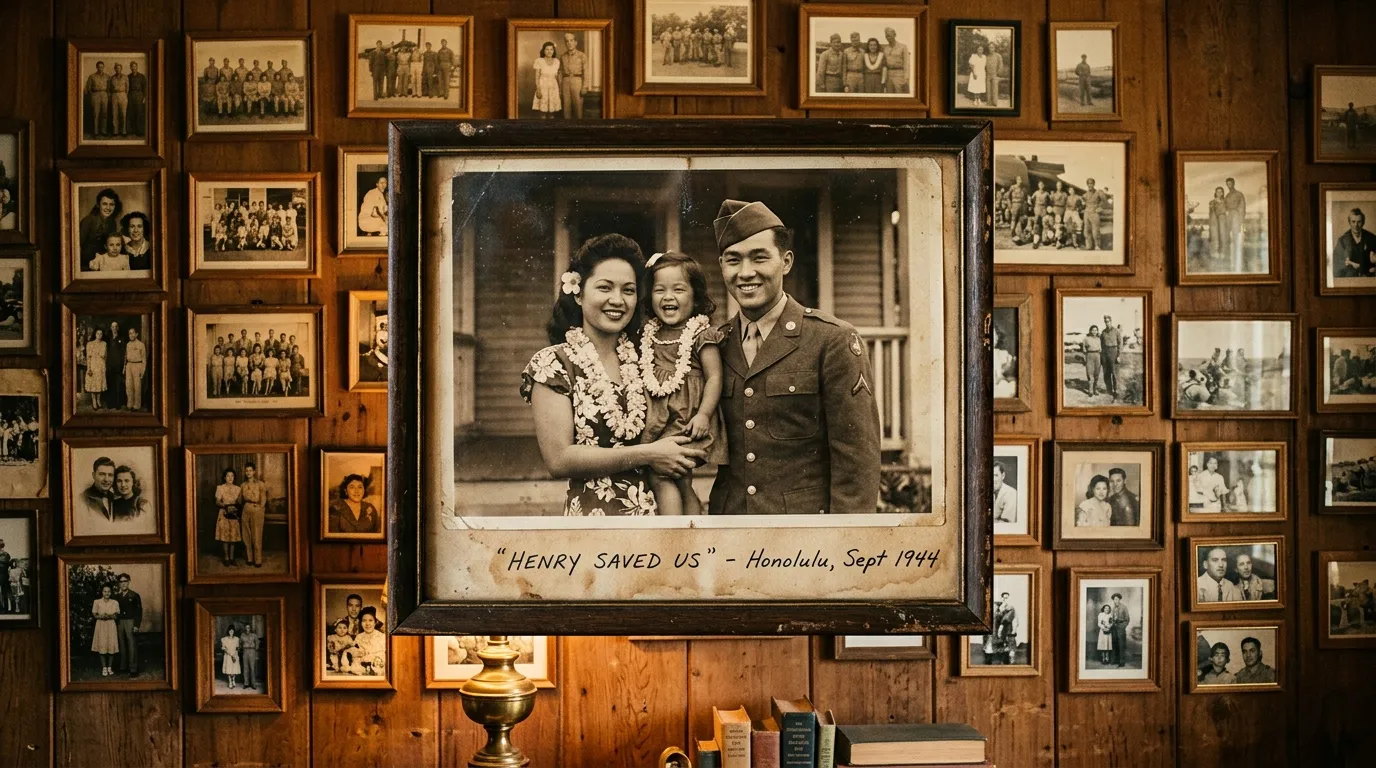
The hotel’s private archive preserved the memory of an eighteen-year-old private who refused to run.
I froze. Behind her, dominating the main wall, was a sweeping collage of archival history. Dozens of vintage photographs spanned across decades—some faded to amber sepia, others protected under museum glass. And right in the center was an enlarged, pristine black-and-white portrait taken outside this very building in the late autumn of 1941.
The hotel looked different then: single-story wings, darker wooden shingles, smaller palms. But standing in the back row, upright and slender in an army uniform, was my grandfather at eighteen years old. His jaw was set, his expression solemn.
Standing directly beside him was a beautiful young Hawaiian woman holding a toddler who couldn’t have been more than four years old. Someone had drawn a careful circle around young Henry’s face decades ago. Underneath, written in faded fountain-pen ink, were three simple words:
HENRY SAVED US.
“Who is that?” I asked, my voice cracking.
“My name is Leilani,” the elderly woman said softly. “I am ninety-one years old. The woman in that photograph was my grandmother, Malia. And the little girl in her arms… was my mother, Ruth.”
The Morning the Sky Fell
The manager pulled out a chair for me, and Leilani began to unravel a story our family had never heard.
Back in 1941, this hotel had been a seaside boarding house run by Malia and her family. They offered cheap lodging to laborers, merchant mariners, and enlisted servicemen waiting for permanent barracks. Young Private Henry Carter had stayed there for several weeks before being deployed across the island.
He was a quiet country boy from Ohio, but he had a servant’s heart. He repaired loose veranda floorboards, carried heavy sacks of flour from delivery trucks, and played afternoon card games with Malia’s father. Most of all, he had a soft spot for little four-year-old Ruth, who trailed him like a shadow. Whenever Henry walked up the gravel path, he brought a piece of sweet candy wrapped in wax paper.
Then came the morning of Sunday, December 7, 1941.
When the first wave of Japanese bombers struck Pearl Harbor, shock waves rattled the coastline miles away. Screams filled the streets as thick, black pillars of smoke rose toward the clouds. Malia’s husband was away working on another island, and her parents had gone inland. She was alone with little Ruth and a few panicked tenants.
A stray explosion struck an adjacent fuel depot, sending a wall of fire ripping toward the wooden boarding house. Roof timbers caught ablaze, and smoke engulfed the second floor.
Henry had been on an errand run when the sky erupted. Instead of seeking shelter or running for military evacuation points, he saw the plume of smoke rising from the boarding house and sprinted straight into danger.
The manager opened a leather-bound binder and slid an archival newspaper clipping across the desk. It was a single paragraph buried deep in a wartime gazette:
“…Pvt. Henry W. Carter pulled three civilians to safety before returning into the collapsing boarding structure to locate an unaccounted-for child…”
“The ceiling had already partially caved in,” Leilani recounted, wiping away tears. “My mother had crawled under a heavy bed in absolute terror. Everyone thought she was gone. But Henry crawled into the flames and found her. He took off his thick military jacket and wrapped it completely around her head and shoulders, ordering her not to look.”
He carried Ruth down a burning stairwell seconds before it gave way. When he delivered her safely into Malia’s arms on the street, his uniform was scorched, his hands were blistered, and his lungs were raw from smoke. Before anyone could properly treat him, military police trucks arrived to herd all enlisted personnel back to their units.
The war swept Henry away. Malia never saw him again.
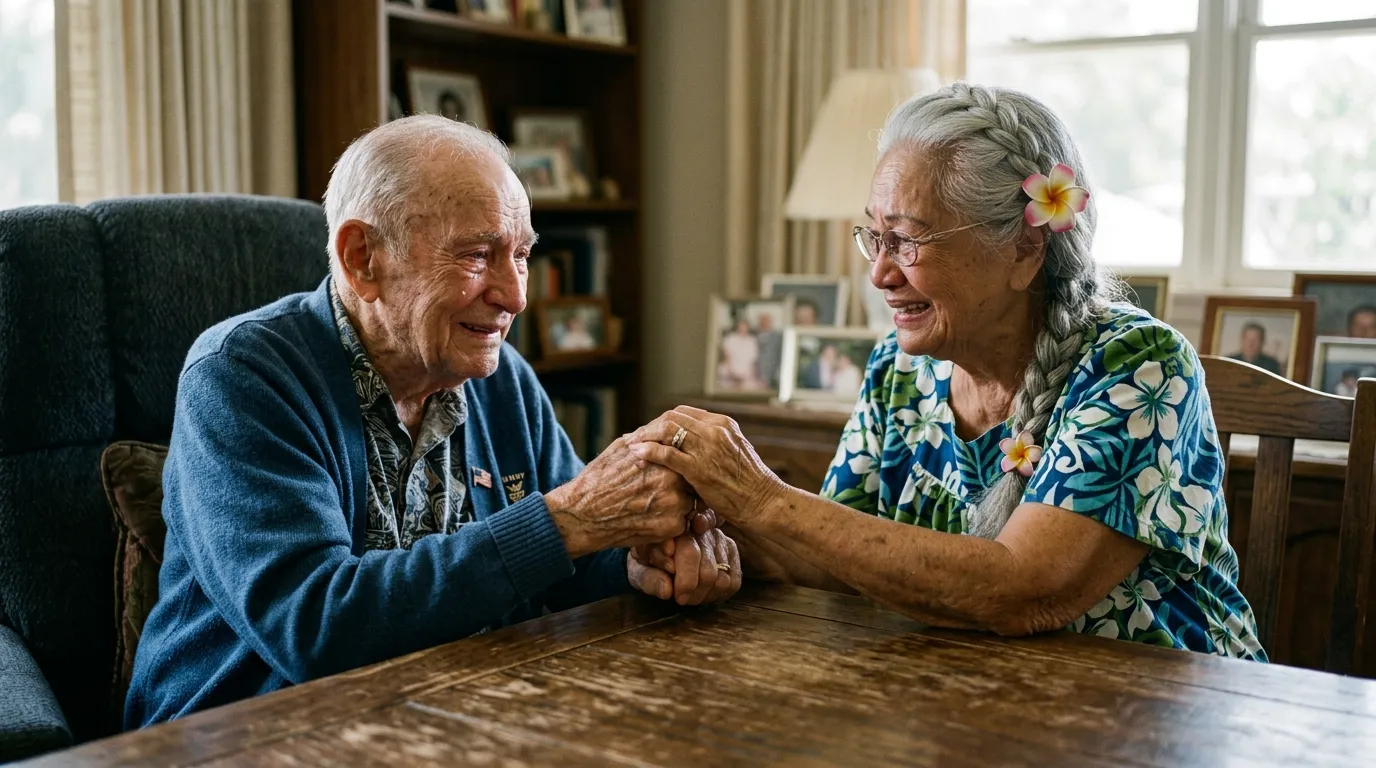
Leilani clasped Henry’s hand, bridging eighty-four years of gratitude and unanswered prayers.
Eighty Years of Letters
The manager opened a wooden cabinet behind his desk, revealing dozens of envelopes neatly stacked in bundles. Every envelope was addressed to Private Henry W. Carter.
After the war, Malia spent years trying to track Henry down. But army records were scattered, Henry’s family farm in Ohio had relocated, and letters marked with his serial number were repeatedly returned: Addressee Unknown.
As the boarding house slowly grew into a modern resort over the decades, the family kept Henry’s photo prominently on the archive wall. Little Ruth grew up, became a mother, and recounted the story of the brave boy with the candy and the jacket every single December 7. When the internet arrived, her grandchildren searched registry databases, but “Henry Carter” yielded thousands of results.
Then, three days ago, our reservation popped up on the check-in screen.
When the desk clerk saw an elderly Henry Carter from Ohio enter the lobby, he noticed the veteran stop dead in his tracks before a vintage photograph of the old 1941 boarding house. The family compared the hotel guest to the eighteen-year-old face on their wall. The cheekbones, the kind slope of his brow, the gentle posture—it was undeniably him.
“My mother passed away at eighty-six,” Leilani said softly, squeezing my trembling fingers. “Until her final breath, she prayed that one day she would get to say thank you to the soldier who saved her life. Please, bring him down to me.”
The Meeting
I rode the elevator upstairs in a daze. When I pushed open the hotel room door, Grandpa was sitting quietly on the balcony, his floral shirt unbuttoned at the neck, gazing out over the glittering blue waves.
“Grandpa,” I said gently. “There’s someone downstairs who needs to see you.”
He frowned playfully. “Did they find out I smuggled a piece of pineapple into my pockets at breakfast?”
“No, Grandpa. Come with me.”
Leaning heavily on his cane, his hand resting securely in mine, we made our way back down the quiet corridor. When I guided him across the threshold of the cedar room, his cane clicked once against the wood floor and halted.
Grandpa froze. His eyes traveled across the wall of photographs until they locked onto the portrait of his younger self standing beside Malia and little Ruth.
A soft, broken whisper left his lips: “Oh, dear God… no.”
Leilani stood up from her chair, her hands trembling. “Henry?”
Grandpa’s knees buckled slightly, and the manager rushed forward to slide an armchair under him. He sat down heavily, staring at the little girl in the center of the frame.
“Ruthie…” he choked out, his voice cracking into sobs. “Little Ruthie.”
Leilani knelt beside his chair. “I am her daughter, Henry.”
I had seen my grandfather weep only twice in my entire life: the day Grandma Evelyn died, and when his younger brother passed away. But here, in this quiet island room, a century of pent-up emotion broke loose. His entire frame shook with tears.
“Did she… did she make it?” Grandpa stammered, covering his face with his calloused hands. “Did she survive?”
“She lived to be eighty-six years old,” Leilani said, placing her warm hands over his shaking fingers. “She lived a long, beautiful, joyful life. She had three children, eight grandchildren, and fourteen great-grandchildren.”
Grandpa let out a breathless sound that was half sob, half laugh. For eighty-four years, he had lived with the haunting question of whether the little girl he had pulled from the fire had survived the chaos of that terrible day. War had swallowed everything, and he assumed she had perished in the aftermath.
“She remembered your jacket, Henry,” Leilani whispered. “She told us that whenever she felt afraid or overwhelmed in life, she closed her eyes and remembered being wrapped in your wool jacket, carried safe through the dark.”
Grandpa leaned forward, resting his forehead against Leilani’s hands, and let eighty years of quiet sorrow wash away.

Four generations gathered under the island stars to honor the private who changed their family’s destiny.
The Ripples of One Good Deed
We canceled our flight home that evening. We stayed an entire extra week.
Over the next seven days, the hotel courtyard transformed into a living family reunion. Ruth’s children, grandchildren, and great-grandchildren traveled from across the islands to meet Henry. They brought home-cooked Hawaiian dishes, leis woven from fresh orchids, and scrapbooks filled with photos of graduations, weddings, and baby showers.
At a celebratory dinner held beneath the courtyard palms, one of Ruth’s great-grandsons—a boy of seven named Noah—walked up to Grandpa’s chair, staring with wide, curious eyes.
“Are you the soldier who saved everyone?” Noah asked.
Grandpa shook his head gently. “No, son. I didn’t save everyone. Not even close.”
The boy looked back at his mother, his grandmother Leilani, and the dozens of cousins laughing around the tables. Then he looked back at Grandpa and said simply: “You saved us.”
Before we finally departed for Ohio, the hotel manager presented Grandpa with a small, varnished block of historic wood. During renovations years earlier, carpenters had salvaged a piece of an original foundation beam from the 1941 boarding house. Deeply scored into the grain were carved initials:
H. CARTER — OHIO
Grandpa ran his thumb over his own carving from eighty-four years ago, smiled that unmistakable crooked grin, and placed the wood firmly in my hands. “Take it,” he told me. “I already know I was here. Now you’ll never forget it.”
Grandpa Henry passed away peacefully fourteen months later at the age of 103, resting in his favorite chair by the window.
While packing his modest belongings, I opened his old leather wallet. Tucked behind the photo of Grandma Evelyn was a tiny, faded reprint Leilani had gifted him in Hawaii. On the back, in Grandpa’s frail, shaky handwriting, he had written a final message to his late wife:
“Evelyn, I finally went back. The little girl lived. You would have loved who she became.”
I had saved my money for years thinking I was giving my grandfather a simple vacation—a final chance to smell the ocean and say goodbye to his past. I had no idea that a miraculous debt of love was waiting there across the ocean, proving that a single act of kindness never truly fades away.
Note:This work is inspired by real events and people, but it has been fictionalized for creative purposes. Names, characters, and details have been changed to protect privacy and enhance the narrative. Any resemblance to actual persons, living or dead, or actual events is purely coincidental and not intended by the author.
All images used in this article are AI-generated and intended for illustrative purposes only.
0 Comments