
For eighteen years, I convinced myself that burying my daughter’s twin sister in absolute silence was an act of profound, protective love. I told myself that a child should never have to carry the heavy shadow of a ghost before her own life had even begun. I believed that by erasing the tragedy from our home, I was building a shield around Hannah’s heart.
Then, on her eighteenth birthday, my husband placed a handmade wooden box in front of her on our patio table, forcing me to confront the devastating truth: I hadn’t been protecting Hannah at all. I had simply been running away from a grief I was too terrified to face.
Our daughter Hannah was not born an only child. She was born alongside a twin sister named Rosie.
Rosie entered the world eleven minutes after Hannah. She weighed six pounds, one ounce, with a crown of fine, dark hair and an unmistakable crease beside her left eye that tucked into her skin whenever she cried. In those first fleeting days, the contrast between them felt almost poetic. Hannah was our fierce, loud girl who demanded the world’s attention the second she was hungry or cold. Rosie was quiet, observant, and calm. I used to look at them resting together in their double bassinet and joke that Hannah made enough noise for the two of them.
And then, when they were only nine days old, Rosie died.
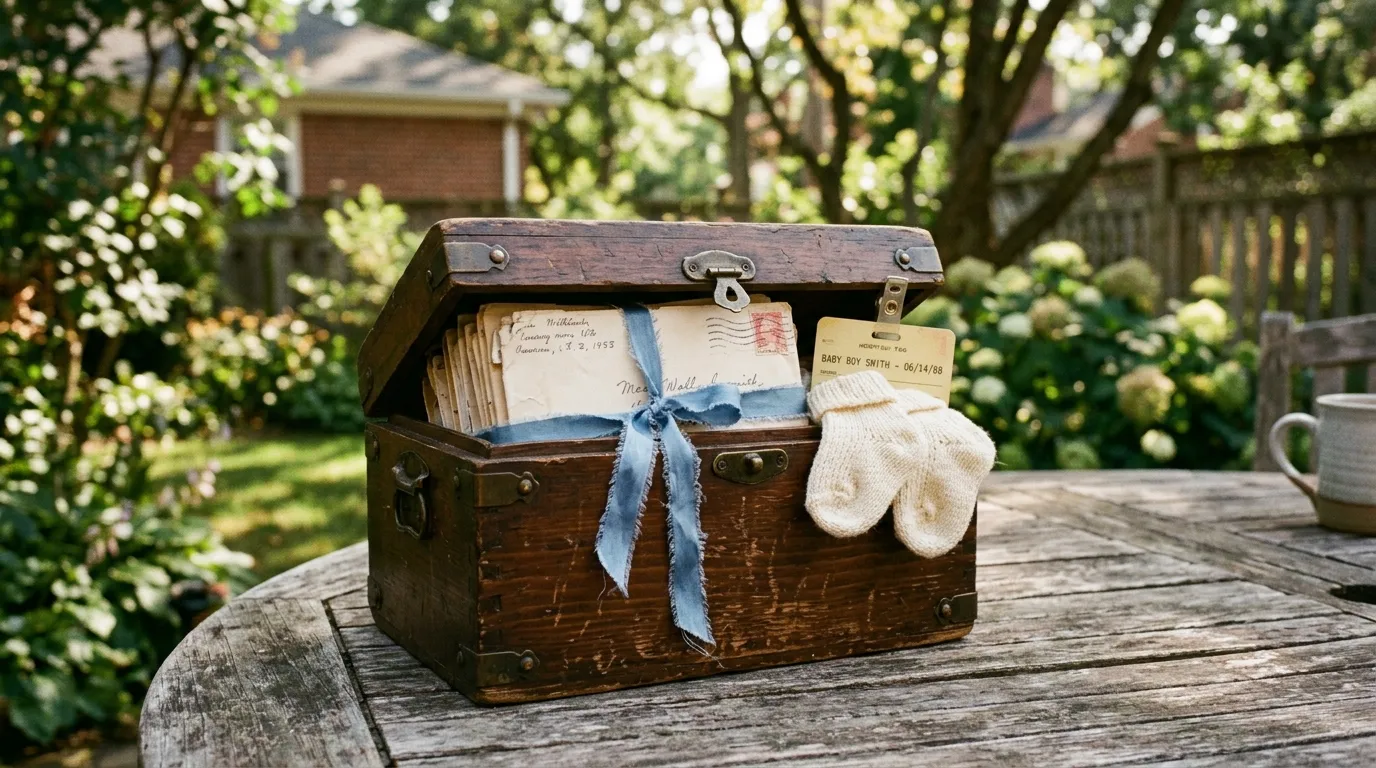
The wooden box had sat hidden in the garage for nearly two decades, holding the pieces of a life we never spoke about.
The doctor labeled it SIDS—Sudden Infant Death Syndrome. Four clinical letters that provided zero comfort, zero logic, and no villain to fight. There had been no warning signs, no medical oversight we could look back on and fix, no careless mistake to regret. People often imagine that hearing “nobody did anything wrong” softens the blow of a child’s death. It doesn’t. When your baby dies without cause, you desperately crave someone to blame, because anger is a solid, fiery thing you can hold onto. Pure helplessness, on the other hand, swallows you whole.
The afternoon Rosie passed away, my husband, David, left the house to go to the funeral home to make arrangements no twenty-seven-year-old father should ever have to make. While he was gone, a kind of frantic mania took hold of me. I walked into the nursery with a screwdriver and took Rosie’s crib apart piece by piece. By the time David walked back through the front door, the tiny mattress was hidden behind cardboard in the garage, and every white wooden railing had been dismantled and dragged away. When he found me standing in the center of the emptied room, he stared at me, his eyes hollowed out by disbelief.
“You did this?” he whispered.
“I couldn’t look at it,” I told him, my breath catching in my throat. “I can’t look at an empty bed.”
He offered a slow, defeated nod, turned on his heel, and walked out. That was the extent of our conversation. We were twenty-seven years old, drowning in a depth of sorrow we lacked the emotional vocabulary to navigate. We didn’t know how to lean on each other, let alone grieve as a unified couple. We were simply two traumatized people trying not to collapse under the weight of surviving separately.
And right in the middle of our private ruin stood Hannah. She didn’t know our hearts were in shards. She was an infant who woke every three hours hungry, who needed her diapers changed, who demanded to be rocked and sung to. Some nights, I would sit alone in the pitch-black nursery, pressing Hannah against my collarbone, waiting with a racing pulse until I felt the tiny, rhythmic heave of her chest against mine. Whenever I felt her breathe, a wave of dizzying relief washed over me—immediately followed by a sickening wave of guilt. How could I feel grateful while Rosie lay cold in the ground? How could I kiss the cheek of the child in my arms without feeling like a traitor to the child who was gone?
Somewhere within that fog of unprocessed trauma, David and I made a quiet, unspoken pact: Hannah would never need to know.
In the beginning, keeping the secret felt entirely practical. She was just an infant, then a toddler babbling her first words. When she turned five, I told myself that no reasonable parent sits a kindergartner down to say, “You shared a womb with a sister who died before you were old enough to remember her.”
David, however, was never entirely convinced our silence was right. When Hannah turned seven, as we were driving home from a neighborhood birthday party, he stared out at the road and murmured, “Maybe we should sit down and tell her soon.”
My entire body went rigid. “Tell her what, David?”
“The truth about Rosie,” he replied gently. “She has a right to know her own history.”
“She’s seven years old!” I snapped, keeping my voice sharp so he wouldn’t hear how terrified I was. “What good does giving that pain to a second grader do?”
“I’m not saying tonight,” David said softly. “I’m just asking when.”
He had no answer, and neither did I. That became our ritual. Every couple of years, usually in the enclosed cabin of the car where I couldn’t run away, David would tentatively raise Rosie’s name. Every single time, I would shut him down with fierce maternal deflection until he grew weary and retreated into silence.
Year after year slipped by. Every September 9 was a day of orchestrated cheer for Hannah. We bought sheet cakes, tied pastel balloons to the porch, invited classmates, and organized chaotic sleepovers. But while everyone sang and watched Hannah blow out her candles, my mind wandered into the quiet shadows. I looked at Hannah turning ten, fourteen, sixteen, and caught myself imagining Rosie beside her. Would Rosie have grown taller? Would her dark hair have curled the same way? Did she still have that little crease beside her eye?
Yet I never dared to speak her name out loud. Over time, the entire extended family fell in line with the conspiracy. My mother quietly took down the framed photograph from the hospital that captured me holding both infants in a single blanket. My sister learned never to reference twins when Hannah was around. Once, when Hannah was eight, my father accidentally referred to “the girls” while recounting a story, and the look of sheer panic and fury I shot across the dining table made him immediately stumble over his words and pretend he meant Hannah and her cousin. Everyone knew the rule. Everyone helped me maintain the lie. Back then, I convinced myself this elaborate silence was an act of parental chivalry. In truth, it was cowardice dressed up as devotion.
Every milestone became another excuse to delay the inevitable. At twelve, Hannah was bullied at school and came home in tears; I told David she was too fragile. At fifteen, her anxiety flared over high school exams. At sixteen, her heart was broken by her first boyfriend. At seventeen, she was paralyzed by college applications. Life was always too complicated, the timing was never right, and there was always another emotional storm to weather.
“She deserves the truth,” David would press, his voice strained with weary persistence.
“And give her survivor’s guilt?” I would argue back. “You want her to spend the rest of her youth wondering why she lived while her sister died?”
“You don’t know that’s how she’ll react, Helen.”
“And you don’t know she won’t!”
We grew into experts at grieving apart. Every year on September 9, after the presents were cleared away and Hannah was asleep or out with friends, David would slip into the garage for an hour alone. I never asked what he did out there. My own coping mechanism was just as mechanical: I did laundry. Even if the hampers were practically empty, I washed, dried, and folded towels until my hands hurt, desperate for routine to keep the memory of my lost daughter at bay.
Then arrived Hannah’s eighteenth birthday.
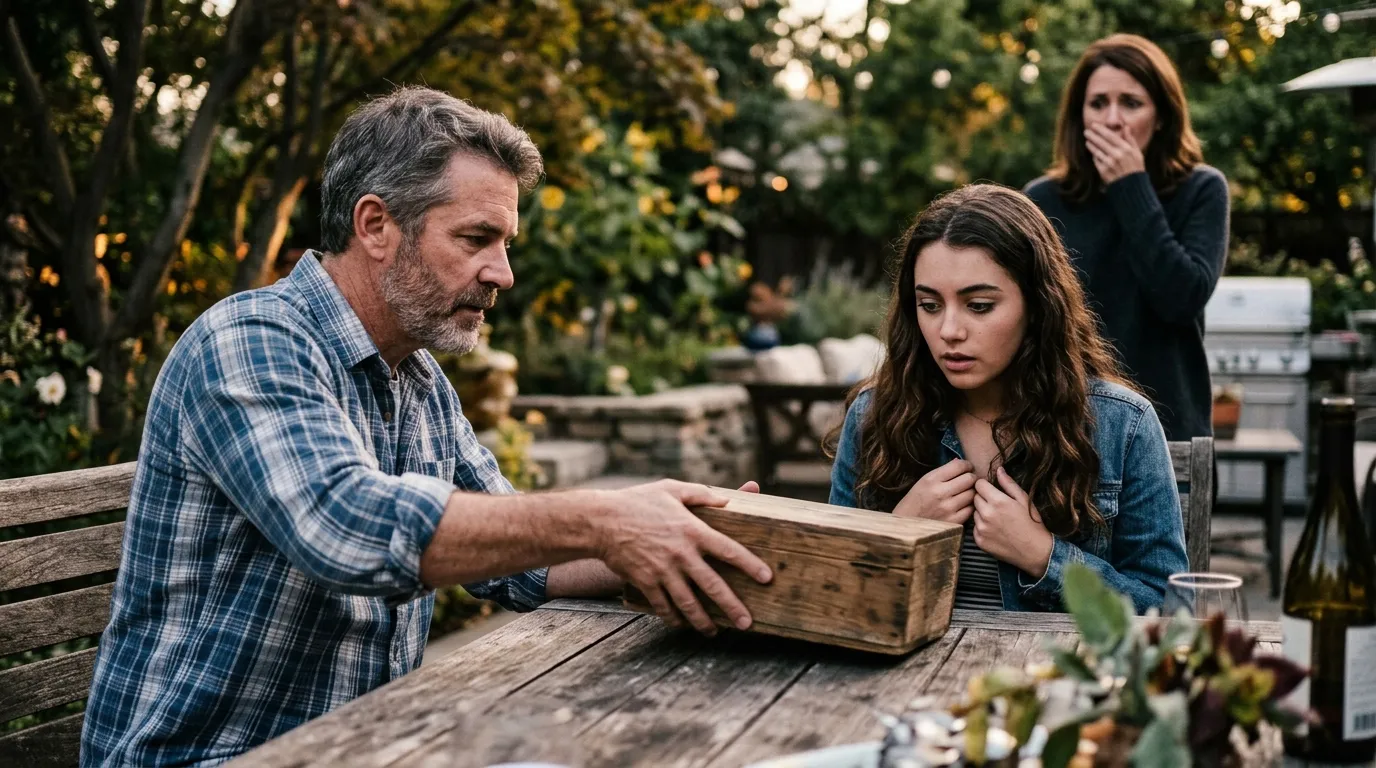
When David slid the chest toward Hannah, the fragile silence we had preserved for eighteen years shattered in an instant.
We threw a milestone party in our backyard with thirty people—aunts, uncles, lifelong neighbors, and school friends. My brother took charge of the barbecue grill, my sister showed up with bowls of potato salad, and on the center table sat a sheet cake decorated with bright blue frosting reading: HAPPY 18TH, HANNAH!
Her main gift was a dependable, used sedan parked out front. When David dropped the keys into her palm, she let out an ear-piercing scream of joy and threw her arms around his neck. Watching her glow with genuine happiness, I felt a familiar, self-satisfied warmth. See? I thought. She is whole. She is happy. Our silence worked.
Then, as the last gift was unwrapped, David cleared his throat and stood up from the patio table.
“Could everyone give the three of us a moment alone?” he asked quietly.
The air seemed to leave my lungs instantly. I locked eyes with David, and the certainty on his face made my stomach drop into a bottomless pit. My sister’s smile vanished across the yard. My mother’s hands went still.
“David, no,” I whispered under my breath.
He didn’t look angry. He didn’t look cruel. He simply looked completely resolute. “Today is the day, Helen.”
Hannah looked between us, the car keys still gripped in her hand. “Wait, what’s going on? Did something happen?”
My mother was the first to move, quickly ushering the guests toward the house under the pretense of cutting more cake. Our friends looked baffled; our family members looked terrified. I wanted to scream, to grab David by the arm, to drag him inside and demand that he stop. But when I searched for words, I realized that after eighteen years of building this fragile wall of glass, there was nothing left to say that wouldn’t shatter it.
David walked out to the garage and returned carrying a heavy wooden chest. I had lived in the same home with him for nearly two decades, yet I had never seen it before. It was handcrafted from dark walnut with rough-cut edges, visible plane marks, and antique brass hinges fitted by hand. He set the heavy box down directly in front of Hannah.
Her smile faded as she touched the wooden grain. “Dad… what is this?”
David pulled out a chair, sat across from our daughter, and took a shuddering breath. “Hannah, there is something we should have told you many years ago.”
She glanced at me, searching for reassurance. I couldn’t bear to meet her gaze; I stared down at the patio stones. David continued, his voice trembling at the edges.
“You didn’t come into this world alone.”
Hannah’s brow knit together. “What are you talking about?”
“You had a twin sister,” David said, his voice cracking on the final word. “Her name was Rosie.”
The entire backyard went dead silent. Hannah remained motionless, her hand frozen on the edge of the lid. “She was born eleven minutes after you,” David whispered. “And she passed away nine days after we brought you both home.”
I braced myself for the reaction I had spent nearly two decades anticipating. I expected hysterical crying. I expected screams. But Hannah didn’t sob. Instead, a chilling stillness fell over her. When she finally spoke, her voice was quiet and deliberate.
“Does everyone know?”
The question sliced through me far deeper than tears ever could. David swallowed hard. “Yes.”
“Grandma knows?”
“Yes, honey.”
“Uncle Matt? Aunt Lisa?”
“Yes.”
Hannah turned her head and looked directly into my eyes. “Every single person at my birthday party knew I had a twin sister except for me?”
“We thought we were protecting you,” I pleaded, my voice breaking under the weight of my own shame.
“Protecting me from what?” she demanded, her voice rising with sudden, blistering heat. “Protecting me from knowing my own sister existed? From mourning her?”
“From the guilt!” I cried out. “From spending your entire childhood wondering why you survived and she didn’t!”
Hannah stared at me with wide, horrified eyes. “So you decided how I was going to feel before I was even given the chance to know her? You took away my sister because you were scared?”
“Hannah, please,” David began, reaching toward her hand.
She pulled back sharply, pointing at the dark chest. “What’s in there?”
David slowly lifted the brass latch and opened the lid. Carved deeply into the underside of the wood were two names: HANNAH & ROSIE. Inside lay two tiny plastic hospital bracelets, two faded knit caps, a folded pink receiving blanket, and dozens of photographs. There were pictures of David asleep on the living room couch with an infant tucked into each arm, photos of the two babies curled up together in matching pastel onesies, and sympathy cards preserved from that terrible week. And alongside them lay a neat stack of envelopes tied together with a faded blue ribbon.
Hannah picked up the topmost envelope. On the front, in David’s unmistakable scrawl, were the words: HANNAH — AGE 1.
“What are these?” she whispered.
“Letters,” David replied softly. “One for every single birthday. Every year while your mother and your friends were celebrating, I went out into the garage and wrote to you about Rosie. About who she was, about what happened, and about how much we loved her.”
Hannah stood up so abruptly her chair scraped loudly against the concrete. “You kept all of this hidden in a garage? You wrote me eighteen letters about a twin sister and never had the courage to look me in the eye and say her name?”
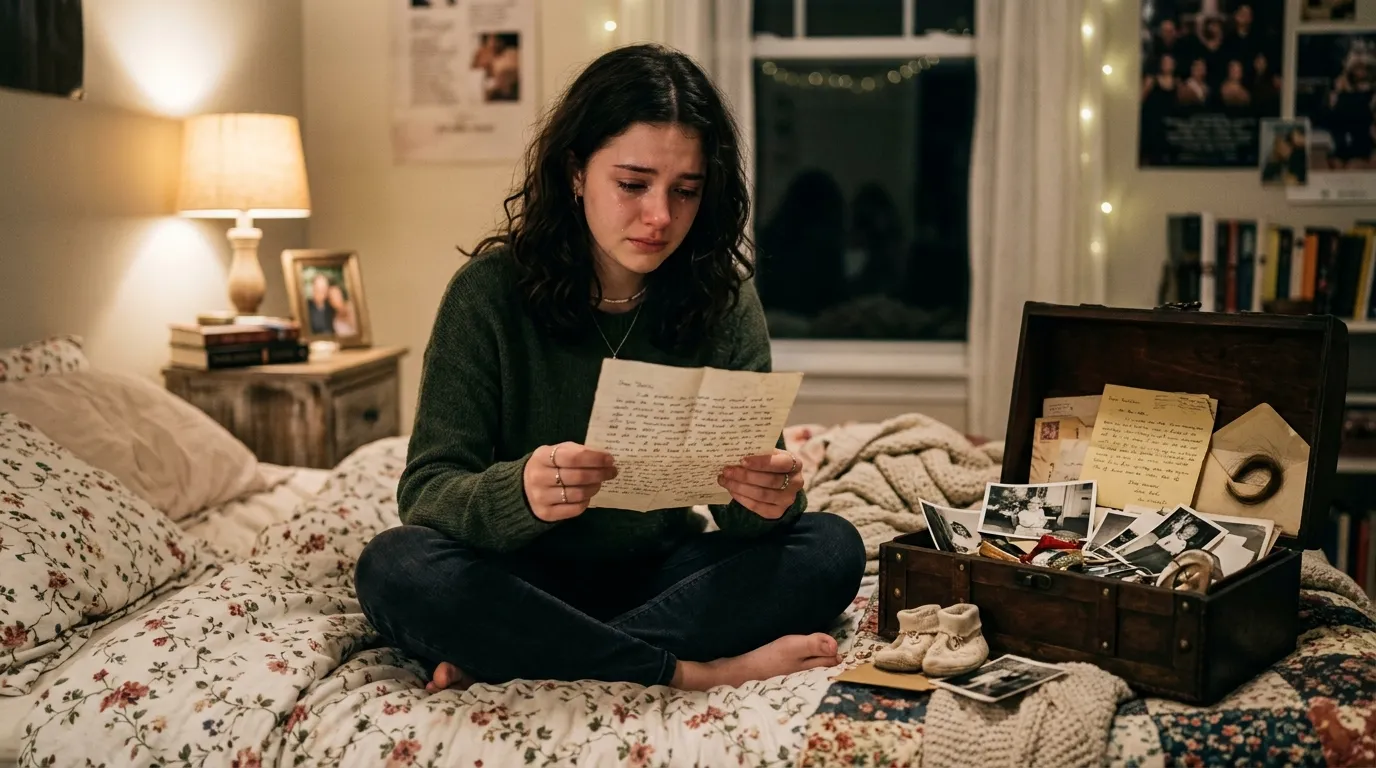
For three days, Hannah sat alone with David’s eighteen letters, discovering the twin sister she never knew existed.
She turned on her heel and marched inside the house. When I ran after her, she was already slinging her bag over her shoulder. She spent that night, and the one after it, staying at my sister’s house.
The following morning, David placed the wooden chest on our dining room table. For hours, neither of us touched it. The presence of that box in our clean, orderly home felt like an unexploded bomb.
“Why did you hide the box from me for eighteen years?” I asked him, staring at the dark grain.
“Because you would have thrown it away, Helen,” he answered tiredly. “The day Rosie died, you tore down her crib before I could even say goodbye. You demanded your mother take down the only picture of you holding both of them. If I had brought this chest into the house, you would have made me get rid of it to keep the illusion intact.”
I buried my face in my hands. I wanted to defend myself, but David was entirely right. I had mistaken my absolute refusal to grieve for strength, and in doing so, I had forced my husband into a lonely, hidden corner with our dead child for nearly two decades.
Hannah returned home three days later. She didn’t yell, but the cheerful, open warmth she had carried her whole life was gone, replaced by a cool, guarded distance. She walked straight to the dining table, picked up the walnut chest without looking at us, and carried it upstairs to her bedroom.
Over the next four days, she emerged only for meals. She read David’s letters one by one, pacing herself through the years of hidden sorrow. Sometimes she came downstairs with red, swollen eyes; sometimes her jaw was set in quiet anger; mostly, she maintained a heavy silence.
On the fourth evening, she walked into the kitchen carrying the envelope labeled HANNAH — AGE 12. She placed it between us on the counter.
“Dad wrote that he wanted to tell me the truth when I started middle school,” Hannah said, looking at me. “He wrote that you begged him not to because you thought I was too emotional to handle it.”
I couldn’t speak. I simply nodded, tears burning behind my eyelids.
Hannah unfolded the yellowed notebook paper and read David’s words aloud: ‘I hope someday you’ll understand that we were only afraid of what knowing might do to you.’
She set the paper down, sat across from us, and looked straight into my eyes. “I need you to listen to me, Mom. I don’t feel guilty for being alive.”
The sentence struck me like a physical blow. All the catastrophic scenarios I had played in my mind for eighteen years suddenly dissolved into thin air.
“I feel heartbroken that Rosie didn’t get to live,” Hannah continued, her voice trembling with raw clarity. “I feel strange and empty knowing there was someone who shared my face and my blood whom I will never meet. But I don’t feel guilty for surviving. I feel furious that you decided I was too weak to carry the memory of my own sister.”
Tears finally spilled down my cheeks. “Hannah, I’m so sorry.”
“You don’t get to decide what someone’s heart can hold just because you’re terrified of breaking your own,” Hannah said softly. “I should have known her name. I should have grown up seeing her picture. I should have known why Grandma looked sad every time she hugged me on my birthday.”
There was no defense left to offer. “You’re right,” I whispered. “You are completely right.”
A week later, Hannah asked a question that brought a fresh wave of grief: she asked where Rosie was buried. In eighteen years, our daughter had never set foot on her sister’s resting place because we had treated the grave like a crime scene we had to keep hidden.
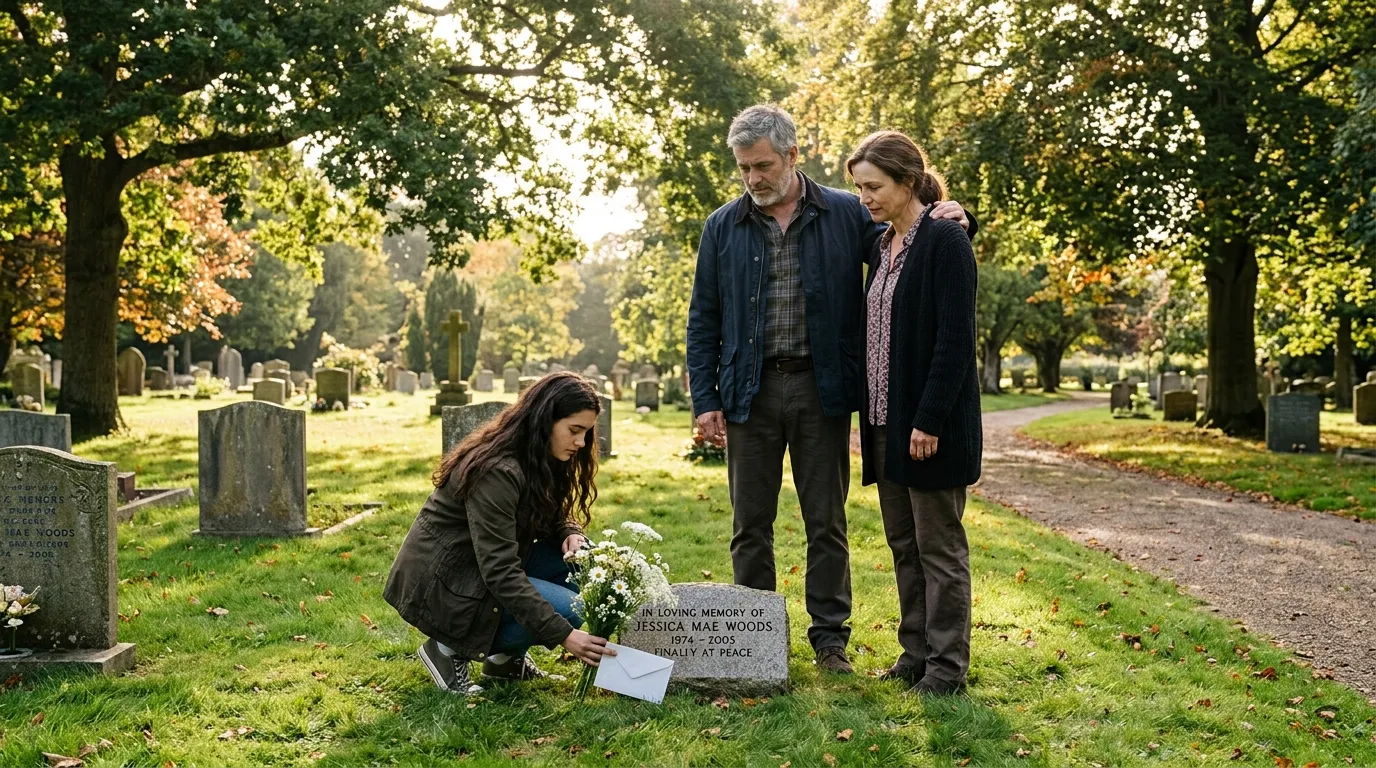
Standing before Rosie’s grave was painful, but for the first time in eighteen years, we were finally standing together.
On a bright Saturday morning, the three of us drove out to the cemetery together. David carried a bouquet of soft white carnations. Hannah clutched the very first letter David had written on her first birthday. Rosie’s headstone was small, weathered by years of rain and sun, bearing a simple inscription:
ROSIE W.
BELOVED DAUGHTER
SEPTEMBER 9 – SEPTEMBER 18
Hannah knelt down on the grass. She traced the carved letters of Rosie’s name with her fingers, her shoulders shaking quietly. After several long minutes, she leaned down, laid her hand against the cold stone, and whispered, “Hi, Rosie.”
Behind her, David and I held onto each other and wept openly. Hannah placed the flowers down, slipping a folded copy of her father’s letter underneath the stems. On the back of the envelope, she had written a private note of her own. Neither David nor I asked what it said; that belonged solely to the two of them.
Today, the handcrafted wooden chest sits on a shelf in Hannah’s bedroom. It isn’t tucked away in a closet, nor is it treated like a dramatic memorial. It is simply an acknowledged part of our family’s history. The photograph taken in the hospital room eighteen years ago is back on my mother’s living room wall. In it, I am exhausted and young, holding two fragile, beautiful baby girls wrapped in white flannel.
For almost two decades, I convinced myself that silence was a shield that could keep my daughter safe from sorrow. But silence doesn’t erase grief—it only leaves it to rot in the dark until it turns into betrayal. Today, we still carry our grief, but we carry it out in the open, where the light can reach it. We are finally allowed to say both names, remember both sisters, and honor the nine days that Rosie was here.
Note:This work is inspired by real events and people, but it has been fictionalized for creative purposes. Names, characters, and details have been changed to protect privacy and enhance the narrative. Any resemblance to actual persons, living or dead, or actual events is purely coincidental and not intended by the author.
All images used in this article are AI-generated and intended for illustrative purposes only.
0 Comments