
For eighteen years, I carried a single, burning word in my chest whenever I thought of my wife: coward.
I told myself the story so many times that it hardened into absolute truth. I told myself that the moment she saw our newborn son’s diagnosis, she decided motherhood had become far too heavy a burden to bear. I believed she had looked at his extra chromosome, weighed her future against his needs, and quietly walked out the front door, leaving the two of us to fend for ourselves in an indifferent world.
For nearly two decades, that righteous anger was my armor. It kept me moving through sleepless nights, endless medical bills, and moments of crushing loneliness.
Then, last night, I unfolded a yellowed piece of paper written in a handwriting I hadn’t seen since I was thirty years old.
And with trembling hands, I discovered that the story I had built my entire life around was only half the truth.
The Day the World Fractured
Eighteen years ago, our life changed inside the sterile, fluorescent quiet of room 412. The doctor was a gentle man, but even the softest voice cannot cushion the blow of words that rearrange your universe. Sitting on a low stool beside my wife’s bed, he quietly explained that our newborn son, Leo, had Down syndrome.
I remember turning my eyes toward the clear plastic bassinet beside the bed.
Leo was so tiny. He had a crown of thick, midnight-dark hair, cheeks like sweet peaches, and fingers so miniature that his entire palm couldn’t wrap around the tip of my pinky. I felt a surge of love so visceral it took my breath away. To me, he wasn’t a medical chart or a set of probabilities. He was whole. He was miraculous. There was nothing about him that needed to be apologized for.
Then I turned to look at my wife, Goldi.
She wouldn’t look at the bassinet. She stared fixedly at the scuffed linoleum between her slippers while the doctor gently outlined the road ahead: echocardiograms to check for congenital heart defects, routine pediatric hearing evaluations, early intervention therapies, and developmental milestones that would need patience and deliberate care.
The doctor spoke with calm compassion, trying to build a bridge for us to walk across. But the moment the door clicked shut behind him, Goldi spoke in a voice barely louder than the hum of the air conditioner.
“I can’t do this.”
I believed it was just the raw exhaustion of labor speaking. I pulled my chair closer, taking her ice-cold fingers into both of mine. “We don’t have to solve eighteen years today, sweetheart,” I whispered. “We’ll learn. We’ll do it together. One day, one step at a time.”
She pulled her hand away, shaking her head with a frightening finality. “No, Arthur. You’re not listening. I can’t.”
“You’re terrified,” I insisted, desperate to reach her. “I am too.”
She turned her face toward the overcast window. “I can’t do this.”
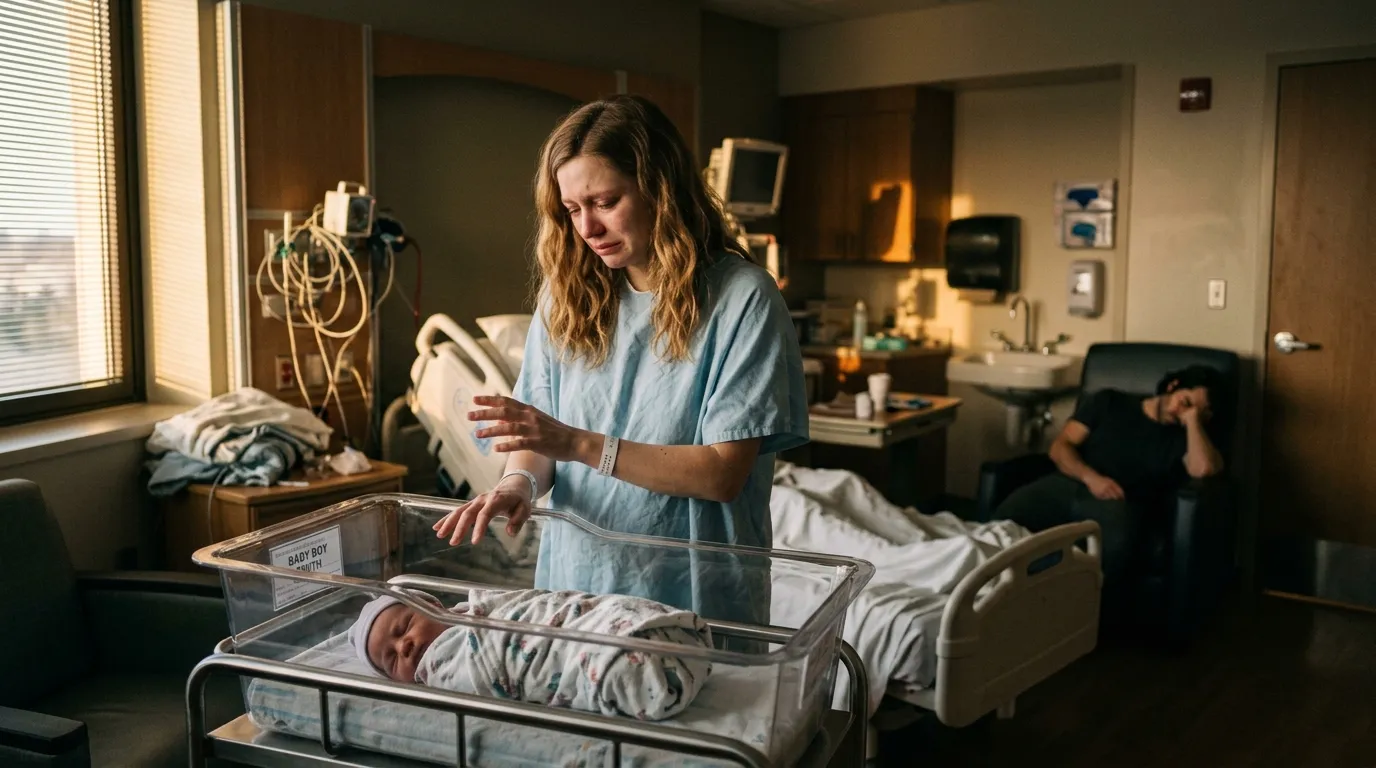
A mother’s hesitation: the silent battle that went unseen.
For the remainder of our stay, Goldi built an impenetrable wall around herself. She wouldn’t hold our son. When he cried, she shrank back against the pillows. I took over completely—changing his tiny diapers, learning how to burp him against my shoulder, rocking him to sleep while whispering promises into his dark hair.
I convinced myself she was just reeling from the shock. Labor had been long and exhausting, and postpartum depression was a real threat. I promised myself I would carry us both until she found her footing.
Late that night, I woke abruptly in the vinyl recliner beside her bed. The room was bathed in the faint blue glow of the streetlights outside. Through half-closed eyes, I saw Goldi standing barefoot by Leo’s crib. Her back was toward me, her shoulders trembling. Her right hand was raised, hovering just millimeters above Leo’s fleece blanket. It looked as though she desperately wanted to rest her palm against his chest, yet something invisible and agonizing held her back.
I didn’t move. I didn’t want to break whatever tender breakthrough was happening. After a long moment, she withdrew her hand, tucked it against her chest, and stepped away into the darkness.
A Door Closes Forever
The following morning brought no warmth. Instead, Goldi asked a question that felt chillingly out of place.
“Arthur… could you raise him on your own?”
I thought it was morbid new-parent anxiety—the fear of freak accidents or sudden illnesses. “I won’t ever have to,” I replied firmly. “He has both of us.”
A single tear tracked down her cheek, but when I leaned forward to brush it away, she flinched and turned toward the wall.
Forty-eight hours after we brought Leo home to our third-floor walk-up, Goldi looked at me across the kitchen counter and calmly said she wanted a divorce.
A short, incredulous laugh burst out of my chest. It sounded like an absurd joke. We had been happily married for four years. Just three weeks earlier, we had been sitting on the floor laughing while assembling a wooden crib and arguing playfully over whether the nursery walls were too mint-green. Now, she wouldn’t look at my face or hold her child.
“You don’t mean that,” I said, the panic finally bleeding into my voice.
“I do.”
“Is it because he has Down syndrome? Because he isn’t what you imagined?”
Goldi said nothing. She lowered her gaze, her silence answering for her with brutal clarity.
From that moment, the unraveling was swift and merciless. Within seven days, she signed every legal document granting me sole custody. She waived visitation rights. She signed away child support. She packed a single tan suitcase, leaving behind her wedding band on the dresser.
Before she walked out the door, she paused beside Leo’s bassinet one last time. I stood rigid in the hallway, praying she would break down, drop the suitcase, and gather our baby into her arms. Instead, she touched two fingers to her lips, pressed them to the wooden railing of the crib, whispered something too low for me to hear, and walked out into the afternoon.
The lock clicked shut. Just like that, our family was reduced to two.
The Long Road of Single Fatherhood
At thirty years old, I found myself standing in a quiet apartment with a fragile infant in my arms, nursing a wound that felt fatal. How does a mother look at her newborn baby and choose to vanish?
In the beginning, my grief was suffocating. But as the months passed, grief hardened into anger—and that anger became the fuel that kept me going. I hated her through every early morning appointment. I hated her when the specialists handed me long lists of physical therapy routines and told me that consistency was the difference between walking and staying immobile.
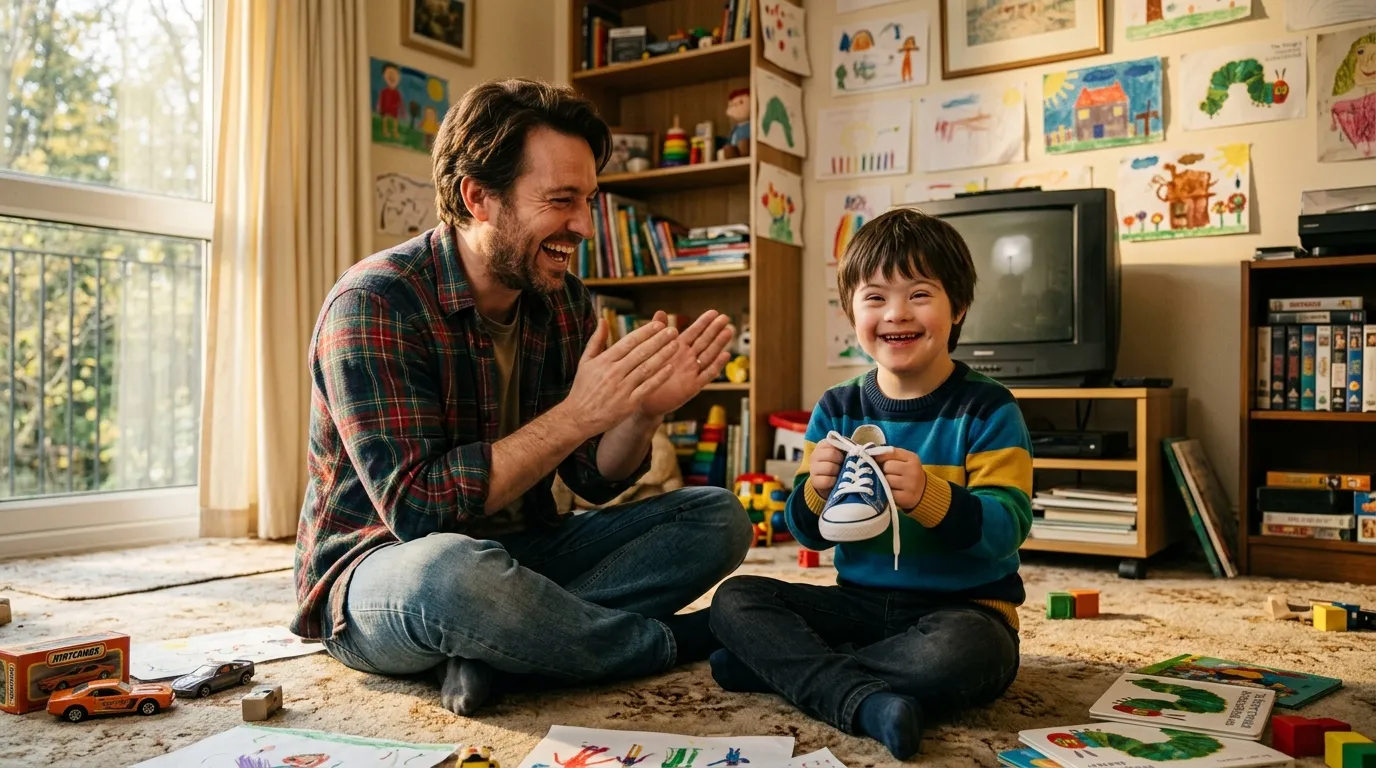
Every milestone was hard-won, and every victory belonged to us.
I hated her when money dwindled to nothing, and I had to choose between paying for speech therapy or keeping the heat on in February. Most of all, I hated her on Mother’s Day, when Leo would proudly bring home construction-paper cards from school with glued macaroni hearts, meant for someone who had never once tucked him into bed.
When Leo was six, he asked the question I had dreaded since the day Goldi left. I was scrubbing a frying pan in the sink when his small voice piped up from the kitchen table.
“Dad? What happened to my mom?”
My breath caught in my throat. I turned off the faucet, drying my hands on a towel to buy time. “Some families only have one parent, buddy. It’s just how our team was built.”
Leo tilted his head, his wide brown eyes searching mine with a wisdom that children with Down syndrome often possess. “I know that. But that doesn’t mean I don’t have a mom. Everyone has one.”
My heart ached. I could not tell him that the woman who gave him life had deemed him too hard to love. “As long as we have each other, Leo, we have everything we need in this whole world.”
He nodded slowly. He knew I was keeping secrets, but he loved me enough not to press.
Raising Leo was demanding, but it was also the great privilege of my life. There were milestones that felt like climbing Everest: his first full, clear sentence; the day he figured out how to tie his sneakers after eighteen months of daily practice; and the unforgettable third-grade holiday play where he forgot his line, flashed an enormous grin, bowed dramatically, and brought the entire auditorium to their feet.
We wouldn’t have survived those years without Mrs. Johnson.
She lived directly across the hall. The morning after Goldi walked out, Mrs. Johnson knocked on my door holding a steaming crockpot of vegetable stew. She took one look at the dark purple bags beneath my eyes and said, “I’ve heard that sweet boy crying all night, Arthur. You’re about to collapse. Sit down and eat.”
Before I could protest, she gently scooped Leo into her arms with the seasoned mastery of a woman who had raised four children of her own. From that morning forward, she was our rock. She sat beside me in hospital waiting rooms during Leo’s ear tube surgeries. She clapped the loudest at his Special Olympics track meets. Long before he understood biology, Leo called her Grandma Johnson.
The Eighteenth Birthday
Yesterday was Leo’s eighteenth birthday. We kept things simple and full of heart: a pan of homemade four-cheese lasagna, a double-fudge chocolate cake, and eighteen candles that smoked so vigorously they threatened our living room fire alarm.
Leo wore a sparkling gold paper crown that Mrs. Johnson had picked up from the dollar store. He sat proudly at the head of our modest table, his chest puffed out.
“Now that I am officially an adult,” he proclaimed with great gravity, “the law says I get two slices of cake before dinner.”
I grinned across the table. “The law also says adults pay a third of the rent, buddy.”
He paused, tapped his chin thoughtfully, and reconsidered. “One slice is very good.”
We laughed until our ribs ached. But after blowing out the candles, Leo didn’t ask to open his presents. Instead, he reached into the pocket of his denim jacket, pulled out an old, yellowed envelope, and gently slid it across the tablecloth toward me.
“What’s this, pal? It’s your birthday—I’m the one who gives you envelopes.”
“Grandma Johnson gave it to me yesterday,” Leo said softly, glancing at our neighbor. “She told me not to open it. She said today was the day we had to read it together.”
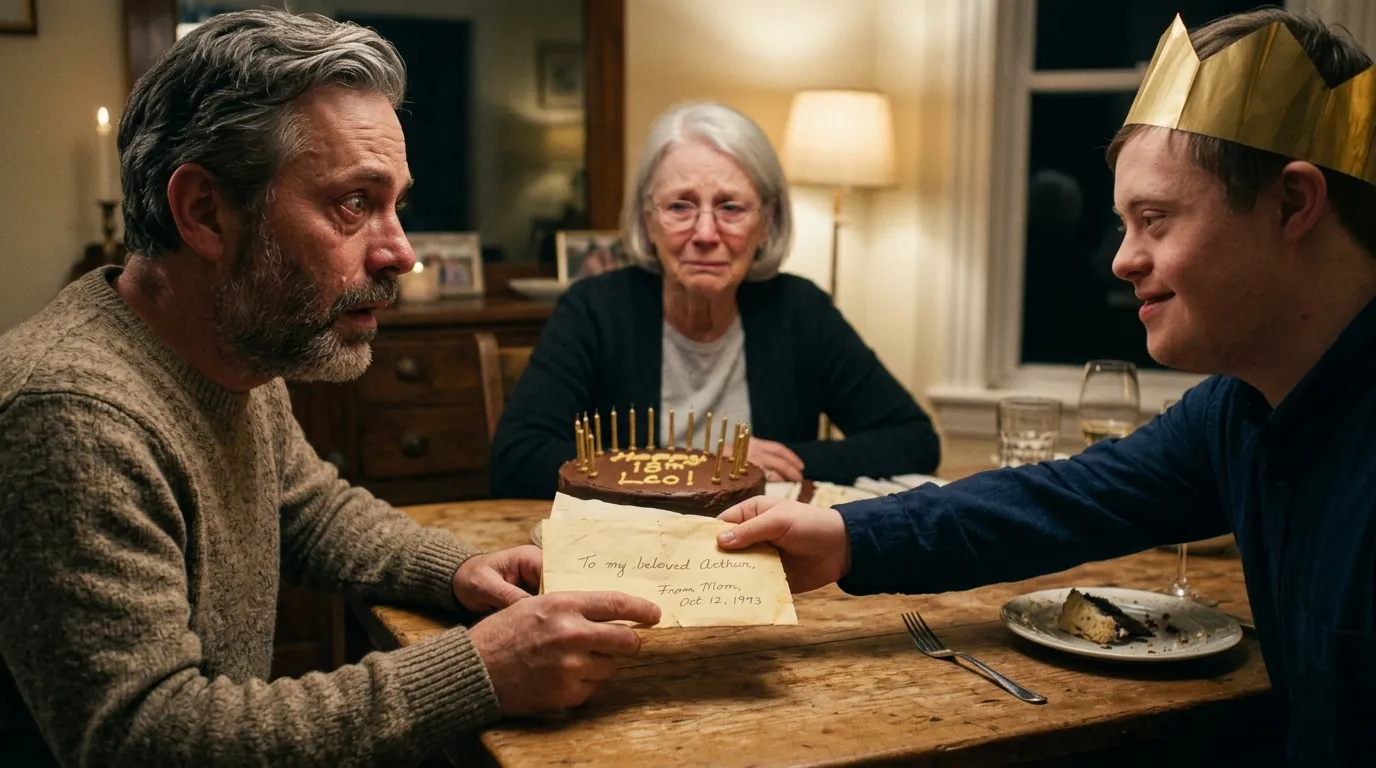
Eighteen years in an envelope: the truth finally revealed.
I looked at Mrs. Johnson. Her usual bright, grandmotherly warmth was completely gone. Her hands were trembling so violently that tea sloshed over the rim of her porcelain cup into the saucer. Her eyes were red-rimmed and brimming with tears.
I glanced down at the envelope. Across the front, faded blue ink spelled out my name. The handwriting was unmistakable. It belonged to Goldi.
“What is this, Johnson?” My voice sounded thin, stripped of all strength.
“Arthur…” Mrs. Johnson choked on the words, pressing a handkerchief to her lips. “She didn’t leave because she didn’t love you two. She made me swear on everything holy that I wouldn’t hand you this until Leo was a grown man.”
The Unbroken Seal
My fingers felt numb as I broke the aged seal. The paper unfolded with a brittle, dry whisper. With Leo watching my face, I began to read out loud:
Arthur,
If you are reading these words, it means my quiet prayer was never answered, and I never got the chance to return and tell you the truth myself.
Five days before our son was born, my doctor sat me down with the results of my bloodwork. I had an aggressive, metastatic form of cancer. By the time they discovered it, it had already spread into my lymph nodes and liver. My odds were less than five percent.
I know who you are, Arthur. You are the most loyal, loving man on this earth. If I had told you the truth, you would have spent every waking minute, every dollar in our savings, and every ounce of your spirit trying to buy me a few more months of life. You would have divided your soul between a dying wife and a newborn baby who needed your undivided love.
I couldn’t let you lose your wife and let our son lose his childhood all at once.
So I made the most excruciating choice a human being can make. I chose to become your villain.
I filed for divorce and walked away so that your anger would give you strength. I knew that if you hated me, you wouldn’t spend your life searching for me or mourning me. You would pour all of that fierce, beautiful devotion directly into raising our son.
I never stopped loving you. I never stopped loving Leo. I simply believed that walking into the dark alone was the only way to give the two of you a chance at light.
I left this letter with Mrs. Johnson, begging her to keep my secret until Leo turned eighteen. I wanted him to be old enough to understand the complexity of heartbreak, and to decide for himself what kind of mother I was.
I don’t know if forgiveness is possible. Maybe what I did was unforgivable. But please believe me when I say this: I loved you both enough to let you hate me.
Always,
Goldi
By the time I reached her name, tears were dripping freely onto the paper, blurring the ink of words written eighteen years ago. The room was deathly still, save for Mrs. Johnson’s quiet weeping.
Leo stared at the letter, his mouth parted slightly. “She… she loved me?” he whispered.
My chest felt as though it had been cracked open with a hammer. I turned to Mrs. Johnson, stunned and disoriented. “You knew? You knew this whole time?”
“She came to my door the night before she moved out,” Mrs. Johnson whispered, her voice cracked with eighteen years of carried guilt. “She showed me the oncologist’s report. She begged me on her knees. She said, ‘Promise me you’ll help Arthur raise him. Be the family they need, but don’t let him spend his life sitting in hospice waiting rooms.’ I didn’t know where she went after she left. She wouldn’t let me know.”
“You let me hate her,” I breathed, the shock giving way to raw bewilderment. “Every day for eighteen years, you watched me curse her name.”
“And every single day, it broke my heart into pieces,” Mrs. Johnson wept, bowing her head. “I stayed by your side because I loved that little boy, but also because I had to atone for the lie. I questioned my promise a thousand times. But she was a dying girl who thought she was saving you.”
Leo stood up suddenly from the table. His chair scraped against the floorboards. Without a word, he walked down the small hallway toward his bedroom.
I followed him immediately. He was standing by the window, his shoulders hunched, angrily wiping tears from his cheeks with his sleeve.
“Leo,” I said softly, reaching out to touch his back.
“Did she know my name?” he asked, his voice shaking. “Did she even hold me once?”
The memory came rushing back through the fog of eighteen years—the darkened hospital room, the blue streetlight, the young mother standing over the bassinet with her trembling hand hovering over his chest.
“Yes,” I choked out, pulling him into my arms. “She chose your name with me. And she loved you so much, Leo. She held you when you took your first breath.”
“Then why didn’t she let us choose?” he sobbed into my shoulder. “I’m happy she loved me. But I’m angry, Dad. Why couldn’t we just love her while she was sick?”
“I don’t know, buddy,” I confessed, holding him as tight as I could. “I don’t know.”
Unlocking the Past
Later that evening, after the cake had been cleared and Mrs. Johnson had retreated across the hall to grieve in private, Leo sat on the living room sofa, staring at the floor.
“Dad?” he asked quietly. “What did she look like?”
The realization crushed me. In my bid to protect Leo from the sting of rejection, I had erased Goldi from our apartment. I had boxed up every trace of her existence so I wouldn’t have to look at the woman who broke my heart.
“Come on,” I said gently.
We went down to the garage. In the dusty corner of an old metal storage locker sat a sealed plastic tote I hadn’t touched in nearly two decades. I cut through the packing tape and pulled off the lid.
Inside was Goldi’s past: her college notebooks, a forest-green wool scarf she used to wrap twice around her neck every winter, a delicate silver charm bracelet I had given her for our first anniversary, and several photo albums.
Sitting side-by-side on the concrete floor, Leo and I opened the first album.
There was Goldi at twenty-four, laughing hysterically on a beach in Maine, her honey-brown hair whipping across her face. “She hated the feel of sand between her toes,” I told Leo, a genuine smile breaking through my tears. “She complained about it for four hours straight, but then refused to get in the car because she said the sunset was too beautiful to leave.”
Leo stared at the photograph, his eyes tracing her features. Then he pointed to a picture of her tilting her head back, laughing at something off-camera.
“Look, Dad,” he whispered, his finger tapping his own cheek. “The dimple.”
I looked at my son. For eighteen years, I had deliberately avoided looking for Goldi in his face. But now, in the dim garage light, she was everywhere: the gentle slope of his nose, the arch of his left eyebrow whenever he was thinking, and that deep, distinct dimple in his left cheek whenever joy took over.
“Yes,” I whispered, kissing the top of his head. “You have her exact smile.”
At the bottom of the tote lay an old spiral-bound telephone address book. Inside was the phone number of Goldi’s mother, Rachel. Goldi had been estranged from her mother since her early twenties, and during our marriage, they had barely spoken. But now, the need for answers was a physical ache.
I dialed the number with shaking fingers. After four rings, an elderly voice answered.
“Hello?”
“Is this Rachel?”
“Yes. Who is calling?”
“My name is Arthur. Goldi’s husband.”
A sharp intake of breath echoed through the receiver, followed by a profound, trembling silence. When she spoke again, her voice was choked with tears. “Arthur? Oh, dear God… Arthur?”
Rachel told me everything. Goldi had shown up on her doorstep seven months after Leo was born, sick and frail. With nowhere else to turn and her body failing, she had reconciled with her mother in her final months. She had lived in home hospice for only a few weeks before passing quietly in her sleep.
“She made me swear on my life never to interfere,” Rachel wept. “She said you were doing the work of two parents, and that dragging you into a funeral would only reopen a wound she had tried so hard to cauterize. Did she talk about Leo? Arthur, she spoke of him every single day. She had his footprints from the hospital framed on her nightstand until the moment she died.”
Leo took the phone from me. For nearly an hour, an eighteen-year-old boy listened to his grandmother describe the girl who gave him life—her favorite meals, her stubborn streak, her terrible singing in the shower, and the ferocious love she carried for her baby boy until her final breath.
Healing at the Headstone
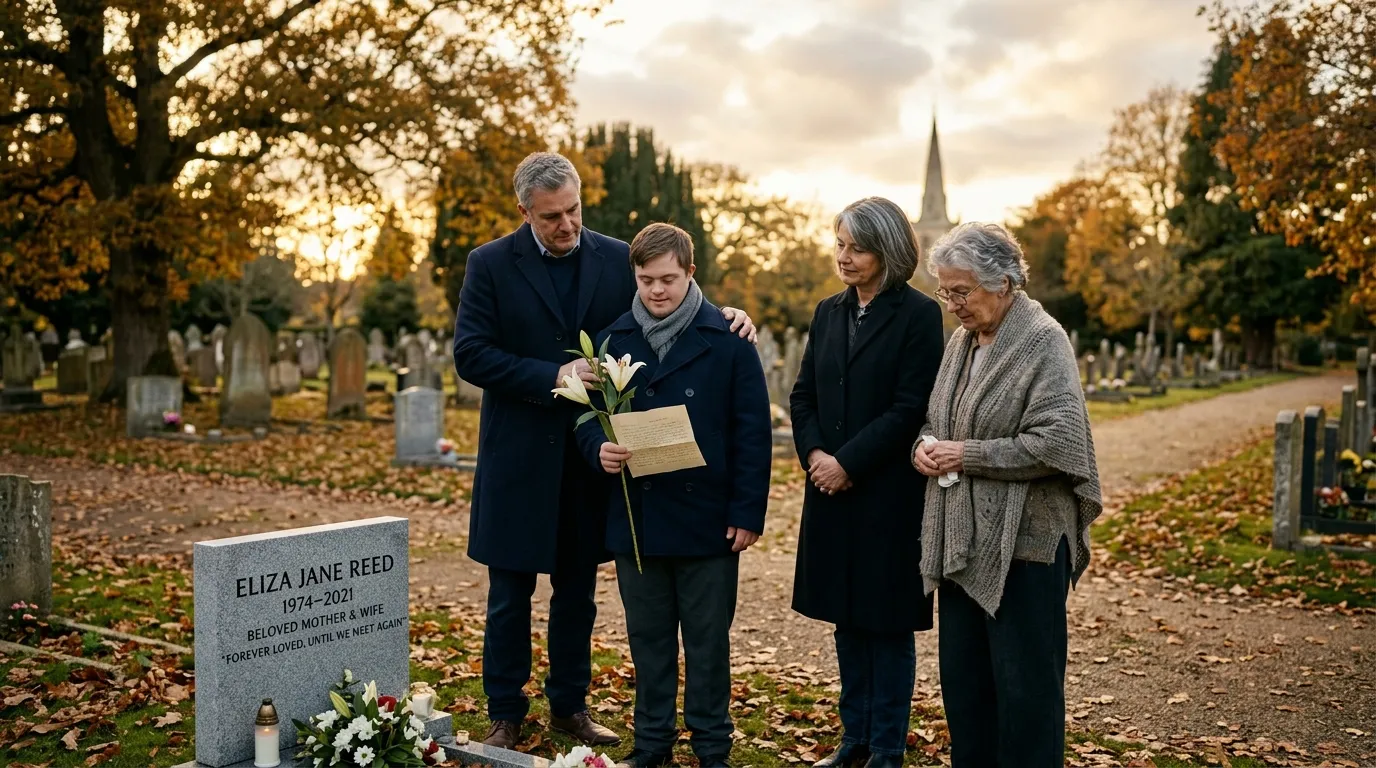
Finding peace where eighteen years of anger finally dissolved.
Three months later, the four of us stood together in a small, quiet cemetery on the outskirts of Boston: Rachel, Mrs. Johnson, Leo, and me.
Mrs. Johnson bent down and placed a bouquet of fresh white lilies beneath the headstone. Rebuilding our trust with her had been painful and slow, but seeing the genuine devotion she had poured into Leo for eighteen years made it impossible to lock her out of our hearts. She had honored an impossible promise made to a dying mother.
Leo stepped forward. Carefully, he placed Goldi’s yellowed letter right beside the flowers.
“Hi, Mom,” he said, his voice steady and calm in the cool morning air. “I’m glad you loved me. I’m doing really good. Dad took great care of me. But I really wish you had stayed long enough to let us love you back.”
I placed my hand on his shoulder, looking down at the carved stone bearing the name of the girl I had loved so fiercely. All the bitter poison of the last eighteen years—the anger that had fueled my sleepless nights and hardened my heart—evaporated into the autumn breeze.
“I hated you, Goldi,” I whispered, not caring that the others could hear. “I hated you because hating you was so much easier than admitting that I still loved you.”
Rachel reached out and took my free hand, squeezing it tight.
Goldi made a tragic, flawed decision. She robbed us of the chance to hold her hand in the dark, to be her comfort, to say a proper goodbye. She believed that becoming a villain was the greatest sacrifice she could offer her family.
She was wrong. Love is meant to be shared in suffering just as it is in joy.
Yet her mistake came not from cruelty, but from a desperate, terrifying depth of love that she didn’t know how else to carry.
Today, our dining table is bigger. Rachel visits every other Sunday, bringing family recipes and photo albums. Mrs. Johnson is still Grandma Johnson, baking sweet potato pies and cheering Leo on at his new job at the community greenhouse.
Leo now knows where he comes from. He knows that he was never a burden who chased his mother away. He knows that his dimple belongs to someone who looked at him in a hospital room, saw absolute perfection, and made an impossible choice to ensure he had everything he needed to thrive.
The truth did not erase the eighteen years of hardship we survived. But it changed the shape of our sorrow. We no longer walk forward carrying the heavy stone of abandonment. Instead, we carry the memory of a woman who loved us with all the broken, imperfect pieces of her heart.
And for Leo and me, that truth—even eighteen years late—has finally set us free.
Note:This work is inspired by real events and people, but it has been fictionalized for creative purposes. Names, characters, and details have been changed to protect privacy and enhance the narrative. Any resemblance to actual persons, living or dead, or actual events is purely coincidental and not intended by the author.
All images used in this article are AI-generated and intended for illustrative purposes only.
0 Comments