
Let me start with the washing machine. I bought it the year my late husband, Frank, and I moved into our house on Elm Creek Road. It was a plain white top-loader with absolutely no personality. It was the kind of appliance you barely think about because it simply does what it is supposed to do without any fuss.
For thirty-one years, laundry was my job. Not because Frank and I ever sat down and divided the chores formally with a spreadsheet. It just happened naturally as our lives intertwined. He took care of the yard, the home repairs, the car, and everything outside the walls of our home. I handled the house. And I did the laundry. Every single week. For over three decades.

The trusty white top-loader where it all began.
Frank’s shirts were washed, pressed, and hung with care. His socks were matched and folded perfectly. When our son, Marcus, was born, I washed his clothes too. I scrubbed grass stains out of little jeans. I soaked paint out of tiny sleeves. I wrestled with socks that mysteriously entered the machine in pairs and came out completely alone. Through sheer repetition, I became very good at laundry. I still am.
But after thirty years of doing it, I learned a profound truth: Laundry isn’t only laundry. It is attention.
You handle the things another person wears against their skin. You see the physical evidence of their days. Where they have been. What they spilled in a rush. What they worked in. What they lived through. There is something deeply intimate about caring for someone’s clothes, and I had willingly done that for the people I loved.
What I had never agreed to, however, was becoming the unpaid, unspoken laundry service for anyone who happened to arrive at my house with a bag.
The Slippery Slope of “Just One Basket”
My name is Dorothy Calloway. I am sixty-eight years old. My husband, Frank, passed away four years ago. My son Marcus is thirty-seven and works as a structural engineer. He is extremely capable professionally, but personally, he has always been somewhat less skilled at handling uncomfortable situations. I first noticed his aversion to conflict when he was around fifteen. I kept hoping he would grow out of it. He’s still working on it.
His wife, Vanessa, is thirty-four. She is a marketing director at a fast-paced software company. Vanessa is incredibly intelligent, deeply organized, fiercely ambitious, and very efficient. I have always respected that about her.
The problem was that her efficiency sometimes meant finding someone else to do whatever she didn’t have time for. Eventually, without anyone ever formally asking, that someone became me.
It began with one single basket.
Marcus and Vanessa had been married six years. They lived about twenty minutes away and came over most Sundays with their two beautiful children. Lily was eight, and Theo was five. Sunday dinner at Grandma’s had become a cherished part of the rhythm of our family. I loved it. I absolutely adored those children. Lily had Frank’s eyes and his rare habit of truly listening when people spoke. Theo had my laugh, which I considered a compliment to both of us. For those children, I would have done almost anything.
One afternoon, Vanessa carried a laundry basket into the house with a rushed smile.
“Would you mind throwing these in with yours?” Vanessa asked.
It seemed harmless enough. I was already doing my own laundry. One extra basket was nothing. So I smiled and said yes.
The first time, it really was nothing. The second time, there were two baskets. Again, I didn’t mind. I knew they were busy. Both were working full-time, the kids had activities, and life happens. But by the sixth or seventh time, those baskets had turned into enormous canvas bags. And what started as requests had quickly morphed into expectations.
Soon, Vanessa was showing up every weekend with bags of laundry and wordlessly placing them beside my washing machine. Then, at the end of the weekend, she would leave with everything clean, folded, and perfectly organized.
I started to notice things that stung. She never offered to help me fold. She never thanked me in a way that acknowledged the actual hours of labor. She would toss over a quick, “Thanks, Dorothy,” but in the exact same tone someone might use at a drive-through window. Efficient. Quick. Barely making eye contact.
I also noticed that Marcus never said a single word about it. Honestly, that bothered me more than the laundry itself. He would sit at my kitchen table eating the lunch I had spent hours preparing, while his wife carried bags of dirty clothes into my basement. He knew exactly what was happening. He simply chose not to comment. Silence may not always mean agreement, but when someone is being treated unfairly right in front of you, silence starts to look an awful lot like permission.
The Breaking Point
One Sunday, after Vanessa brought yet another enormous bag, I decided it was time to set a boundary. I waited until we were in the kitchen.
“Vanessa, I’m sixty-eight,” I said, deliberately keeping my voice calm and even. “I’m happy to help occasionally, but I’m not your personal laundromat.”
I wasn’t trying to start a war. I was simply stating a fact.
Vanessa actually laughed. Not cruelly, but almost as if she thought my boundary was slightly ridiculous.
“You’re home all day anyway,” she said smoothly.
I looked instantly at Marcus. He lowered his head and kept his eyes glued to his plate.
That moment anchored itself in my chest. Vanessa’s comment hurt, but at least it was honest. In her mind, my retirement meant endless availability. If I was home, then obviously my time belonged to anyone who needed it. It was a remarkably selfish way of thinking, but it was visible. Marcus’s reaction was much harder to swallow. His wife had dismissed his mother right in front of him, and he chose his plate over my dignity.
I couldn’t help but think about Frank. Frank would not have looked at his plate. He would have spoken quietly and calmly. He would have said something like, “My mother asked you not to bring the laundry anymore. We’ll take it home.” And that would have been the absolute end of it.
But Frank was gone. And Marcus had said nothing. I spent the next week thinking deeply about what to do next.
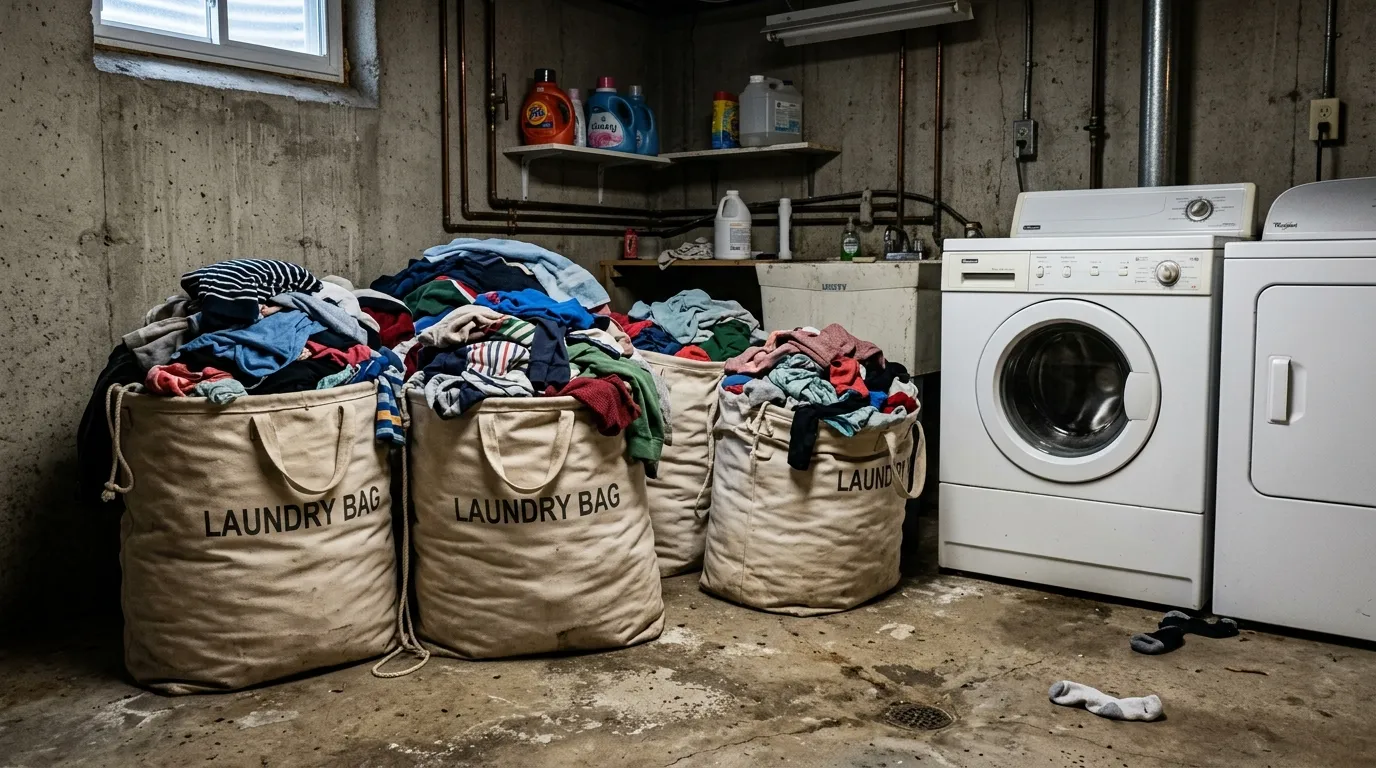
The four bags that finally pushed me to draw a line in the sand.
The following weekend, Vanessa showed up with four bags. Four. More than she had ever brought before. Marcus carried them downstairs, lined them up beside my washing machine, and walked away. That was apparently where his involvement ended.
I didn’t complain. I didn’t raise my voice. I just smiled pleasantly at Vanessa.
“Leave them downstairs,” I said.
She actually looked surprised, perhaps expecting a continuation of our previous argument. “Are you sure?”
“Perfectly.”
That afternoon, while everyone relaxed in the beautiful, mild backyard weather—Marcus with a cooler, the children running through the grass, Vanessa scrolling on her phone—I carried myself into the laundry room. But I never turned the dial on the washing machine.
Instead, I executed the plan I had been formulating all week. I emptied every single bag onto the floor and began separating everything.
Vanessa’s clothes in one pile. Marcus’s in another. The children’s things separated neatly. My plan was brilliantly simple: I would organize everyone’s things and return them exactly as they had arrived. Unwashed. They could take their own laundry home and deal with it themselves. No shouting. No dramatic lectures. Just a clear, unavoidable physical boundary.
The Discovery in the Basement
Halfway through sorting Vanessa’s massive pile, I froze.
Mixed in with her blouses and skirts were men’s dress shirts. Shirts I had never seen my son wear in his life. You might wonder how a mother knows, but when you have washed someone’s clothes for the first sixteen years of their life, you know their things implicitly. Marcus preferred practical, sturdy clothes. These shirts were different. They were expensive, tailored, and chosen by someone who cared very much about making a visual impression.
I placed them aside, my heart beating a little faster.
Then I found a pair of dark gray, expensive dress trousers. I held them up. They were obviously too small for Marcus, too narrow and too short. Next came three crisp white button-down shirts, completely untouched, with dry-cleaning tags still stapled to the collars. The cleaner was located all the way across town—nowhere near where Marcus and Vanessa lived.
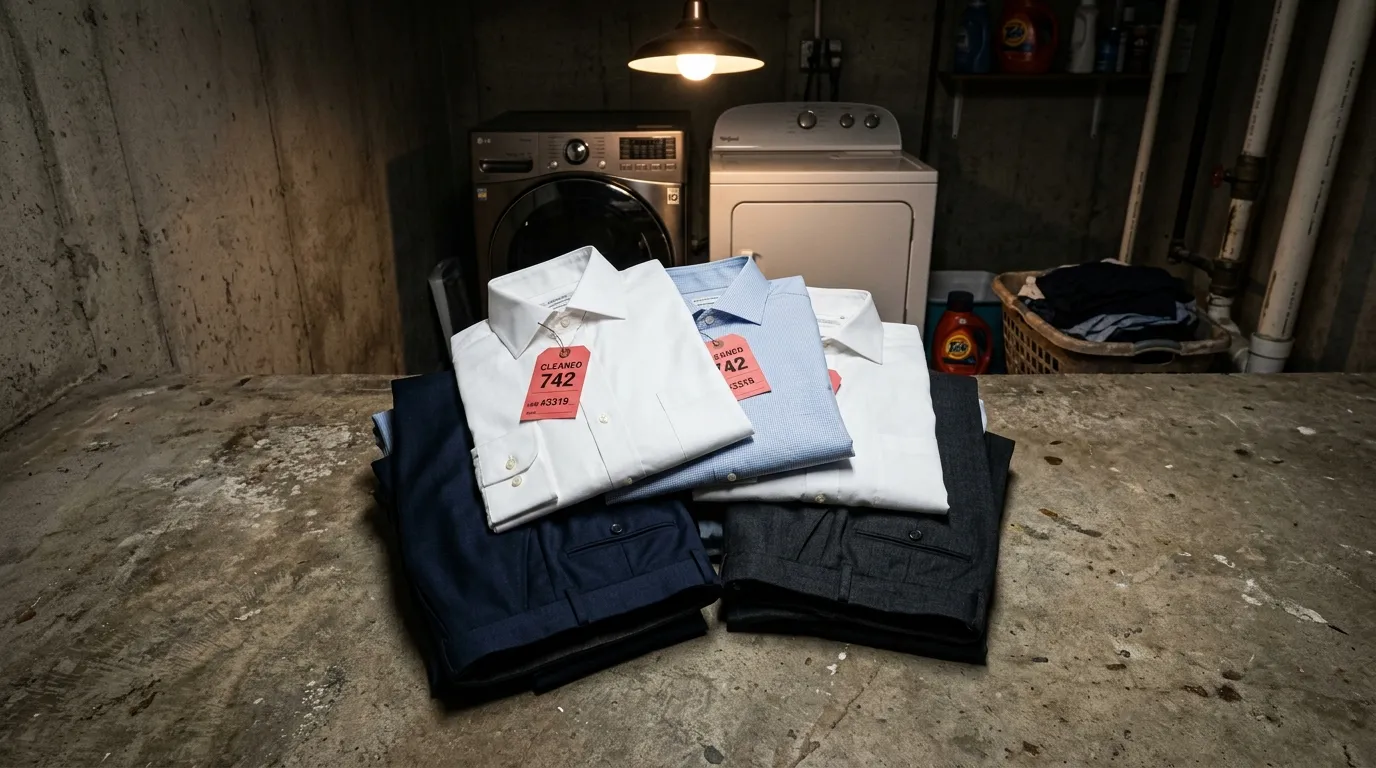
The strange garments that stopped me in my tracks.
I sat back on the hard basement floor and stared at the pile. For a moment, my first, panicked instinct was to march upstairs and call my son down. My hand actually hovered over my phone.
Then, I took a deep breath and stopped. I thought about what would happen if I called him down right now while the children were playing happily outside. The only thing I truly knew as a fact was that I had found men’s clothes that did not belong to my son inside my daughter-in-law’s laundry bags.
I didn’t know why they were there. Of course, the absolute worst-case scenario flashed through my mind immediately. But I didn’t actually know. And once certain accusations are spoken out loud, you can never, ever take them back. Frank would not have called Marcus from the basement without knowing the full story. He would have minded his own business. Their marriage was theirs.
So, I finished exactly what I had planned. I separated everything carefully, returning each person’s clothes to different bags, including placing the mysterious men’s clothes right back into Vanessa’s bag. I left every single item exactly as it was. Not washed. Not dried. Not folded. Then, I went upstairs to make dinner.
The Collision
At six o’clock, Vanessa announced brightly that she was going downstairs to collect the laundry. I held my breath as she descended the stairs. A few seconds later, her voice echoed sharply through the house.
“What did you do?!”
Everyone turned. Footsteps rushed toward the basement door. My son went down first, the children trailing behind him. I stayed completely still in the kitchen.
A moment later, everything below became strangely, suffocatingly quiet.
Then my son spoke, his voice carrying a weight I hadn’t heard before. “Vanessa… whose clothes are these?”
That was the moment everything shifted. Because I had sorted the piles, the expensive men’s shirts were now sitting openly in their own distinct pile. So were the trousers. So were the white button-downs with the unfamiliar dry-cleaning tags. Things that had been so easy to hide and overlook when they were buried deep inside four massive bags were suddenly impossible to ignore.
When I finally walked toward the basement stairs, Vanessa’s face had drained of all color. My son was staring blankly at the clothes, and then at his wife. Suddenly, the laundry Vanessa had been perfectly comfortable dumping at my house every weekend was the absolute last thing she wanted anyone looking at closely.
I hadn’t searched through her belongings maliciously. I hadn’t been trying to expose a dark secret. I had simply stopped doing work that was never mine to begin with. But sometimes, the moment you stop quietly cleaning up everyone else’s messes, you finally get to see what was hiding inside them.
The Dinner Table Stand-Off
A few minutes later, Marcus came upstairs alone. He stood in the kitchen doorway looking confused and uncertain—like a twelve-year-old boy again.
“What happened with the laundry?” he asked quietly.
“I sorted it. I thought it would be easier if everyone’s things were separated so you could handle your own,” I replied, stirring the dinner pot.
“There were clothes down there I didn’t recognize,” he said.
“I imagine Vanessa can explain those,” I said smoothly. I looked directly at him. “I told her last week that I’m not a laundromat. You heard me. Go talk to your wife. Bring the children up when you’re ready. Dinner will still be warm.”
Ten minutes later, the family emerged from the basement. Vanessa had her purse over one shoulder and all four heavy laundry bags in her arms. She looked ready to bolt.
“We’re going home,” she announced.
“Stay for dinner,” I said, keeping my voice firm.
“Whatever you and Marcus need to discuss, you don’t need to solve it right now in front of the children,” I continued. “You can eat dinner. Then you can go home and have whatever conversation you need to have after Lily and Theo are asleep. I want dinner with my grandchildren. And my son. And his wife. That’s all I want from tonight.”
Vanessa slowly put her purse down.
Dinner was not comfortable, but we ate. Lily told me about her science project, Theo spilled his water, and for a few fleeting seconds, the tension broke, and we were simply a family again. At the end of the night, before they left, Vanessa stopped on the porch.
“The clothes you found. I know what you’re thinking,” she whispered.
“I don’t know what I’m thinking. I just sorted the laundry,” I replied honestly. “Whatever the explanation is, explain it to Marcus. Not me.”
The Truth Comes Out
At 10:30 that night, my phone rang. It was Marcus.
“She was washing clothes for someone from work,” he said immediately. “A man in her office named David. His wife has been in the hospital for weeks. He’s handling the house and everything else totally alone. He couldn’t even find time to get to the laundromat, so she started taking his laundry with ours to help him.”
I let out a long breath I didn’t realize I was holding.
“Why didn’t she tell you?” I asked.
“She thought it would be awkward and I wouldn’t understand. She does things like this, Mom. Helps people without telling anyone.”
“She’s complicated,” I agreed.
“Does that change anything about the laundry?” Marcus asked tentatively.
“No,” I said firmly. “Vanessa helping someone whose wife is ill is a beautiful, kind thing. But dumping four bags of someone else’s dirty clothes at my house without asking me is still wrong. It just means the clothes don’t mean what I briefly feared they might mean.”
Then Marcus told me something that made my heart swell. “I talked to her about the laundry. All of it. I told her what I should’ve said last week.”
I smiled in the dark. “And you? You didn’t notice she was doing it either. You looked at your plate. Your father never looked at his plate. I expect you to become the version of yourself who speaks when something needs to be said, especially when it’s uncomfortable.”
“I know, Mom,” he said softly. “I owe you a real apology.”
Establishing the Boundary
Vanessa called me at nine the next morning. She apologized profusely—no excuses, no corporate spin. Just a genuine apology.
“I genuinely didn’t think about how much work I was giving you,” she admitted. “I thought, you’re home anyway, you have the machine…”
“Can I explain something to you?” I interrupted gently. “Retired does not mean available. It means I finished one chapter of my working life and now I get to decide how I spend the next one. I read. I garden. I take a painting class. Being home doesn’t mean I’m waiting for someone to assign me a task. It means I’ve earned the right to decide what my time is for.”
She was quiet for a long time. “I never thought about it that way.”
We talked it through. I admitted I should have spoken up sooner instead of letting resentment build like water behind a dam. She admitted she needed to stop volunteering other people’s labor while trying to be a savior at work. By the end of the call, the air was clear. Vanessa organized a proper meal train and support group for David at work—a solution that actually helped him without burdening me.

The Sunday dinners continued, better and stronger than before.
Marcus and Vanessa hired a weekly laundry service shortly after. It was practical, sustainable, and required absolutely nothing from me. Exactly as it should be.
The Sunday dinners continued. At first, they were slightly awkward, but soon, Vanessa started helping me clear the table. Then she started helping with the dishes. It stopped feeling like an ongoing apology and started feeling like real, genuine participation in our family.
The washing machine on Elm Creek Road still works perfectly. It’s plain white, top-loading, with no personality whatsoever. It washes exactly what I choose to put inside it. Nothing more. Nothing less. And at sixty-eight, that is exactly how it should be.
Note:This work is inspired by real events and people, but it has been fictionalized for creative purposes. Names, characters, and details have been changed to protect privacy and enhance the narrative. Any resemblance to actual persons, living or dead, or actual events is purely coincidental and not intended by the author.
All images used in this article are AI-generated and intended for illustrative purposes only.
0 Comments