
We thought my grandmother’s surprise appearance would simply be the crowning moment of my daughter’s first birthday. After all, a woman reaching 101 years old and making a cross-town trip was reason enough to celebrate. But as the afternoon unfolded, we realized she hadn’t made the grueling journey just to watch a baby smash a vanilla cupcake. She had brought something with her—a battered relic strapped to the back of her wheelchair that would tear open a generational silence and force our entire family to confront a truth buried for over half a century.
My grandmother, Evelyn, had not stepped foot out of her bed in nearly two years. In our family, that reality had settled into a quiet, unchanging routine. Whenever I closed my eyes and pictured Grandma, the image was always identical: the soft hum of an air purifier, sheer pale curtains swaying over an open sash, a polished mahogany dresser crowded with silver-framed portraits, and a half-empty glass of lemon water on the nightstand. She would sit propped against three pillows, her translucent, vein-lined hands resting neatly atop a quilted blanket while morning sunlight crawled across the hardwood floor.
Evelyn had spent a century being the architect of her own life. She was fiercely independent, razor-sharp, and notoriously stubborn. Even as age slowly chipped away at her mobility, narrowing her physical universe to a single sunlit bedroom, she refused to relinquish control. She still corrected nurses on the exact minute her medication was due, and she cut off anyone who dared to speak on her behalf. So when my phone rang at eight o’clock on a Saturday morning and her scratchy, unmistakable voice came through the receiver saying, “I’m coming,” I froze.
I was standing in the kitchen, a roll of pastel pink streamers pinned under my arm, balancing my phone on my shoulder with thumb-smears of buttercream frosting on my apron. My daughter, Sophie, sat in her high chair by the island, giggling and slamming a plastic spoon rhythmically against her tray.
“Grandma, you can barely sit up in bed for an hour,” I said gently, trying not to sound patronizing.
“I said I’m coming, Elena. Have someone clear a path through the front hallway.”
Her voice sounded frail, like dry leaves scraping across pavement, but beneath the weakness was an iron resolve. That was Evelyn. She possessed a rare ability to sound completely exhausted and entirely commanding in the very same breath.
“The party is all the way across town at our house,” I reminded her. “There’s going to be music, kids running everywhere, chaos—”
“I know where you live,” she cut in. “And I know what a one-year-old’s birthday looks like. I’ll be there by noon.”
I squeezed my eyes shut. Arguing with Evelyn had always been an exercise in futility. Growing up, I watched my mother concede every debate she ever had with her. Doctors surrendered to her will; physical therapists threw their hands up; my late grandfather had learned decades ago that telling Evelyn ‘no’ was merely handing her an invitation to prove everyone wrong.
Yet this felt wildly out of character. Grandma had skipped Thanksgiving. She had skipped Christmas dinner. She had even missed Sophie’s birth because moving from the bed to a car had become a painful, dangerous ordeal. Then, as I stood there listening, a wet, rattling cough broke from her chest. It went on for several seconds, rough and suffocating.
“Grandma,” I pleaded, my chest tightening. “Please, don’t push yourself like this.”
“I am fine,” she wheezed, clearing her throat with sheer willpower. “Does your mother know yet?”
“No, of course not. She’ll have a heart attack.”
“Good. Keep it that way. I called you first because you have more sense than she does.”
The line clicked dead. I stared at the phone screen, my heart thumping against my ribs. Grandma wasn’t a woman of whimsical impulses. She didn’t burn through what little physical strength she had left just to eat cake. There was a calculation in her voice, a hidden urgency that made the hair on the back of my neck stand up.
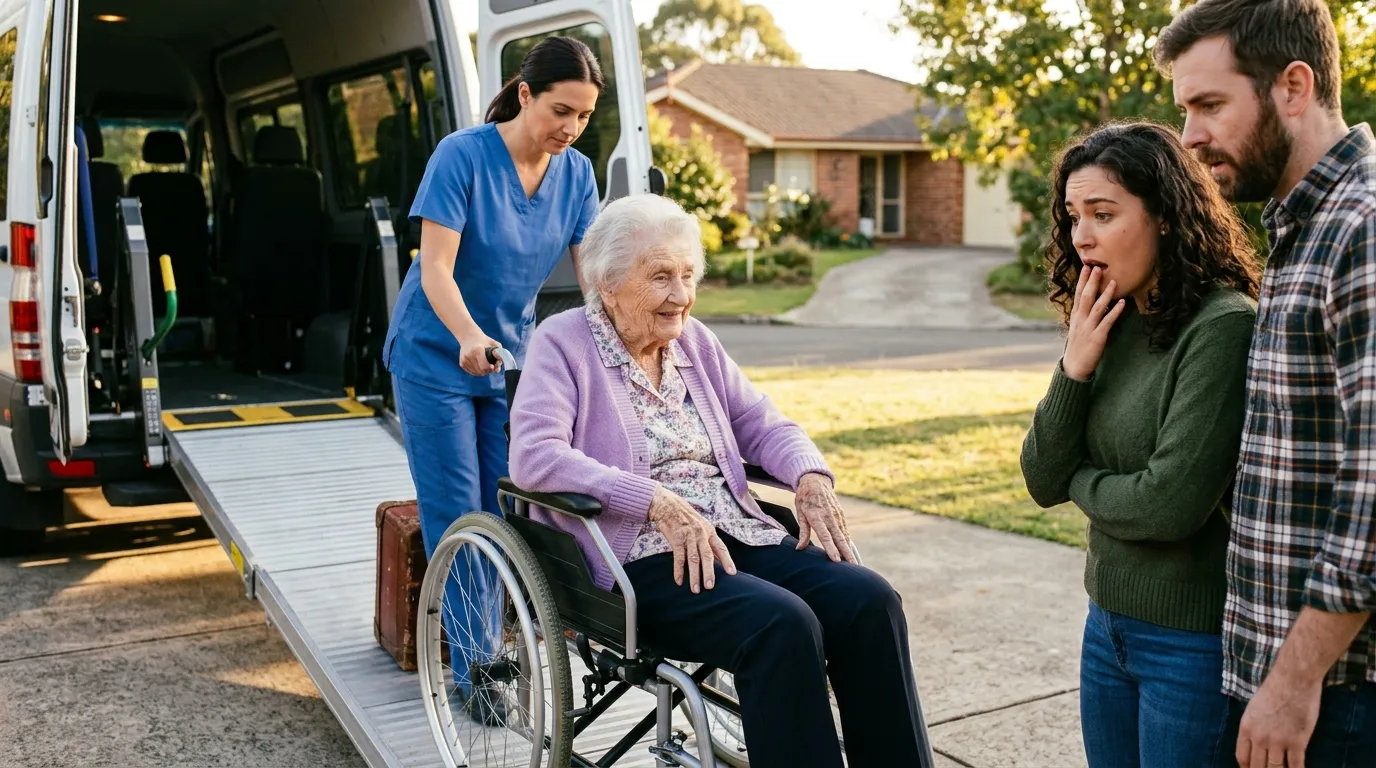
Evelyn’s arrival stunned the entire family, but it was the luggage strapped behind her that drew every eye.
The Arrival and the Locked Case
Promptly at 11:45 AM, a private medical transport van pulled into our driveway. I was adjusting the banner over the front window when Bryce, my husband, walked up behind me and stopped dead in his tracks.
“Tell me that’s not what I think it is,” he murmured.
“I told you she called,” I replied, grabbing his arm.
“I thought she was delirious, Elena. She hasn’t left her house since 2024.”
The van’s hydraulic lift lowered with a mechanical whine, revealing two uniform-clad attendants guiding a heavy wheelchair backward onto the pavement. Seeing Grandma out in the raw daylight was jarring. Beneath the bright sky, she looked astonishingly small. Her narrow shoulders swam inside a lavender knitted cardigan. Her white hair had been neatly brushed back into a silver clip, and someone had dusted a touch of rose powder over her sunken cheeks—almost certainly under her strict orders. But what arrested both of us immediately was what was strapped behind her backrest.
Secured with heavy bungee cords to the steel frame of her wheelchair was an antique, compact suitcase. It was made of deep red, scuffed leather, aged to the color of dried cherries, with brass corner plates and a tiny, tarnished padlock sealing the clasp. It was ancient—easily seventy or eighty years old. She hadn’t brought an overnight bag. She had brought no purse, no cardigan change, no walking cane. Just that solitary, mysterious piece of luggage.
“What on earth is that?” Bryce whispered.
“I have never seen that box in my life,” I admitted.
We hurried down the front walk as the attendants rolled her toward the porch. “Grandma,” I breathed, crouching down beside her wheel. “You actually made it.”
Her dark eyes flicked over my face, as piercing as an eagle’s. “Don’t look at me like that, Elena.”
“Like what?”
“Like you’re calculating the odds of an ambulance having to take me away in front of your neighbors.”
I swallowed hard and managed a guilty smile, bending to press my cheek against hers. She smelled of cold air, menthol ointment, and the familiar lavender powder she had worn since my childhood. For a single second, the tension evaporated, and I was just a granddaughter leaning on the safest pillar of my youth.
Bryce stepped up, offering a warm smile. “It’s an honor to have you here, Evelyn. Here, let me unhook that bag for you so it doesn’t tip the chair.”
He reached toward the red case. Before his fingers could even brush the worn handle, Grandma’s right hand whipped out with startling speed. Smack!
She struck his wrist with the flat of her palm. “Keep your hands off that.”
The two transport attendants went rigid. Bryce pulled his hand back as if he had touched a hot stove. “Sorry, Evelyn. Just trying to help.”
“Nobody touches this case,” she said, her voice dropping into a register that brook no defiance. “Not until I say so. Roll me inside.”
An Unsettling Afternoon
Once settled in the corner of our open-plan living room, Grandma became the undisputed center of gravity. Cousins, aunts, and family friends crowded around her in waves, marveling at her presence, snapping photos, and showering her with compliments she visibly detested.
“Yes, I’m still breathing,” she barked at an over-enthusiastic cousin. “No, I don’t want sugar-free punch. Bring me plain tap water.”
My mother, Marian, hovered relentlessly over her chair like an anxious hummingbird, smoothing her collar, offering cushions, asking if the draft from the air conditioner was too sharp. Finally, Evelyn snapped, “Marian, if you adjust that cushion behind my head one more time, I will have Bryce wheel me into the driveway. Go talk to your guests.”
My mother backed away with that familiar, slightly wounded slump that every adult child wears when put in their place by a matriarch. On the surface, the party seemed to flow into familiar domestic rhythms. Balloons drifted against the ceiling, children ran through the hallway leaving sticky handprints on the walls, and the chatter of old friends filled the air. But as the afternoon wore on, I noticed something strange about Grandma.
She didn’t care about the party. She barely looked at the banner, never glanced at the gifts piled on the credenza, and ignored the birthday cake sitting on the kitchen island. Instead, her gaze was pinned entirely on Sophie.
When Bryce picked Sophie up to show her a helium balloon, Grandma’s head turned, tracking every step. When my mother sat on the rug to roll a wooden ball toward the baby, Grandma leaned forward, gripping her armrests so tightly that the tendons in her wrists bulged against her skin. It wasn’t the warm, nostalgic gaze of a great-grandmother soaking in a milestone. It was the intense, calculated scrutiny of an investigator waiting for a hidden clue to reveal itself.
I walked over with a glass of water and knelt beside her. “Grandma? Are you feeling alright? Is your chest hurting?”
“I’m fine,” she whispered, without looking away from Sophie.
“You’ve been watching her like a hawk for two hours. You’re making me nervous.”
Grandma turned her head slowly, looking straight into my eyes. Her expression was solemn, almost mournful. “She’s beautiful, Elena. Strong. But some things don’t show on the surface until the time is right.”
“What things?”
She turned away again. “Bring the cake out. It’s time.”
The Mark on the Heel
We gathered everyone around the dining room table. Bryce buckled Sophie into her high chair, setting a little pink cardboard crown on her fine baby curls. The room quieted down as the single candle was lit, flickering brightly against the cheerful sugar frosting.
“Happy birthday to you…” the room sang out in chorus.
Sophie squealed, clapping her tiny hands together and laughing as everyone cheered. Bryce caught my eye and mouthed, “She loves it.”
I smiled, turning to look at Grandma in the back of the room. The smile died on my lips.
Grandma Evelyn was weeping. Silent, heavy tears spilled over her wrinkled eyelids and ran unchecked down the deep hollows of her cheeks. Her mouth was drawn into a tight, trembling line. Suddenly, her bony finger shot forward, pointing straight at the high chair.
“Take off her sock,” Grandma ordered. Her voice cut through the fading applause like a razor blade.
The room instantly dropped into silence. A cousin holding a camera lowered his hands. “What did she say?” someone whispered.
“Elena,” Grandma commanded, her voice trembling with raw power. “Take off Sophie’s left sock. Right now.”
My mother stepped toward her. “Mom, what is this? We’re about to blow out the candle—”
“Lock the front door,” Evelyn interrupted, her eyes darting toward the foyer. “Bryce! Go to the front door, turn the deadbolt, and stand there.”
Bryce laughed nervously, glancing between me and the rest of the family. “Evelyn, come on, we’re having a party—”
Grandma reached out and grabbed my wrist with a grip so ferocious, so icy cold, that I gasped. Her eyes were wide with genuine terror. “Lock the door, Bryce,” she hissed. “Do not let anyone leave this house until I am finished.”
The collective breath of twenty people caught in their throats. Bryce didn’t argue. He crossed the hardwood floor, reached the entryway, and clicked the heavy deadbolt shut. The sharp metallic snap echoed through the silent house.
“Now,” Grandma breathed, releasing my wrist. “The sock.”
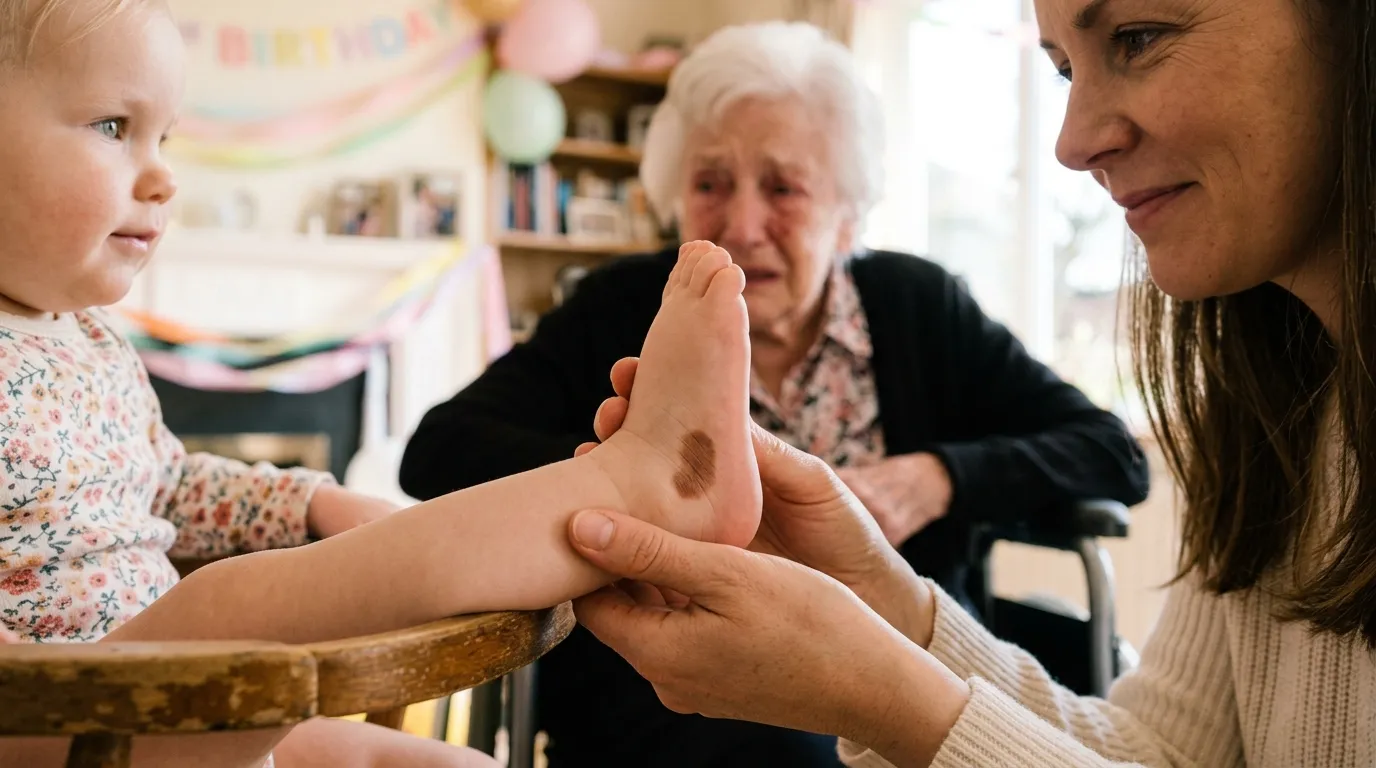
The small brown mark above Sophie’s heel was something I had seen a thousand times—never knowing its true significance.
I crouched down beside the high chair, my hands shaking. Sophie looked at me with wide, innocent blue eyes, kicking her little legs against the plastic frame. I reached down, caught the cuff of her ruffled white sock, and slid it off her foot.
There was nothing horrific. There was no injury. Just baby skin, smooth and pink. But right above the curve of her left heel, sitting on the outside edge of her ankle, was a small, irregular brown mark. It was roughly the size and shape of a pumpkin seed. I had seen it every single day during her bath. The pediatrician had called it a benign café-au-lait birthmark. Nothing to worry about.
Grandma made a sound from across the room—a strangled gasp that sounded like she had been struck in the stomach.
“Turn the foot,” she whispered, her chin quivering. “Turn it toward me.”
I gently lifted Sophie’s ankle, turning the heel toward Evelyn’s wheelchair. Grandma leaned forward as far as her frail spine would allow, staring at the mark as if looking at a ghost. Every trace of color had drained from her face.
“Mom, it’s just a birthmark,” my mother said, stepping closer, her tone caught between annoyance and profound worry. “We’ve known about it since she was born.”
“You know nothing,” Grandma said quietly. Then she raised her eyes. She didn’t look at my mother, nor at me, nor at the baby. Her gaze locked directly onto a man standing quietly near the back patio door.
My Uncle Dean.
Dean was 68 years old, my mother’s older brother. He had been strangely subdued all afternoon, standing by the drinks table with his arms folded across his chest. Beside him, his wife Trina looked around nervously, sensing the sudden shift in the room.
“You stay right where you are, Dean,” Grandma said, her voice dropping to a deadly whisper.
Dean’s jaw tightened. A dark flush crept up his neck into his cheeks. “Mom, this is ridiculous. You’re turning a kid’s birthday party into some kind of dramatic sideshow. I’m going outside for some air.”
He took half a step toward the glass slider, but Grandma’s voice cracked like thunder: “Take one step toward that door, Dean, and I will have Bryce call the police.”
Dean froze. The entire room seemed to stop breathing. Even Sophie stopped kicking her feet, picking up on the sudden electric tension.
“What’s ridiculous,” Evelyn continued, her voice trembling with decades of suppressed fury, “is that I waited until my one-hundred-and-first year to drag this out into the light.”
The Red Suitcase Unlocked
Grandma reached behind her wheelchair and tapped the worn red leather. “Bryce. Bring it around.”
Bryce stepped forward cautiously, unclipped the heavy bungee cords, and lifted the suitcase. It wasn’t heavy, but the weight of what it represented made his hands visibly deliberate. He placed it gently onto Grandma’s lap. The tarnished brass clasp and its tiny padlock pointed straight up.
With trembling fingers, Evelyn reached inside the collar of her lavender cardigan. She pulled out a thin silver chain that had been hidden against her collarbone. Hanging from the end was a miniature brass key, worn smooth by years of handling. Her fingers shook so violently that she couldn’t align the keyhole. “Elena,” she whispered. “Help me.”
I knelt beside her, wrapping my steady hand over her cold, fragile fingers. Together, we slipped the key into the tumbler. A tiny, crisp click rang out across the room.
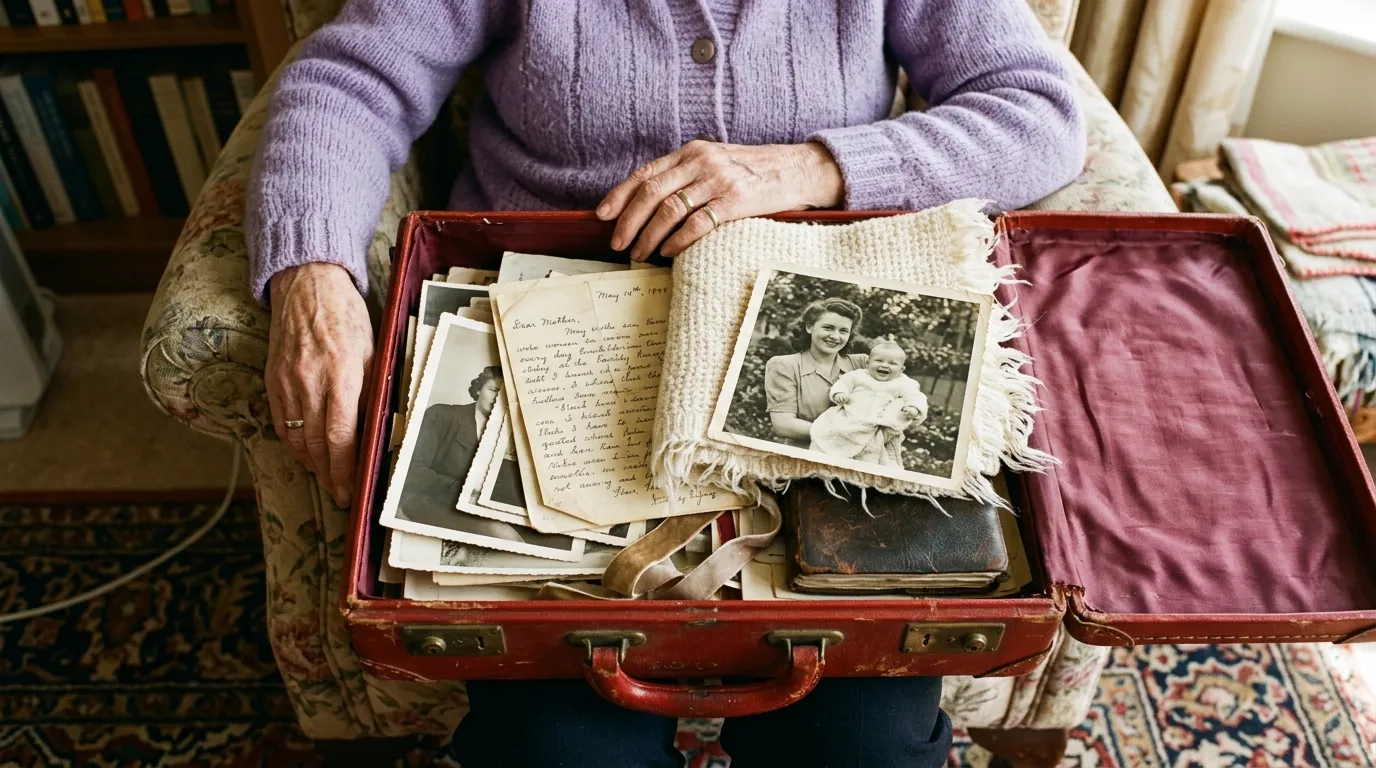
The case hadn’t been opened in decades; inside lay the fragments of a story our family had never been told.
The lid opened on squeaking brass hinges. Inside, resting against faded, gold satin lining, was a time capsule: bundles of letters tied with fraying twine, a yellowed, moth-eaten woolen baby blanket, a slender leather-bound diary, and a stack of silver-toned black-and-white photographs.
Grandma lifted the top photograph. Her weathered thumb stroked the glossy paper gently before she held it out to me. “Look at her, Elena.”
I took the photo. It depicted a young woman sitting on a wooden bench, holding a newborn swaddled in blankets. The portrait was taken sometime in the mid-1940s. But what made my breath hitch was the woman’s face. She had dark, wide-set almond eyes, high cheekbones, and a narrow, resolute chin. Even the tilt of her head—curious, guarded, slightly defiant—felt uncanny.
It was like looking into an antique mirror. She looked exactly like me.
“Who is she?” I asked, my voice barely a whisper.
“That was my younger sister, Margaret,” Grandma said. “Your great-aunt.”
My mother leaned over my shoulder, staring at the print. “Aunt Margaret? But… she died when you were both young. You said she passed away from illness down south.”
“That was the lie your grandparents told everyone,” Grandma said, her eyes blazing with fresh tears. “Margaret didn’t die down south. She was sent away. In 1944, when she was barely seventeen years old, she found out she was pregnant. Our parents were prominent people in their church and their town. To them, an unwed teenage pregnancy wasn’t a tragedy—it was an unforgivable scandal. They shipped her off to a maternity home three states away before her belly even began to show.”
The room listened in stunned silence. Nobody shifted; nobody coughed.
“She gave birth to a little girl,” Evelyn said, her fingers lightly brushing the yellowed baby blanket in the case. “She named her Rose. Margaret begged our parents to let her bring the baby home. She promised to work, promised to raise her in secret. But my father arranged for Rose to be signed away to an adoptive couple before Margaret could even hold her for an entire afternoon.”
I looked from the photograph to Sophie, who was now quietly sucking her thumb. “Grandma… what does this have to do with Sophie’s birthmark?”
Grandma pulled a second photograph from the stack and handed it to me. This one was a clinical, private shot of the infant girl lying on an examination towel, her left foot held gently by a nurse’s hand. Just above the heel, perfectly identical in shape and placement to the mark on my daughter’s foot, was a brown, pumpkin-seed birthmark.
Bryce leaned over and let out a soft curse. “My God.”
“Birthmarks can appear randomly,” my mother protested, though her voice lacked conviction. Her hands were shaking so hard she had to grip the back of a dining chair. “People share marks all the time.”
“Not this one,” Grandma countered sharply. “This mark has run through Margaret’s bloodline for three generations. But it wasn’t supposed to be here. Not in this house. Not unless…” She turned her gaze back toward Dean, whose face had gone pale as bone.
“Tell her, Dean,” Grandma demanded, her voice cracking with fury. “Tell your sister who she really is.”
The Hidden Record
My mother looked at her brother, confusion twisting her features. “Dean? What is she talking about?”
Dean refused to meet her eyes. He stared at the baseboards, his hands clenched into tight fists in his pockets. “Mom, don’t do this. Not here. Not in front of everyone.”
“You had twenty years to do it in private!” Evelyn roared, finding an astonishing surge of vocal strength that startled everyone in the room. “You found the papers when your father died, and you buried them!”
With trembling hands, Grandma extracted a thick manila envelope from the bottom of the case. The edges were stamped with a faded county clerk seal from 1971. Dean suddenly lurched forward, but Bryce stepped directly into his path, his tall frame blocking him completely.
“Back up, Dean,” Bryce said quietly.
“Give that to me,” Dean snapped, his voice thick with panic. “That belongs to the family estate!”
“It belongs to your sister,” Evelyn said firmly. She thrust the envelope into my hands. “Read it, Elena. Read the names.”
I pulled out the fragile, legal-sized carbon copies. The document was an adoption decree and a sworn deposition. As my eyes tracked across the faded typewritten lines, the room seemed to tilt beneath my feet.
Margaret’s daughter, Rose, had grown up knowing she was adopted. When she turned twenty-one, she had hired a private investigator to find her birth mother. She eventually found Margaret, who was then living in Pennsylvania, dying of tuberculosis. They had spent only three weeks together before Margaret passed away, but in those three weeks, Rose shared her own life: she was married, living in upstate New York, and had just given birth to a daughter of her own.
A daughter she named Marian.
A year later, when Rose and her husband were killed in a tragic car accident on an icy highway, their will named Evelyn—the great-aunt who had secretly maintained correspondence with Margaret—as the child’s legal guardian.
Evelyn hadn’t merely adopted a random child. She had taken her dead sister’s orphaned granddaughter and raised her under her own roof. To protect the family from the lingering societal stigma of the 1950s, and to spare Marian the devastating knowledge of her double-abandonment, Evelyn and her husband had quietly absorbed her into their household, listing her as their own natural-born daughter on all social records.
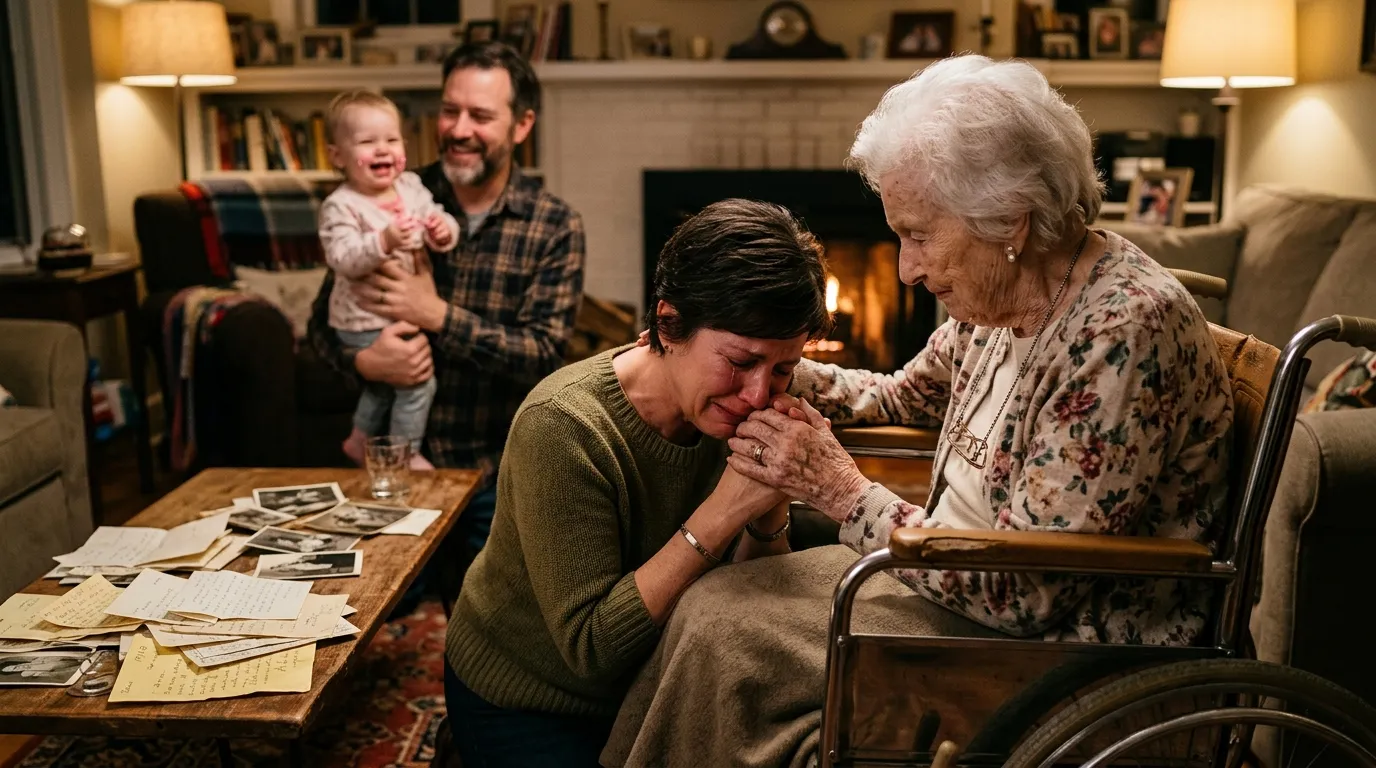
The truth brought tears, but it also dissolved decades of unspoken distance between mother and daughter.
My mother sank slowly to her knees on the hardwood floor, clutching her chest. “I’m… I’m not your daughter?”
“You are my daughter in every way that matters on God’s earth,” Grandma said, her voice softening into a tender, broken sob. “I held you through every fever. I taught you to walk. I loved you more than my own pride. But biologically, you were Margaret’s blood. My sister’s flesh.”
“Then why didn’t you tell me?” Marian cried, tears streaming down her neck. “Why did I have to find out like this, at sixty years old?”
“Because your father and I promised to take the secret to our graves,” Grandma explained gently. “We wanted you to grow up whole, never feeling like an afterthought or a charity case. But when your father passed away in 2004, Dean was tasked with going through his legal safe. He found the original adoption decree. He found Margaret’s letters.”
I glared at my uncle. “And you hid them? Why?”
Trina, Dean’s wife, looked horrified. “Dean? Is this true?”
Dean slumped against the wall, all the fight draining out of him. “The property,” he muttered bitterly. “Grandpa’s will left the coastal acreage and the trust specifically to ‘natural-born heirs.’ If the trust attorneys knew Marian was legally adopted under questionable paperwork, the entire estate distribution would have been frozen in probate court for a decade. We would have lost millions in legal fees.”
“You kept my own identity from me for twenty years over a piece of land?” Marian whispered, her voice laced with pure disgust.
“It wasn’t just the land!” Dean yelled, his face crumpling. “I didn’t want to destroy the family! Mom was already getting frail. What good would it have done to tear our history apart?”
“The truth doesn’t tear families apart, Dean,” Grandma said with devastating clarity. “Greed does. Lies do.”
The Mark Returns
Grandma turned her wheelchair slightly, looking back down at Sophie, who was still kicking her bare left heel against the high chair tray.
“When you were born, Marian,” Grandma said, “I searched your feet. The mark wasn’t there. When Elena was born, I looked again. Nothing. For two generations, Margaret’s mark skipped our family. I thought it was gone forever. I thought the past had truly buried itself.”
She reached out, her frail hand resting gently against Sophie’s ankle, brushing the small brown birthmark with the pad of her thumb.
“Then, two weeks ago, Elena sent me a video of Sophie taking her first steps in her nursery,” Grandma whispered. “The camera zoomed in on her feet. And I saw it. The exact shape. The exact placement. The mark my sister Margaret wept over eighty years ago when they tore her baby out of her arms.”
Grandma looked around the room, tears glistening in her eyes. “I realized then that God wasn’t going to let Margaret be erased. I am one hundred and one years old. I knew I wouldn’t survive another winter. If I died with this locked in my bedroom, Dean would have burned this suitcase, and my sister’s memory would have vanished forever. I had to see it with my own eyes. And I had to make sure Marian knew whose blood gave her life.”
Silence hung heavy in the living room. For nearly a full minute, the only sound was the faint tick of the mantel clock and the soft sniffling of my aunts.
Then, Marian crawled forward on her knees, burying her face into Evelyn’s lap. Her shoulders shook as decades of unspoken, complex feelings between a mother and daughter collapsed into pure love. Grandma placed both of her frail, liver-spotted hands on my mother’s head, stroking her hair with a tenderness I had never seen her display before.
“Margaret would have been so proud of you,” Evelyn murmured softly. “She looked down on you every single day.”
Suddenly, a loud, wet smack broke the silence.
We all turned. Sophie, completely oblivious to the generational reckoning taking place around her, had plunged both of her chubby hands straight into the middle of her birthday cake. She smeared bright pink frosting across both of her cheeks, looked directly at Bryce, and let out an ear-splitting, joyous squeal.
Bryce burst out laughing through his tears. I choked out a laugh, and even my mother lifted her head from Grandma’s lap, wiping her eyes and smiling through her grief.
Grandma Evelyn looked down at Sophie, and for the first time in two years, her entire face lit up with a genuine, triumphant smile. “Well,” Grandma said dryly, “at least she inherited Margaret’s manners.”
The party never quite returned to normal, and our family dynamic was irrevocably altered that afternoon. Dean left quietly through the side gate twenty minutes later, unable to face his sister. But as I pulled Sophie’s tiny white sock back over her heel and kissed the crown of her head, I didn’t feel anger.
I looked at the scuffed red suitcase resting open on my kitchen counter, its letters and photographs finally breathing the open air. Grandma had spent a lifetime guarding the people she loved—first with silence, and finally with the courage to tell the truth. She hadn’t let age, illness, or shame keep her from doing what was right. And on a sunny Saturday afternoon, she gave my daughter, my mother, and me the greatest birthday gift of all: the truth of who we really are.
Note:This work is inspired by real events and people, but it has been fictionalized for creative purposes. Names, characters, and details have been changed to protect privacy and enhance the narrative. Any resemblance to actual persons, living or dead, or actual events is purely coincidental and not intended by the author.
All images used in this article are AI-generated and intended for illustrative purposes only.
0 Comments