
The third time the small gray cat climbed into my moving box and sank her claws into the corrugated cardboard, I stopped laughing. The humor drained right out of the room, replaced by a hollow, unsettling ache in my chest.
I was standing in the center of apartment 3B, holding a heavy plastic dispenser of brown packing tape in one hand, trying my best to stay on schedule. The lease had expired months ago, the building was changing management, and I had a job to do. But every time I turned my back, the cat reappeared inside the same carton.
She wasn’t curled up taking an afternoon nap. She wasn’t swatting at the dangling flaps or chasing the loose curls of plastic tape. She sat rigid, her belly pressed flat against an old stack of faded bath towels, her ears pivoted forward like radar dishes. Her round, amber eyes remained locked on the open front door.
It was the unmistakable posture of someone sitting on a wooden bench at a deserted depot, clutching their ticket, terrified that the last bus of the night was going to pull away without them.
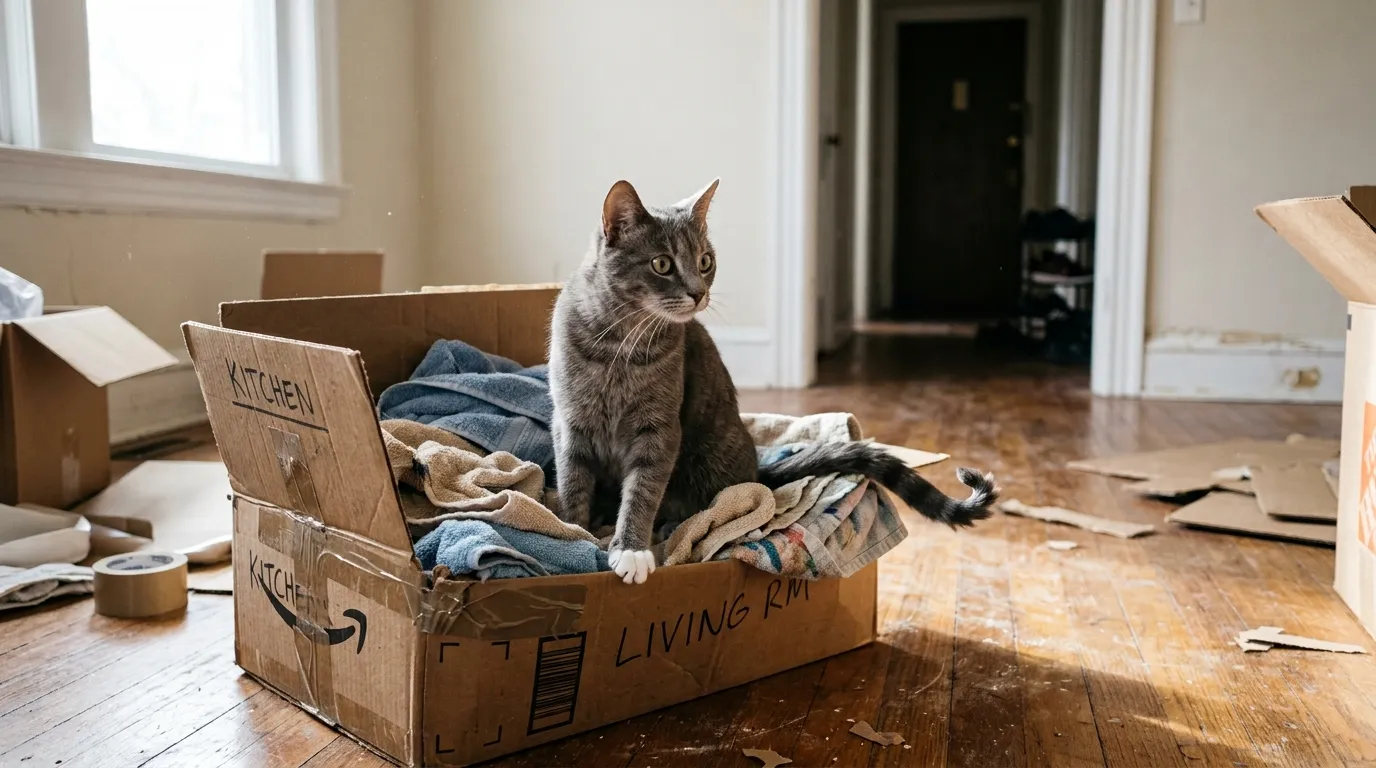
She didn’t want a hiding spot; she was waiting for someone to carry her away.
“Look, little girl,” I said, my voice bouncing off the bare plaster walls. “You have to get out.”
The cat didn’t blink. She didn’t budge an inch.
I leaned over and slid both hands into the carton. The moment my palms brushed her ribs, her entire frame turned to stone. She leaned away from my touch, pulling her chin back, but she never hissed. She never bared a claw. I lifted her gently onto the hardwood floor.
Up close, she felt lighter than air. Her dusty gray coat hid a frame that was far too thin. One front paw was stark white, looking precisely like she had stepped into a saucer of white paint, and the very tip of her tail carried a slight, crooked bend. She touched the floor silently, spun on her heels, and leaped right back into the box.
“You’ve got to be kidding me,” I muttered under my breath.
Eleven Years of Empty Rooms
I had been clearing abandoned apartments and handling building turnover for nearly eleven years. Over that decade, I had patched thousands of drywall holes, replaced rotted sink bases, stripped waterlogged carpet, and carted away the physical wreckage of shattered lives. I had bagged up family photo albums left on kitchen tables, winter coats still on their hangers, wedding gowns sealed in plastic, and once, an urn of cremated ashes tucked behind a furnace.
I had encountered abandoned animals before, too. Usually, they were wild with terror. They bolted into heating ducts or hissed savagely from behind appliances until animal control arrived with catch-poles and gloves.
This cat wasn’t wild. She was waiting.
I lifted her out a second time. She hopped right back in. On the fourth attempt, she anchored her curved claws so deeply into the bottom flaps that I had to pry them loose toe by toe. Even then, she didn’t bite. She didn’t show anger. She just stared at me with pure, unvarnished panic.
That look broke something inside me.
I set her down with deliberate care. The box was supposed to go down to the curb for the donation truck—it held three frayed towels, a small brass desk lamp, and a couple of wool sweaters that smelled of mothballs and stale cedar. I set the carton on my heavy steel handcart and wheeled it toward the hallway.
The cat trotted right beside the rubber wheels, keeping pace like a trained dog. When I reached the elevator bank, she hopped onto the cart’s lower steel tray, wedging her thin body between two stacked cartons.
The heavy elevator doors parted with a deafening screech of industrial metal. The cat flattened herself instantly, her chin resting on the steel grate. When I reached to grab her, her claws dug into the metal mesh.
The Neighbor Across the Hall
Just as the elevator chimed, the door directly opposite apartment 3B creaked open. An elderly woman stepped into the dim hallway. She wore a faded blue quilted housecoat, thick wool socks, and short, uneven white hair that looked as though she trimmed it herself in the bathroom mirror. Her wrinkled hand gripped the brass doorframe for balance.
She looked down at the cat wedged between the boxes. Then she looked up at me.
“Are you taking her?” she asked, her voice thin and raspy.
“I’m taking the junk,” I replied frankly.
The woman’s expression fell, her mouth sagging into a tight, sad line.
“She doesn’t belong in 3B anymore,” I said. “Is she yours?”
“No.”
“Whose is she, then?”
The old woman hesitated, her fingers twitching against the wood trim. “She used to live there.”
I glanced back through the open doorway of 3B. The apartment had been locked up for months before I received the work order from the property manager. Yet inside, pantry shelves still held tins of soup and dry beans. A floral housecoat hung from the back of the bedroom door, and an old pair of soft slippers rested beside the armchair.
It didn’t look like the home of someone who had packed up and relocated. It looked like someone had walked out to check the mail and vanished off the face of the earth.
“What happened to the lady who lived here?” I asked.
“She left,” the neighbor replied, far too quickly.
“And she just abandoned her cat?”
The woman stared at the cat’s white paw. “People leave behind all kinds of things.”
The elevator began to sound its persistent warning beep. I reached out, grabbed the cart handle, and backed it away from the threshold, letting the heavy doors slide shut. The cat never moved from her spot between the cartons.
“What’s her name?” I asked.
The old woman’s hand tightened around the molding until her knuckles showed white. “I don’t know.”
Before I could press her, she backed into her apartment and clicked the deadbolt shut.
Not a Hiding Spot, but Luggage
I wheeled the cart back into 3B. The moment the metal wheels crossed the sill, the cat hopped down, trotted over to the carton of old towels, and climbed straight back inside.
I left her there. I told myself it was simply practical—if she stayed in the box, she wouldn’t be underfoot while I worked. But the truth cut much deeper than that.
I knew that posture. I recognized that desperate, quiet stillness. I had worn that exact expression when I was eight years old, sitting on an unmade cot with all my worldly belongings stuffed into a black trash bag, watching headlights sweep across the driveway, wondering if the next house would finally be the one that kept me.
I hadn’t thought about that foster kid in twenty years.
The next morning, I stopped at the corner bodega and bought two cans of poultry paté and a plastic bowl. When I set the meal on the floor of 3B, the cat emerged from beneath the kitchen sink, took two delicate bites, and paused.
Then I grabbed the roll of brown packing tape and pulled a long strip free.
Rrrrrrrip.
The harsh, tearing sound split the silence of the empty flat. The cat scrambled across the linoleum, her back paws skidding on the dust, and launched herself into the nearest packed carton. Her eyes were wide, dilated, fixed entirely on the front door.
I let the tape dangle from my hand. To test a theory, I set out three clean, empty boxes on the floor. Most cats find empty boxes irresistible. She didn’t look at them once. Then, I took an old wool cardigan from the closet, placed it inside one of the empty boxes along with a framed painting of a meadow, and pushed it two feet toward the door.
The cat crept out of her corner, padded over, and leaped inside.
A chill swept through me that had nothing to do with the November draft. She wasn’t seeking safety. She was seeking baggage. She believed that anything left loose on the floor was discarded, and only the things sealed inside boxes were allowed to move forward.
“You’ve got a terrible plan,” I told her as I sat on the floor with my sandwich. “Nobody ships cats through the post.”
She blinked slowly, resting her chin on the edge of the cardboard.
“And I don’t have a better one,” I added quietly.
The work order gave me until Friday afternoon. After that, the contractors were arriving to gut the kitchen, seal the subflooring, and replace the drywall. Any animal trapped behind the baseboards wouldn’t survive the weekend.
I had spent my adult life keeping my world deliberately barren. My own apartment consisted of a single bed, a kitchen table with two unmatched chairs, and a small TV. In six years, I had never hammered a single picture nail into the walls. People thought I was a minimalist. The reality was simpler: I refused to own anything I wasn’t prepared to lose in a fifteen-minute move.
The Box in the Closet
By Wednesday afternoon, the apartment was nearly stripped bare. In the master closet, pushed high onto the top shelf behind two moldering suitcases, I discovered a dust-covered cardboard carton marked with black grease pencil:
3B — BEDROOM / KEEPSAKES
As soon as the carton hit the floor, the cat appeared at my side. She didn’t just climb into this one; she began feverishly digging with her paws, burrowing through tissue paper and old blankets. Her nose nudged aside a worn woolen scarf, sending a small object rolling across the floorboards.
It was a handmade cloth mouse, frayed at the seams, missing one felt ear. The cat snatched it between her teeth and tucked it under her paws like a rescued child.
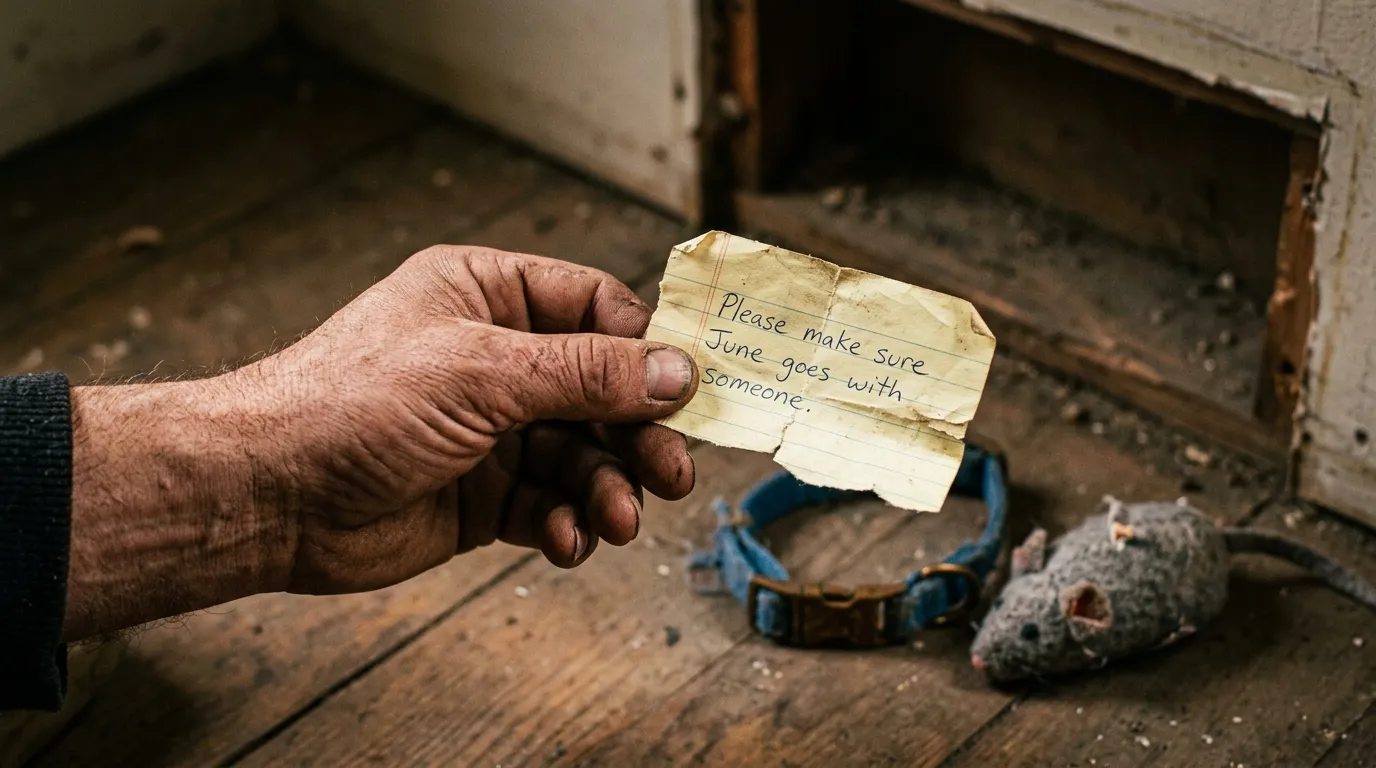
The scrap of paper hidden in the closet revealed a name and a desperate wish.
Beneath the blankets lay a weathered blue nylon collar with an empty split ring, and a yellowing slip of veterinary paper. Scrawled across the top in faded blue ink was a single word:
June.
“June?” I murmured.
Her ears flicked back toward me. Her body softened. For the first time, she looked straight into my face instead of staring past me at the exit.
Across the hall, the neighbor’s door swung open again. Mrs. Dwyer stepped out carrying a plastic trash sack. When she saw the blue collar dangling from my fingers, she stopped dead in her tracks, her knuckles trembling.
“Where did you find that?” she whispered.
“In the back of the closet,” I said, rising to my feet. “You knew her name all along.”
Mrs. Dwyer looked away, her face tightening defensively. “You’re here to throw out garbage, young man. Not rifle through people’s memories.”
“Her memories are sitting in these boxes,” I snapped. “Tell me what really happened here.”
Before she could answer, June bounded out of the apartment with the cloth mouse in her mouth, running straight to Mrs. Dwyer’s feet. She set the mouse on the welcome mat and looked up, waiting. Mrs. Dwyer looked down, choked back a dry sob, and quickly retreated into her apartment, slamming the door between them.
The Panic and the Pipe
That evening, determined to get June out before the renovation crews arrived, I brought in a professional plastic pet carrier lined with blankets. I placed a handful of roasted chicken inside.
June wouldn’t touch it. She treated the crate like a trap.
Frustrated and running out of time, I placed the carrier inside a large cardboard carton, leaving the crate door unlatched. When June hopped into the outer box, I leaned in quickly and slid the plastic gate shut.
The latch clicked.
What followed was pure hysteria. June shrieked—a sound more human than animal—and threw her entire weight against the plastic wire, clawing madly at the mesh. In her terror, she managed to squeeze her skull through the narrow opening, gouging my wrist as she scrambled free. Blood welled on my skin as she shot across the room, vanished beneath the kitchen sink, and slipped into the dark wall cavity where the copper water pipes dropped toward the basement.
She did not reappear on Thursday morning. The food was untouched; the floor was silent.
In a panic, I pounded on Mrs. Dwyer’s door. When she saw the blood on my wrist and the look on my face, the old woman abandoned her slippers, grabbed her wooden cane, and hobbled straight into 3B, kneeling painfully on the cold kitchen tiles.
“June, sweetheart,” Mrs. Dwyer called into the open wall cavity, her voice breaking into ragged sobs. “June, baby, please come out.”
Hours passed. It was nearly nine at night when I finally heard faint scratching behind the drywall. I lay flat on the floor with my flashlight, shining the beam into the dark recess. June was curled around a vertical steam riser, shivering, surrounded by scraps of paper she had dragged into the void to keep warm.
One torn scrap was within reach. I stretched my arm until my shoulder popped, catching the corner between two fingers.
It was a lined sheet torn from a notepad. The pencil strokes were shaky, almost illegible:
“Please make sure June goes with someone.”
The Unbearable Truth
I walked straight across the hall and didn’t bother knocking gently. When Mrs. Dwyer opened the door, I held the paper in front of her face.
“Who wrote this?”
Mrs. Dwyer sagged against the wall, her eyes closing. “Come inside,” she whispered.
Her apartment was crowded with fifty years of living—porcelain figurines, stacks of knitting, expired medicine bottles, and framed portraits of people long gone. She sank into a heavy floral armchair and buried her face in her hands.
“Her name was Clara,” Mrs. Dwyer whispered. “She lived across the hall for sixteen years. We weren’t family, but we were all each other had. We swapped soup. We took in each other’s mail. Clara found June ten years ago behind the grocery store loading dock, crying in the rain inside a wet cardboard box. That was how Clara brought her home—carried through the front door in a cardboard box.”
My throat tightened. June’s very first memory of safety was arriving inside a carton.
“In June,” Mrs. Dwyer continued, tears leaking through her fingers, “Clara had a massive stroke. I found her on the bedroom floor. When the paramedics wheeled her out on the stretcher, she grabbed my arm so hard she left bruises. She told me: ‘Don’t let them forget June.’”
“What went wrong?” I asked softly.
“Everything,” Mrs. Dwyer wept. “The paramedics left the door wide open. June bolted into the walls. The estate liquidators came the next week. I told them the cat was inside, but they said she must have escaped out the front door. They cleared the furniture. Every day, June watched another piece of Clara’s life get packed into a box and carried down the hall. June kept trying to jump into the boxes, thinking they were taking her to Clara. The movers kept dumping her on the floor.”
“Why didn’t you keep her?”
“I tried!” Mrs. Dwyer cried, her voice cracking. “I brought her in here! But she threw herself against my windows, screaming, tearing the curtains off the rods. She wanted Clara. So I left food in 3B and told myself I’d coax her out tomorrow. Then tomorrow became next week. Then Clara called me from the hospice facility.”
Mrs. Dwyer looked up at me, her eyes raw and hollow.
“Clara was slipping away. She was crying. She asked if June was sleeping on her yellow blanket. She asked if June was sitting by the sunny window. She asked if June thought she had abandoned her. What was I supposed to say, Mr. Reed? That her cat was starving behind a wall because I was too old and crippled to catch her?”
“So you lied,” I said quietly.
“I told her June was safe,” Mrs. Dwyer sobbed. “I told her June was in a warm house with a big sunny window and someone who adored her. Clara smiled, thanked me, and passed away three days later. I gave a dying woman peace, but I left that poor cat in hell. She didn’t want the boxes because she loved them. She thought boxes were where the things that mattered went. She thought she wasn’t important enough to be packed.”
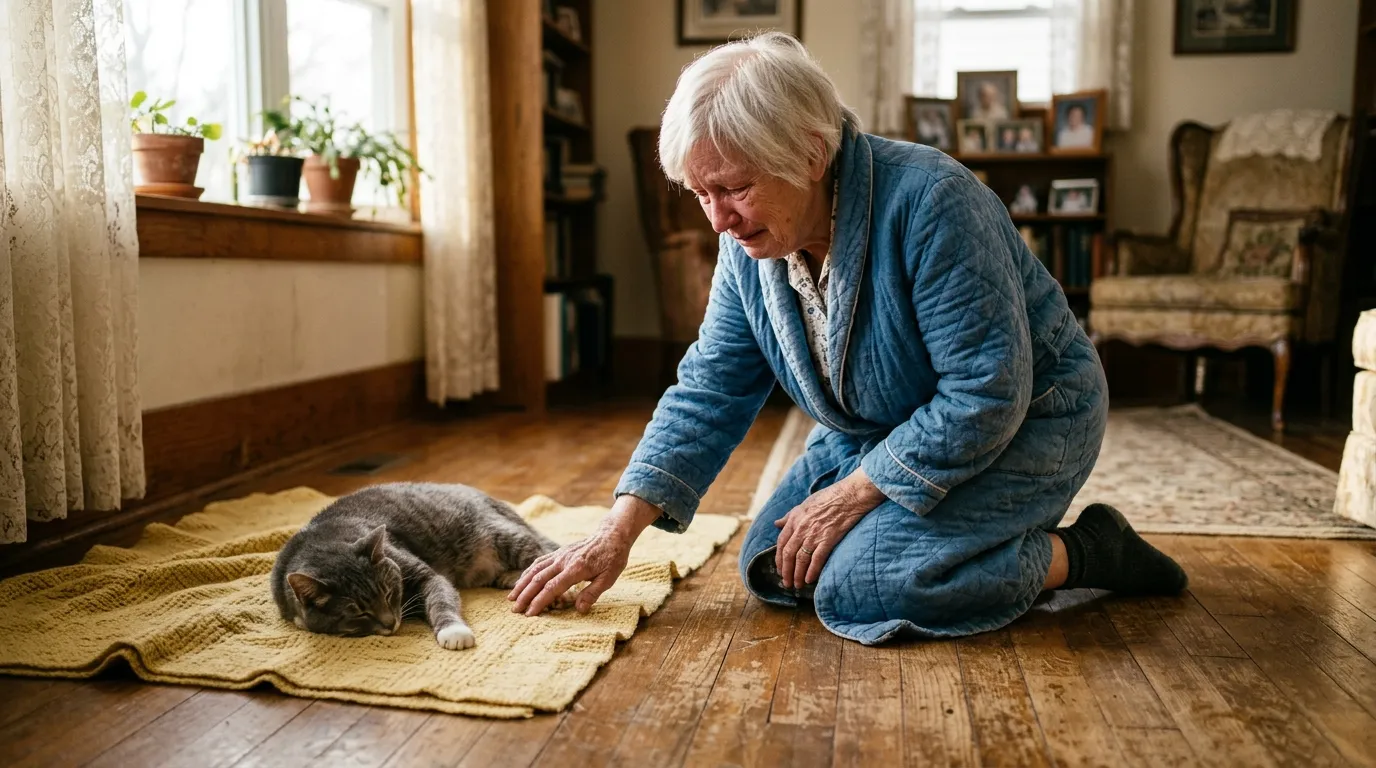
A long-overdue moment of healing between two souls carrying the weight of grief.
I sat in the chair across from her, the silence stretching long and heavy. “Someone has to make that lie true,” I finally said.
Mrs. Dwyer looked at me through her tears. “You?”
“I don’t have curtains,” I said. “And I don’t have anyone waiting for me.”
Choosing the Person, Not the Box
On Friday morning, I didn’t bring the plastic crate. I brought Clara’s old cardboard keepsake box, fully lined with the washed yellow blanket Mrs. Dwyer had brought over, and placed Clara’s framed photograph inside it.
I sat on the floor of 3B for an hour, talking to June. I told her about my quiet third-floor walk-up above the bakery, the radiator that clanked in the winter, and the wide window that faced an oak tree. When I stood up and placed the box on the rolling cart, June followed me to the elevator.
When the steel doors opened, she didn’t cower. She stepped onto the cart, settled herself on the yellow blanket, and let me wheel her out to my truck.
Her first few weeks at my apartment were defined by vigilance. Every morning when I reached for my work boots, June would scramble into the cardboard box I had placed near the door, staring at the latch, terrified I would vanish like everyone else. And every evening when I turned my key in the lock, she was still sitting there, waiting.
Trust did not arrive like a lightning bolt. It arrived in drops.
It came in the sound of a food can opening at exactly six o’clock every morning. It came in the familiar thud of my work boots hitting the floor at night. It came in the soft cotton work shirt I laid across her blanket so she wouldn’t forget my scent.
By the third month, she stopped sleeping by the door. She moved to the rug, then to the foot of my bed, and finally, onto my chest, resting her white paw against my collarbone while her purr rattled like a small engine.
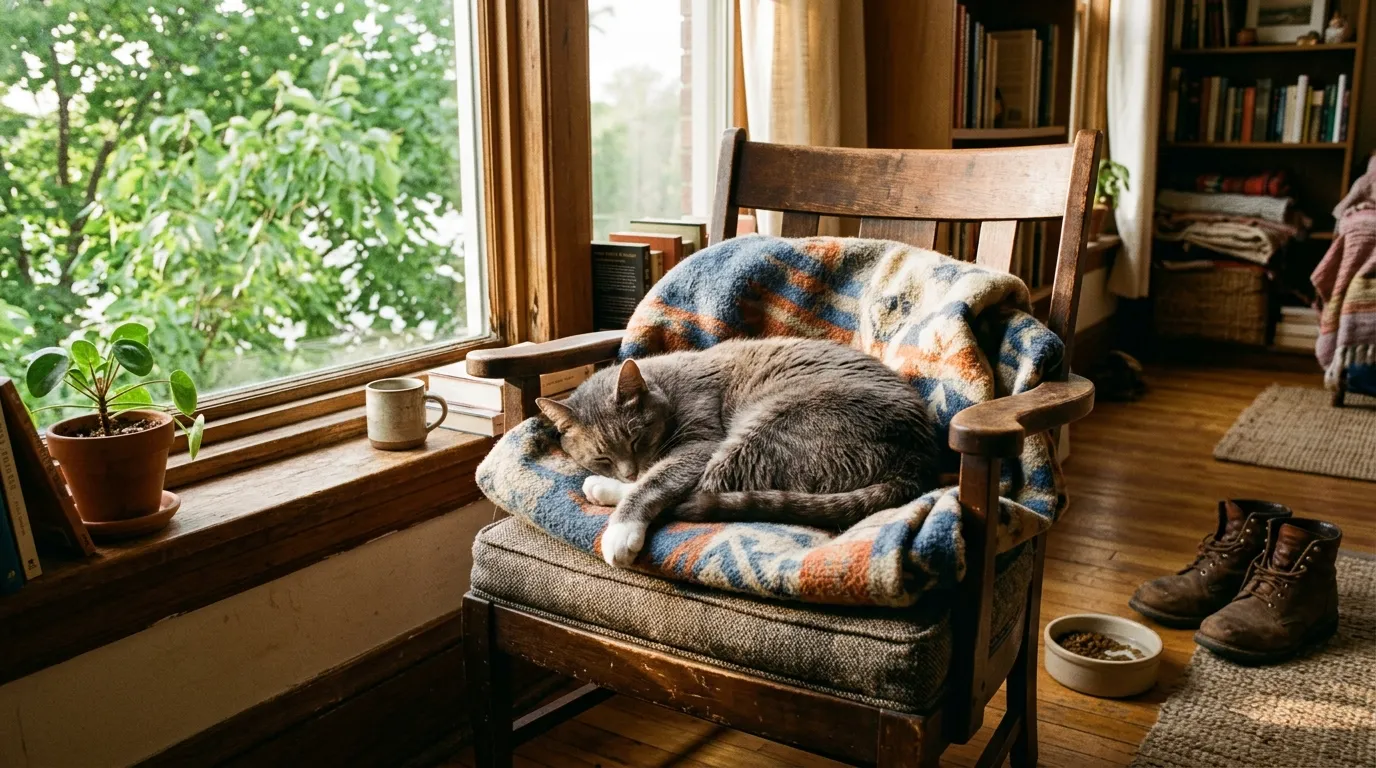
The sunny window Clara had dreamed of finally became June’s reality.
In the spring, my landlord offered me a larger corner flat on the second floor with tall bay windows and direct afternoon sunlight. When I brought home moving boxes to pack my books and tools, June didn’t run. She walked over to the first open carton, sniffed the tape, and casually walked past it.
Then, she hopped into my lap, circled three times on my knees, and curled into a tight ball, resting her chin across my wrist.
She didn’t need to pack herself anymore. She finally understood that the boxes weren’t going without her—because home was no longer a piece of cardboard. Home was the person who always came back through the door.
Note:This work is inspired by real events and people, but it has been fictionalized for creative purposes. Names, characters, and details have been changed to protect privacy and enhance the narrative. Any resemblance to actual persons, living or dead, or actual events is purely coincidental and not intended by the author.
All images used in this article are AI-generated and intended for illustrative purposes only.
0 Comments