
The first time Gianna looked at my newborn daughter, she didn’t smile. She didn’t coo, reach for her tiny fingers, or marvel at how peaceful she looked sleeping with her little mouth parted. Instead, she stood rigidly over the bassinet, her sharp gaze locked onto one specific detail.
Stella was only nine days old, but the hair crowning her head was completely unmistakable.
It was a shock of bright, vivid copper red.
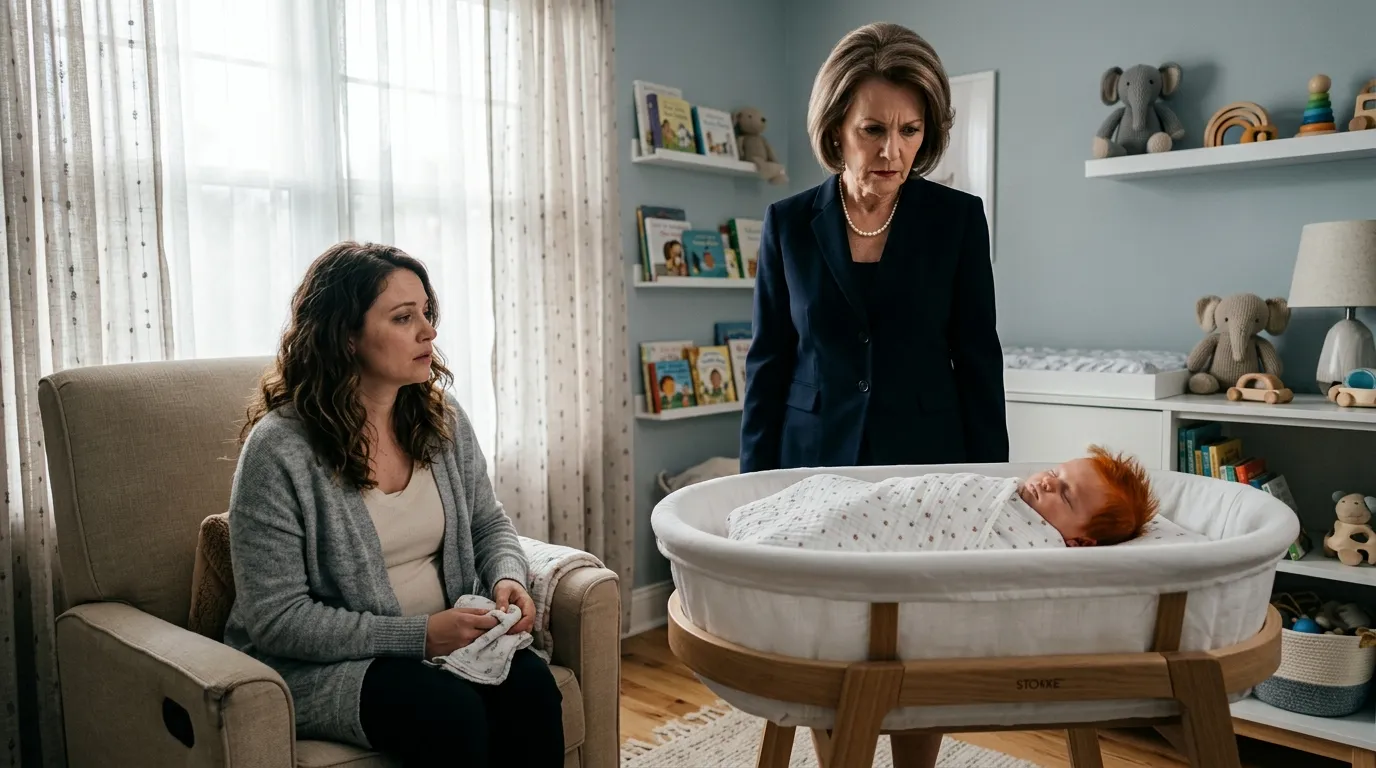
The tension was immediate the moment Gianna looked down at Stella’s hair.
My husband, Bryson, and I both have thick, dark brown hair and deep brown eyes. Stella’s eyes were still the cloudy, slate-blue common to most newborns, but that fiery hair blazed against the white cotton swaddle like a beacon. I sat on the couch with an ice pack pressed against my tender side, exhausted from hours of labor and sleep deprivation, completely unprepared for the storm brewing in my living room.
Gianna finally tore her eyes away from the crib and looked at me. “That’s certainly… noticeable.”
“She’s gorgeous,” I whispered, pulling my robe tighter around myself.
Bryson walked in a moment later balancing two steaming mugs of coffee. Sensing the chill in the air, he looked into the bassinet and chuckled softly. “She’s nine days old, Mom. Newborns change every week.”
Gianna didn’t return his smile. “Hair can darken,” she said coldly. “Eyes can change, too. But not everything changes.”
I didn’t realize it then, but those five words were the first hairline fracture in our family.
The Subtle Art of Cruelty
For the six years I had been with Bryson, Gianna had perfected the art of weaponized politeness. She masked hostility as concern, packaging cruel insults as casual jokes.
When we purchased our starter home, she strolled through our living room, brushed dust off the mantel, and asked, “Does my son really come home to this every evening?” When I took a step back from corporate life to pursue a remote career, she tilted her head and smiled: “Well, dear, not everyone is built for ambition.”
Whenever I brought these jabs up to Bryson in the privacy of our bedroom, he would wrap his arms around me and sigh the same tired phrase: “That’s just how Mom is, Macy. She doesn’t mean it.”
For years, I let those words smooth over the sting. But once Stella arrived, Gianna abandoned her passive-aggressive subtlety entirely.
At three weeks old, Stella’s hair remained resolutely copper. When Gianna held her during a family dinner, she squinted down at her face and remarked, “She doesn’t have Bryson’s eyes at all. Bryson’s eyes were dark brown the hour he was born.”
“They’re baby eyes, Gianna,” I answered evenly. “Her vision is barely adjusting to light.”
Gianna handed the baby back to me as if she were returning a defective sweater to a department store. From that afternoon on, a subtle but devastating shift occurred: Gianna stopped referring to Stella as her granddaughter. She would say, “How’s the little one?” or ask Bryson, “Is the baby sleeping through the night?”
Never “my granddaughter.” Never “our sweet girl.” She was deliberately distancing herself from an innocent child.
The Accusation on a Sunday Afternoon
The breaking point arrived on a quiet Sunday when Stella was six weeks old. The afternoon was supposed to be relaxing; Bryson was sitting on the rug folding tiny cotton onesies, while Stella slept peacefully on my chest, her warm breath rising and falling against my collarbone.
Gianna sat opposite us on the armchair, observing our domestic peace with an expression of pinched disdain. Finally, she broke the silence.
“I think we need to stop playing this game,” she declared flatly.
Bryson paused with a half-folded sleeper in his hands. “What game, Mom?”
“Pretending that no one in this room sees what is staring us right in the face,” Gianna snapped, gesturing sharply toward my daughter. “That baby looks nothing like you, Bryson.”
“Mom, please don’t start—”
“Fire-engine red hair. Pale skin. Blue eyes,” Gianna pressed, leaning forward with her hands clasped tightly. “Neither of you has a drop of red hair. Where on earth did those traits come from, Macy?”
A hot prickle of anger surged through my chest. “Genetics don’t require your permission to skip generations, Gianna.”
Her mouth thinned into a razor-sharp line. Then came the words that felt like a slap across my face: “I will not sit quietly and watch you pass another man’s child off as my son’s.”
The room dropped into suffocating silence. The ticking of our kitchen wall clock suddenly sounded deafening. I slowly turned my head toward Bryson, waiting for him to erupt—waiting for him to stand up, open the front door, and order his mother out of our house.
Instead, Bryson looked at the carpet. His face flushed bright red, his posture slumping into something small and hesitant. “Mom, stop it,” he muttered.
His voice wasn’t furious. It was embarrassed. He sounded like a cornered boy rather than a husband and father defending his family. A cold knot formed in my stomach.
Gianna seized on his hesitation. “If I am mistaken, Macy, then prove it. If you have nothing to hide, you have nothing to fear from a simple test.”
I looked at Bryson. “Are you going to let her say this in our home?”
He rubbed the back of his neck, his eyes darting nervously between his mother and me. “Macy… look, I know how horrible this sounds. But maybe… maybe if we just do the test, this whole nightmare ends. For everyone.”
I stared at him as if looking at a stranger. “I already know who her father is, Bryson. Do you?”
He swallowed hard, unable to meet my eyes for two full seconds. That hesitation told me everything I needed to know.
“Fine,” I whispered, my voice shaking with ice-cold fury. “We’ll do your test. But understand this: when the paper comes back, neither of you gets to pretend you didn’t break something in this room today.”
The Clinical Humiliation
Two days later, we sat in a nondescript diagnostic clinic. The sterile scent of antiseptic hung heavy in the air. The lab technician wore blue nitrile gloves and swiped sterile cotton swabs against the inside of Stella’s soft cheeks, treating the transaction with mundane efficiency.
To the technician, it was an ordinary Tuesday morning workflow. To me, it felt as though the sanctity of my marriage had been reduced to a barcoded plastic vial.
In the parking lot afterward, Bryson tried to break the heavy silence as I buckled Stella into her rear-facing car seat. “Well, she was a champ. Slept right through the swabs.”
“Good for her,” I said, slamming the car door shut.
He caught my arm. “Macy, stop shutting me out. I never accused you. My mother did.”
“You asked me to submit scientific evidence that I didn’t betray you, Bryson,” I said, looking right into his eyes. “In my book, that is the exact same thing.”
“I was panicked! I was scared!” he pleaded.
“So was I,” I replied softly. “I was terrified to find out that the man I married could be convinced to abandon his faith in me by the one person who has hated me from day one.”
Over the next five days, Bryson walked on eggshells. He took the night feeds, cleaned the kitchen without being asked, and brought home takeout from my favorite restaurants. But his newfound attentiveness didn’t comfort me. It only served as a constant reminder that he was performing penance while secretly waiting for a laboratory envelope to tell him whether his wife was a liar.
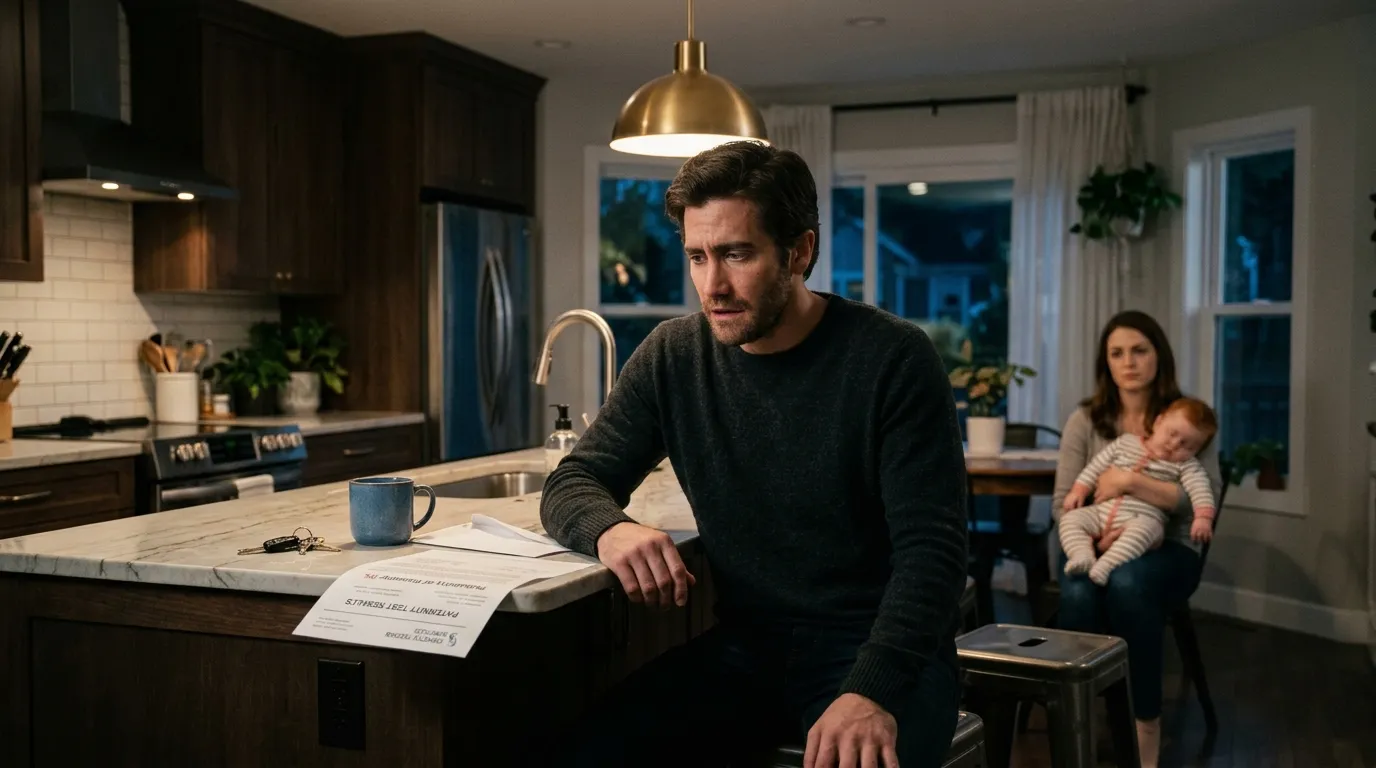
The white envelope sat on the counter like an unexploded bomb until Bryson opened it.
The Truth Arrives in the Mail
When the results finally arrived on a Friday afternoon, I didn’t tear into the envelope. I placed it squarely in the middle of our kitchen island and walked away.
When Bryson stepped through the door twenty minutes later, his eyes locked onto the envelope instantly. “Macy? Did you open it?”
“No,” I called from the living room, where Stella was nursing. “I don’t need a sheet of paper to tell me who my daughter belongs to.”
He approached the island with hesitant steps. With shaking hands, he slit the top edge of the envelope and slid the single page out. I watched his eyes scan the letterhead, move down the columns of genetic markers, and finally stop at the bolded bottom line.
He froze. Every sound in our home seemed magnified: the humming refrigerator, our daughter’s gentle swallowing, the wind brushing against the glass.
Bryson whispered, “I can’t believe this is real.”
He turned the paper toward me. In bold black letters, the conclusion read: PROBABILITY OF PATERNITY: 99.999%.
“Congratulations,” I said, my voice completely devoid of warmth. “Now you know.”
Tears welled in his eyes. He walked toward me, dropping to his knees beside the sofa. “Macy, I am so sorry. I should never have doubted you. I should never have listened to my mother. I swear I knew in my heart you would never—”
“Stop,” I cut him off, holding up a hand. “Do not rewrite history to soothe your conscience. If you knew in your heart, that envelope wouldn’t be sitting on our counter.”
Before he could respond, his smartphone buzzed against the table. The caller ID flashed: Mom.
Bryson looked at me. I said nothing. He reached over, swiped the screen, and placed it on speakerphone.
“Bryson?” Gianna’s voice came through, high and anxious. “Did the envelope come today?”
Bryson took a deep breath, his jaw tightening. “Yes, Mom. It came.”
A heavy pause hung over the line. “And?”
“Stella is mine,” Bryson said, his voice ringing with fierce certainty. “She is one hundred percent my daughter. And you are done interfering in our lives.”
There was a long, stunned silence on the other end of the line. Then, barely audible, Gianna breathed a ragged whisper: “Then it came back.”
Bryson blinked, taken aback. “What did you say?”
Silence.
“Mom? What came back?”
The call went dead.
The Skeleton in the Closet
Bryson stared at his phone, the anger in his face suddenly replaced by total confusion. He looked at Stella’s bright copper hair, then over at me. “She knew something. We’re going over there right now.”
Within twenty minutes, we pulled into Gianna’s driveway. When she opened the front door, she looked smaller, stripped of her usual haughty posture. Bryson pushed past her into the foyer without greeting her.
“What came back, Mom? You said red hair wasn’t in our family. What were you talking about?”
“Bryson, please, lower your voice,” she murmured, glancing nervously at me and the baby carrier in my arms.
“Was it Dad?” Bryson demanded, pointing toward the hallway gallery wall filled with portraits of his late father—every single one displaying a man with dark, wavy hair. “Where are the old family albums? The ones from before you got married?”
Gianna hesitated, biting her lower lip. Finally, defeated, she pointed up the stairs. “In the cedar chest in my bedroom.”
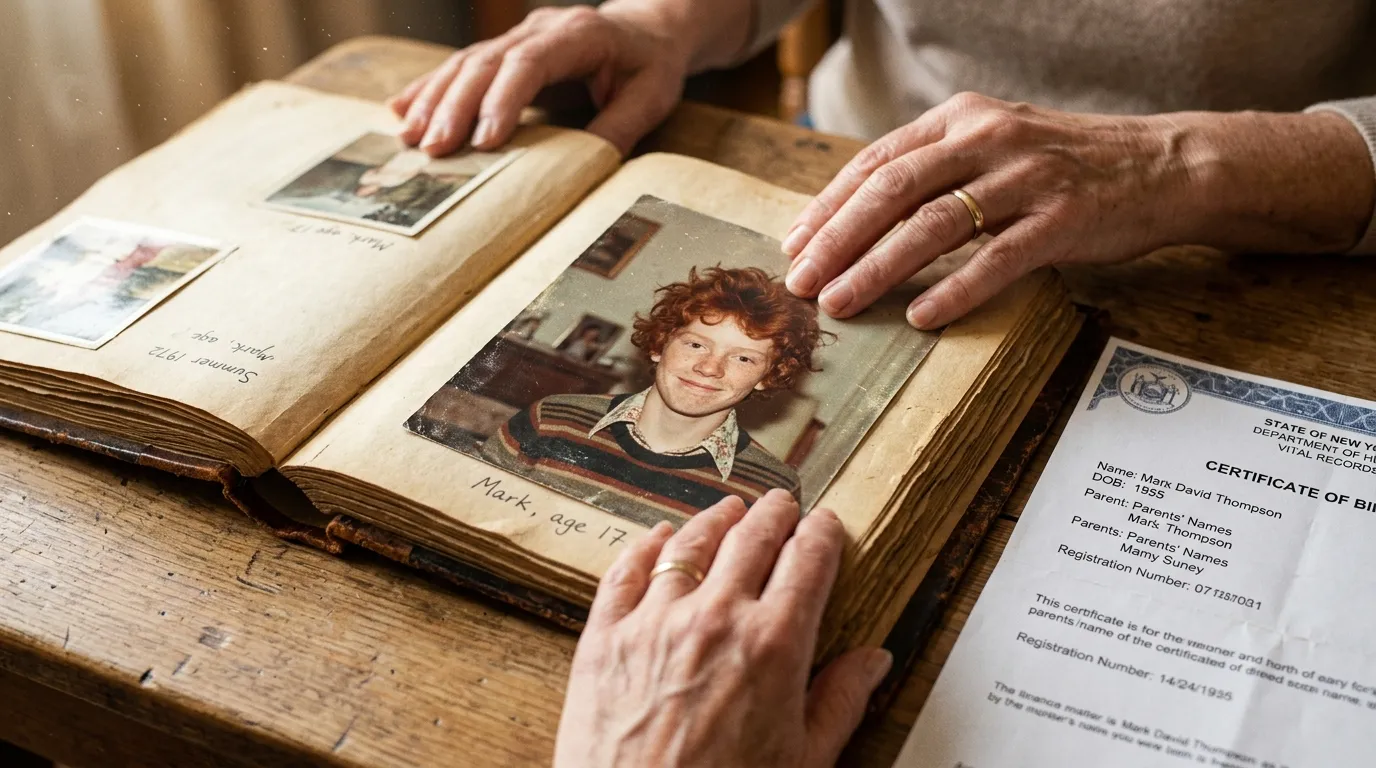
Hidden deep in a dusty album was the image that unraveled Gianna’s entire facade.
Ten minutes later, we were sitting on Gianna’s bed with a heavy, dust-covered album opened across our knees. Bryson flipped past black-and-white portraits of distant ancestors until his hand froze over a square, color-tinted photograph from the late 1960s.
The boy in the picture was about seventeen years old, standing awkwardly against a brick wall. His cheeks were peppered with freckles, and on his head was a thick, unruly mop of unmistakable, blazing copper-red hair.
Bryson leaned in, breathless. “Dad?”
Gianna sat on the edge of the mattress, her hands folded tightly in her lap. “Yes.”
“You accused my wife of cheating… when you knew my own father had red hair?” Bryson’s voice rose with incredulous fury. “How could you do that to us?”
“It wasn’t that simple!” Gianna cried out, her eyes glistening with tears. “His hair turned dark brown by the time he was twenty-two! By the time you were born, no one remembered he was ever a redhead!”
“That doesn’t explain why you tried to destroy my marriage, Mom!”
Gianna looked down at her hands, trembling. “Get in the car. There’s something I have to show you.”
The Ghost in the Courtyard
She led us to the grounds of their old high school, just fifteen minutes across town. We walked along a perimeter path to an isolated brick courtyard shaded by overgrown oak trees, where three weathered wooden benches sat forgotten in the corner.
Gianna stopped beside the furthest bench and stared at the cracked wood. “Your father used to eat his lunch right here. Alone.”
Bryson frowned. “Why alone?”
“Because the other kids were vicious,” Gianna whispered, her voice cracking with shame. “They called him terrible names. They mocked his pale skin, his freckles, his hair. They told him he was unnatural. He was miserable for four years.”
Bryson looked at her closely. A sickening realization crossed his face. “And where were you, Mom?”
Gianna couldn’t look him in the eye. “I was sixteen years old. I was desperate to sit with the popular crowd. When they made fun of him… I laughed. Sometimes, Bryson… God forgive me, sometimes I was the one who started the joke.”
The silence that fell over that courtyard was heavier than any stone. I held Stella closer to my chest, horrified by the confession.
“How did Dad ever forgive you?” Bryson asked quietly.
“We ran into each other at a diner five years after graduation,” Gianna explained, wiping away a stray tear. “He had filled out. His hair had darkened into a deep brown. But he recognized me immediately. I was so ashamed that I broke down in tears and apologized right there at the counter. He was gracious enough to listen. Forgiveness took years, but he loved me anyway. And I loved him more than life itself.”
“Then why,” Bryson choked out, “did you look at my daughter with so much hatred?”
Gianna turned to look at the baby in my arms, her expression raw with decades-old guilt. “Because the second I saw that copper hair, I wasn’t looking at a sweet newborn. I was looking at the boy on this bench. I was looking at the ugliest, most cruel version of myself. I couldn’t bear to see his face in her… because seeing him meant remembering what a monster I had been to the man I loved.”
I looked at the older woman standing before us. “So it was easier to believe I was an unfaithful wife than to look in the mirror and face your own guilt.”
Gianna bowed her head, weeping silently. “Yes. I buried that memory so deep that my mind twisted it into suspicion. I am so, so sorry.”
Her explanation didn’t wipe away the humiliation of the past six weeks, but it stripped Gianna of her power. She wasn’t an infallible matriarch handing down moral judgments. She was just a broken woman haunted by her own unresolved shame.
Uncovering the Truth
As we walked back to our car, Gianna hurried after us, reaching out toward my shoulder. “Macy, please… can you ever forgive me?”
I stopped by the passenger door and turned to face her. “Do not ask for my forgiveness yet, Gianna. You spent six weeks refusing to call this child your granddaughter. Start by apologizing to the person you decided didn’t belong.”
On the drive home, Bryson reached across the center console to hold my hand. I quietly moved my hand into my lap.
“I know I failed you,” he said, staring through the windshield. “I know I let my fear override my loyalty to you.”
“I had just given birth to your child, Bryson,” I said, looking out at the passing trees. “The one person in this world who was supposed to be my safe harbor chose to validate an accusation fueled by cruelty. That is not something that heals just because the DNA test came back positive.”
He nodded slowly, tears slipping down his cheeks. “I’ll spend the rest of my life earning your trust back.”
Later that evening, our doorbell rang. Gianna stood on our front porch. For the first time in our marriage, she didn’t barge in uninvited. She waited with her hands folded until I opened the screen door.
“May I come in?” she asked softly.
I stepped aside. Stella was awake in her bassinet, kicking her tiny feet against the mattress. Gianna walked over slowly and looked down. Then she turned to me with moist eyes.
“May I… may I please hold my granddaughter?”
The word hung in the air, heavy and true. I lifted Stella and placed her gently into Gianna’s arms.
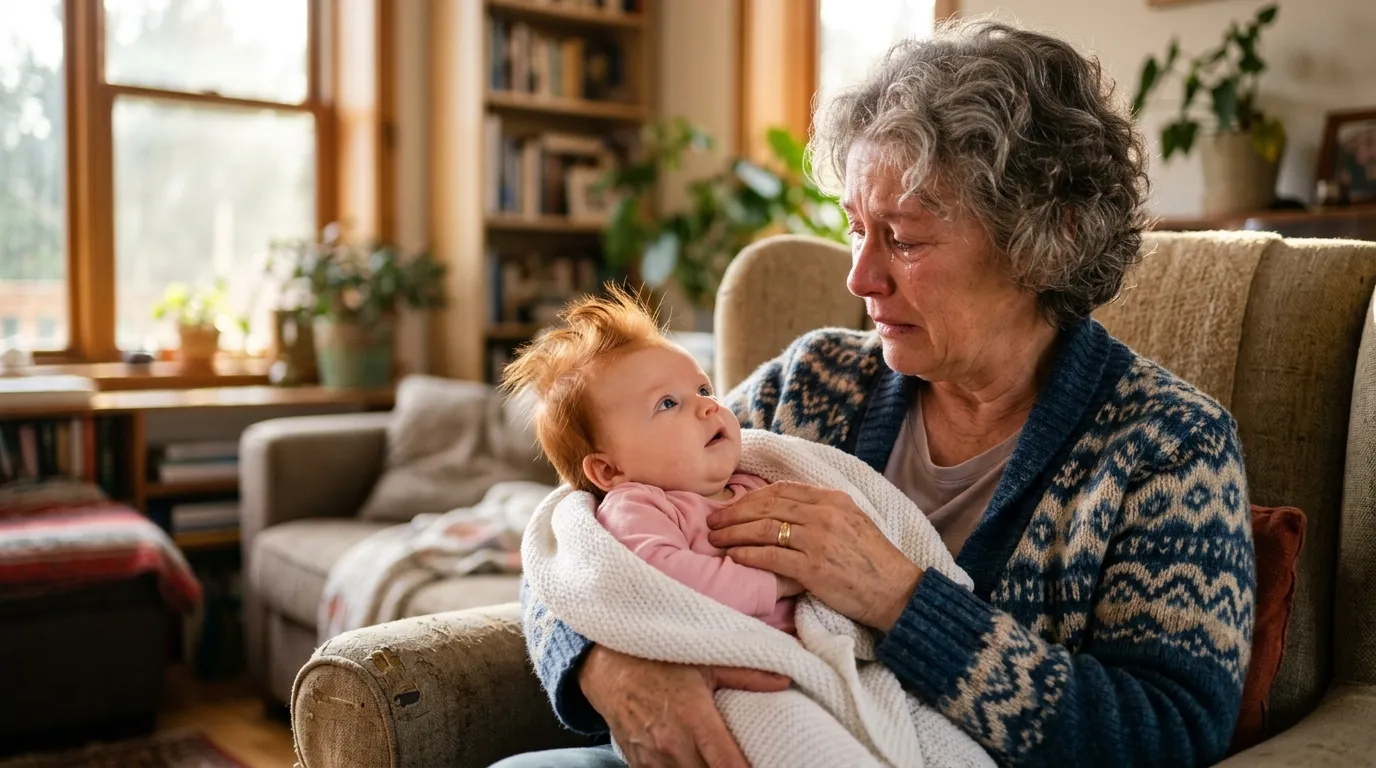
Holding her granddaughter with love and deep remorse, Gianna finally made peace with the past.
As Gianna cradled her, she noticed a tiny tuft of copper hair springing straight up from the crown of Stella’s head, refusing to lie flat. A soft, tearful chuckle escaped her throat.
“Your father had that exact same cowlick,” Gianna whispered to Bryson. “He tried to grease it flat every single morning before school. By noon, it was standing right back up.”
From her purse, Gianna pulled out a small, faded woolen beanie. “His mother knitted this for him when the bullying got too bad. He wore it everywhere to hide his hair.”
She looked down at Stella, hesitated, and brought the little cap toward the baby’s head. But halfway there, her hands stopped. She stared at Stella’s sweet, bright face. Then, with deliberate care, she folded the little cap and set it aside.
“No,” Gianna whispered firmly. “No one is hiding her. Not ever again.”
Tonight, as I sit writing this, Stella is fast asleep against my chest. Bryson sits on the opposite end of the couch, giving me the space I still need to heal. When he looks at our daughter, his eyes fill with pride and humility.
Stella never needed a laboratory report to prove she belonged in this family. Her vibrant hair wasn’t evidence of a betrayal—it was a living, breathing connection to a grandfather she would never get to meet. A reminder that our roots run deeper than what meets the eye, and that shame only holds power when we keep it hidden in the dark.
One day, when Stella is older and looks in the mirror wondering why her hair is different from ours, we will tell her the entire story. We will tell her about the boy on the bench, about the mistakes made, and about the courage it takes to forgive. But most of all, we will tell her that she never has to shrink, apologize, or cover her head for anyone.
She belongs. Exactly as she is.
Note:This work is inspired by real events and people, but it has been fictionalized for creative purposes. Names, characters, and details have been changed to protect privacy and enhance the narrative. Any resemblance to actual persons, living or dead, or actual events is purely coincidental and not intended by the author.
All images used in this article are AI-generated and intended for illustrative purposes only.
0 Comments