
Beyond the Empty Chair: Why My Husband Vanished During the Darkest Weeks of My Life
I spent two agonizing, terrifying weeks in the hospital after a life-threatening surgery, and the man I had loved for two decades—my husband, Rowan—never visited me once.
Oh, he answered my text messages. He told me he was doing okay. He promised me, over and over again through the sterile glow of a phone screen, that he would explain everything eventually. But he never actually walked through the door of my hospital room.
By the time I was finally medically cleared to be discharged, I had spent hundreds of hours replaying every conceivable possibility in my exhausted mind. I had mentally prepared myself for the absolute worst case scenario. I was entirely ready to walk through our familiar front door and discover that twenty beautiful, chaotic years of marriage had somehow quietly evaporated while I was in a hospital bed fighting to recover.
Then, I opened our front door. And I froze completely.
A Promise Made on the Edge of Fear
Rowan and I had been married for twenty years. That is a lifetime in its own right. It’s long enough to finish each other’s sentences without thinking. It’s long enough to survive more difficult, heartbreaking seasons than I could ever count. It’s long enough that I could tell exactly what kind of day he was having simply by the rhythm of his footsteps and the specific way he dropped his keys on the kitchen counter.
That is precisely why what happened made absolutely zero sense to me.
A few weeks earlier, severe, blinding stomach pain had left me doubled over in pure agony on our living room floor. After a frantic rush to the ER and a chaotic series of urgent tests, the doctors discovered a serious, rapidly deteriorating problem that required immediate, invasive surgery.
The days leading up to the operation were terrifying. The world felt like it was spinning out of control. But through all the chaos, Rowan never left my side.
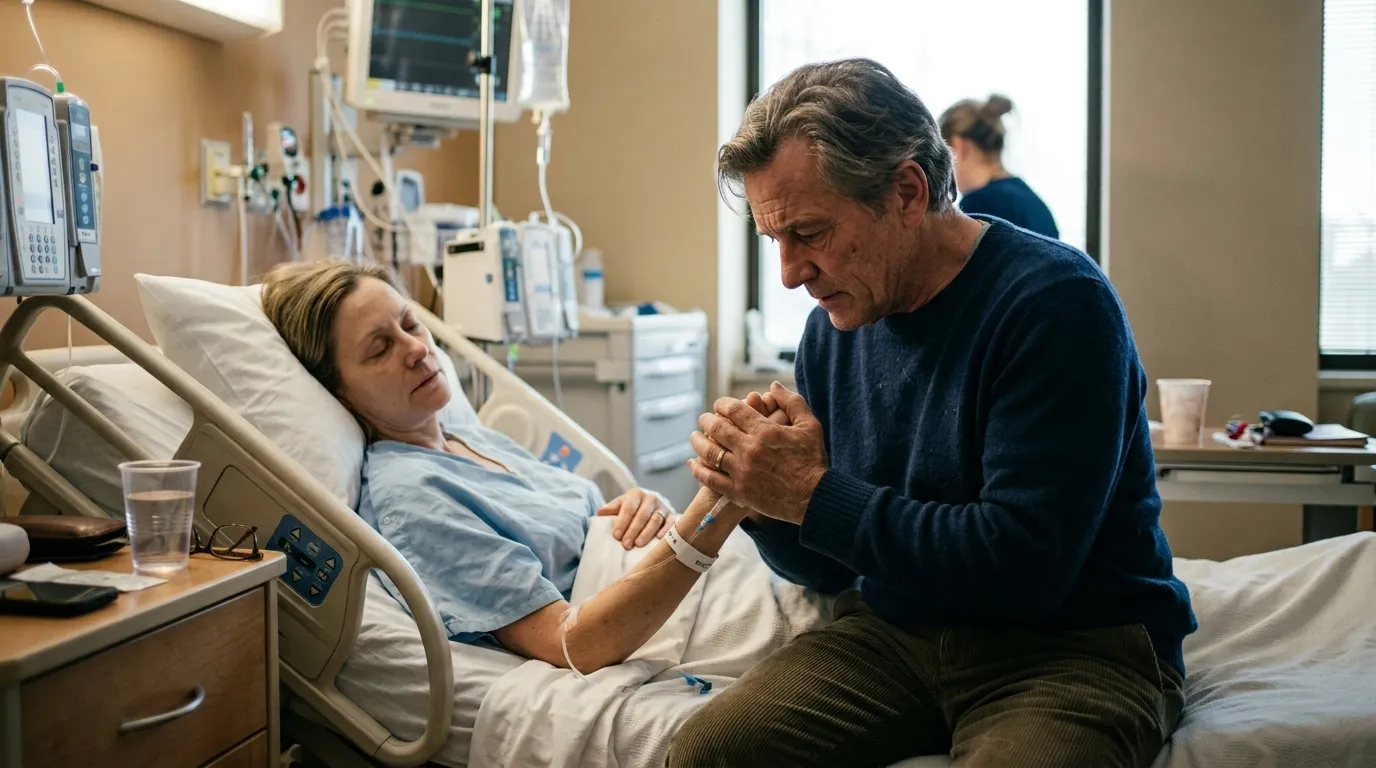
Even in the terrifying moments before surgery, Rowan’s presence was my anchor.
He slept in the incredibly uncomfortable plastic chair beside my hospital bed. He held my hand until my knuckles turned white. He took notes and asked the doctors vital questions when my brain was too clouded by fear and pain medication to think clearly.
On the morning of the operation, the reality of the situation crashed down on me. My hands were shaking so violently that I could barely keep them still. Rowan sat gently on the edge of my bed, capturing my trembling fingers between his warm, steady hands.
“I’m terrified, Ro,” I whispered, tears spilling hot down my cheeks.
He looked directly into my eyes, his gaze unwavering. “You are the strongest woman I know, Bev,” he said softly, his voice a soothing rumble. “I am not going anywhere.”
A few moments later, Nurse Clara, a beacon of calm in her blue scrubs, walked into the room with a warm, reassuring smile. “Dr. Evans is the very best surgeon we have on staff, Beverly. You are in excellent hands.”
Rowan looked up at her, his jaw set. “Will someone come get me the absolute second she’s out?” His voice was tight, strung with an anxiety I rarely saw him display.
“The moment she is safely resting in recovery,” Clara promised gently. “I will come down to the waiting room and find you myself.”
Rowan turned back to me, brushing a stray lock of hair from my forehead. “Three hours,” he said firmly. “And I promise I’ll be the very first thing you see when you open your eyes.”
“You swear?” I asked, desperate for the anchor.
“On my life,” he replied without hesitation. He leaned down and kissed my forehead lingeringly. “I’ll even have a cup of your terrible, watered-down hospital coffee waiting.”
They wheeled me away into the bright, freezing lights of the operating room. I fully expected to wake up three hours later to his familiar smile.
I didn’t.
The Awakening and the Empty Chair
My recovery did not go according to the neat, optimistic plan the doctors had laid out. Severe, unforeseen complications arose on the operating table. These complications kept me under heavy sedation far longer than anyone had anticipated.
When I finally drifted back into the realm of consciousness, the world was a blur of muted beeps and harsh fluorescent lights. My throat burned like sandpaper from the intubation tube, and my head throbbed with a dull, relentless ache. My heavy eyes struggled desperately to focus on the room around me.
“Rowan?” I croaked out, my voice barely a rasp.
A woman’s voice answered from the shadows. “It’s Nurse Clara, Beverly. Take it slow.”
I blinked, trying to clear the fog. “You’re in the intensive recovery wing now. You had a bit of a rough ride, but you’re safe.”
I swallowed, wincing at the sharp pain. “Where is my husband?”
Clara paused, busying herself with an IV bag for a fraction of a second too long. “He isn’t here right now, sweetie.”
I stared at her, the monitor beside me accelerating its beeping rhythm. “Where is my husband?” I demanded, panic rising in my chest.
“We checked the waiting room,” she said softly, her eyes full of sympathetic pity. “It was empty.”
I felt something vital inside of me detach and sink to the bottom of my stomach. “He promised,” I whispered to the empty chair beside the bed. “He swore on his life.”
Fourteen Days of Silence
My hands were still incredibly weak and trembling when I finally managed to grasp my phone and call Rowan. He answered on the third ring.
“Beverly.”
His voice sounded incredibly heavy. Exhausted. But more terrifying than that—it sounded miles away. Distant. Disconnected.
“I’m okay,” he added in a rush, before I could even formulate a word. “I’ll explain everything soon. Just focus all your energy on getting better right now.”
My voice broke, a sob catching in my damaged throat. “Rowan, I almost died on that table.”
“I know,” he whispered.
And then, the line went devastatingly quiet. He hung up.
That exact, agonizing pattern continued on a loop for the next thirteen days. Short, emotionless text messages. Vague, evasive answers to my questions. Endless, empty promises that he would explain it all later.
But there was no visit. No flowers. No explanation. Absolutely no Rowan sitting in the chair beside my bed, holding my hand.
I spent endless hours staring at old photographs of our house on my phone, zooming in on his smiling face, wondering whether I would even recognize my own marriage when I finally got home. What on earth had happened to the fiercely loyal man who had promised me, on his life, that he wasn’t going anywhere?
Nurse Clara became the sole tether keeping me sane. She would bring my evening medication and purposely linger, staying a few extra minutes just to chat. Sometimes she’d pull up the chair beside my bed and ask me random questions about my life, my hobbies, my past—questions she didn’t really need the answers to. It was simply her profoundly kind way of making sure I wasn’t spending my nights talking to the ceiling tiles.
One evening, as the sun dipped below the horizon outside my small window, she looked at me thoughtfully.
“He was so devoted before the surgery, Beverly,” she said, almost musing to herself. “Something must have frightened him terribly.”
“Or someone,” I replied bitterly, letting the darkest thoughts win.
She looked at me gently. “Do you really, truly believe that?”
I stared at the glowing screen of my phone, displaying a picture of our front porch. “I don’t know what I believe anymore, Clara.”
The Return to a Stranger’s House
By the morning of my official discharge, I had rehearsed the inevitable confrontation in my head so many times that it had practically become a well-oiled, theatrical speech.
I knew exactly which questions I would ask first. I knew which points mattered the most. I knew, with absolute clarity, what kind of excuses I would absolutely not accept. Twenty years of unwavering loyalty. Twenty years of building a life together. And when I was at my absolute weakest, when I needed him more than I had ever needed anyone in my entire life, he had simply vanished into thin air.
I had become very, very quiet about the whole situation over the last few days. But internally, I had also become razor-sharp and crystal clear about what I intended to say to him.
Then, the taxi dropped me off. I slowly walked up the driveway, pushed open the heavy front door, and the fiery, devastating speech I’d spent two weeks preparing immediately died in my throat.
The hallway was wrong.
But it was wrong in the absolute best possible way.
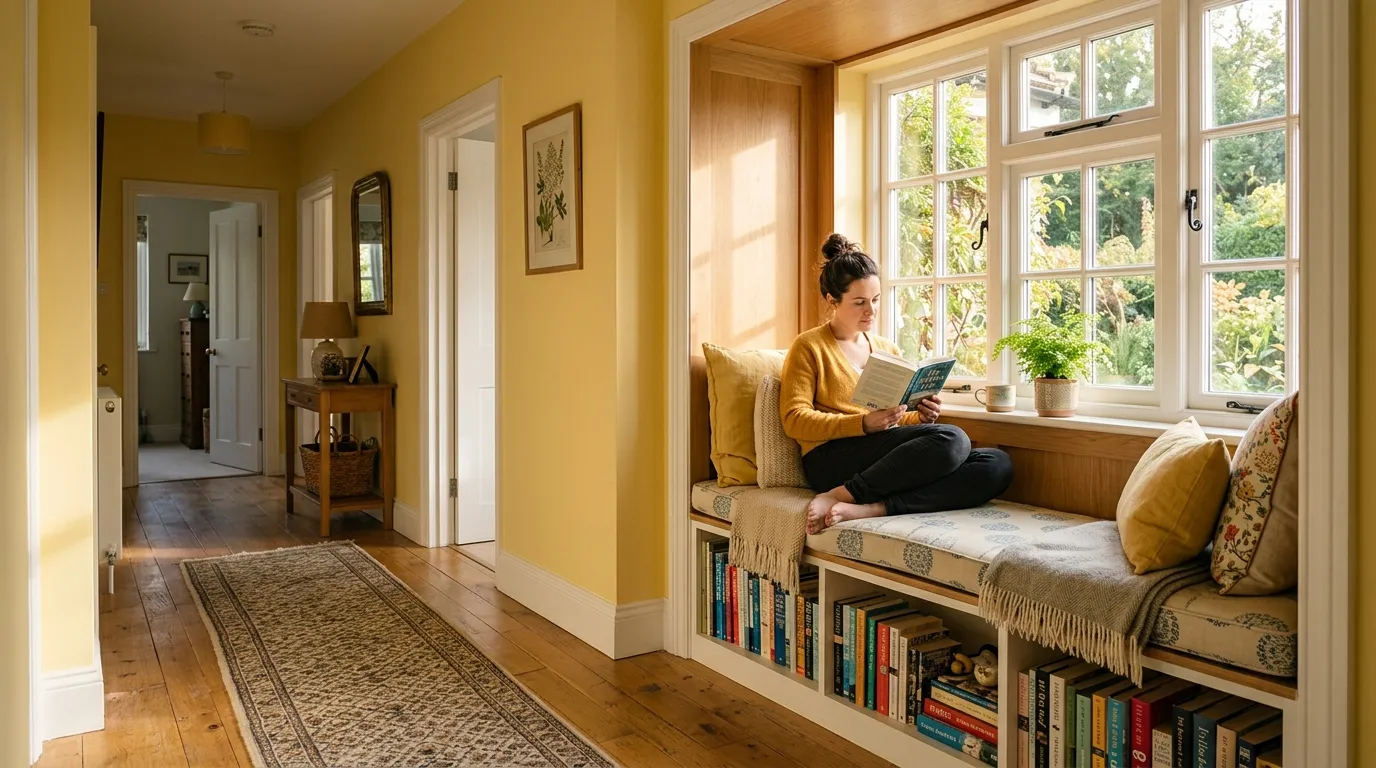
The peeling wallpaper was gone, replaced by the exact shade of morning sunlight I had dreamed of.
The drab, peeling floral wallpaper we’d been talking about replacing for ten solid years was completely gone. In its place was fresh, warm, impeccably clean paint. A soft, radiant yellow. It was the exact, specific shade I’d pointed out in a home design magazine nearly a decade ago, declaring that I loved it.
I remembered telling him back then that it was too frivolous. Too expensive. That we would do it “not yet.” “One day.”
Now, it covered the walls, glowing warmly. I stood in the entryway, my hospital bag slipping from my shoulder, just staring.
The ugly brass light fixture that had flickered annoyingly since our second winter together was gone. In its place hung a simple, elegant new fixture. It was exactly the kind of thing I would have chosen if I’d ever actually allowed myself the budget and time to choose.
I stepped farther inside, my heart pounding a strange, confused rhythm.
The warped, creaky oak floorboard in the hallway—the exact one that had caught my toe almost every single morning for eleven years—had been repaired so seamlessly that I nearly missed it. The ugly, jagged crack along the living room ceiling that we’d watched slowly spread like a spiderweb over three harsh winters was completely gone. The entire ceiling had been expertly replastered and given a fresh coat of paint.
I stood in the center of our living room, completely disoriented, trying desperately to process what my eyes were seeing. Then, I noticed the blank wall where we’d spent countless evenings talking about eventually putting up custom bookshelves.
There were shelves. Real, actual, built-in shelves. They were solid, perfectly even, and beautifully finished with rich, dark wood. All of our books, previously stuffed into cardboard boxes in the attic, were now arranged across them in a deliberate, artistic way that looked carefully considered rather than simply abandoned.
I reached out and ran my hand along the smooth grain of the wood. The furious speech I’d prepared was somewhere millions of miles behind me now, replaced by a profound, breathless confusion.
The Clues Left Behind
I walked slowly into the kitchen. The outdated, dark cabinets that had always made the room feel like a gloomy cave were gone, replaced by bright, modern ones. The broken drawer track I’d begged Rowan to fix for nearly a decade had finally been replaced. The countertops were brand new.
The entire room looked breathtakingly different. And sitting right in the center of the new marble island was a small, neatly folded index card.
I recognized the familiar, slanted handwriting immediately. Rowan.
My hands shook as I picked it up.
“You were right about the yellow. It really does look like morning.”
I read the words twice, my vision blurring. I stood there holding that tiny, insignificant piece of paper while the boiling anger I had nurtured for two weeks suddenly became fiercely tangled with a heavy, complex emotion I couldn’t quite name yet.
I wandered into our master bedroom. The walls had been freshly painted the exact warm, creamy white I’d wanted since the very day we signed the mortgage. Sitting neatly on my nightstand was another handwritten card.
“The good pillow is yours. It was always supposed to be yours. I don’t know why it took me this long to just give it to you.”
I sank down onto the edge of the mattress, my legs suddenly too weak to hold me. That’s when I noticed his heavy denim work shirt lying carelessly beside his desk. I reached over and picked it up. The heavy fabric was stiff and crusty with dozens of fresh paint stains. Stains that definitely hadn’t been there before I went into the hospital.
Not old, faded paint from past projects. Fresh paint.
My eyes drifted toward his desk. A massive stack of contractor invoices and hardware store receipts sat anchored by a paperweight. Beside them were plumber receipts, lumber yard delivery slips, and electrical permits. I flipped through them, my breath catching in my throat.
Every single date stamped on those receipts fell squarely within the fourteen days I’d been lying in the recovery wing, feeling completely abandoned.
Rowan hadn’t been sitting at home avoiding me, doing nothing. He’d been working. Relentlessly. From dawn until dusk, every single day.
I walked back out into the hallway, a new realization dawning on me. I remembered something else. The reading nook.
Years earlier, during a rainy Sunday afternoon, I had sketched a dream reading nook on a piece of graph paper. I’d tucked the drawing away into a desk drawer because I immediately convinced myself it was far too impractical and expensive to bother with. I had almost entirely forgotten it existed.
But as I turned the corner, there it was. Brought to life from the pages of my memory.
The reading nook had been custom-built directly into the small alcove beside the large bay window. It was executed exactly the way I’d drawn it on that scrap of paper years ago. It featured low, accessible shelves, a deeply cushioned bench seat, and it was built at the exact specific angle necessary to catch the golden afternoon light.
I reached out and touched the velvet cushion. A small white card was propped up against the fabric.
“You showed me this sketch in 2009, and I kept the paper in my wallet. I always knew exactly where it was.”
My eyes began to burn with hot, unshed tears.
The Heartbreak in the Garage
Needing air, I walked out the side door and into the garage.
The large wooden workbench was absolutely covered with tools, drills, and saws. Dozens of empty hardware boxes and sawdust piles were scattered haphazardly across the concrete floor. There were massive piles of building supplies everywhere you looked. The space looked like a frenzied construction zone where someone had been working like a man possessed for two straight weeks.
But the tools and boxes weren’t what made me stop dead in my tracks.
Sitting perfectly neat on the far, clean corner of the workbench were three plastic shopping bags. They were still tightly sealed. The price tags were still firmly attached to the items inside.
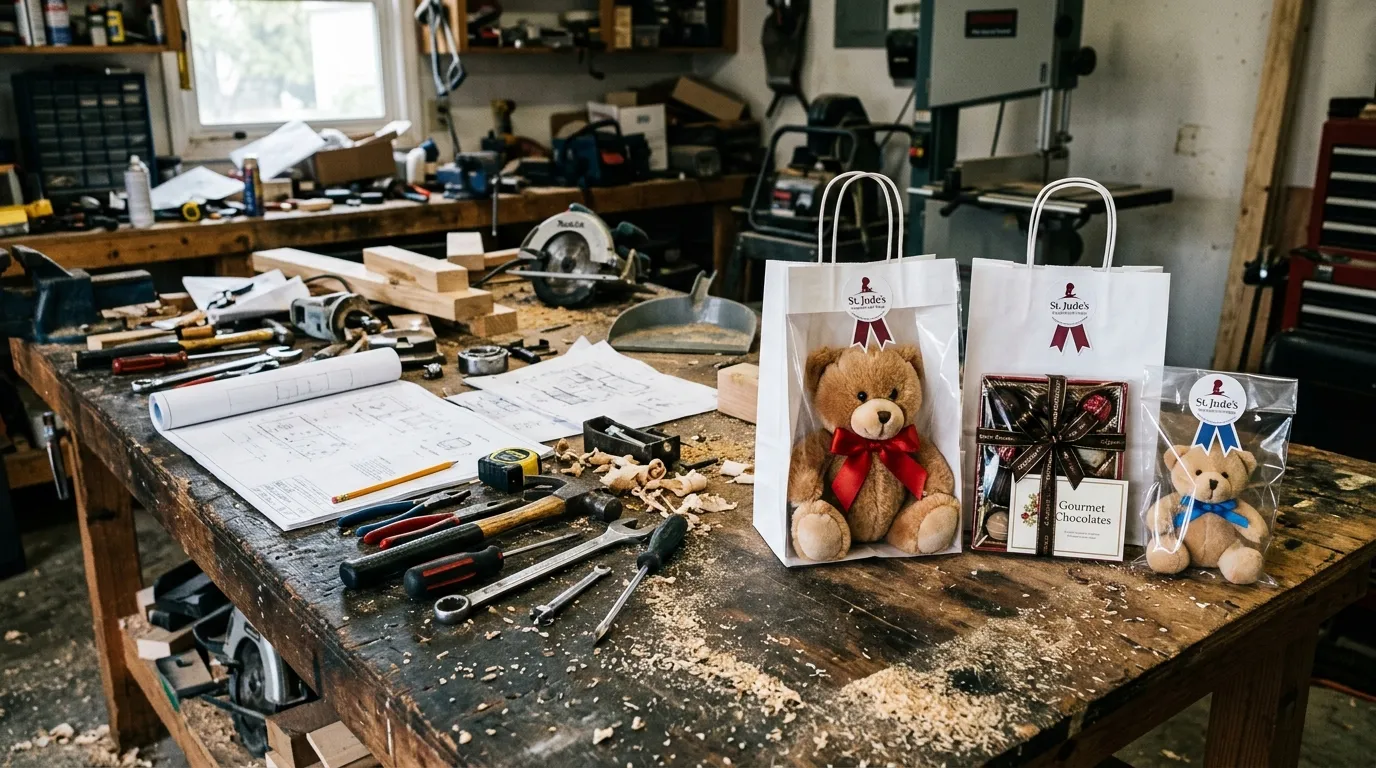
The untouched gift shop bags told a story of a man who tried, but simply couldn’t cross the threshold.
With trembling hands, I opened the first bag. Inside was a soft, brown stuffed bear with a cheery red bow tied around its neck. The second bag contained a beautiful, oversized get-well card featuring a satin ribbon on the front cover. The third bag held a small, expensive box of artisanal chocolates.
I reached out and turned one of the plastic bags over to read the logo. A crinkled receipt was stapled to the top hem.
I read the store name printed at the top: Mercy General Hospital – Main Lobby Gift Shop.
Then, my eyes dropped to the timestamp on the receipt. It was dated exactly three days after my surgery.
I stood completely still in the dusty garage, the air suddenly trapped in my lungs.
Rowan had been there. He had physically driven his truck to the hospital. He had walked through those sliding glass doors into the bustling lobby. He had gone into the gift shop. He had meticulously picked out a stuffed bear, a thoughtful card, and my favorite chocolates.
And then… he hadn’t come upstairs to my room.
I stood there clutching the soft stuffed bear, its cardboard tag digging into my palm. Suddenly, the image of him was vividly clear in my mind. I could perfectly picture him. Driving the thirty minutes to the hospital complex. Pacing through the brightly lit lobby. Standing somewhere deep inside that massive, intimidating building, clutching these bags.
He had been close enough to buy these gifts for me. He had been just an elevator ride and a few short minutes away from my bed. And yet, he had found himself entirely unable to walk through my hospital room door.
For two excruciating weeks, I had been absolutely, rigidly convinced that his absence meant he simply didn’t care about me anymore. That I was a burden he was eager to drop.
Now, standing amidst the sawdust and the proof of his agonizing efforts, I was beginning to realize that the truth might have been the exact, polar opposite. The hard, heavy knot of anger I’d carefully carried through those fourteen days finally started to loosen. It didn’t magically disappear, but it unwound, making room for something else: profound empathy.
I placed the stuffed bear gently back down on the workbench.
That’s when I noticed one final, slightly smudged note taped to the glass of the back door.
“Come outside to the backyard. I’m so incredibly sorry it took me this long to be ready.”
The Sunroom and The Truth
I pushed the heavy door open and stepped out into the backyard.
The garden, which had been a neglected, overgrown mess of weeds before I went to the hospital, had been completely transformed. The broken wooden side gate had been repaired and rehung on brand new hinges. The messy garden beds had been painstakingly cleared, mulched, and replanted with vibrant rows of perennials. The beautiful stone walking path we’d talked about laying since our second summer together now ran perfectly straight from the back door, leading directly toward a structure that hadn’t been there a month ago.
I stopped walking, putting a hand over my mouth.
The sunroom.
It was the exact glass-and-cedar sunroom Rowan had been promising to build for me since the very year we got married. Every single time I’d excitedly described what I wanted over morning coffee, he’d listened quietly. He’d always smiled and told me it would be beautiful. He always promised that we’d build it “one day,” when we had the time, when we had the money, when things settled down.
Now, against all odds, it was standing right in front of me.
Taped to the cedar doorframe, right at my eye level, was another card.
“You described exactly this layout to me when we were thirty-one years old. I remembered every single detail.”
I stared at the black ink on the card for a long time. Then, taking a deep breath, I turned the brass handle and opened the door.
He was inside.
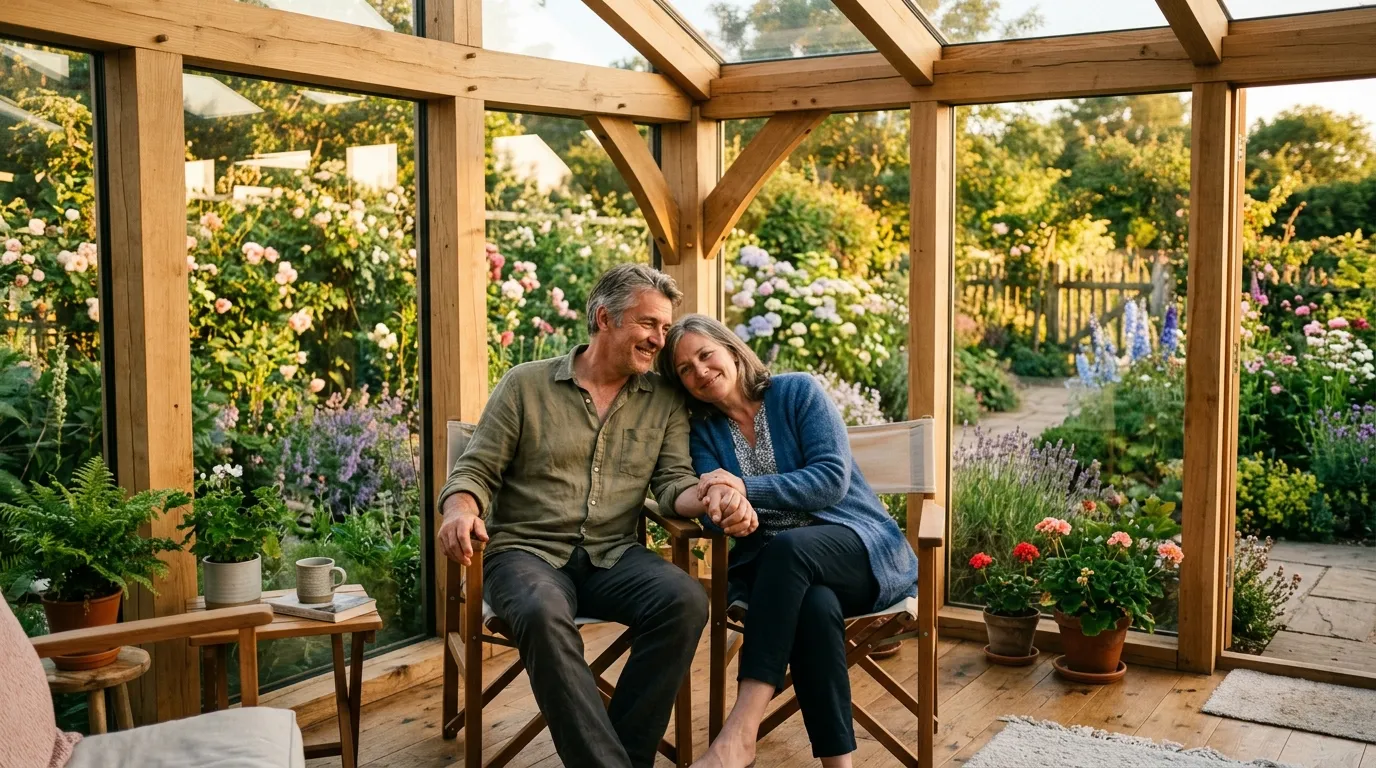
The sunroom we had dreamed of for twenty years, finally brought to life in a frantic two-week marathon of love and panic.
Rowan was deeply asleep, slumped awkwardly in a cheap canvas folding chair in the center of the unfinished floor. His head was tipped back against the wall, his jaw slack with exhaustion. His muscular arms were covered in a tattered shirt heavily stained with a mosaic of dried paint and wood glue. Crinkled blueprints, hardware receipts, and empty coffee cups were scattered like fallen leaves across the floor all around him.
He looked utterly, fundamentally exhausted. He didn’t look like a husband who had been resting and taking it easy for two weeks while his wife suffered. He looked like a man who hadn’t stopped moving, hadn’t stopped working, for a single second.
I walked over and gently touched his shoulder.
He startled awake, gasping as his eyes flew open. He blinked violently, disoriented, until his gaze finally landed on me.
For one brief, incredibly vulnerable second, a wave of pure, unadulterated relief flooded his tired face. But that relief vanished almost instantly the moment he registered the guarded, hurt expression that was still etched onto mine.
“Bev?” he croaked, standing up quickly, the chair scraping loudly against the wood floor.
“Two weeks,” I said. My voice betrayed me, shaking violently. “Rowan. Two whole weeks.”
He took a step toward me, reaching out. I instinctively took a step backward. I just wasn’t ready for him to hold me yet. The pain was still too raw.
“You promised me you’d be sitting right there when I woke up,” I said, the tears finally spilling over. “You promised me on your actual life.”
His face fell, the exhaustion seeming to age him ten years in a matter of seconds. “I know,” he said, his voice barely a whisper.
He didn’t try to explain it away with a neat excuse. He didn’t try to gaslight me and tell me I was overreacting. He didn’t blame the chaotic hospital circumstances or the traffic.
Instead, he slowly sat back down in the folding chair. He leaned forward, resting his forearms heavily on his paint-splattered knees, staring down at his calloused hands. And finally, into the quiet, golden light of the sunroom, he told me the whole truth.
The Paralyzing Fear of Loss
He told me he had come to the hospital the very next morning after my surgery, fully intending to be by my side. He walked up to the ICU desk, and the attending nurse grimly informed him that there had been severe, life-threatening complications overnight.
Panicking, he rushed down the hall and found my room. He stood frozen in the doorway.
And he saw me.
He saw the sheer number of machines surrounding my bed. He saw the thick tubes snaking down my throat. He saw the terrifying pallor of my skin, the monitors tracing a fragile, unsteady heartbeat. He saw all of it.
Looking up at me now, his eyes red-rimmed, he confessed that he had never been that profoundly, suffocatingly afraid of anything in his entire forty-five years on earth.
“I couldn’t do it, Bev,” he choked out, his voice cracking. “I couldn’t make my legs walk inside that room. I felt like I was watching you die, and I couldn’t breathe.”
He told me he backed away, retreated to the elevator, and rode it down in a daze. He went to his truck and sat in the hospital parking garage staring at a concrete wall for two solid hours. After that, he drove home. But the house felt like a tomb without me. He couldn’t even bring himself to turn the key in the front door. So, he slept curled up in the backseat of his truck in the driveway.
The next morning, determined to be stronger, he drove back to the hospital. He made it as far as the main lobby. He sat in a rigid plastic chair near the sliding entrance doors for forty grueling minutes, fighting a panic attack, before he finally broke down and walked back to his car.
“I tried every single day, Bev,” he pleaded, tears finally tracing tracks through the sawdust on his cheeks. “I swear to God, I tried. Some days I made it further inside than others.”
I listened in silence, my heart breaking for the solitary hell he had been living in while I was living in mine.
“Once, I actually made it all the way up to your floor again,” he continued, staring blankly at the floorboards. “I was close enough that I could see the busy nurses’ station right from the elevator banks.”
He paused, wiping a rough hand across his face. “I stood there, hiding around the corner for maybe a minute. Listening to the machines beeping. And then… I panicked. And I left.”
I swallowed hard, the lump in my throat feeling like a jagged rock.
He looked out the glass windows toward the garage. “I bought those gifts in the shop on the third day. I thought to myself, if I just have something tangible to bring you, if my hands are full, I can force myself to go in and give them to you.”
He shook his head, a gesture of deep self-loathing. “I couldn’t. I am so sorry, Bev. I just couldn’t.”
I looked at his hands—hands that had built an entire house from the inside out in fourteen days, but couldn’t push open a lightweight hospital door.
“I knew it was wrong,” he continued, his voice tight with anguish. “I knew every single day that leaving you alone in there was the worst thing a husband could possibly do. But I couldn’t physically force myself to walk back into that room, see you hooked up to those machines fading away, and know that I was completely, utterly powerless to save you.”
He took a deep, shuddering breath, looking up to meet my eyes.
“So, I came home. And I did the only thing I felt like I actually had the power to do.”
“Ro…” I whispered.
“I couldn’t stand the agonizing thought of you coming home—if you even came home—and running out of time before any of our dreams were finished,” he said passionately, gesturing wildly around the beautiful sunroom. “The house. The paint. The garden. The shelves. Everything we’d been pushing off and saying we’d get around to doing ‘someday.’”
He looked around the space, his chest heaving. “We’ve been saying ‘one day’ for twenty years, Bev. We just keep deferring our lives.”
His voice dropped, becoming heartbreakingly quiet. “When they told me about the complications… I kept thinking, What if this is it? What if she doesn’t make it, and there is no ‘one day’ left for us? I wanted you to see it all. I wanted you to have it all. Now.”
I looked around the room we were sitting in. The freshly painted walls. The scattered receipts representing thousands of dollars and hours. The detailed architectural plans. This beautiful, tangible life he’d been frantically building for me while I was lying in a hospital bed fighting to recover.
For two excruciating weeks, I’d been convinced that my husband had cowardly abandoned me because he didn’t care.
But the truth was, he had been absolutely terrified. He had been terrified by the prospect of a world without me in it, in a profound way he simply didn’t possess the emotional vocabulary to explain. And so, he had spoken his love the only way he knew how—through his calloused, bleeding hands, hammer and nail.
I walked over and slowly sat down in the second folding chair across from him. I reached out, gently taking his rough, paint-stained hands in my still-weak ones.
“We were both terrified, Ro,” I finally said softly, the last remnants of my anger dissolving into the warm air.
He looked up, squeezing my fingers.
“Just in completely, entirely different ways,” I added.
Outside the vast glass windows of the sunroom, the newly planted garden was turning a brilliant, fiery golden around the edges as the sun began to set. Neither of us spoke for a long time.
And somehow, sitting there together, that shared silence felt entirely different from all the hollow, echoing silence I’d experienced alone in the hospital. This silence wasn’t empty or abandoning. It was incredibly full. Full of relief, full of understanding, and full of everything we had finally managed to say.
Stopping the Wait for ‘One Day’
Weeks later, as my strength fully returned, we sat in those exact same two chairs inside the sunroom, drinking coffee. The garden outside was spectacularly blooming, buzzing with life. The yellow reading nook in the hallway had quickly become my absolute favorite place in the entire house to spend my mornings.
Nurse Clara had even stopped by to visit us twice since my discharge. Both times she came over, Rowan made a fresh pot of coffee, sat with us, and made a point to ask about her other patients by their names.
Because, beneath the panic and the fear, that is the exact kind of man he truly is. He is the kind of man I had somehow, during two dark weeks of fear and isolation, almost allowed myself to forget.
I sat back, looking around the bright sunroom, letting the warmth soak into my skin. Then I looked over at him.
“What happens now, Ro?” I asked, smiling over my mug.
He didn’t answer immediately. He took a sip of his coffee, looking thoughtfully around the room. At the vibrant garden outside. At the beautiful, finalized life we’d spent twenty long years treating as a distant destination, instead of a beautiful place we were already lucky enough to be standing in.
Finally, he reached across the small table and took my hand in his.
“We stop saying ‘one day,’ Bev,” he said firmly, his eyes locking onto mine with a new, grounding certainty.
His fingers closed warmly around mine. “We just start living it.”
Outside the newly washed glass, the garden was doing exactly what we’d always hoped it would do someday. It was growing. Quietly. Patiently. Simply being there. It was real. And most importantly, it was finally ours, right now.
Note:This work is inspired by real events and people, but it has been fictionalized for creative purposes. Names, characters, and details have been changed to protect privacy and enhance the narrative. Any resemblance to actual persons, living or dead, or actual events is purely coincidental and not intended by the author.
All images used in this article are AI-generated and intended for illustrative purposes only.
0 Comments