
My husband created the garden during the long, sweltering summer of 1997. He never once asked whether I wanted one.
One bright Saturday morning, Roy simply backed his pickup truck into our driveway. The bed was packed to the tailgate with heavy bags of dark topsoil, wooden flats overflowing with vibrant red and sunny yellow blossoms, a spade, an iron rake, and—judging by the steady, unhurried rhythm of his footsteps—a design he had quietly mapped out in his head over many evening porch sits.
I stood behind the screen door, my hands wrapped around a mug of black coffee, watching him work.
Roy was fifty-three that year. He still carried the broad shoulders and steady stride of the young man I had married when I was twenty-six, though time had quietly trimmed away any wasted motion. Every shovel turn was deliberate. Every kneel into the grass was calculated. He moved like a craftsman who understood the exact price of his own energy and refused to spend a single penny more than the job demanded.
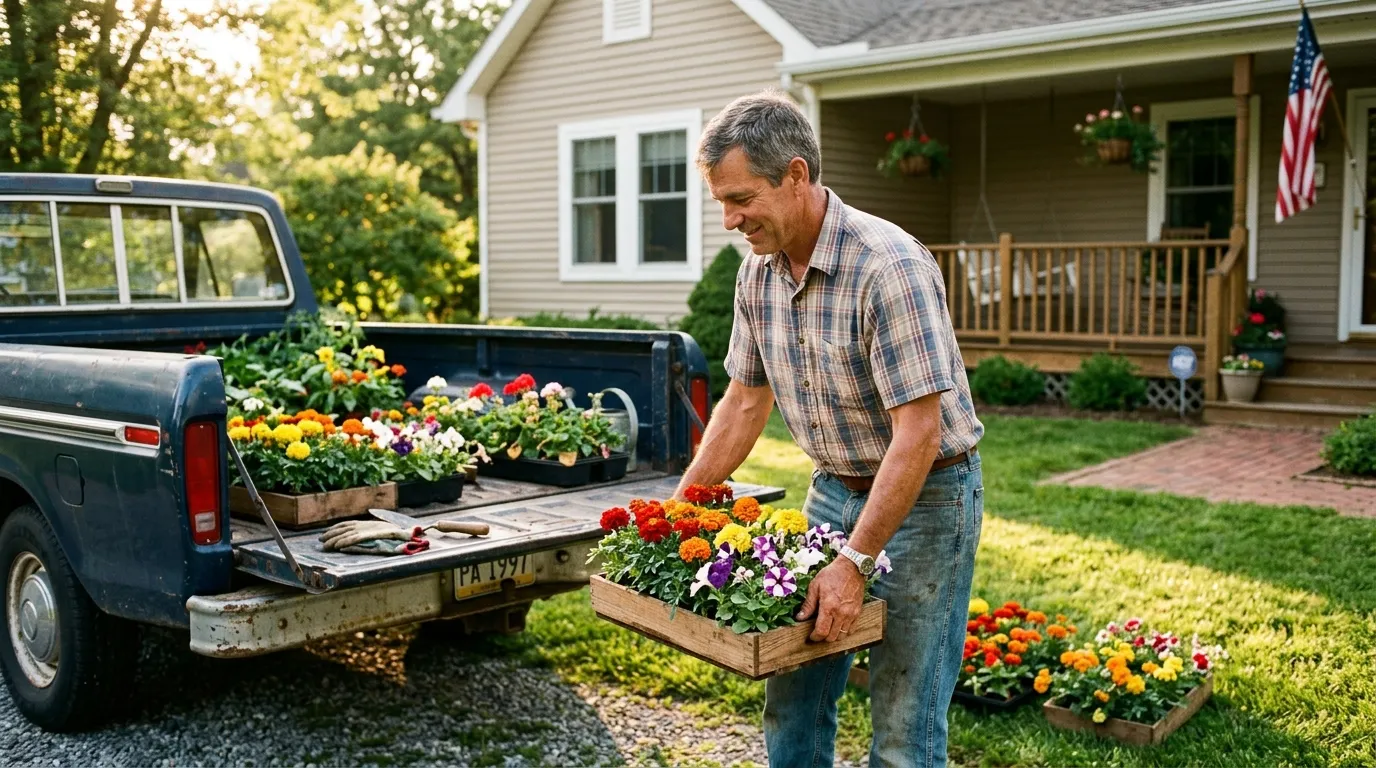
Roy creating the sweeping curve of red and yellow blossoms in 1997.
He worked nearly eight straight hours under the July sun. It wasn’t until six that evening, with sweat soaking the collar of his chambray work shirt, that he finally climbed the three wooden steps of the porch and leaned against the railing beside me.
Together, we looked out across the lawn at what his hands had built.
From the curb, the flowerbed looked almost spontaneous—an organic, sweeping crescent where red and gold petals blended into one another. But standing elevated beside Roy, I could see the underlying geometry. Every perennial and annual had been placed with mathematical intent. As the amber evening sun dipped low behind the neighbor’s roofline, the petals caught the light, and the entire bed appeared to ignite with a warm, living glow.
“Roy,” I said softly.
He turned his gaze toward me, wiping his brow with the back of his forearm. “Do you like it?”
“Why red and yellow?”
A small, familiar crease appeared at the corner of his mouth. “Because those are the flowers I always bring you.”
He delivered the sentence flatly, as if I had asked him why water was wet or why winter brought snow. That was simply Roy. He had a gift for explaining the most profound gestures with an understated smile that gently teased me for needing an explanation in the first place. It was the exact same smile that had arrested me across a crowded fellowship hall at a church social in the autumn of 1968.
Every single anniversary, without fail, Roy arrived home with a bouquet of red roses and bright yellow lilies or daisies. Every year. For forty-one uninterrupted years.
I looked back down at the fresh, damp earth. “This might be the most beautiful thing anyone has ever given me.”
Roy gave a casual lift of one shoulder. “It’s just dirt and petals, Ellie.”
“No,” I answered, resting my hand on his wrist. “It isn’t.”
He didn’t reply, but his fingers curled gently over mine. He knew.
The Ritual of Spring
Roy passed away in March of 2011. He was sixty-seven years old.
To this day, sixty-seven strikes me as far too brief a life. But in truth, any number would have felt like an injustice. If we had been granted seventy-five years, I would have begged the universe for eighty. If he had reached eighty-five, I would have clung to ninety. When you love a man completely, there is no age at which saying goodbye feels acceptable.
He was still entirely himself right up to the final breath. Still planning out his weekend yard projects. Still tightening loose door hinges before anyone else noticed the rattle. Still wearing that patient, slow-blooming grin.
His heart gave out while he was tending that very garden on a cool Saturday morning—right where he had spent hundreds of peaceful weekends before. The paramedics told me it was instantaneous, that he felt no pain. I decided on that cold hospital morning that I would accept their words as absolute truth, because living with any other thought would have been unbearable.
In the quiet years that followed, I preserved the flowerbed precisely as Roy had envisioned it. Or at least as faithfully as nature allows.
Anyone who tends a garden knows they are never static. Soil leaches nutrients. Bitter frosts split roots. Weeds wage endless silent wars, and blossoms inevitably wither. Yet every April, I put on Roy’s oversized leather work gloves, knelt on a foam pad in the dirt, and rebuilt the rhythm. Red flowers on the outer curve. Golden yellow sweeping through the center. The identical gentle wave Roy had staked out with string and stakes in 1997.
Every spring, when the last flat was tucked into the earth and I stood up to brush the damp peat from my jeans, I could feel Roy hovering just at my shoulder. It wasn’t supernatural. I am a sensible woman; I knew my mind was simply reaching into memory. But when you share four decades of daily habits with another soul, the physical motions become an open door. The act itself carries their presence back into the room—or across the yard.
Financially, the flowerbed was inconsequential. It cost fifty dollars in nursery flats, ten dollars in potting soil, and a modest bag of bone meal every spring. Nothing that would catch an appraiser’s eye. But the currency poured into that earth—four decades of shared fidelity, grief, resilience, and memory—could never be itemized on a ledger. Nor could the peace it handed back to me every time I looked out my front window.
A Shift on the Block
My name is Eleanor Marsh. Most neighbors along our quiet avenue call me Ellie. Roy pinned that nickname on me during our second date, and like nearly everything Roy planted, the name outlived him.
At seventy-one, I had spent nearly three decades in our two-story house. I knew the cadence of the street by heart. I knew which maple tree would drop its leaves first each October. I knew that the mail carrier arrived at quarter past one, and I had watched the children at the corner transition from training wheels to used sedans and college bumper stickers.
And, naturally, I knew the Hauser household.
Dennis Hauser lived three doors down on the opposite side of the road. He had moved into the neighborhood twelve years earlier following a lucrative expansion of his commercial restaurant supply firm. Dennis was a self-made man who moved with the effortless, frictionless ease of someone who had crossed financial finish lines so long ago that money had ceased to be an obstacle.
Dennis wasn’t a malicious neighbor. His grounds were immaculate, his hedges squared with surgical precision, and he always gave a polite two-finger salute from the wheel of his silver sedan. Once, after an August thunderstorm snapped a heavy oak limb onto my driveway, Dennis sent his private maintenance crew over to saw it into firewood before I had even picked up the telephone.
The disturbance began when his twenty-two-year-old son, Kyle, finished college and moved back into the guest wing.
Within his first two weeks in residence, the boy’s character became plain. Dennis hadn’t failed Kyle by providing for him; providing for your family is a virtue. The failure lay in the fact that providing things had completely substituted for cultivating restraint. Kyle possessed the dangerous confidence of someone who had never bumped against a firm boundary in his life. He assumed that consequences were an administrative burden meant for other, lesser people.
He spoke loudly because no one had ever told him to listen. He took reckless shortcuts because someone with a checkbook had always smoothed the pavement behind him. And he owned a high-displacement sport motorcycle that he rode with far more swagger than skill.
For months, our street endured him in resentful silence. Suburbia is a fragile ecosystem. Most residents convince themselves that swallowing an annoyance is cheaper than sparking an open feud with an influential neighbor. When Kyle left his bike idling across elderly Mrs. Patterson’s driveway at midnight, Dennis offered a smooth, polite apology, and Kyle repeated the stunt four nights later. When he tore across the corner of the Nguyen family’s front turf, they simply replaced the sod and said nothing.
I didn’t yell, but I didn’t forget either. Roy used to tease me that I had the soul of a forensic auditor. I don’t operate on impulse; I observe, I catalog, and I wait until scattered incidents reveal their undeniable architecture.
By late August, Kyle’s trajectory was obvious. Eventually, his carelessness would collide with something irreplaceable. I simply didn’t foresee that the collision would happen on my own front lawn.
The Tire in the Earth
It occurred on the final Saturday afternoon of September. The afternoon air was crisp, carrying that faint, smoky scent that preludes autumn, though the garden remained in its late-season glory. The red salvias and yellow marigolds were putting on their final, defiant display before the winter frost.
I was in the kitchen waiting for the kettle to whistle when the sudden roar of an engine tore through the quiet street. It wasn’t the distant hum of traffic; it was a rising, frantic scream of acceleration right outside my dining room window.
I set my porcelain mug on the counter and stepped toward the front room just in time to see the catastrophe unfold.
Kyle had taken the residential curve far too hot. Overcorrecting to avoid an oncoming delivery van, he panicked, grabbed his front brake, and veered violently across my curb. The wide rear tire of the motorcycle plowed straight through the center of Roy’s flowerbed.
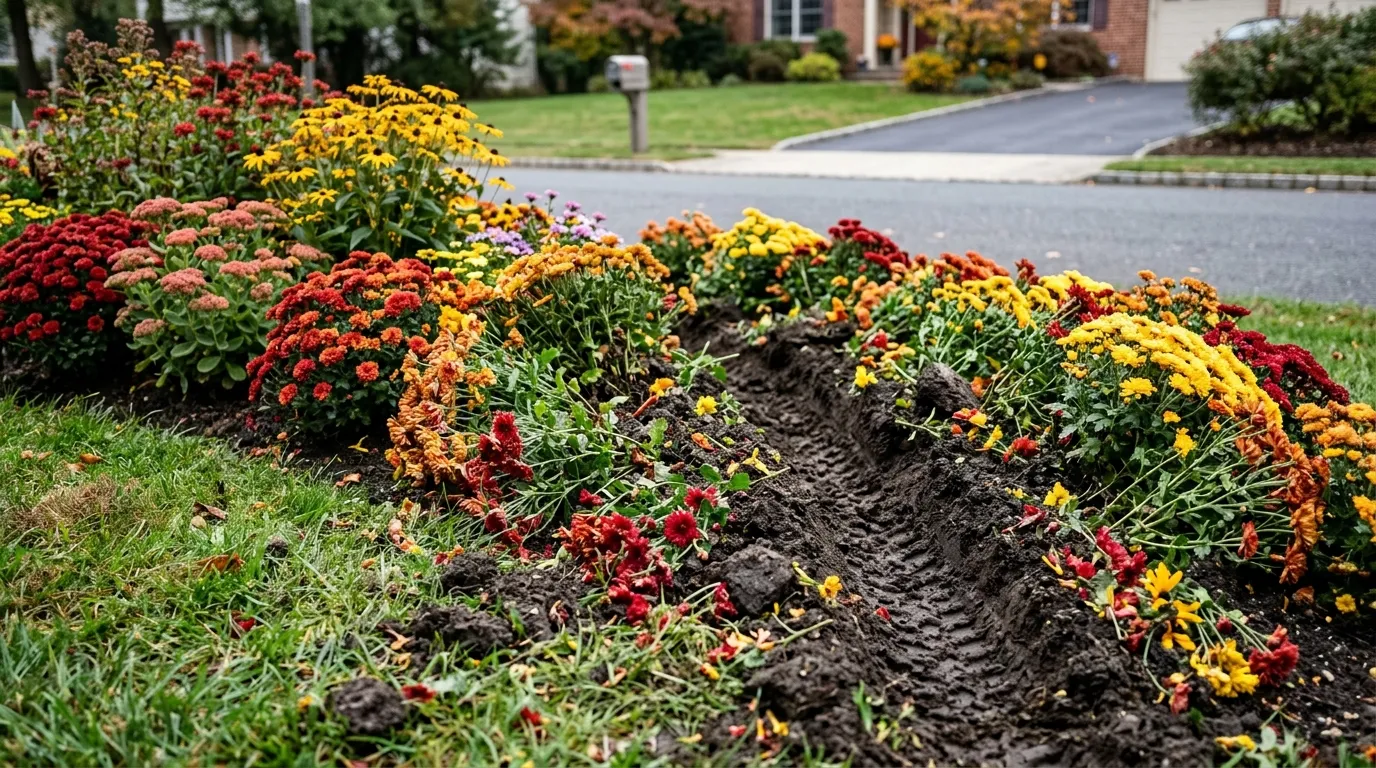
The sudden muddy trench through nearly thirty years of memory.
The entire incident lasted perhaps three seconds, but every frame etched itself into my memory with terrible clarity. The churn of dark earth hurling upward. The snapping of green stems. The delicate red and gold blossoms pulverized beneath hot rubber. The sweeping crescent Roy had staked out twenty-nine years ago was cleanly severed by a muddy, jagged trench.
Kyle regained control, bounced off the far edge of the lawn, and killed the engine in his father’s driveway three houses down.
I walked out the front door, down the steps, and across the ruined turf until I reached the property line. Kyle was striding toward his garage, unlatching his helmet.
“Those flowers were for my husband,” I said across the fence line. My voice was steady, carried by an icy calm. “He passed away.”
Kyle stopped. He glanced down at the fresh mud clinging to his rear tire, then looked toward the deep trench carved through the bed. He didn’t blush. He didn’t rush forward in horror. He simply lifted both shoulders in a detached shrug.
“It’s just grass and flowers, lady,” he muttered, resting the helmet on his hip. “They’ll grow back.”
There was no burning hatred in his tone, and that apathy made the cut far deeper. Active cruelty at least acknowledges that the victim possesses worth before deciding to strike. Kyle was simply blind. He looked at Roy’s crescent and saw only landscaping—easily replaced, commercially traded shrubbery.
He couldn’t see the sweat soaking Roy’s collar in July of 1997. He couldn’t see forty-one anniversaries wrapped in florist paper. He couldn’t see the Saturday morning in 2011 when the paramedics carried my husband past those very flowers under a white sheet.
Across the road, Janet Kowalski stood frozen on her porch with a watering can in hand. Our eyes met across the street. She offered an apologetic, helpless look, then retreated behind her screen door. Kyle tapped his phone screen, dismissed me with a bored nod, and walked into his air-conditioned home.
I didn’t yell. I didn’t raise my hands. I turned on my heel, entered my home, and closed the door firmly behind me.
The Auditor at Work
I spent five quiet minutes in the kitchen, letting the stillness settle. My hands were perfectly steady. I wasn’t weeping. Grief is an ocean, but anger—proper, disciplined anger—is a sharp instrument.
The tire had sheared a three-foot scar through the southern curve. Eight established plants were shredded beyond salvage. Kyle had admitted the act, offered zero remorse, and informed me that nature would take care of his mess.
I crossed the hall to my writing desk, unlocked the bottom right-hand drawer, and pulled out an accordion file labeled Hauser / Residential Documentation.
Because, as Roy always knew, I never rely on luck. I had been logging Kyle’s conduct since early June. Not out of spite, but because decades of living teach you that carelessness without friction always escalates. I had dates. Exact timestamps. High-resolution digital photographs taken with my telephoto lens. Descriptions of vehicle speed, excessive noise levels, and property encroachments.
I lifted my receiver and dialed Patricia Delgado.
Patricia was a junior partner at a reputable firm in town specializing in municipal codes and property litigation. I had placed her on a modest retainer back in August on the recommendation of a friend who warned me that wealth often counts on weariness to win arguments.
Patricia picked up on the second ring. “Mrs. Marsh. Has the situation escalated?”
“He ran his motorcycle through Roy’s garden twenty minutes ago,” I told her plainly. “Tore the bed in half. When confronted, he dismissed the damage and walked inside.”
“Did you document the immediate aftermath?” she asked, her legal training instantly taking over.
“I am stepping out with my camera right now.”
“Do it before the wind or a garden hose alters the scene,” Patricia instructed. “Take wide angle establishing frames, close-ups of the tire treads, and ruler measurements if you can. Any witnesses?”
“Janet Kowalski saw the entire thing from across the avenue.”
Patricia went quiet for a moment. “Eleanor, let’s look at this objectively. A property damage lawsuit for eight crushed annuals will yield a few hundred dollars in small claims court. Dennis Hauser carries that in his money clip. It won’t register.”
“I don’t care about a settlement check, Patricia.”
“I know you don’t,” she replied softly. “Which is why we aren’t going to treat this as an isolated dispute over landscaping. Men like Dennis Hauser protect their sons because neighborhood silence allows them to. When one neighbor complains, they are labeled unreasonable. But when the pattern is placed on public record, the dynamic reverses.”
Patricia explained her strategy. Her firm worked closely with municipal oversight committees. A well-documented file detailing repeated violations of residential peace and property codes would land squarely on the city council member’s desk. Furthermore, she had contacts with the community section of the municipal paper, which was currently running an investigative series on suburban accountability and local bylaws.
“Dennis Hauser sits on the regional zoning advisory board and the Chamber of Commerce,” Patricia noted. “A private nuisance lawsuit is nothing to him. A formal public docket showing systemic neighborhood violations originating from his address is an entirely different matter.”
“Proceed,” I said.
Before hanging up, Patricia’s professional armor slipped. “Mrs. Marsh?”
“Yes?”
“I know what that flowerbed represents. I’m truly sorry.”
“Thank you, Patricia.”
I spent the next forty minutes outside with my digital camera, capturing the tire tread depth, the crushed stems, and the spray of topsoil across the grass. I logged the photos onto my computer, creating side-by-side comparisons with shots I had taken of the garden in full bloom three weeks earlier. By evening, my file contained eleven dated infractions spanning three months.
The Notice on the Walkway
At eight o’clock on Sunday morning, Patricia phoned with an update. Her weekend had been remarkably productive.
“The residential noise ordinances in our district are explicit,” she informed me. “Your log demonstrates clear, repeated infractions. The city council liaison has agreed to open a formal neighborhood review. Furthermore, I contacted the municipal licensing division regarding Kyle’s vehicle registration. It turns out he had a reckless operation citation at eighteen that placed specific conditions on his motorcycle endorsement in residential zones.”
I raised an eyebrow at my kitchen wall. “You’ve been thorough, Patricia.”
“You paid my retainer, Mrs. Marsh. I believe in giving my clients their money’s worth.”
By nine-thirty, a courier from Patricia’s office arrived at my house. He didn’t make a scene; he simply drove two small steel stakes into the turf right beside my walkway, mounting a formal, laminated notice under the firm’s letterhead.
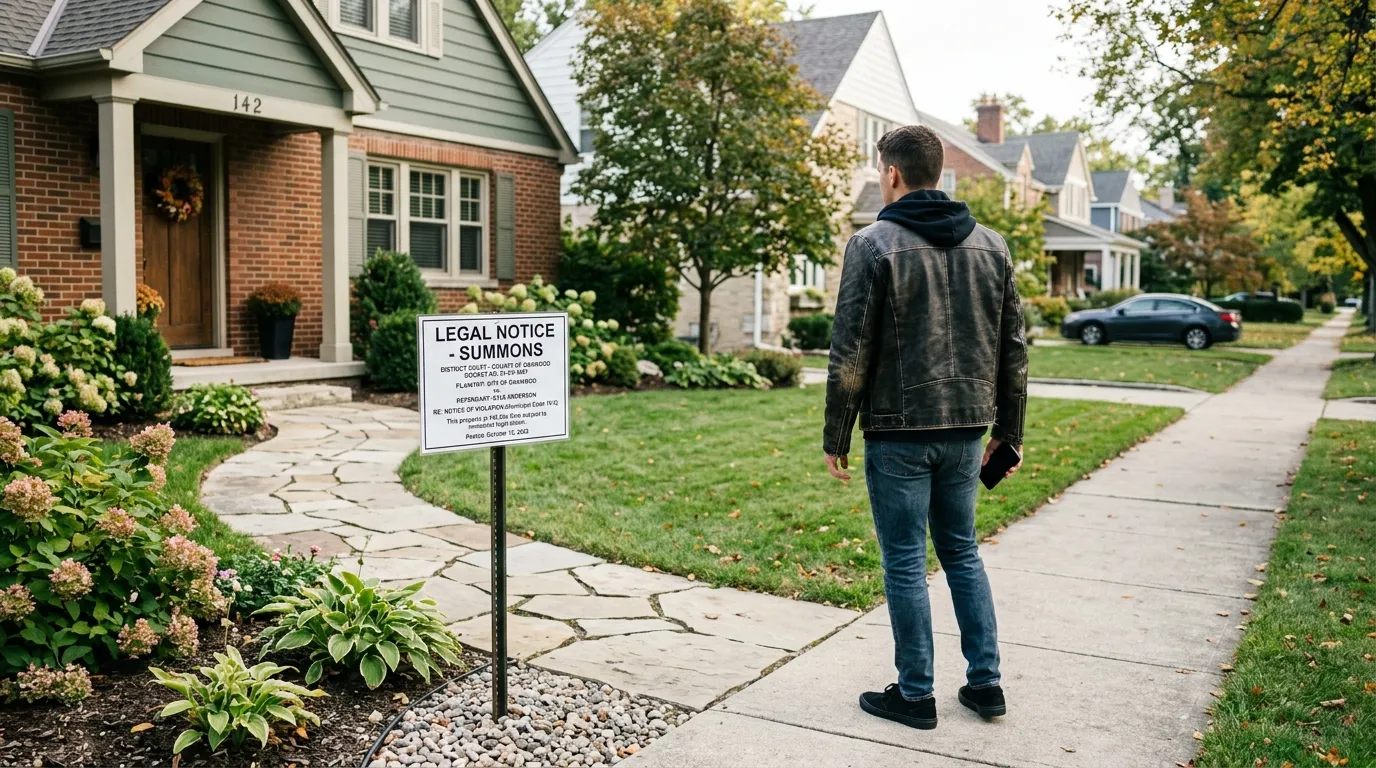
The official notice that brought an abrupt halt to the neighborhood silence.
The text was spare, polite, and uncompromising. It stated that the premises and adjacent frontage were under formal legal monitoring following documented vehicular property damage; that all past and ongoing infractions had been forwarded to municipal authorities; and that retained legal counsel was actively preparing formal dockets. Everything on the placard was verified fact.
I sat by my window with a fresh cup of tea.
At ten-fifteen, Kyle emerged from the Hauser residence, wearing his leather jacket and staring into his phone. As he crossed toward his motorcycle, his gaze caught the white sign. He stopped dead on the sidewalk.
He stepped closer, reading the text once, then leaning in to read it again. When he finished, he lifted his head and stared straight at my house. The bored arrogance was gone, replaced by the stunned confusion of someone who had tossed a match into dry grass and was shocked to discover it produced actual heat. He stood there for nearly two minutes before turning abruptly and walking back inside.
Twenty minutes later, Dennis Hauser walked out. He stood over the sign for twice as long as his son had, his hands clasped behind his back, his jaw tight. Then he marched up my walkway and knocked firmly on my door.
The Conversation at the Threshold
I opened the door and met his gaze through the storm glass before unlatching it.
“Dennis.”
“Mrs. Marsh,” he began, his voice pitched to project practiced warmth. “I’d like to speak with you regarding the placard on your lawn.”
“Step in,” I said, gesturing to the foyer.
He stepped inside, standing with his hands held openly at his sides—the posture of a seasoned executive determined to de-escalate an operational dispute. “Kyle informed me about the mishap yesterday afternoon.”
“Did he characterize it as a mishap?”
Dennis cleared his throat slightly. “He realizes his maneuver was inappropriate. I came over immediately to rectify the matter. Whatever the cost to re-sod the lawn and replace the plants, bring me the bill. I will cover it in full, right now.”
“Yes,” I said quietly. “I know you will.”
Dennis blinked, thrown off by my lack of resistance. “Well… then we can take the notice down?”
“No, Dennis. The replacement cost of the flowers is the most insignificant detail on the table.”
His eyes narrowed slightly. “I’m not following.”
“Has your office received an inquiry from the city council liaison yet?”
A flicker of tension crossed his forehead. “No. Why would they call me?”
“Because a formal community quality-of-life dossier has been opened,” I explained calmly. “And my attorney has already forwarded Kyle’s recent moving violations to the regional licensing division regarding the conditional status of his motorcycle permit.”
Dennis went completely rigid. “Mrs. Marsh, surely this can be handled privately between neighbors without dragging municipal offices into our street.”
“Dennis, you’ve had all summer to handle this privately,” I replied, holding his gaze without blinking. “You knew about Mrs. Patterson’s driveway. You knew about the Nguyens’ lawn. You knew your son was treating this residential street like his personal drag strip at midnight.”
“I have detailed timestamps and photographic records dating back to June,” I added. “Every single incident.”
For the first time since he moved into the neighborhood twelve years ago, Dennis Hauser ran out of polished phrases.
“My husband spent an entire Saturday in 1997 digging that bed,” I continued, my voice low and steady. “He planted red and yellow because those were the flowers he brought me on every anniversary for over forty years. He passed away in that dirt. Yesterday, your son plowed through it and informed me that it didn’t matter because it would grow back.”
I took a breath. “And he is partially right. Next spring, I will buy more flats, kneel in the soil, and plant them again. But the municipal review will proceed. The licensing board will review his record. And the reporter covering neighborhood bylaws for the morning edition will publish her piece.”
Dennis looked down at his shoes, then out toward the window. “What is it you actually want from this, Eleanor?”
“I want Kyle.”
He jerked his head up. “I’ll make him apologize right now—”
“No,” I cut him off. “If you force him across the grass, it’s just your compliance talking, not his conscience. I want Kyle to walk up these steps only when he understands what he did.”
Dennis stood in my foyer for a long time. Slowly, the defensive executive posture dissolved, leaving behind a tired, sixty-year-old father who suddenly realized the shortcut he had taken.
“I let it slide because it was easier than confronting him,” Dennis confessed, his voice dropping into raw honesty. “He was home for three months, and I convinced myself he’d mature on his own. I’m sorry, Eleanor. Truly.”
“Thank you, Dennis,” I said. “Now we wait for Kyle.”
The Broken Silence
Three days later, the city council representative walked our avenue alongside an administrative aide. What began as a conversation on my front porch quickly turned into something far larger.
Janet crossed the street to join us. Then Mr. Nguyen appeared. Within half an hour, seven neighbors were gathered near the damaged flowerbed, sharing their own accounts. The wall of suburban silence that Dennis’s wealth had inadvertently built crumbled in an afternoon. People hadn’t stayed silent because they didn’t care; they had stayed silent because isolation makes everyone feel powerless. Documentation had simply provided the spine they needed.
Two weeks later, the article appeared on the front page of the regional section. It was a thoughtful, well-balanced examination of residential rights, civic responsibility, and the quiet agreements that keep communities civil. Neither Kyle nor Dennis was named, sparing the family cheap public humiliation. But my name was there. And the garden was there.
And Roy was there. That was the only detail that truly mattered to me.
The following Friday evening, Dennis called. “Eleanor. Kyle read the newspaper piece this morning. He asked if he could speak with you.”
“Tell him ten o’clock tomorrow morning.”
Sitting at the Table
At ten o’clock on Saturday, the doorbell rang. When I pulled the door open, Kyle was standing on the porch. He wasn’t wearing his heavy leather riding gear or sunglasses. He was dressed in a plain denim shirt and worn jeans, his posture stooped with awkward hesitation. Without his mechanical armor, he looked every bit the twenty-two-year-old boy he actually was.
“Mrs. Marsh,” he mumbled. “May I come in?”
“Come sit at the table, Kyle.”
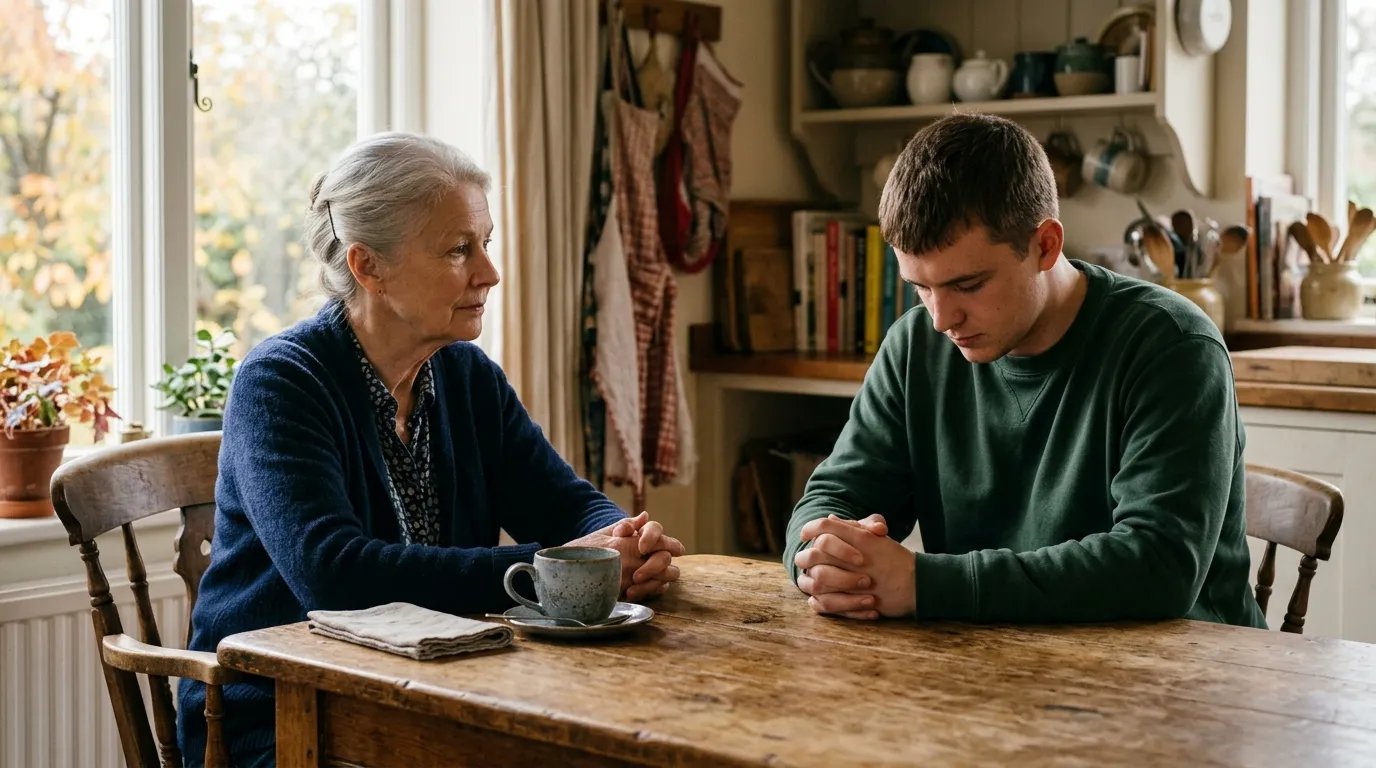
The quiet conversation where accountability finally took root.
He sat on the edge of the wooden chair where Roy had eaten breakfast for twenty-nine years. His hands were clasped between his knees, his eyes fixed on the grain of the oak table.
“I read the paper,” he began, his voice thick. He hesitated, clearing his throat. “I didn’t… I didn’t know anything about your husband. Or why those flowers were there.”
I said nothing, allowing the silence to do its necessary work.
“I came to tell you I’m sorry,” he whispered, looking up briefly. “My dad didn’t push me to come. I had to come myself. What I said to you after I wrecked your lawn was stupid and callous.”
“Why did you say it, Kyle?”
He stared at his knuckles. “Because I didn’t look at it. I mean, my eyes saw flowers, but I didn’t think about what they meant to someone else. I’ve gone through school just assuming that as long as an insurance company or my dad could pay for something, it didn’t count as a real problem.”
He swallowed hard, his voice trembling slightly. “I kept thinking about what it would feel like if someone trashed something my dad built with his hands before he died, and then laughed it off. I realized I’ve been acting like nothing matters unless it belongs to me.”
I watched him carefully. There was no rehearsed polish in his speech. He was grappling with genuine shame, perhaps for the very first time in his adult life.
“You told me the flowers would grow back,” I reminded him gently.
“I know,” he said, closing his eyes. “That was the worst part. It was like saying that if something can be replaced at a store, the love behind it doesn’t count. And I think… I think I’ve treated people that way too.”
He looked at me directly then, his eyes clear and honest. “I hired a professional landscape crew out of my own savings to repair the sod and prep the soil before the ground freezes. Not my dad’s account. Mine.”
He paused, twisting his fingers together. “And next spring… when it’s time to put the red and yellow ones back in… if you’ll let me, I want to help you plant them. I want to do the digging.”
I looked across the table at this young man who, two weeks prior, had carelessly destroyed thirty years of devotion with the twist of a throttle. In his posture, I saw the slow, clumsy beginning of real maturity.
“Yes, Kyle,” I told him softly. “You may help me plant them.”
He let out a long breath, nodding gratefully. “Thank you.”
We sat in silence for a moment before he glanced toward the window. “Mrs. Marsh? What was he like? Your husband?”
The question caught me off guard, and a warm, unexpected smile touched my face. “Roy was the kind of stubborn, wonderful man who would show up with a truckload of topsoil on a random Saturday morning without warning me, just so I could see the finished garden when the sun went down.”
Kyle offered a small, crooked smile of his own. “He sounds like a man who knew what mattered.”
“He did,” I answered. “He always did.”
“I’d like to become someone like that,” Kyle murmured, half-embarrassed. “I know I’m not there yet.”
“You are twenty-two, Kyle,” I said, rising from the table. “You have time to build that kind of character. Just remember that time is a gift, and what you do with it is your responsibility.”
He stood up, standing taller than when he had arrived. “Next spring, Mrs. Marsh. First Saturday of May?”
“First Saturday of May,” I confirmed. “Bring your own gloves.”
What Remains
Winter came early that year, cloaking our street in clean, quiet snow. Outside my front window, the flowerbed rested beneath a white blanket, its soil dark and dormant, waiting for the thaw.
Roy planted that garden in 1997 because he loved me in a quiet, durable way that didn’t require fanfare. He never asked if I wanted a garden because he already knew my heart better than I did. I kept it alive after his death because every blossom was a thread connecting me to forty-one years of steadfast grace.
When May arrives, a twenty-two-year-old boy who once drove through that memory will kneel in the dirt beside a seventy-one-year-old widow. We will tamp the soil down around fresh red and yellow roots, following the same sweeping curve Roy laid out decades ago.
Kyle will never completely comprehend everything that garden holds. No one except me ever truly can. But he will understand enough. He will understand that living in this world means handling other people’s memories with reverence.
Understanding rarely arrives like a lightning strike; it is planted in small seeds, tended through patience, and nurtured through accountability. Roy understood that long before I did. Perhaps that is why he brought home the truckload of dirt in the first place.
It was the garden Kyle said would grow back.
And it will. Because in every way that truly matters, it never really left.
Note:This work is inspired by real events and people, but it has been fictionalized for creative purposes. Names, characters, and details have been changed to protect privacy and enhance the narrative. Any resemblance to actual persons, living or dead, or actual events is purely coincidental and not intended by the author.
All images used in this article are AI-generated and intended for illustrative purposes only.
0 Comments