
At 53, my mother started dating again, and I had never seen her happier. After everything she had sacrificed throughout her life, I was genuinely excited for her. She had spent decades putting everyone else first—especially me—and I wanted nothing more than to see her finally enjoy a slice of life meant entirely for herself.
Then she invited her new beau, Marcus, to dinner.
I opened the door to welcome him in. And the very second I saw his face, the bottom dropped out of my stomach. I knew him. I knew that man from eleven years earlier. I knew the cadence of his voice. I knew the quiet, steady way he carried himself. And, much more importantly, I knew a heartbreaking secret about his past that I was certain my mother didn’t know.
I plastered on a smile and pushed through dinner. I waited until the plates were cleared and he finally left. Then I looked at my mother and said the heavy words I never expected to have to say: “Mom, before you get any closer to him, there’s something you need to know.”
The Outfit Changes and the Doorbell
But before all that, the evening started with earrings. Mom had changed them three times before Marcus even arrived.
“The gold ones,” I called from the kitchen, stirring the pasta sauce.
“You said the silver ones,” she called back.
“That was two earrings ago!”
Mom appeared in the kitchen doorway, holding yet another pair against her neck, her eyes searching mine for approval. “These?”
“Mom, he’s coming for dinner, not conducting a jewelry inspection.”
“Easy for you to say.” She looked down at the delicate silver hoops in her hands with a sigh. “Too much?”
“Which ones do you actually want to wear?” I asked gently.
She glanced toward the gold pair she’d abandoned on the counter. I picked them up, wiped off a speck of dust, and held them out to her. “Then wear those.”
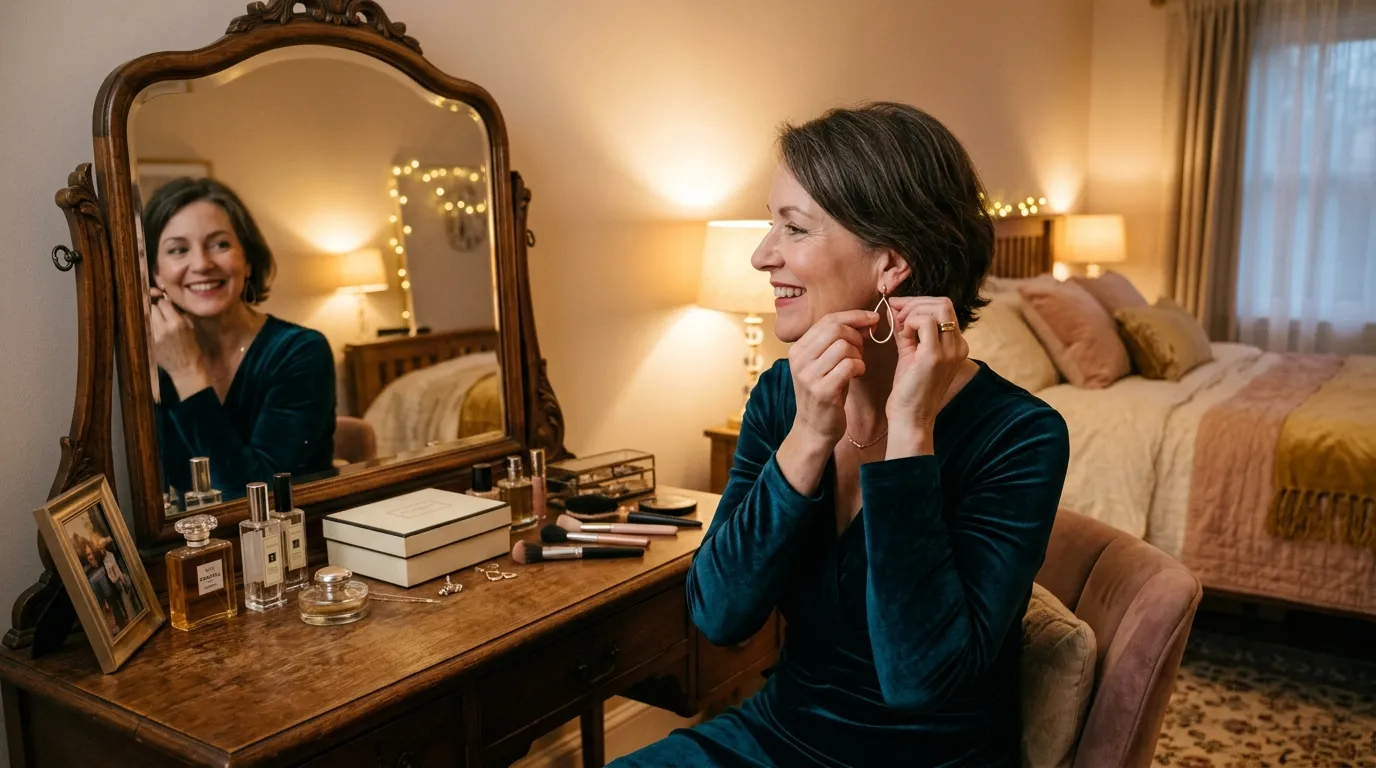
Getting ready for a first date at 53 brings back a rush of youthful nerves.
At 53, my mother was nervous about a man. That fact alone was almost unbelievable to me. My mother, Ella, had spent most of her life being the calmest, most resolute person in any room. But that night, she was a bundle of electric, nervous energy. She rolled her eyes at my teasing.
“When did you become my mother, Jean?”
“Around your third outfit change.”
She let out a bright, genuine laugh. The joyful sound was still hanging in the warm air of the living room when the doorbell rang.
“I’ll get it,” I said, wiping my hands on a towel.
“Wait.” Mom caught my arm, suddenly serious. “Be nice.”
“I’m always nice, Mom.”
“You once asked my dentist whether he had a personality outside of teeth.”
“He brought up plaque during lunch, Mom. It was warranted.”
The bell rang again, and Mom playfully shoved me toward the door. “Go!”
I was still grinning when I pulled the front door open. Then I saw the man standing on the porch, holding a bottle of red wine. He was older than I remembered. His dark hair had gone mostly gray at the temples, and deeper, weathered lines framed his kind eyes. But I knew that face immediately.
Marcus’s polite, expectant smile faltered too. He looked at me. Then he looked past me at Mom. Then back at me. “Jeannie?” His voice made the eleven years disappear in an instant. “Ella’s Jean?”
My hand tightened so hard around the doorknob my knuckles turned white. “Marcus.”
Mom appeared behind me, her brow furrowing as she looked between the two of us. “Wait. You two know each other?”
Marcus lifted the bottle of wine he’d brought as a peace offering to the universe. “Jeannie worked for me years ago.”
Mom laughed in utter disbelief. “You’re kidding.”
“Small world,” Marcus said softly.
He walked past me into the house. And with him came a rush of memories I hadn’t thought about in over a decade. A little downtown bookstore. A woman I’d never forgotten. And one seemingly simple sentence Marcus used to say that had, quietly and profoundly, changed the trajectory of my life.
The Weight of Quiet Sacrifices
My mother had spent most of her adult life making sure I never noticed the things she went without. My father left when I was little, fading into the background of our lives. After that, Mom became my everything. She picked up extra shifts at the clinic but somehow still managed to appear at my school concerts with five minutes to spare, cheering the loudest.
She remembered every doctor’s appointment. Every messy school project. Every birthday. Every little thing I thought was important, she made important.
When I was 13, I found an unopened pair of beautiful winter boots in her closet. “Why haven’t you worn these, Mom?” I asked.
“They’re uncomfortable, dear,” she brushed it off.
Months later, I realized she’d returned them. That very same week, I had magically received the expensive art supplies I’d been begging for. That was how she loved me. She gave things up quietly, in the shadows. She never announced her sacrifices to the world. She never reminded me what my childhood had cost her.
When I graduated from college and finally landed a good, well-paying job, I started trying to push back, trying to balance the scales.
“Take the trip, Mom.”
“That’s ridiculous money, Jean.”
“Then buy the dress.”
“I have dresses, dear.”
“Those are archaeological artifacts.”
She would laugh, but eventually, she gave in. She traveled with friends. She started painting again. She joined a community volunteer group. And then, one evening, she casually mentioned a man named Marcus. Within weeks, his name began lighting up her phone screen almost as often as mine. One night, Mom admitted with a giddy laugh, “He makes me feel 25 again.”
I told her I couldn’t wait to meet him. And I meant it with my whole heart. Until I opened that door.
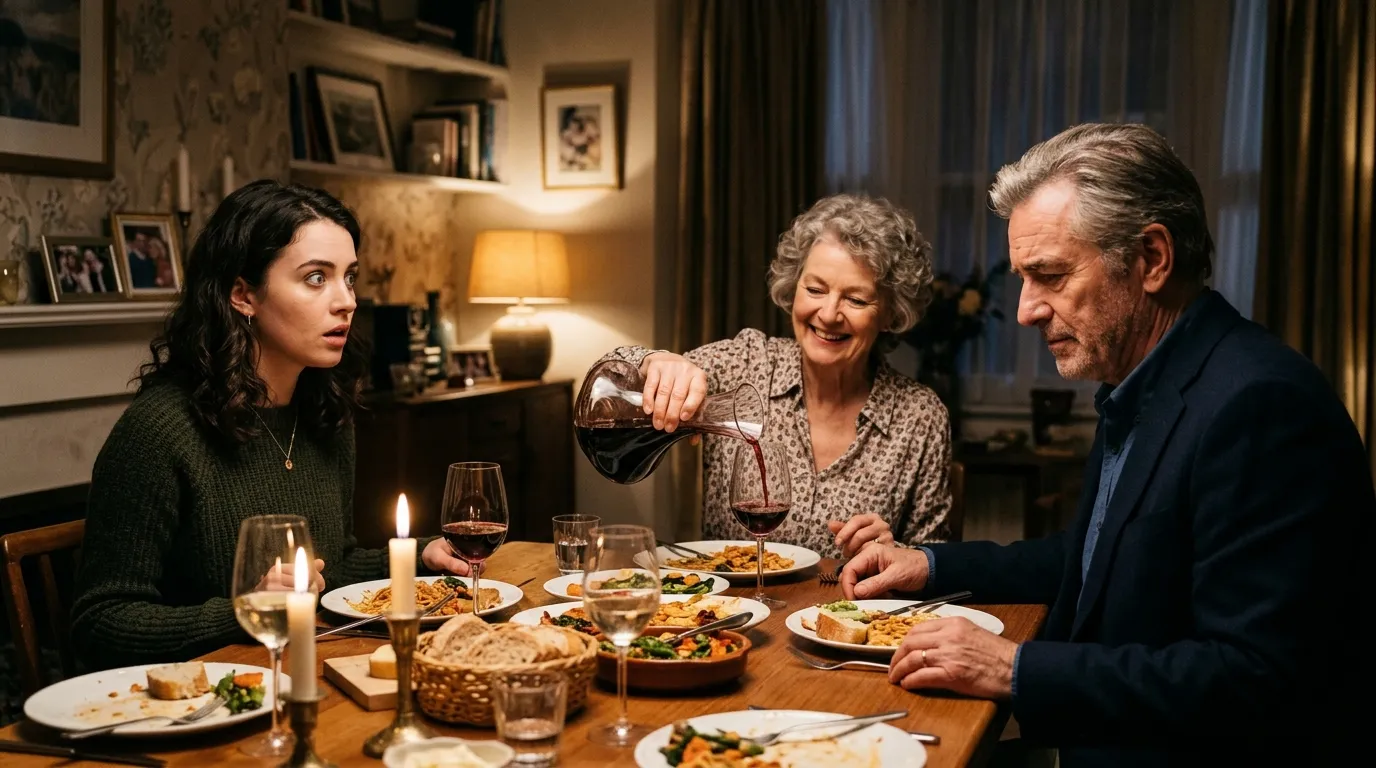
The realization hit me all at once—my mother was dating a ghost from my past.
Dinner with a Ghost
Marcus was attentive at dinner without hovering. When Mom coughed after swallowing her wine too quickly, he quietly slid her water glass closer without interrupting her story. He remembered that she hated mushrooms, subtly moving the serving dish away from her side of the table without making a big deal about it.
“So,” Mom said, playfully pointing her fork at him, “tell Jean about the tomatoes.”
Marcus groaned, rubbing his face. “Absolutely not.”
“You should see them, Jean,” Mom teased.
“They’re recovering, Ella.”
“They’re leaning sideways.”
“Toward sunlight,” he corrected with a wry smile.
Mom shook her head. “You’re still checking on them tonight, aren’t you?”
Marcus shrugged defensively. “They’re unsupervised. I finally got ours to stop collapsing.”
My fork stopped halfway to my mouth. Ours.
“My wife used to grow tomatoes,” Marcus added, his voice dropping slightly. “She made it look insultingly easy.”
I looked at Mom. She just smiled warmly at him. “Marcus inherited her confidence.”
“Unfortunately, not her competence,” he said.
They laughed. I didn’t.
Because suddenly, I wasn’t sitting at dinner with my mother’s new boyfriend. I was sitting across from someone from my past, surrounded by memories of a love story that didn’t include my mother.
The Bookstore and the Question
Back then, I worked part-time at a little indie bookstore downtown. Marcus was my manager. I was also dating a man named Tyler.
If you’d asked me then, I would have told you Tyler was just “protective.” He picked the restaurants because I “took forever” to decide. He chose our movies because I “always picked weird ones.” He corrected my clothes before we went to parties. He called three times in a row if I didn’t answer the first time.
At twenty, I didn’t recognize controlling behavior for what it was. I simply got used to making myself smaller, constantly saying: “Whatever you want.”
One lazy afternoon, Marcus was rearranging the front window display. He held up two hardcover books. “Which one?”
I shrugged without looking up. “Whatever.”
He didn’t move. “Which one, Jeannie?”
“Either.”
“I didn’t ask which one wouldn’t upset civilization,” he noted dryly.
I laughed. He held the books up again. “What do you want?”
I actually looked at them this time. “The blue one.”
“Great.” He put it prominently in the window.

It started with a simple question: “What do you want?”
It should have meant nothing. Except Marcus kept doing it. Our coffee order. The work schedule. Display signs. The store music.
“What do you think?”
“What do you want?”
“Which do you prefer?”
They were tiny, insignificant questions. But they were questions I slowly realized almost nobody in my personal life was asking me.
One afternoon, Tyler came into the store and immediately criticized the oversized sweater I was wearing. I reflexively apologized, shrinking into myself. Marcus was shelving books nearby. He didn’t look at Tyler. He looked directly at me.
“Do you like the sweater, Jean?” he asked clearly.
Tyler scoffed. “Apparently somebody has to.”
I looked down at the soft, cozy fabric. I found a tiny spark of defiance. “Yeah,” I said. “I do.”
Tyler and I broke up three months later.
But there was another person from those years whom I remembered even more clearly than Tyler. Marcus’s wife. She used to draw ridiculous, hilarious cartoons on Marcus’s brown paper lunch bags. She would come in and tape her favorites beside the cash register. Every Thursday, without fail, Marcus left work at exactly five o’clock.
“Regional meeting,” someone teased him once.
Marcus grabbed his coat, beaming. “Dinner with my wife.”
“The meeting’s important, Marcus.”
“They’ll survive,” he’d reply, already out the door.
Then, one Thursday, he didn’t leave. He just sat in his cramped back office, staring blankly at his phone. The next week, he barely spoke to anyone. A month later, Marcus left the bookstore completely. His wife was sick. He was going home to care for her full-time. I never saw him again.
Eventually, through the grapevine, I heard she had died.
And now, eleven years later, he was sitting at my mother’s dinner table, laughing about tomatoes. I couldn’t stop wondering whether Mom truly understood what she was stepping into.
The Confrontation
Marcus stayed until just after nine. Mom stood at the front door, smiling like a teenager as his car backed out of the driveway. Then she closed the door, let out a happy sigh, and turned toward me.
“Well?”
I looked out through the glass until Marcus’s taillights disappeared into the dark. Mom’s radiant smile faded when she saw the look on my face.
“Mom, before you get any closer to him, there’s something you need to know.”
She didn’t answer. She just waited.
So I told her everything. I told her about the bookstore. I told her about how Marcus was back then. I told her about his incredible, artistic wife. I told her how deeply and entirely that marriage had seemed woven into the very fabric of who he was.
Mom listened quietly, without interrupting.
Finally, I said the words that had been sitting like a heavy stone in my chest all evening. “You’ve spent your whole life coming second, Mom.”
Her eyebrows drew together in confusion.
“To the bills. To your work. To Dad when he was still around. To me.” I swallowed hard, fighting back tears. “I don’t want you spending the rest of your life competing with someone who isn’t even here anymore. You deserve to be first.”
Mom didn’t answer. Instead, she walked briskly into the hallway and grabbed her coat from the hook.
“Put your shoes on, Jean.”
I stared at her. “What?”
She grabbed her car keys. “I could explain this to you, but you’d still think I’m just making excuses for him.” She looked at me with a fierce love. “There’s something you need to see.”
The Community Garden
Mom drove in total silence for about fifteen minutes.
“Are you kidnapping me?” I finally asked.
“Yes.”
“Good to know.”
“You ask too many questions.”
“You raised me, Mom.”
That finally earned a small smile. But she kept driving. We eventually turned down a dirt road and pulled into a community garden tucked behind a small neighborhood recreation center. Most of the garden plots were completely dark, but strings of warm, glowing lights ran along the main path.
Then I saw Marcus.
He was kneeling beside a pathetic-looking tomato plant, his large hands carefully trying to tie one of its fragile stems to a wooden stake.
Mom lowered her window. “You’re strangling it,” she called out into the night.
Marcus looked up, not looking surprised to see us at all. “I’m supporting it.”
“It’s leaning away from you.”
“Ungrateful plant,” he muttered affectionately.
I stared at Mom in the driver’s seat. “You knew he’d be here?”
“I knew he’d probably be here.”
She parked the car. Marcus brushed the dark soil from his knees as we approached. His tired face softened instantly the moment he saw me.
“Ah,” he said softly.
I folded my arms defensively across my chest. “That’s reassuring.”
Mom gently touched my elbow. “Jean, look around.”
I looked. Really looked. Several small, brass plaques marked the garden plots around us. Some had names engraved on them. Others had dates.
Marcus followed my gaze. “This specific section belongs to a bereavement group.”
“Bereavement group?” I asked, my voice softening.
He nodded toward the crooked tomatoes. “My wife grew them every summer.” His voice changed slightly, carrying the heavy weight of old grief. “After she died, I couldn’t even look at one without thinking about her.” He took a slow, deep breath. “When I joined the group, the counselor told us to plant something we’d have to keep alive long enough to see another season.”
“And you chose tomatoes?”
Mom snorted beside me. “Arrogance. He killed two entire batches.”
“One and a half,” Marcus corrected with dignity.
“Two.”
Marcus sighed. “Your mother’s very supportive.”
I looked at Mom, my defenses crumbling. “You knew about his wife?”
“Of course I knew.”
“How much?”
Mom slipped her hands into her coat pockets, looking at the tiny green tomatoes. “Enough to know I would’ve really liked her.”
That stopped me cold. All evening, I’d been terrified that Mom was too infatuated to see the truth. But she’d seen more than I had. She saw the whole picture.
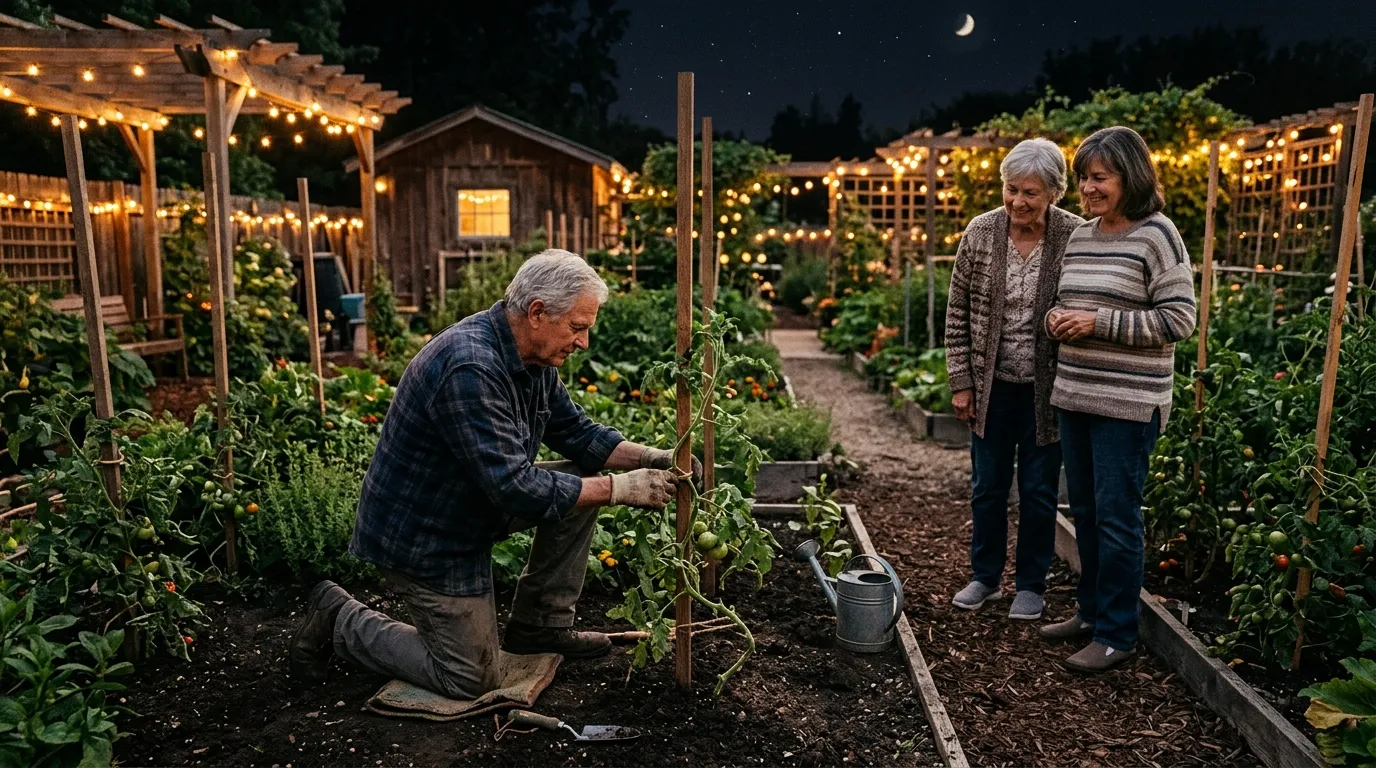
In the quiet of the garden, I realized my mother wasn’t competing with a memory.
Meeting in the Middle
Marcus stepped closer to me, but he deliberately left enough space between us. I looked directly into his eyes.
“Do you still love her?” I asked.
“Yes.” His answer came immediately, without a single ounce of hesitation.
He glanced lovingly toward the crooked tomato plant. “She’s dead, Jeannie. Not erased.” Then he looked at my mother, his eyes full of warmth. “Loving your mother didn’t require me to stop loving the woman who taught me how.”
I frowned, trying to process this. “What does that even mean?”
Marcus rubbed a bit of dirt from his thumb. “You remember how I used to constantly ask you what you wanted at the bookstore?”
I nodded.
He smiled faintly. “That wasn’t originally my wisdom, Jean.”
I stared at him, stunned.
“My wife used to get furious with me because I planned absolutely everything. Restaurants. Vacations. Weekends. I controlled it all.” He shook his head regretfully. “I thought taking care of somebody meant handling things for them. Taking away their burdens.”
His expression became serious. “One night, my wife finally looked at me and said, ‘Marcus, stop loving me like a project. Ask me.’”
I felt something massive shift inside my chest.
“Years later,” Marcus continued, “I watched you say ‘whatever’ to every single question anyone asked you. I watched you shrink yourself for a man who didn’t deserve you.” He looked at me softly. “I recognized it.”
I thought about the blue book in the window. The oversized sweater. The tiny, persistent questions. All those years ago, I had believed Marcus was simply teaching me to have an opinion. Now I understood that he had learned that painful lesson from someone else. Someone who had mattered deeply to him. Someone I had been terrified my mother could never compete with.
I turned toward my mother. “Doesn’t it bother you?”
Mom looked at me, her face serene. “That he still loves her?”
I nodded.
Mom thought for a moment. “Jean, I raised you by myself for most of my adult life.” She gave me a deeply knowing look. “Do you really think I’d trust a man whose answer to profound loss was simply pretending that somebody never mattered?”
I looked away, feeling foolish.
“I’m not dating the man he was before her,” Mom said, her eyes moving back toward Marcus. “I’m dating the man he became.”
Marcus cleared his throat loudly. “This is becoming alarmingly positive. I’m uncomfortable.”
I laughed before I could stop myself, wiping a tear from my cheek.
Mom reached out and took my hand. “I know why you were worried.”
“I thought I was protecting you, Mom. Like you always protected me.”
“I know, sweetheart.” She squeezed my fingers tight. “You’ve been doing a lot of that lately.”
I frowned. “What does that mean?”
“The expensive trips you keep trying to buy me. The art classes. The clothes. Pushing me to date.”
“Mom, I just want you to have nice things after everything you gave up for me!”
“I know.” She smiled, reaching up to tuck a strand of hair behind my ear. “But you don’t owe me a happy ending, Jean.”
For years, I had been desperately trying to balance a ledger my mother had never even opened. Every sacrifice she made. Every double shift she worked. Every pair of boots she returned so I could have something instead. Every time she told me she was completely fine when she was exhausted.
“You gave up so much for me, Mom.”
“And I would do it all again in a heartbeat.” She smiled, her eyes shining. “But my life isn’t your debt to pay.”
That sentence hit me harder than I expected. I realized, standing there in the dirt, that I had spent years trying to repay something she had never asked me to repay. Mom had sacrificed for me because she loved me. Not because she wanted to own the rest of my choices, and certainly not because she expected me to manage her happiness.
I looked at her, my vision blurry. “I’m sorry.”
She squeezed my hand one last time. “You don’t have to be.” Then she smiled mischievously toward Marcus. “And for the record, I’m not coming second.”
“No?” Marcus asked.
“No.” She looked at him with absolute confidence. “Marcus had a whole life before me. So did I. We’re meeting in the middle, that’s all.”
Planting Seeds
Marcus suddenly brightened, eager to change the emotional subject. “Speaking of our great accomplishments…” He carefully twisted a tiny, misshapen tomato from the vine and held it out to Mom as if presenting a diamond ring.
It was small, incredibly crooked, and mostly orange.
Mom stared at it critically. “That’s pathetic.”
“I raised that with my own hands,” Marcus declared proudly.
“You interfered with nature until it finally surrendered, Marcus.”
“I don’t need this kind of hostility in my garden,” he deadpanned.
I laughed so hard I had to wipe my eyes. Marcus bent down, picked up a small metal hand shovel, and tossed it toward me. I barely caught it by the handle.
“What am I supposed to do with this?” I asked.
He pointed toward an empty strip of dark soil right beside Mom’s volunteer plot. “Plant something.”
“What?”
“Something you’d like to see later.”
I looked at the empty patch of dirt. Mom was already kneeling beside it, getting her jeans dirty without a care in the world. “Anything?”
“Within reason,” Marcus warned. “Ella vetoed my grand watermelon proposal last week.”
“You had six square feet of space,” Mom argued. “Dream killer.”
Mom handed me a crinkled packet of seeds from the wooden gardening box. I read the faded label. “Will these survive total neglect?”
“Plastic survives neglect,” Marcus said.
Mom nudged him aside with her shoulder. “Don’t listen to him. He murdered an entire family of basil.”
“Allegedly!”
I crouched beside her in the soil. For once, I didn’t think about what my mother had sacrificed twenty years ago. I noticed Marcus wasn’t staring at the life he’d lost eleven years ago. And Mom wasn’t sitting around waiting for permission to enjoy whatever beautiful years came next.
I pressed one small seed into the dark, damp soil. Mom covered another one right beside mine.
Marcus immediately hovered, starting to explain exactly how much water they were going to need.
“Are you sure about that?” I asked, raising an eyebrow.
“No.”
Mom laughed, a rich, full sound that echoed in the quiet garden. “At least he’s learning to ask.”
I looked at the two of them. Then I looked down at the little patch of earth beneath my hand. Nothing was growing there just yet. But that didn’t make it empty, and it certainly didn’t make it a graveyard. It simply meant that something brand new could still grow there.
So I planted another seed.
And for the very first time in a long time, I realized something vital about my mother that I had somehow completely missed. She wasn’t trying to replace anyone. She wasn’t trying to erase the pain of the past. She wasn’t asking Marcus to forget the wife he had loved so dearly. And she certainly wasn’t asking me to forget everything she had sacrificed to get us here.
She was simply allowing herself to have a future. A beautiful, messy, tomato-filled future that belonged entirely to her.
And maybe that was what I had been trying to protect all along. I just hadn’t understood that sometimes, protecting the people you love means trusting them enough to let them choose for themselves.
Mom looked at the little patch of soil. Marcus stood steadily beside her, his hand resting lightly on her shoulder.
I smiled in the dark.
For the first time that night, I wasn’t afraid of what might grow there. I was just excited to see what would bloom.
Note:This work is inspired by real events and people, but it has been fictionalized for creative purposes. Names, characters, and details have been changed to protect privacy and enhance the narrative. Any resemblance to actual persons, living or dead, or actual events is purely coincidental and not intended by the author.
All images used in this article are AI-generated and intended for illustrative purposes only.
0 Comments