
The emerald green dress I’d spent two entire paychecks saving up for was still hanging in Claire’s bedroom when my phone slipped from my pocket and disappeared into the dark crevice of her sofa. It was supposed to be our celebration night—six months together, reservations at the Italian bistro across town, and the dress she’d admired in the boutique window for weeks finally draped over her shoulders. But when I plunged my arm into that narrow gap between the cushions, I didn’t just retrieve my phone. I pulled out a ghost from seventeen years ago wearing my own eight-year-old face.
Beside my scruffy, gap-toothed likeness sat a little girl with thick glasses. And flipped over on the back, inked in Claire’s distinct, upright handwriting on the exact afternoon we first matched on Tinder, was a five-word sentence that stopped my breath: “Found Ethan today. Tell him.”
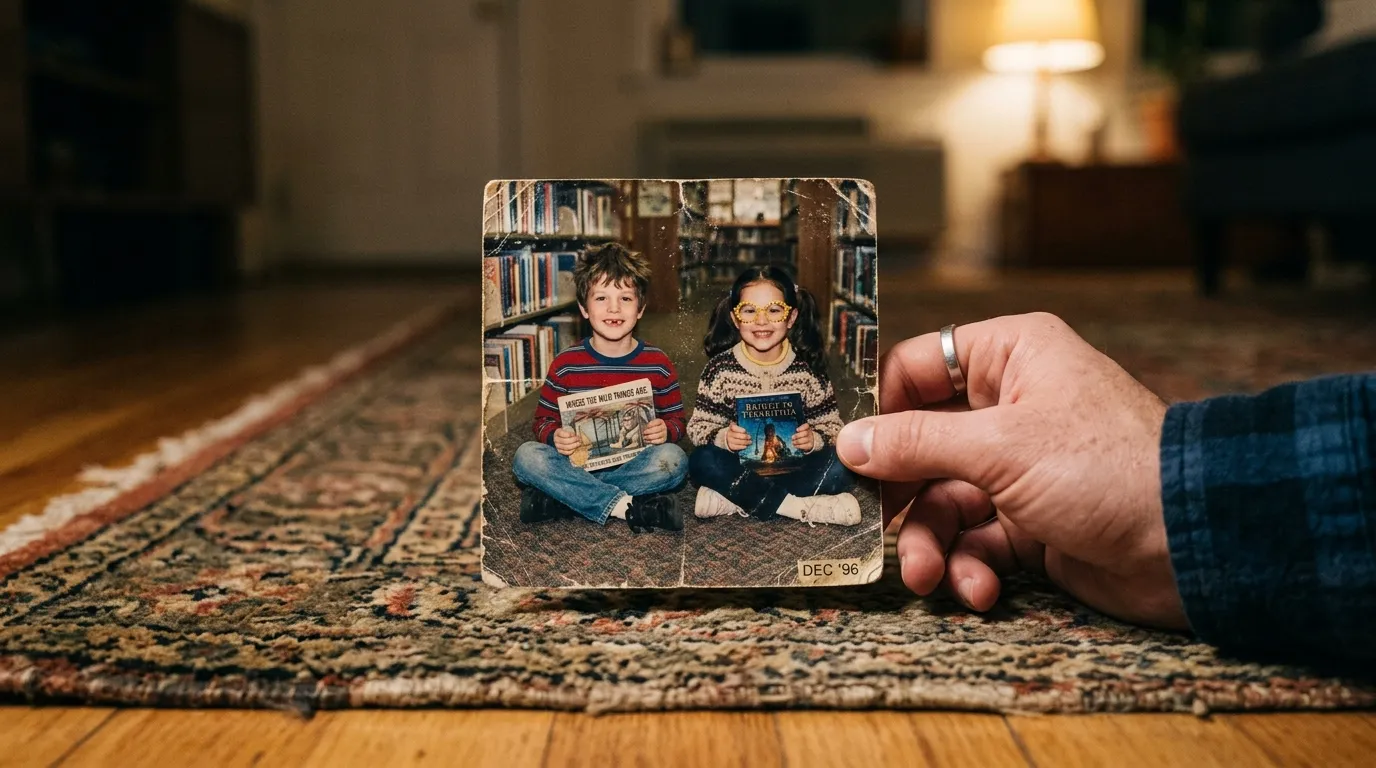
The faded photograph from the Pine Street summer reading club that changed everything.
The Discovery in the Cushions
My phone had wedged itself deep down into the upholstery springs while Claire was in the bedroom getting ready. I grumbled something under my breath and shoved my wrist past the seam, blindly feeling around the dust and fabric. My fingertips grazed two loose quarters, a forgotten plastic pen cap, the hardened corner of a fossilized potato chip, and finally the cool glass screen of my phone.
As I hauled my hand out, my knuckles caught on the stiff edge of cardstock. The small square fluttered out and landed facedown on the living room rug.
I picked it up on pure reflex. Then the room seemed to lose all its air.
The snapshot was old—the glossy emulsion beginning to yellow and crack around the white borders. In the frame, eight or nine children sat in a row on a library floor, each proudly holding up a paperback. Near the left side sat a skinny, messy-haired boy in a hideous horizontal-striped polo shirt, grinning with an empty space where his upper incisor should have been. It was me. I remembered that shirt with painful clarity because my mother had practically forced me into it every picture day, swearing it made me look like a little gentleman.
I had never brought a childhood photo over to Claire’s apartment. I’d barely ever mentioned my childhood at all.
Beside my eight-year-old self sat a small girl with unruly dark curls, grinning straight into the lens behind a pair of oversized, clumsy glasses. When I turned the print over, the faded blue ballpoint inscription read:
“Nora + Ethan, Summer Reading Club.”
Right below it, penned in sharp, dark gel ink that couldn’t have been older than half a year, were those five chilling words:
“Found Ethan today. Tell him.”
And beneath that, a date. October 14th.
I stared at the numbers until they blurred. October 14th wasn’t our anniversary, but it was the day the algorithm paired our profiles. The day she swiped right. The day she greeted me with a witty comment about my biography line before I even knew her last name.
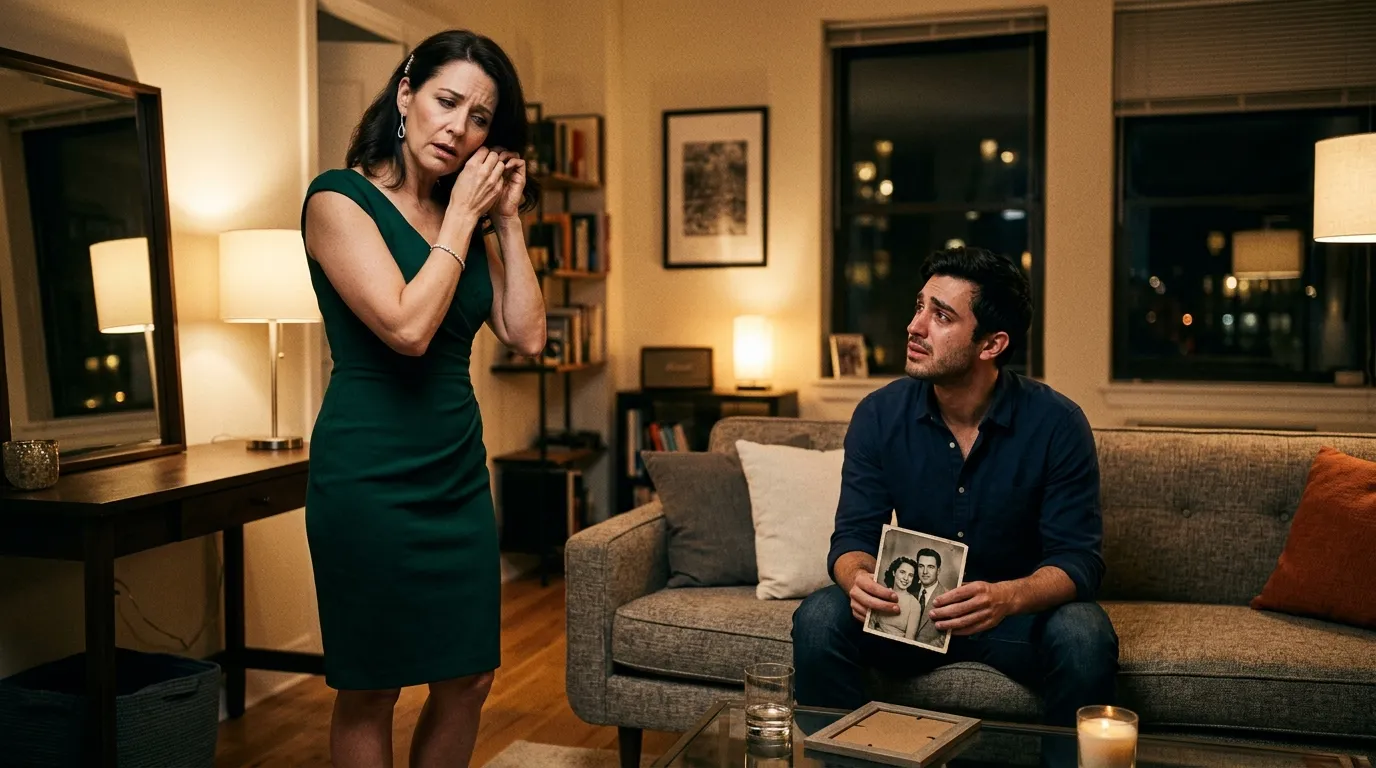
The emerald dress fit perfectly, but the sudden truth froze the room.
The Woman in the Emerald Dress
“Ethan? How does the zipper look in the back?”
Claire’s voice drifted down the hallway, light and warm. A second later, she stepped into the entryway, and the sight of her nearly knocked the wind out of me. The emerald silk hugged her silhouette just as gracefully as I had pictured when I snuck back to the boutique to buy it. Her dark hair was pinned up on one side, and she had one hand lifted, gently threading a silver earring through her earlobe.
She began to smile, but her gaze dropped to my hands.
Her fingers froze against her ear. The silver earring dangled loose, never fastened.
“Where did you find that?” she asked. Her voice didn’t shake, but it lost every drop of its warmth.
“Between the sofa cushions,” I said, my voice deadpan. “Right next to thirty cents and some lint. Who is Nora, Claire?”
Her arm dropped slowly to her side. “Ethan, let me—”
“No,” I cut in, turning the photo toward her and tapping the black ink. “Why did you write this on October 14th? Why did you write my name the very morning we matched on Tinder?”
She looked around her living room as if searching for an escape hatch or an easier script. When none appeared, she drew a slow breath. “Because I knew who you were.”
“Before Tinder?”
“Yes.”
The bright green dress, which five minutes ago had felt like the pinnacle of romantic effort, now felt like a costume in a stage play I hadn’t realized I was performing in.
“How?” I demanded. “How could you possibly know who I was?”
Instead of answering directly, her eyes remained fixed on the little girl in the print. “Nora was my sister. My half-sister. She was fifteen years younger than me.”
A faint, distant vibration stirred in the back of my mind. A flash of carpet. The scent of vanilla-scented library paste and sun-baked paperback pages. Two sets of knees bumping together under a short table. But the memory was like smoke—the harder I grabbed at it, the quicker it dispersed.
“Your sister?” I asked. “Why am I in a photograph with your sister?”
“Because for two months when you were eight,” Claire said softly, “you were her best friend.”
Six Months of Illusions
For half a year, I had built an entire world on the premise that Claire and I were an improbable modern miracle. I was twenty-five, exhausted by dead-end dating apps and casual flings that went nowhere. Claire was forty-five, confident, sharp, hysterically funny, and completely unapologetic about who she was.
The twenty-year age difference had given me pause for about twelve minutes until our first date at the corner coffee shop stretched into four uninterrupted hours. She never played games. She remembered that I couldn’t stand cinnamon in my lattes. I remembered that she collected the tackiest, cheapest refrigerator magnets from every state she visited. By date three, she knew the name of my overbearing boss, my go-to late-night pizza joint, and the story behind the faint scar slicing across my left wrist.
With Claire, I had felt known. I had felt chosen.
Now, standing under the amber ceiling lamps of her dining room, I felt like a museum exhibit she had been studying through glass.
“So you didn’t match with me because you liked my profile,” I said, laying the picture flat on the glass coffee table between us. “You matched with me because of a ghost.”
“At first? Yes,” she answered. She didn’t flinch, and in some twisted way, her honesty made it sting worse.
“You saw my profile, recognized a boy from seventeen years ago, swiped right, sat across from me at a coffee table for four hours, and let me spend six months falling in love with you without saying a word?”
Claire closed her eyes. “I wanted to tell you that first afternoon. I swear to you, Ethan, I rehearsed it the entire drive there.”
“Then why didn’t you?”
“Because you were real,” she whispered. “You weren’t a memory or a favor I was doing for the past. You sat down, you laughed, you spilled coffee on your cuff, and suddenly I didn’t want the afternoon to be an interrogation about a tragedy.”
“Tragedy?” I seized on the word. “Where was this taken?”
“The old Pine Street branch,” she replied quietly. “The brick one downtown.”
“They remodeled that whole complex a decade ago.”
“The main building, yes,” she said. “The city preserved the original children’s annex in the rear. They built the modern glass structure around it.”
The pieces began colliding in my chest. Pine Street. The low oak bookshelves with rounded edges. The lumpy navy beanbag chairs. A sun made of crinkled yellow construction paper hanging crookedly from an acoustic ceiling tile. And then, another detail rose up so sharply it felt physical.
“Her glasses,” I blurted out, staring down at the little girl in the image. “Her glasses were bright yellow.”
Claire looked surprised. “No. They were lavender plastic. My mother bought them.”
“No,” I insisted, my voice rising. “They were yellow. Neon yellow.”
Claire stopped. Her lips parted slightly, and then an unexpected, fragile laugh broke from her throat. “Oh god. She painted them. She stole a bottle of neon yellow nail polish from my vanity and coated the rims because she hated purple. My mother grounded her for a week.”
The memory hit me with the weight of an avalanche. A little girl sitting cross-legged, the chemical tang of dried enamel, holding a fantasy novel three inches from her nose, stubbornly ignoring the world. I remembered being furious at her.
Claire watched me process it. “Do you want to go there?”
I glared at her, raw and defensive.
“I’m sorry,” she stepped back quickly. “That was wrong. I shouldn’t push you. If you want me to explain everything here, I will. If you want me to leave, I’ll walk out the door. Just tell me what you need.”
It was the first time all evening she hadn’t sounded like she held all the cards.
“Change your clothes,” I said, grabbing my coat. “Take me to the library.”
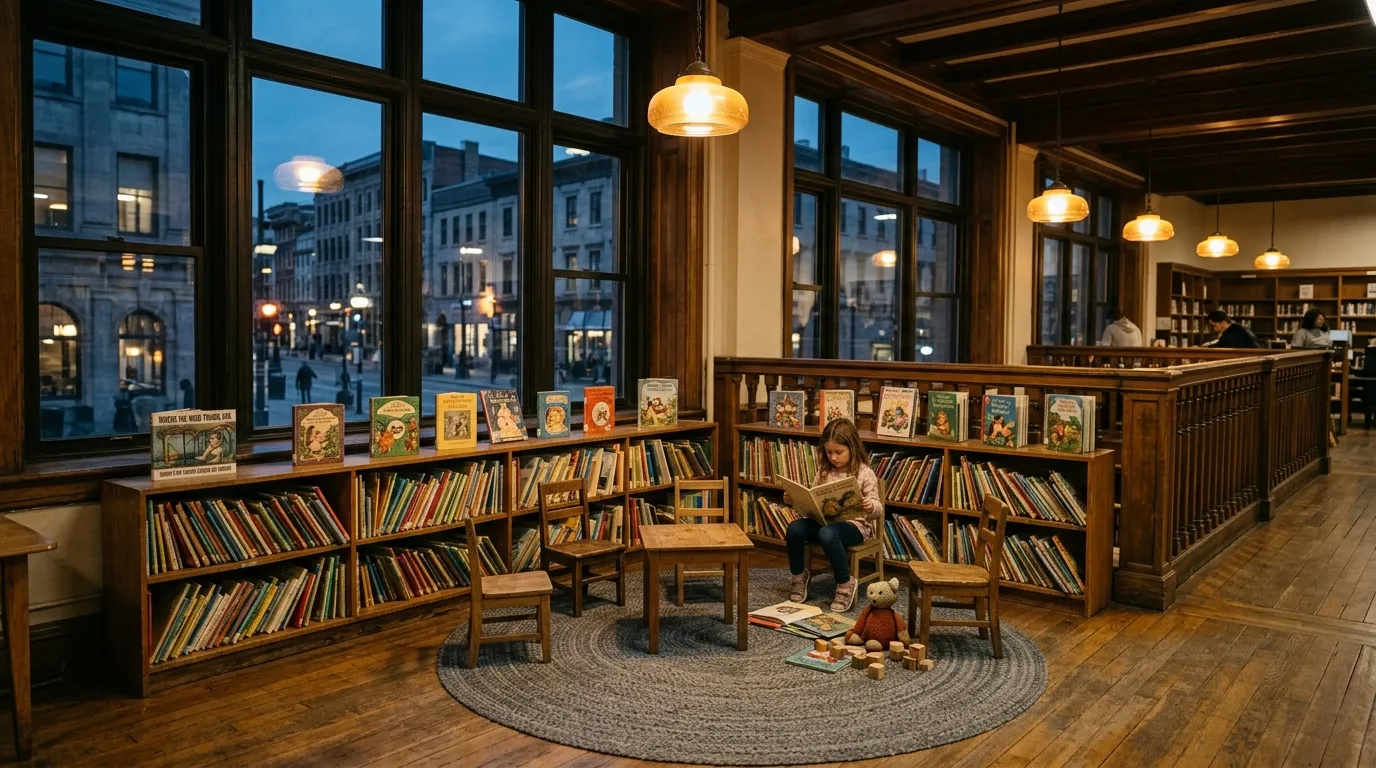
Returning to the Pine Street branch to confront seventeen years of silence.
The Miniature Table
She swapped the emerald dress for dark jeans and a plain wool sweater. We drove across the city in an agonizing silence, the heater humming against the damp evening air.
The Pine Street library had indeed transformed into a gleaming municipal landmark of steel and tinted glass. But when we pushed through the double doors and navigated to the back corridor, we stepped across a brass threshold into the past. The original wood molding remained intact. The shelves were low, tailored for eight-year-olds.
It was impossibly small.
I walked between the rows of faded spine labels until I reached the corner window. “There used to be a royal blue rug right here.”
Claire lingered near the doorway, keeping her distance. “They replaced it with commercial gray ten years ago.”
I pulled out one of the miniature oak chairs and sat down. My adult knees jammed clumsily against the underside of the table. Across from me sat an empty matching chair.
A display rack stood against the brick wall, showcasing paperback fantasy novels with worn covers. In an instant, the sensory dam broke:
Nora slamming a thick fantasy book shut with a loud thwack.
Me yelling that she was lying about finishing chapter five.
Her sticking her tongue out, yellow glasses slipping down her nose, insisting I was just a slow reader.
A dry laugh escaped my mouth before I could choke it back.
Claire stepped into the circle of light. “What is it?”
“She cheated,” I said, looking up. “She skipped the descriptions and only read the dialogue so she could finish before me.”
“Constantly,” Claire agreed quietly. “She had zero patience for exposition.”
“I couldn’t stand her for the first two weeks.”
“She knew. She bragged to me that she was driving the boy in the striped shirt crazy.”
I looked at Claire. A fond, aching smile played across her face, but it wasn’t meant for me. It was aimed at someone who had been gone for decades. The realization that I was merely a doorway to her sister’s ghost felt like a physical blow.
“Was she sick back then?” I asked.
Claire took a slow breath, resting her knuckles against the edge of a bookshelf. “Yes. Autoimmune complications from early childhood. That summer was a rare plateau—she felt good enough to get out of the apartment, so our mother brought her here every Tuesday and Thursday.”
“I didn’t know,” I said, tracing the grain of the wood. “She never told me.”
“Nora despised being pitied. If anyone asked how she felt before asking her name, she refused to speak to them for the rest of the day. You never asked. You just argued with her about board games and dragons.”
“Don’t make me out to be some saintly kid,” I muttered. “I made her cry over an Uno game.”
“Because she drew four extra cards when you weren’t looking.” Claire gave a bittersweet smile. “She deserved it.”
The fleeting humor died. The quiet weight of the library settled back over us.
“What happened to her, Claire?”
Claire walked over and pulled out the small chair across from me. “May I?”
I gave a slight nod.
She folded her tall frame into the tiny seat. “In August of that summer, her counts dropped. Mom took her to a research hospital in Philadelphia for what was supposed to be a three-week trial regimen. But her body couldn’t handle the strain. She spent the autumn in an ICU. She passed away two days before Christmas.”
I stared at a small gouge in the tabletop. A child’s laughter echoed from the main lobby, distant and muted. Seventeen years of my life had rolled on—middle school, high school, college, bad jobs, broken leases—while this little girl’s story had simply stopped right where our summer ended.
“Nobody told me,” I murmured.
“You had moved,” Claire said softly. “By the time my mother and I packed up our grief and came back home, your family had relocated across the river. All I had was a first name, a memory of a red station wagon your mom drove, and that reading club photo in Nora’s memory box. For years, I didn’t think about it. But when I turned forty, I started thinking about the people who made her happy during the short time she had. You were on that list. But I had nothing to go on.”
“Until my profile popped up on your screen.”
“Seventeen years later,” Claire nodded. “There was that scar on your wrist from the day you tripped on the curb outside this very door. There was your smile. Same uneven brown hair. I swiped right because I thought the universe had handed me an impossible miracle: a chance to tell Nora’s childhood friend that he mattered.”
“That was the plan? Tell me over coffee and say goodbye?”
Claire rested her forehead against her hand. “Yes. One coffee. Hand over the photo. Thank you for making her last good summer wonderful. And then walk away.”
“And instead?”
“Instead, you made me laugh until my cheeks hurt,” Claire looked up, her dark eyes glistening under the library lights. “You listened to me talk about my ridiculous marketing job. You ordered a second round of drinks. You stayed until the barista was sweeping the floor around our feet. I went there for Nora, Ethan. But I stayed for you.”
I leaned back, crossing my arms. “If Nora had never existed… if I had just been another random twenty-five-year-old on that app… would you have swiped right on me?”
The silence stretched between us. She didn’t offer a platitude. She didn’t soften the blow.
“No,” she whispered honestly. “Probably not. The age gap would have made me scroll past.”
The truth stung, cold and sharp. But at least it was real.
“Nora opened the door,” Claire said, reaching across the table without touching me. “She didn’t make me fall in love with you. I did that entirely on my own.”
“You still lied by omission for six months, Claire. Every time you looked at me, you were keeping a secret.”
“I know.”
“Why didn’t you just tell me in month two? Or three?”
Claire looked down at the scratched wood. “Because I became terrified that if you knew the origin, you’d think the entire relationship was an assignment. A tribute project. I was terrified you’d pack your bags and leave.”
Her voice cracked on the last word. For the first time since I pulled that picture from the cushions, she looked small.
I stood up. “I need some fresh air.”
“Do you want me to leave?”
“No,” I told her. “Stay here.”
The Echo in the Courtyard
I pushed through the emergency exit into the cool concrete courtyard behind the library. The night air was brisk, smelling of damp brick and oncoming rain. I paced the paving stones, turning the weathered photograph between my fingers.
As I reached the center of the courtyard, an old memory snapped into focus with terrifying clarity:
Nora slamming her book shut.
Me throwing my hands in the air, frustrated, walking toward my mother’s car.
My own eight-year-old voice snapping over my shoulder: “Fine. Finish it yourself.”
I stopped dead in my tracks. A cold knot formed in my stomach. Were those the last words I ever said to her? An angry dismissal over a fantasy novel?
My fingers flew across my phone screen. “Come outside. Please.”
Claire pushed through the metal door seconds later, wrapping her wool sweater tightly around her chest. She stopped several paces away, giving me room.
“I remembered our last fight,” I said, my voice hoarse. “I told her to finish the book herself. Was that the day she left for Philadelphia? Were those the last words I ever said to a dying girl?”
Claire looked at me with immense gentleness and slowly shook her head. “I don’t know what your final words were, Ethan. Nobody kept a transcript of eight-year-olds in a reading room.”
Her refusal to invent a comforting lie felt like an anchor.
“Did she talk about me in the hospital?” I asked.
Claire smiled faintly. “She complained that you were stubborn. She told the pediatric nurses that she had a boy back home who thought he was smarter than her.”
I let out a ragged breath, smiling through the sting in my eyes.
“And,” Claire added softly, “she told me that even when you got mad because she cheated, you never packed up your books and moved to another table. You always waited for her.”
I looked down at the photograph in the courtyard lamplight. The little girl in the yellow glasses wasn’t just a mysterious tragedy anymore. She had her personality back. Her stubbornness. Her sharp edges.
I turned back toward Claire. “I believe you love me. But I don’t know how to trust the foundation of the last six months yet.”
She nodded quietly. “I don’t expect you to figure that out tonight.”
“I want to go home,” I said. “Alone.”
“Okay,” she replied without hesitation. “Let me drop you off.”
When we stepped back into her apartment to gather my keys, the emerald green dress was lying neatly folded over the back of the entryway armchair. It looked quiet, stripped of its dramatic weight.
“Do you want me to give it away?” Claire asked softly.
I looked at the rich green silk. “No. Keep it. I bought it for the woman who spent six months making me happy. That part wasn’t a lie.”
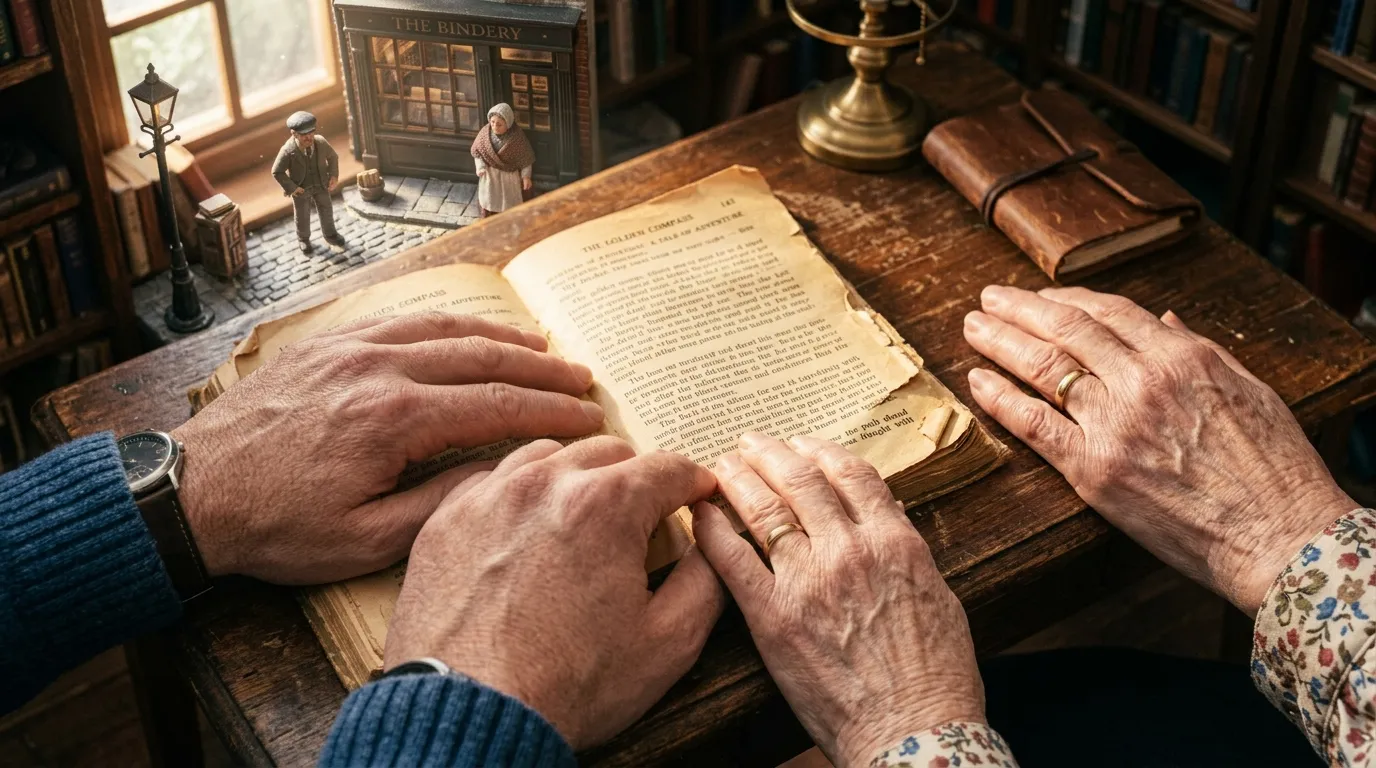
Learning to slow down and turn the page together.
Turning the Page
I spent four days in my own apartment without calling her. I worked, made coffee, went for long walks, and let the shock settle into something manageable.
On the fifth afternoon, I took the bus downtown and walked into the Pine Street library on my own. I went to the fantasy rack, found the faded edition Nora and I had squabbled over, checked it out at the front desk, and sat down at our small table.
I read the entire second half in two hours.
The ending was rushed, clumsy, and entirely unsatisfying. She had been completely right.
I pulled out my phone and tapped out a text: “Nora was right. The ending of this book is absolute garbage.”
Three dots danced instantly. “She was completely unbearable whenever she was right.”
I stared at the screen, feeling the knot in my chest untie just enough to breathe. “I’m still at the small table if you want to come argue about chapter seven.”
Claire arrived twenty-two minutes later, breathless, wearing an ordinary trench coat and sneakers. She didn’t rush in with grand speeches or tearful apologies. She simply pulled out the little chair across from mine and sat down.
We spent the next hour dissecting the plot, talking about Nora, talking about ourselves, and acknowledging the heavy, complicated baggage that now lived between us. We weren’t magically fixed, and the secret still left a scar. But for the first time, we were starting from the absolute truth.
As I reached the final chapter again, Claire leaned forward, her hand instinctively drifting toward the edge of the paperback to see the next paragraph.
I placed one index finger firmly against the top corner of the paper.
“Hey,” I said gently, looking up into her eyes. “I’m not finished yet.”
Claire paused. She looked at my finger, then at me. A slow, genuine smile touched the corners of her mouth.
“Sorry,” she whispered, resting her hands flat on the table. “I’ll wait.”
I read the final sentence at my own pace. And then, together, we turned the page.
Note:This work is inspired by real events and people, but it has been fictionalized for creative purposes. Names, characters, and details have been changed to protect privacy and enhance the narrative. Any resemblance to actual persons, living or dead, or actual events is purely coincidental and not intended by the author.
All images used in this article are AI-generated and intended for illustrative purposes only.
0 Comments